A couple of posers here , are there design similarities between the he177s undercart and the fokke wolfe condor? and was the short stirlings undercart the tallest unit in production during the war? , and how complex was its retraction process?:cool: 😎

By: JDK - 27th October 2007 at 10:49
A couple of posers here , are there design similarities between the he177s undercart and the fokke wolfe condor? and was the short stirlings undercart the tallest unit in production during the war? , and how complex was its retraction process?:cool: 😎
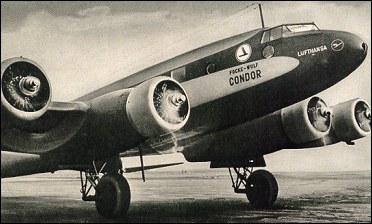
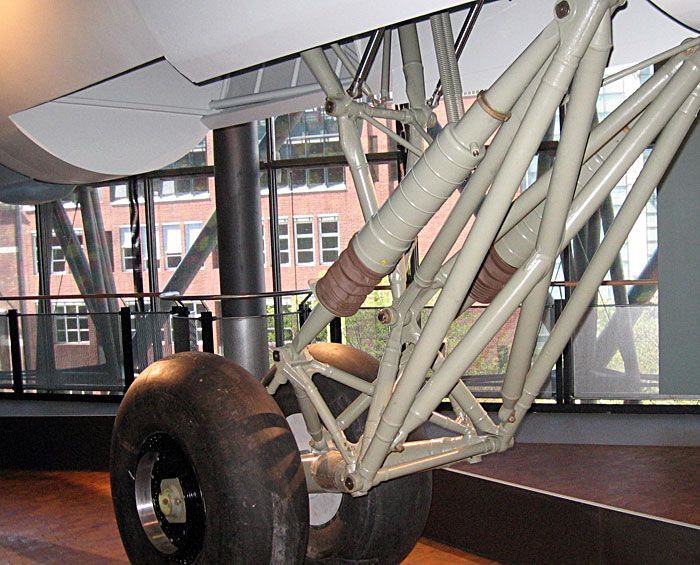
I’m surprised no-one’s picked up on this. The Focke-Wulf Condor’s undercarriage was originally designed with a single mainwheel, and later developed into double wheeled units. (I don’t know whether to allow a greater load (likely in the move from civil airliner to maritime bomber) or for a lower ground footprint.) The rather ingenious drop forward framework was intended to allow the undercarriage to be lowered by gravity in the even of a power failure. (It has nothing to do with the He-177’s gear.)

(More here: Club Hyper)
© The Condor had an unusual forward-retracting main undercarriage with double wheels. This would lock into place with air pressure when loaded.
From: http://avia.russian.ee/air/germany/fw-200.php
The additional ‘crate’ to raise the wing from the already designed undercarriage on the Stirling would have been a fine interim idea – to have gone into production with it merits some award for poor practice. Excuses are just that – other designers coped with more major redesigns.
Extending the saga, the Beaufort’s undercarriage doors is framed by pipework that any Victorian bathroom would be proud to call its own – at about the weight of Victorian ironmongery as well. A completely ridiculous setup, and the opposite of ‘add lightness’.
The Lockheed 10 and 12, in many other ways excellent aircraft are extremely prone to undercarriage failures as Lockheed didn’t provide an over-centering ‘lock’ on the retraction and support arms but required them to be dead straight to take a load. Any variation loaded the jacks’ gearing which pulled out of the wing.
There was a lot of experimentation in the ’30s with undercarriages. The Lockheed 14 gear and the B-17’s both seem good design to me.
More in the Putnam on aviation development interwar.
Cheers,
By: Flanker_man - 27th October 2007 at 10:31
I’m surprised that no-one has mentioned the MiG-23/27 undercarriage.
A neat design solution – because of the shoulder-mounted swing wing, it was contained in a narrow fuselage – but swivelled out to provide a wide track.
One of the doors was even mounted on the wheel hub !!!:eek:
Rumour has it that the designer was a woman!!
Ken
By: Flanker_man - 27th October 2007 at 10:19
Great photos…perfectly illustrates that alarming angle! 😀
Was this B-52 taxiing (looks like it) or was this take-off/landing (lots of flap)? :confused:
No – he had already landed east-to-west and was backtracking down the runway to the eastern dispersal when he did the ballet.
I was surprised that the (almost) wingtip outriggers could take the strain – they don’t appear to swivel with the main gear.
In the photos they are off the ground – I can’t remember if they actually grounded during the manouevre – I assume they must do at some point ??
Ken
By: Creaking Door - 27th October 2007 at 00:42
I’ve always understood that the undercarriage was designed by Arthur Gouge – Short Brothers’ chief designer and he who invented the Gouge Flap.
I stand corrected. 🙂
Gouge’s main experience had been in designing aircraft without wheels and the Stirling was the first retractable undercarriage aircraft for the company. But then again, how many, at that time, had experience of retractable gear on large aircraft? When considering the Stirling you have to remember it was the first four engined bomber in service.
Good point. I suppose we do tend to forget that retractable u/c were pretty cutting edge stuff in 1940….never catch on mind! 😀
By: Pondskater - 26th October 2007 at 23:21
But surely u/c designed by specialist company (messier / dowty etc.)?
I’ve always understood that the undercarriage was designed by Arthur Gouge – Short Brothers’ chief designer and he who invented the Gouge Flap.
I’ve sometimes wondered if the oddity that was the Stirlings undercarraige might have been due to Shorts having made a series of large aeroplanes without undercarraiges for quite a while.
Gouge’s main experience had been in designing aircraft without wheels and the Stirling was the first retractable undercarriage aircraft for the company. But then again, how many, at that time, had experience of retractable gear on large aircraft? When considering the Stirling you have to remember it was the first four engined bomber in service.
CH Barnes in the Putnam book on Shorts Aircraft states that “without doubt a one-piece forged chassis, like that of the Halifax, would have stood up to the side load [of L7600’s accident] but Gouge, aware of the long delay in obtaining large forgings and castings, and the milling machines suitable for reducing them to final proportions, had insisted on a built-up chassis using separate forged oleo legs.”
The bodge on the Stirling I think was referred to as a crate, fitted between the top of the legs and the attachment points.
I guess it all leads back to the Air Ministry’s insistence that the wingspan be less than 100 feet to fit into existing hangars. With a bigger wing the take-off run would presumably be reduced. It would have had a better ceiling too.
The change always reminds me of the last minute change to the Sunderland. By adding a tail turret, the CofG was moved back far enough that the rear wing spar had to be shortened to give slightly swept back wings. This is why the engines on the Sunderland all point slightly outwards, rather than straight ahead. And yet it was never considered necessary to correct this in the development of an aircraft which was in service over 20 years.
Allan
By: victor45 - 26th October 2007 at 22:59
undercarts
thanks everyone for thse responses and exellent phots of the B52 landing ballet amazing! id no idea that TSR2 had and undercart problem at all perhaps it was a deciding factor in its demise? if the problem couldnt be overcome, or Healy used it as an excuse to cancel the project.?
the short stirling was a tragedy of ministerial interference and could have been a truly formidable bomber if it had been designed with the correct wingspan as one member has covered very well, and the undercarriage mods executed by shorts were a quick fix enabling the aircraft to be put into service without too much delay, is there any test footage of the stirlings undercart retracting? ive seen footage of the HE177s retracting it splayed out sideways very quickly for a large aircraft, thanks again everyone:cool:
By: Creaking Door - 26th October 2007 at 20:31
The B-52 at RIAT Fairford did it a couple of years ago……
Not only that – but he swivelled from one side to the other as he went down the runway…
Great photos…perfectly illustrates that alarming angle! 😀
Was this B-52 taxiing (looks like it) or was this take-off/landing (lots of flap)? :confused:
By: 25deg south - 26th October 2007 at 20:05
Another novel feature of the Trident’s undercarriage design was the sideways-retracting nosewheel, which was mounted well off-centre. This was to allow space for the Smiths autoland system and other avionics.
The joke claim at the time was that it was to avoid passenger discomfort on Autolanding ,caused by the nosewheels bumping down the centreline runway lights.
Another reason often quoted was to do with pressure hull integrity, but please don’t quote me as I don’t know.
By: Flanker_man - 26th October 2007 at 18:35
Both mainwheel units on the B-52 ‘castor’ at an alarming angle so the aircraft can land/take-off into wind in conditions that a ‘fixed’ u/c wouldn’t allow.
Not sure what the limits are but I’ve seen head-on video of a B-52 ‘side-slipping’ down a runway at about 20° to the centreline! 😀
The B-52 at RIAT Fairford did it a couple of years ago……
Not only that – but he swivelled from one side to the other as he went down the runway……..
It completely distracted everyone’s attention from the RAF C-130 flypast 😮
Ken
By: dhfan - 26th October 2007 at 14:17
The bodge on the Stirling I think was referred to as a crate, fitted between the top of the legs and the attachment points.
I guess it all leads back to the Air Ministry’s insistence that the wingspan be less than 100 feet to fit into existing hangars. With a bigger wing the take-off run would presumably be reduced. It would have had a better ceiling too.
By: Creaking Door - 26th October 2007 at 12:05
But not strong enough, there are even photographs showing a row of Stirlings and one of them on it’s belly.
I’ve sometimes wondered if the oddity that was the Stirlings undercarraige might have been due to Shorts having made a series of large aeroplanes without undercarraiges for quite a while.
But surely u/c designed by specialist company (messier / dowty etc.)?
Wasn’t the ‘bodge’ on the Stirling u/c to have a second stage added that effectively ‘extended’ the original u/c downwards an extra four feet or so?
The u/c was certainly a weakness in the design and I think collapsed quite often in situations when other aircraft would have got away with it…still a Stirling always landed on its wheels…even when it landed on its belly! 😀
Don’t forget the twin tailwheels too.
By: Creaking Door - 26th October 2007 at 11:53
Another Undercarriage that looks extremely complex is on the B52, I Had a good look at it at Duxford and thought it was quite clever in the way it must have worked.
Both mainwheel units on the B-52 ‘castor’ at an alarming angle so the aircraft can land/take-off into wind in conditions that a ‘fixed’ u/c wouldn’t allow.
Not sure what the limits are but I’ve seen head-on video of a B-52 ‘side-slipping’ down a runway at about 20° to the centreline! 😀
By: Ant.H - 26th October 2007 at 11:39
Another novel feature of the Trident’s undercarriage design was the sideways-retracting nosewheel, which was mounted well off-centre. This was to allow space for the Smiths autoland system and other avionics.
By: Cees Broere - 26th October 2007 at 09:56
And what about the manual retraction device where you had to do 740 revolutions by hand and then do it again to retract the other wheel. Not something to do when you are in an emergency situation.
On the Halifax the Messier undercarriage was bulky and slow to retract which created a log of drag. The Hastings used a similar set up but the casting was much slimmer (experience?)
Cees
By: RPSmith - 26th October 2007 at 09:44
I’ve sometimes wondered if the oddity that was the Stirlings undercarraige might have been due to Shorts having made a series of large aeroplanes without undercarraiges for quite a while.
Roger Smith.
By: Cees Broere - 26th October 2007 at 08:06
Indeed, the need for shorter take off and landing runs was identified while testing a half scale prototype, leading to the longer undercarriage.
The first prototype L7600 was lost on an early test flight when a seized brake caused the undercarriage to collapse – fortunately with no injuries but, a few of years ago when I spoke the daughter of the test pilot, Lankester-Parker, she still had clear memories of being led away from the airfield hysterical at watching her father’s crash.
The undercarriage was made simpler and stronger for the second prototype.
Allan
But not strong enough, there are even photographs showing a row of Stirlings and one of them on it’s belly. But a very nice aircraft type, about time one found intact somewhere;)
Cheers
Cees
By: mike currill - 26th October 2007 at 03:40
All I know of the TSR2 u/c is that on one flight the port undercarriage beam turned over or didn’t rotate into its proper position on lowering so the choices were: retract it and belly flop an expensive aircraft, eject and guarantee destroying said aircraft or risk a landing ‘on tiptoe’ as Roland Beamont put it. He took the third option and pulled it off successfully. I’ve only ever seen one photo of that event taken from the chase plane. If you are interested it is mentioned and the photo included in his book ‘My Piece of The Sky. An absolutely fascinating bit of reading from start to finish.
By: Scouse - 26th October 2007 at 00:59
When I worked at BAC in the early 70s there were many who spoke in hushed tones about the TSR-2 undercarraige. The general consensus was that it was an engineering nightmare and had TSR-2 gone into full operational service a major redesign may have been called for. From memory, the retraction sequence depended on a whole chain of microswitches working as they should…only they didn’t.
Can anyone throw a bit more light on this?
By: Denis - 26th October 2007 at 00:30
Another Undercarriage that looks extremely complex is on the B52, I Had a good look at it at Duxford and thought it was quite clever in the way it must have worked.
By: Pondskater - 25th October 2007 at 22:41
The Stirling aquired it’s ungainly height in an odd way. It was discovered at an early stage that the wing incidence needed changing and affected take-off, and as re-design and engineering was a massive task the undercarriage was lengthened as a compromise.
John
Indeed, the need for shorter take off and landing runs was identified while testing a half scale prototype, leading to the longer undercarriage.
The first prototype L7600 was lost on an early test flight when a seized brake caused the undercarriage to collapse – fortunately with no injuries but, a few of years ago when I spoke the daughter of the test pilot, Lankester-Parker, she still had clear memories of being led away from the airfield hysterical at watching her father’s crash.
The undercarriage was made simpler and stronger for the second prototype.
Allan


 Sign In








 October 24, 2007 at 11:13 pm