Seen today sitting outside at Avspecs, Ardmore
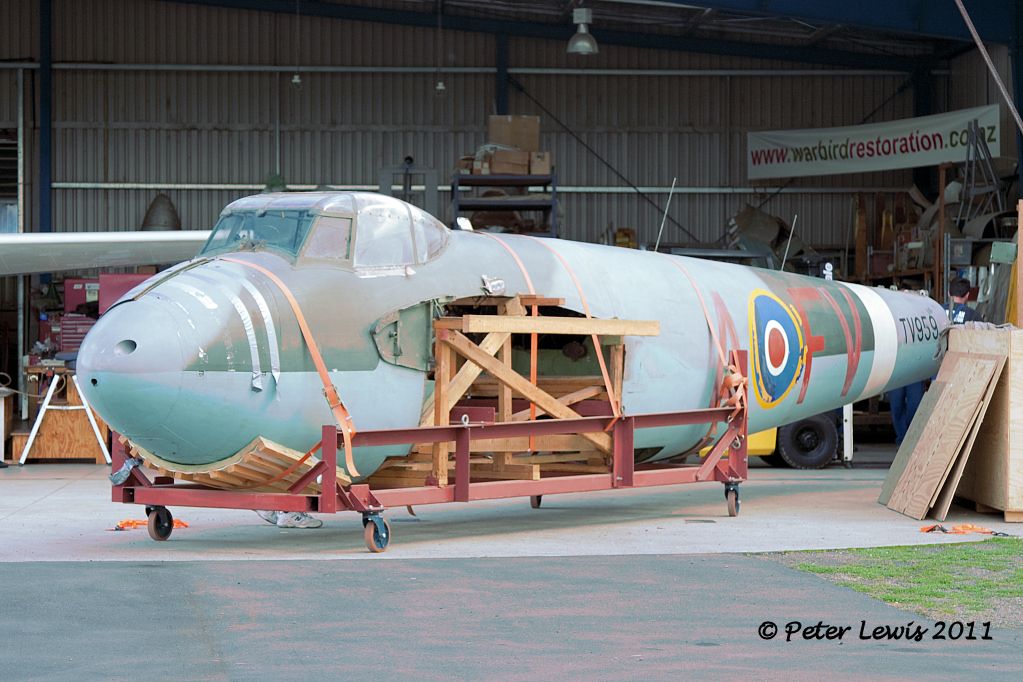
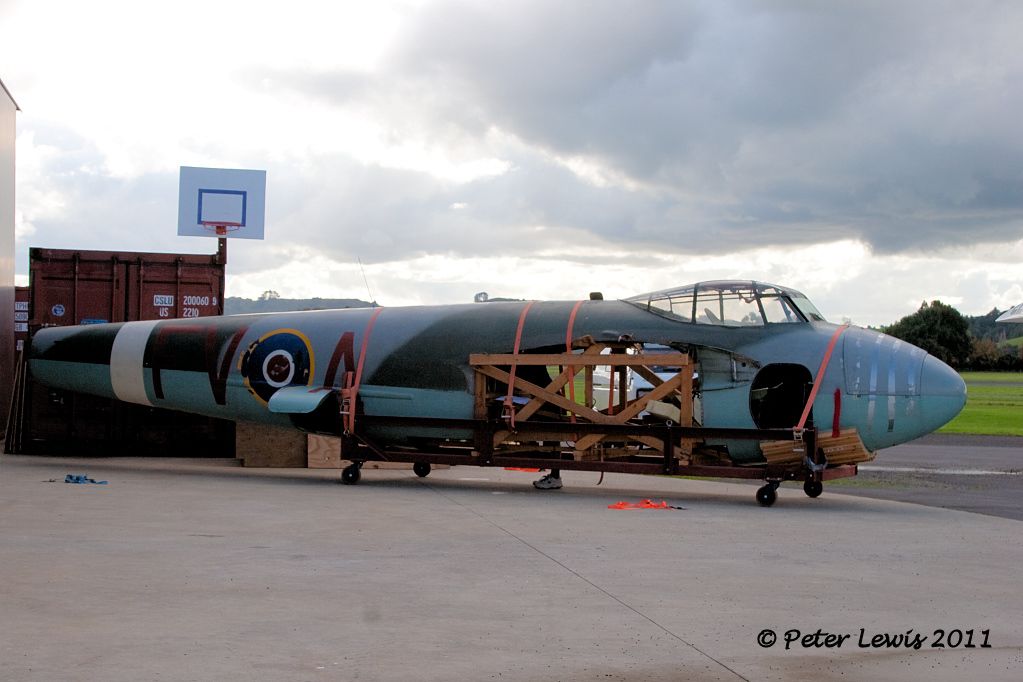
According to the usual internet sources:
Mosquito T.III TV959. Accepted: July 1945, Assigned: 29 August 1945 No 13 OTU (KQ RAF type C roundel.svg G) (RAF Middleton, St George), Assigned: 31 October 1946 No. 266 Sqd, Assigned: 24 April 1947 No. 54 OTU (RAF Eastmore), Assigned: 17 May 1947 No. 228 OTU (RAF Leeming), Assigned: 15th July 1951 No. 204 AFS, Stored: 6 February 1952 No. 27 MU (RAF Shawbury), stored: 20 August 1953 No. 49 MU, Stored: 16 November 1954 No. 27 MU (RAF Shawbury), Assigned: 16 December 1955 HCEU / HQ’s Fighter Command Communications Squadron (RAF White Waltham), Assigned: 30 April 1959 No.3 CAACU ( RAF Roundel Y) (RAF Exeter), SOC: 31 May 1963, Movie: 633 Squadron (HT RAF type C roundel.svg P / serial MM398) , Transferred: Imperial War Museum, sold: 6 April 2003,
Currently with The Flying Heritage Collection, stored in Norfolk.
So it looks like we have another rebuild to airworthy?

By: Trolly Aux - 2nd July 2016 at 09:11
How pretty is that Aeroplane?
By: ErrolC - 1st July 2016 at 21:30
AvSpecs gave August as their expected date for flight testing back in April.
http://rnzaf.proboards.com/post/237674/thread
By: Firebird - 1st July 2016 at 21:22
A comment posted on social media. No verification of veracity but it would be fantastic if this turns out to be ‘on the level’.
”Another Kiwi-built DH Mosquito is about to take to the Ardmore skies for trial flights in August prior to heading to the US so I imagine a lot of activity there will be based around that!”
Yes, reports are hoping of a first test flight Aug/Sept time from what I’ve read.
This was what it looked like a few months ago.
[ATTACH=CONFIG]246765[/ATTACH]
By: Propstrike - 1st July 2016 at 20:18
A comment posted on social media. No verification of veracity but it would be fantastic if this turns out to be ‘on the level’.
”Another Kiwi-built DH Mosquito is about to take to the Ardmore skies for trial flights in August prior to heading to the US so I imagine a lot of activity there will be based around that!”
By: Tango Charlie - 13th May 2011 at 22:21
Great news as far as i am concerned. One assumes that Avespecs having nearly completed one Mosquito will find number two that much easier and quicker to build having worked out any problems on the USA bound example. I recall that the UK Blenheim rebuild second time around was much quicker for the same reason. All I would ask please is that you leave enough Spruce and plywood in the northern hemisphere for our three Proctor rebuilds!!
By: PeterVerney - 13th May 2011 at 13:43
Re glue joints, here is part of something I wrote for mossie.org
“the Mosquitos were getting tired, I do not understand the technicalities but there was a tolerance on a glue joint which was measured periodically and aircraft were scrapped if this tolerance was exceeded. The M.U. however was getting short of replacements so a technical conference decided that the tolerance could be increased to keep us going, but after another month or so there was again a shortage of aircraft, and a further technical conference decided that perhaps this tolerance was not so important after all and could be ignored!”
And here is a piece regarding repairing the main spar
“We did have an aircraft written off because a ricochet dented the laminated wooden main spar, if the main spar was damaged within 18” of an engine mounting no repair was allowed and the aircraft was a write off. “
This refers to 1952-3 usage.
By: Fouga23 - 13th May 2011 at 10:39
I think it is a helicopter of some sort possibly modified for a film set to represent a ………….
Mark
Looks like a fake Alouette III
By: Bruce - 13th May 2011 at 08:37
The fuselage in the picture is RS715, ex 633 squadron. Its nose was used for the cockpit shots, along with that of TJ118.
TJ118’s fuselage was recovered at about the same time, the nose went one way and settled on the Mosquito Museum (as it was), and the fuselage went to David Elvidge. Over time, that too gravitated to the Mosquito Museum, so the whole of the fuselage of TJ118 is preserved there. It is however in bad condition, but time and skill will, I am sure come into play in due time.
Bruce
By: Jayce - 13th May 2011 at 08:08
Where do you think that where Bruce is and Tony Agar got their bits from ?
Mike, as you yourself said one post up, Tony’s plane has bits from at least seven different airframes. As I was under the impression that the bulk of the stage use pieces from Elstree had gone to Hatfield, I was unsure if the fuselage in the picture that Peter posted was from 633 or another unrelated Elstree source, hence my phrasing it as a question. 😉
By: Firebex - 12th May 2011 at 18:54
One of the ones acquired for 633 squadron maybe? One that they chopped up for cockpit filming? And wasn’t one of the cockpits also recovered after they’d reused it in Mosquito Squadron?
Where do you think that where Bruce is and Tony Agar got their bits from ?.And if anyone mentions the records office in Lancashire thats also in Tony’s airframe or what was salvageable as a lot of it got burnt and I think I am right in saying part of the Port wing is from that aircraft along with a bit of tail and a lot of metal work.
I think a good bit of the film set stuff such as cockpit etc from Mosquito Squadron and 633 are also resident at Elvington in one form or another.
By: Firebex - 12th May 2011 at 18:50
[QUOTE=SADSACK;1743337]
A society needs to be set up to either complete the Elvington example or build an airworthy example from scratch.
I am not knocking the work of the owner. On the contrary, I can only praise highly the work of a man who has given us the only chance of a working Mosquito on this side of the world, not least a unique variant.
However if, and only if, he were willing, I don’t see why a group could not be set up to continue the restoration as I am sure deep down he would love to see his a/c fly.
Another option would be to build a new one with original parts, ie data plate.
I am sorry but you asre Missing th eplot somewhere along the line.The Mosquito at Elvington is contructed from parts of at Least 7 airframes plus other parts.The centre section has a splice in it that would never ever be permitted in a war time accident damage mosquito let alone one today.If the rear fuselage only was damaged fine you can do something if the outer 6 feet of wing is damaged fine it is permissable to repair but a composite airframe with multiple splices in places that would make DH cringe can only ever mean one thing.The aircraft cannot and will not ever ,ever,ever be capable of flying.A lovely aircraft and testament to Tony’s dedication and something that will survive and be ground running for all to see for a very long time and has been said for the forseeable future the only semi live Mosquito in the UK.But sorry it will only ever be capable of that.
By: jeepman - 12th May 2011 at 18:06
Does Mosquito Survivors by Stuart Howe (Aston Publications) remain the definitive history of surviving Mosquito airframes? I can’t imagine that it has dated as much as its contemporary, Spitfire Survivors from the same publisher
By: Bruce - 12th May 2011 at 16:59
Yes, that was the rear fuselage of RS715, which, with TJ118 was stripped for parts, and the cockpits used for interior shots.
All the recovered parts still survive.
Bruce
By: Jayce - 12th May 2011 at 16:39
As I remember it, in about 1973, there were a couple of chopped up Mosquito fuselages at the Boremwood Film Studio lot. I think they were the residue after the engines had been removed to be wind machines.
One of the ones acquired for 633 squadron maybe? One that they chopped up for cockpit filming? And wasn’t one of the cockpits also recovered after they’d reused it in Mosquito Squadron?
By: Stepwilk - 12th May 2011 at 15:56
Having built a wooden airplane using the exact same glue used in Mosquitos (a Falco built with two-part Resorcinol), I know that it’s easy to at least test the quality of a glue batch, by first gluing together a couple of small maple or oak blocks–very strong wood–and then fracturing them with a sledge, seeing that the wood fails and not the glue joint. Assuming proper assembly and clamping technique and subsequent visual inspection (if possible) of the glued aircraft component, you can fairly well assure yourself of integrity.
But how you would possibly test a 70-year-old existing glued joint short of destroying it, I have no idea. Other than to say that I would -never- trust a 70-year-old glued joint…modern wooden airplanes, like Falcos, are thoroughly protected inside and out by two-part polyurethane coating, but Mosquitos had nothing but old-fashioned varnish.
By: Mark12 - 12th May 2011 at 14:12
What is the main item in your photo there Mark12? Is that a large turret?
I think it is a helicopter of some sort possibly modified for a film set to represent a ………….
Mark
By: Dave Homewood - 12th May 2011 at 14:02
What is the main item in your photo there Mark12? Is that a large turret?
By: Mark12 - 12th May 2011 at 10:58
There is the small question of where the owner, who has dedicated close to 40 years of his life to this project, would find the odd £3-5m to get it flying in the UK.
Now if he ever decided to part with it, and it comes to everybody eventually, it could certainly be a candidate to go through the NZ process and fly somewhere in the world….but probably not the UK.
Mark
By: Jayce - 12th May 2011 at 09:49
I suspect it’s not just stresses that are a factor but wear and tear too. Delamination is tricky to detect in modern composites it must be a nightmare in more traditional laminates, especially when the technical knowledge is rapidly dying out.
By: Tin Triangle - 11th May 2011 at 20:35
It surely can’t just be need to work out all the stresses etc effecting an aircraft of plywood construction, as don’t we have things like Proctors flying (and under restoration to fly) with plywood construction, albeit much more simple airframes? Is it a case of trying to combine a massively powerful and complex warbird with wooden construction that presents such a hurdle with the CAA? Or is this not a fair comparison?


 Sign In








 May 9, 2011 at 7:24 am