I thought some of you may be interested in seeing some of the “astro-images” I have taken recently. I bought a small telescope back in November 2004 and was very quickly bitten by the bug (it is a strangely addictive passtime). 4 months later Erika and I took the plunge and purchased a second hand 10 inch Meade LX200. Fortunately Erika is also very interested in astronomy too.
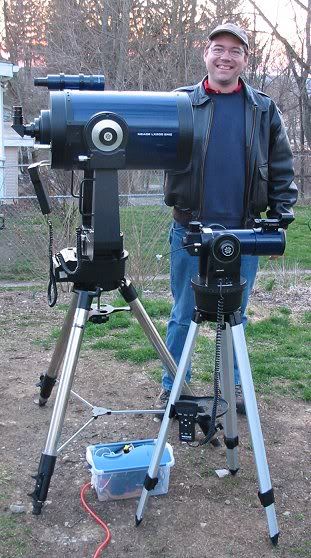
Here are a few of the images I have taken using two modified webcams (one for longer exposure shots).. There is also a shot of me with the two telescopes to give some idea of what equipment I am using. Click on the thumbnails for the full sized pictures.
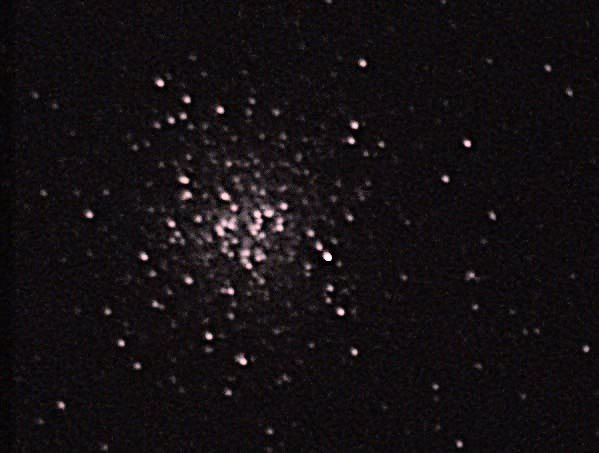
M53 Globular Cluster.
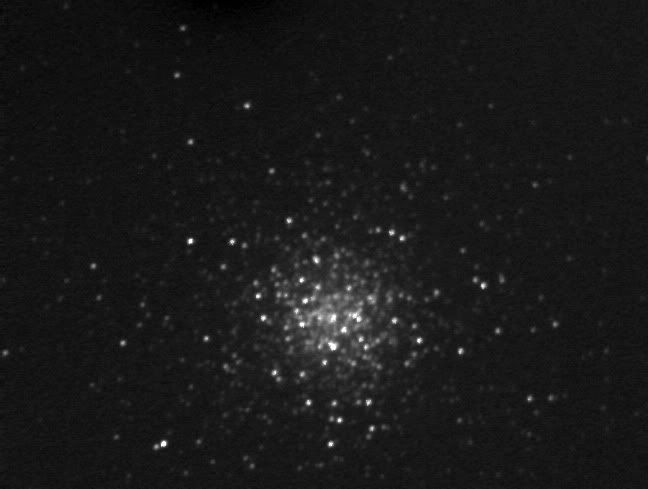
M3 Globular Cluster
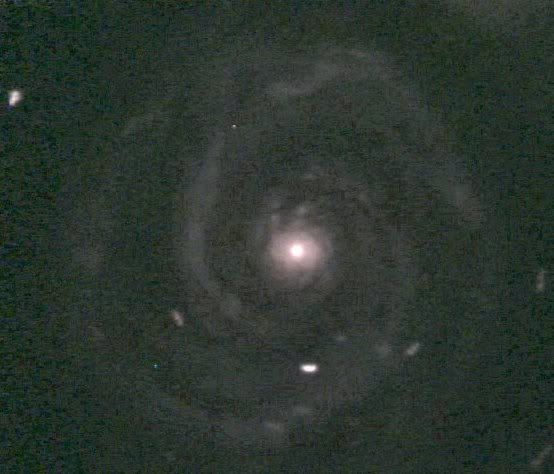
M51 – The Whirlpool Galaxy
A piece of an old Russian Rocket that has been in orbit since 1994.
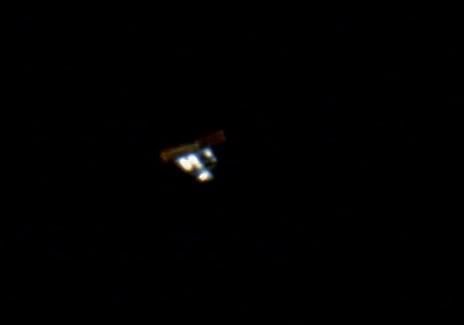
I am quite proud of this one… The International Space Station.
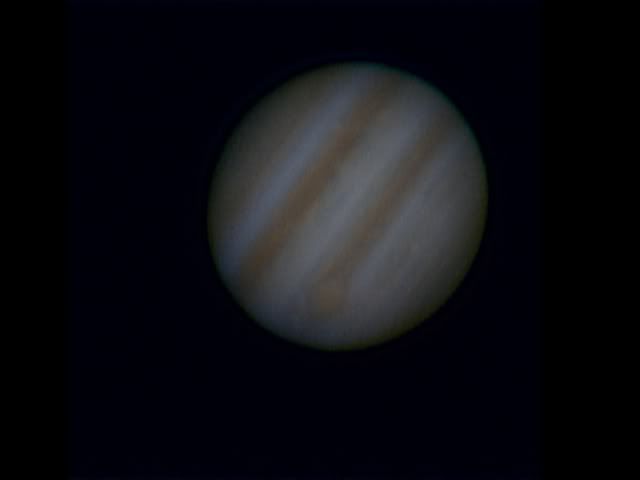
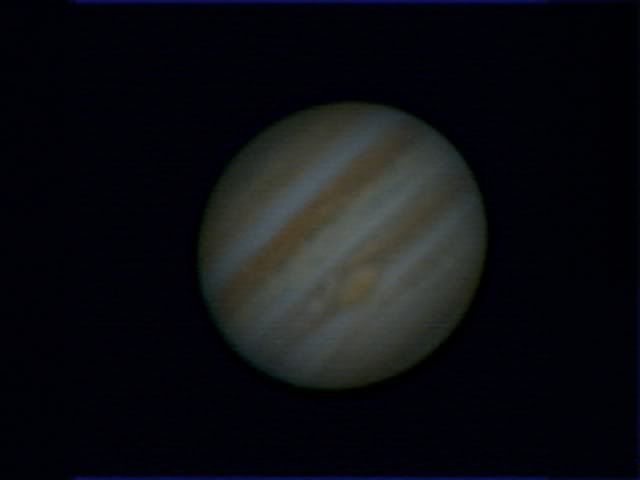
Jupiter
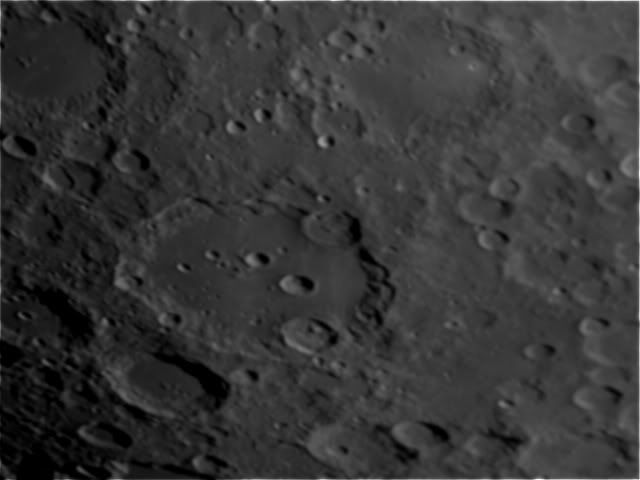
Moon Crater Clavius
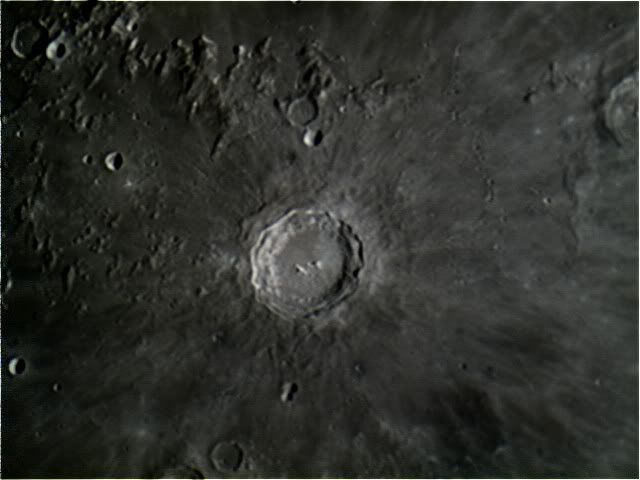
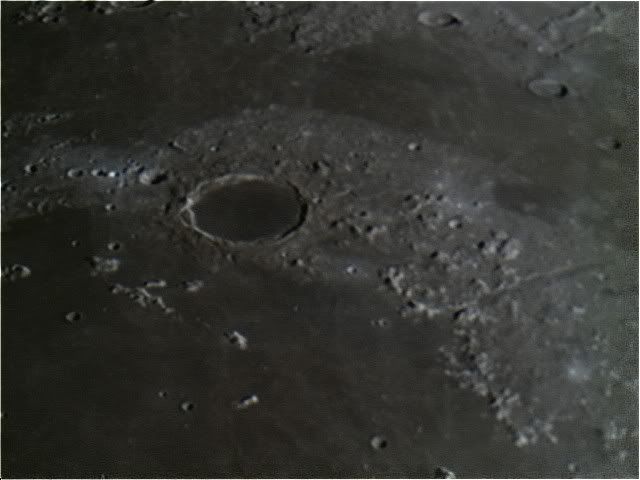
Moon Crater Plato
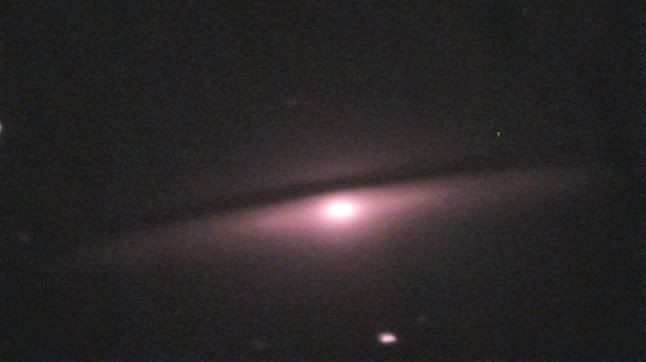
M104 – the Sombrero Galaxy
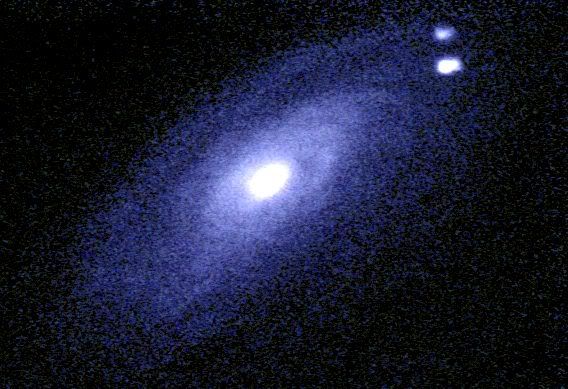
M88 Spiral Galaxy.
These were taken from my light polluted back garden here in Zanesville Ohio.
I hope I hve not bored you all too much 🙂

By: DME - 12th July 2005 at 17:43
Amazing shots there. It would be quite interesting to sit there and watch the rest of the world go by…..
dme
By: Arabella-Cox - 12th July 2005 at 16:49
That moon transit animation’s fabulous! Living in the UK, we rarely get clear enough skies to see much out there, be it through cloud, or just light pollution.
Oddly enough, the clearest views of the night skies that I’ve ever seen were on exercise with the RAF and later the TA during the early and mid nineties, on training areas which were far enough away from urban conurbations to enable us to see what’s out there. Many’s the time I’ve lain in an OP at 3am watching satellites glide gently across the night sky, while I should have been watching for the enemy… 😉
By: whalebone - 12th July 2005 at 15:41
Lovely stuff Paul. 🙂
By: Paul Rix - 12th July 2005 at 02:28
A few more images.
It has been a couple of months since my last batch of images, so here are the latest of my back yard astronomy pics. I think I am making progress with some of these. These were all taken with the 10inch LX200 telescope. Click on the Thumbnails for the full size images.
This is NGC7662 known as the Blue Snowball. It is a ‘Planetary Nebula’. Planetary nebulae have nothing to do with planets though. They are caused by dying stars violenty shedding gasses. You can see the star responsible right in the centre of the Nebula.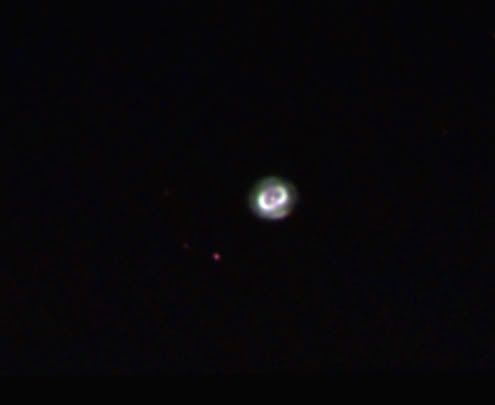
This is M16 The Eagle Nebula. This cloud of gas and dust is about 7000 Light years away. It is a ‘stellar nursery’ where stars are formed in the gas clouds. The centre column in this image is about 9 light years long. To put that in context, that is twice the distance from the Sun to our nearest neighboring star.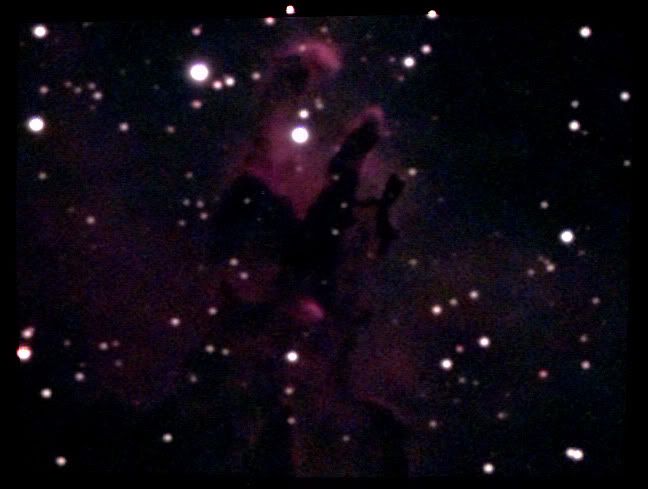
Mars. You can clearly see the Southern polar ice cap and some surface shading. Mars will be getting closer as the summer progresses into Autumn, so images should get much more detailed as the year goes on.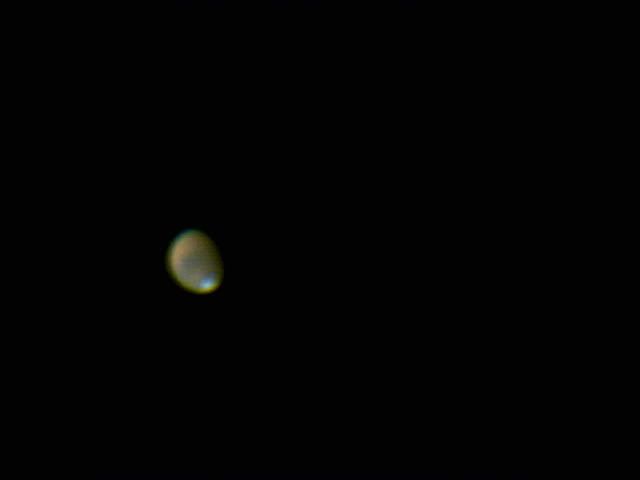
This is M27 The Dumbell Nebula. It is another planetary nebula. You can see the dying star at the centre. This is fairly close to us Astronomically speaking at about 1000 light years.
M51 The Whirlpool Galaxy. This is found close to the last star in the tail of Ursa Major (The Plough or Big Dipper). It is approximately 38 Million Light Years way.. Recently a Super Nova was detected in this galaxy. I am hoping to get a chance to image it. The Super Nova will show up as a very bright star near the centre of the Galaxy.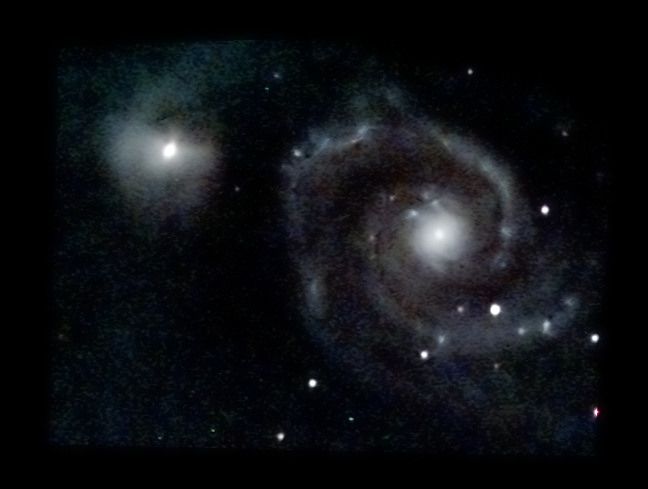
Jupiter on June the 18th showing a moon transit. You can see the shadow of the moon as it crosses the planet.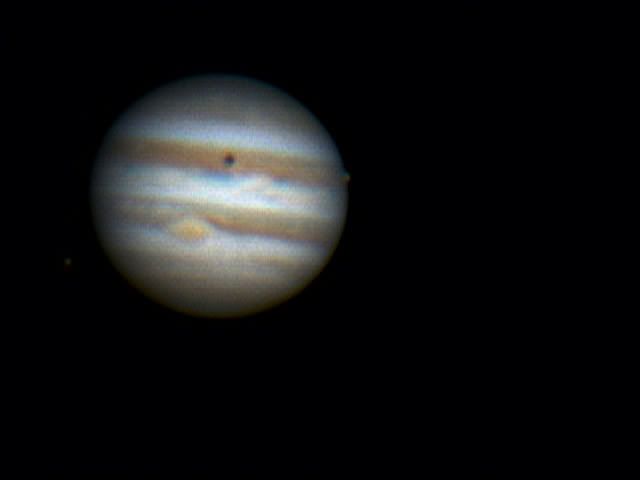
I took several images of the transit and strung them together to make a crude animation…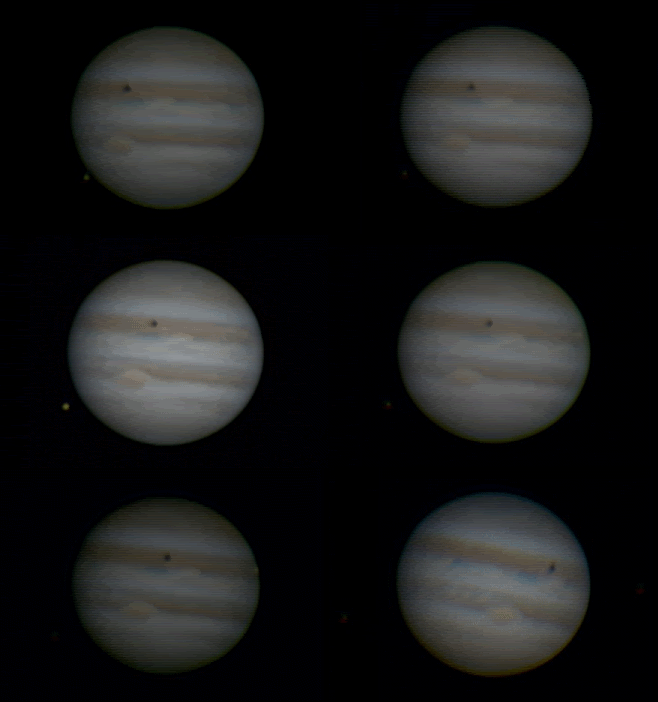
Finally, this is M57 the Ring Nebula. Another planetary nebula. You can see the dying star right at the centre.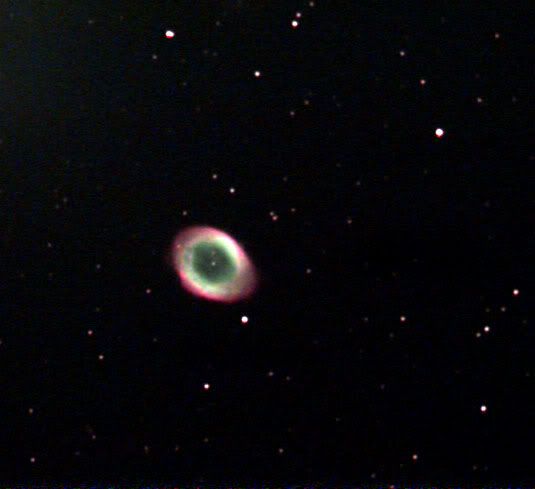
Thanks for looking :).
By: Paul Rix - 12th May 2005 at 03:53
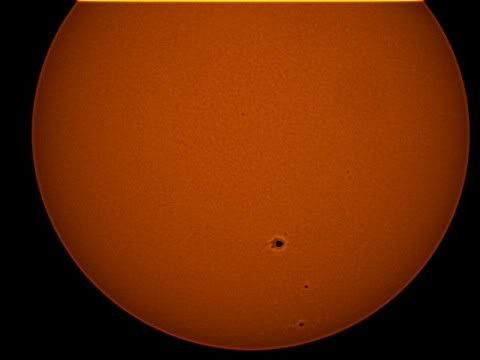
Ok, just show that a small scope can see some amazing things… these were all imaged using the small telescope (Meade ETX70). Click on the thumbnails for the full sized images.
Sunspots (using a Solar Filter – under no circumstances should you point the telescope at the sun without a Solar Filter attached to the objective end).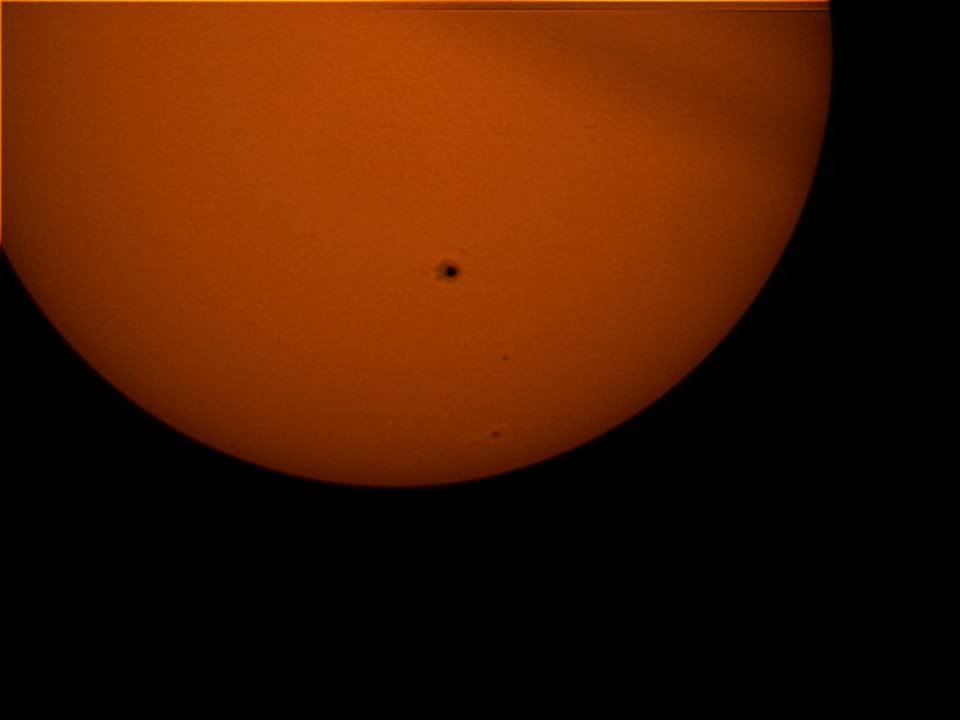
Saturn: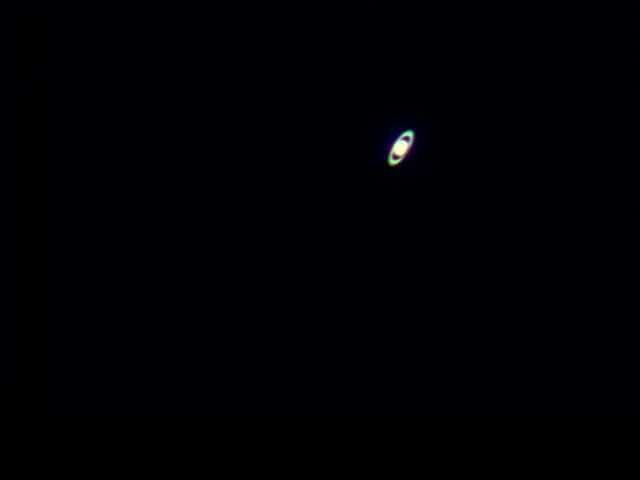
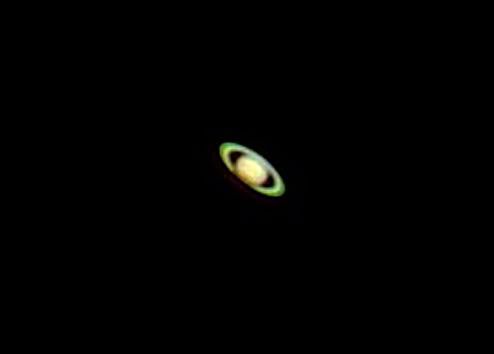
This shows my shots of Saturn as I gained some experience with the telescope and camera settings..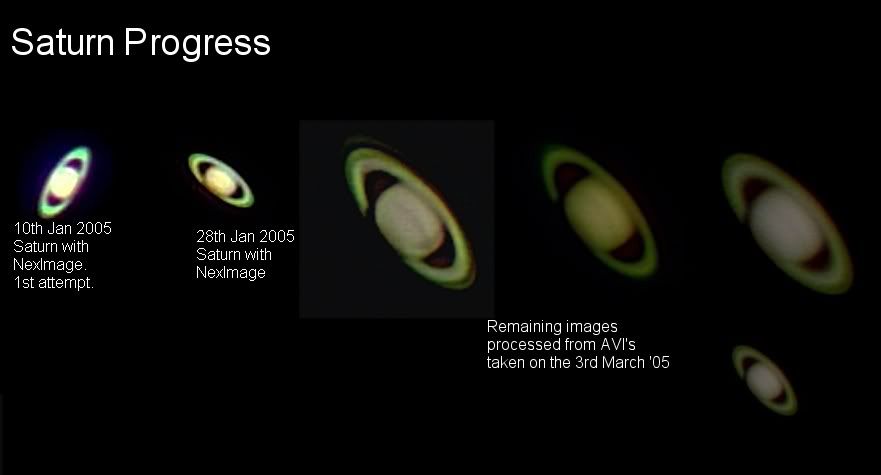
Jupiter:
This is my first ever jupiter image.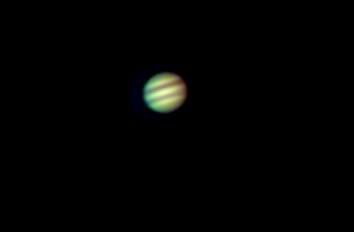
More Jupiter shots as I learned more..
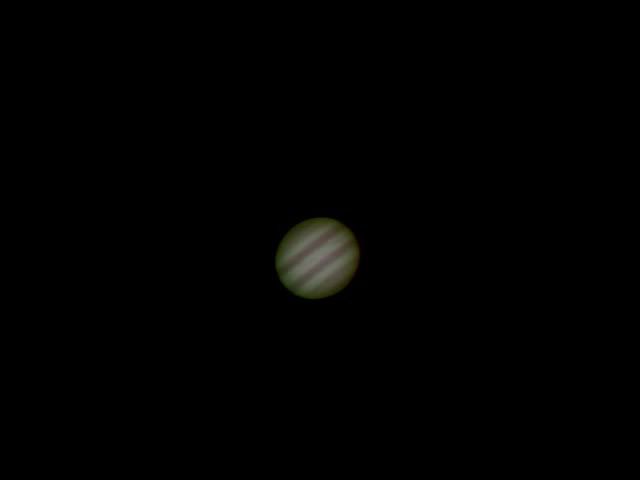
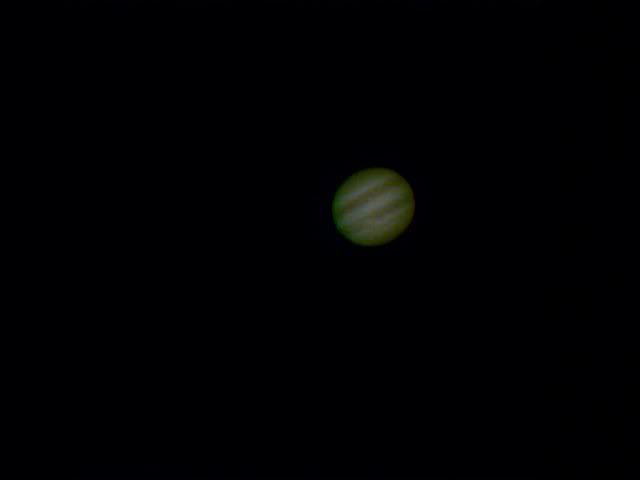
My best ETX70 Jupiter image, showing the Red Spot: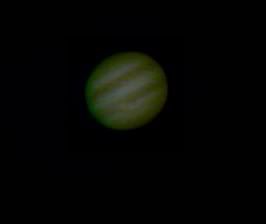
The Great Orion Nebula (M42):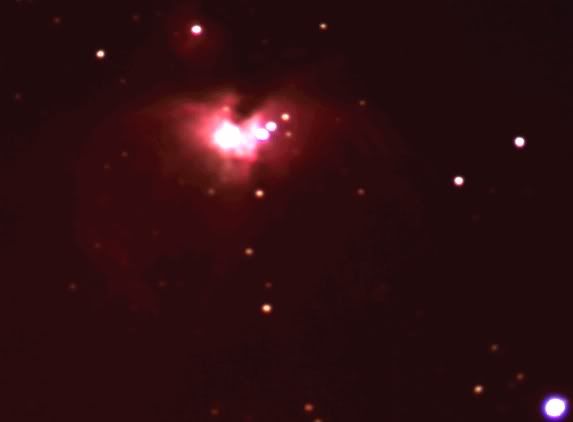
Globular Star Cluster (M53)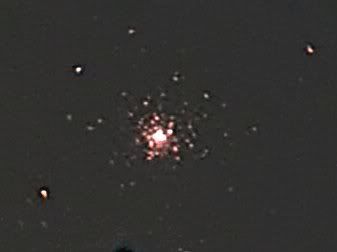
M44 open star cluster.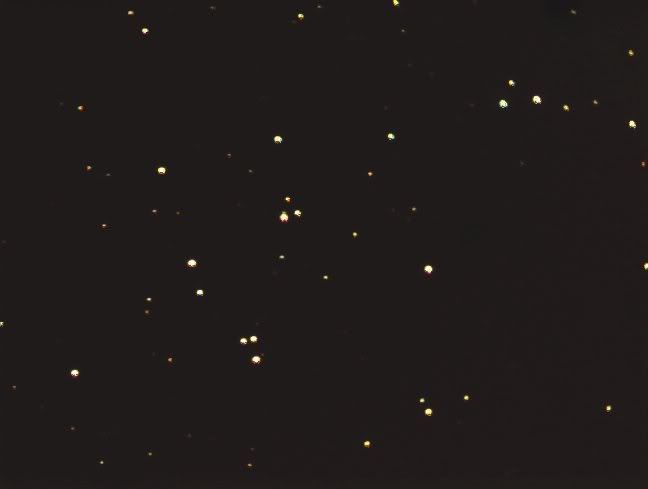
Not quite Hubble standard by any means, but not bad when you consider that the equipment used cost about $300 (telescope, barlow lenses and Camera) excluding the laptop pc for the planet images. The deep space objects used the DSI camera which cost almost as much as the rest of the setup put together ($275).
Please bear in mind that the view through the eyepiece is not as good as the images at the greater magnifications. The images are possible through a process called stacking, where you take hundreds of frames in an AVI file, align them and stack them (basically you average the individual frames).
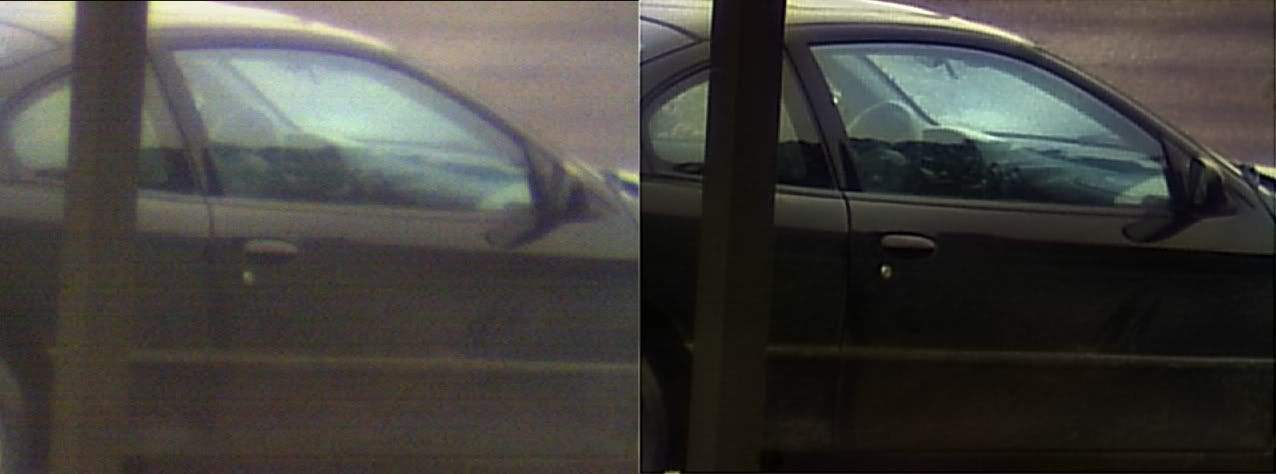
Here is an example. This was a test shot I did when I first got the camera.
The frame on the left shows what you see as the camera captures the avi file. Kind of low quality.. The frame on the right shows the result of aligning and stacking several hundred frames.. the ‘noise’ gets averaged out and you end up with a huge improvement.
By: whalebone - 12th May 2005 at 00:14
Oh yes, loads of oooohh’s and aaaahh’s and wow’s from folk looking through the 125 but, light pollution has knocked it on the head. I know I can get “further out” but local conditions now prevent it happening.
If you live somewhere that is properly dark at night they are great bit if kit, get yourself onto e-bay. 🙂
Paul, those images are superb and shows what can be done, all be it with a whopper :rolleyes: but even they are not too dear these days.
By: F-18 Hamburger - 11th May 2005 at 21:53
can you view something as far as Saturn or something as small as say the moons of Mars? You got me interested in spending my loads of cash.
By: whalebone - 10th May 2005 at 18:18
Joining your local club is sound advice,
For all things ETX try here
By: mixtec - 10th May 2005 at 18:02
For anyone starting out in astronomy, a refractor is by far the best to get, 60mm minimum. You can get a good 80mm for as little as $200 to $300. The problem is once you get serious into it, you have to start buying eye pieces which cost $100 to $200 a piece. The only thing I dont like about current refractors is that they are short tubes which have a very fast focal length and therefore not quite as good as the normal long tube refractors, but they are still capable of getting good images. The Telescope Paul has is a schmidt-cassigrain which is what most of the major telescopes are, like hubble or keck. A shmidt cassiegrain has a series of relective mirrors and corrective lenses that correct problems in a normal newtonion reflector which only has one mirror and no corrective lenses. Although a newtonion is still very useful for deepspace objects. There is also a newtonion refered to as a dobsonion which is basically a huge newtonion on a cheapo tube and mounting, a cheap way to get alot of power for some inconvenience of use. If you have one of these high prices telescopes like a shmidt cassigrain, you really need an electronic drive to maintain centered on the object while the earth rotates for long exposer photos. Its really good to join a local astronomy club and check out other peoples telescopes before you start investing alot on your own.
By: danohagan - 10th May 2005 at 17:20
Got quite into astronomy when I was a wee ‘un. Read loads of books and can still name most of the constellations. There’s nothing better than looking up at a starry night sky miles from any light pollution… Mind you, I’d better stop going on, or I’ll start off on my other hobby – UFOs…
By: whalebone - 10th May 2005 at 17:00
I have got an ETX-125 EC with Autostar, fantastic bit of kit but the light pollution around here has become so bad 99% of the time I rarely get it out and try and use it for anything serious. 😡
I guess I should flog it or move somwhere darker :rolleyes:
Mind you it does make for a great terrestrial telephoto lens on an old SLR,
1900mm @ f15 😀
By: Paul Rix - 10th May 2005 at 16:28
PilotDKH,
The cameras fit right intot he eyepiece holder, so you can think of the camera as another eyepiece I guess.
What type of telescope do you have? For imaging the brighter planets such as Jupiter or Saturn you may get ok results. Automatic computer tracking makes a big difference when imaging smaller, dimmer objects. I have seen some excellent images taken by amateur astronomers using just a 60mm refractor telescope. Having said that, in this game, bigger is usually better when it comes to telescope aperture size. I ran through the costs further up on this thread..
By: PilotDKH - 10th May 2005 at 12:34
Very nice photo’s paul.That’s a monster telescope.Was it expensive? How do you take the photo’s? Do you put the camera lens in the hole for the eye-piece?
Thanks for sharing.You have motivated me to start using my telescope again.It’s a small childrens telescope.Would it be any good for taking photo’s? It’s good for looking at the full moon,but it was no good for looking at Mars,when it was visible a few years ago.
By: Sauron - 10th May 2005 at 04:43
Paul
I check out the Cloudy Nights forum occasionaly but I do not contribute, I just lurk.
I see you are also a Heavens-above user. A great site from which I learned just how many man-made objects are visable. I am always surprised at the number of times something passes throught the narrow field of view of my scope. The other night, two tracked through while I was looking in Lyra.
You are probably already aware, but one or two of the May 31-June 3 and June 9-10 transits of the Jovian moons would make interesting photos for your big Cat. Quite a number of transits are at timed for decent viewing.
Regards
Sauron
By: Paul Rix - 9th May 2005 at 22:20
They are digital images, taken with digital webcams. Views of deep space objects such as galaxies are nowhere near as good visually as what can be seen in a photo or digital image. My images of galaxies have exposure times of between 15 and 30 seconds. You take a number of these images and combine or “Stack” them.
If you look through the telescope at Jupiter or Saturn you can see some very good detail, but it takes practice. The more you look at a planet the more detail you will be able to pick out. Personally I like the imaging side of the hobby best for two main reasons:
1. You can push the telescope further when imaging than you can for visual observing. It is a challenge that I enjoy.
2. If you get to image something cool (such as the ISS for example) you can share it with others. A picture speaks a thousand words with something like this. If I came here and said “I saw the ISS last night with it’s solar array and smaller panels” that would be ok, but nowhere near as interesting as being able to show you a picture.
It is very subjective though and different people are attracted to different aspects of the hobby.
By: F-18 Hamburger - 9th May 2005 at 21:40
wait, so you’re saying these are computerized images.. you don’t see them with your own naked eye through the telescope?
By: Tony - 9th May 2005 at 17:40
Paul
You have brought back memories of my old 4″ reflector borrowed from school in London-you can imagine not the most ideal place with all the lights!My old school had a planetarium, albeit a mini one – but still good. Part of our “O” Level Exam (in the seventies!) was to do a project on the 4 visible moons crossing Jupiter but all we could do was draw them!
You have some nice photos from your 10″ Meade-we could only dream of making photos as good! I remember doing drawings of the various craters on the moon such as Copernicus (particularly bright some nights) and of other distant objects such as the Seven Sisters (Plaeides).
I recommend astronomy for anyone interested in the sky-we also had a bit of navigation thrown in as well which might be useful later -and the sites recommended above are good.
I personally am also interested in cosmology! Will the Universe continue to expand at ever increasing speed as there does not appear to be enough ‘dark matter’ to arrest the expansion? How many parallel Universes are there and can we connect to them or empirically prove their existance? And biggest question of all: what was there before the Big Bang 12 Billion years ago?
By: Der - 9th May 2005 at 08:03
Paul.
Thanks for the info.
I’ll follow that up.
By: steve rowell - 9th May 2005 at 05:44
Very interesting, seems there’s no escaping pollution even in the outer limits
By: Paul Rix - 9th May 2005 at 05:30
Sauron, do you still frequent the Cloudy Nights forum?
I was planning to observe tonight as well, but transpancy is not that good here. I’ll hopefully have more luck tomorrow night.
Dave, with regard to the lunar landing sites… you can see the general locations, but not even Hubble can resolve the objects left behind by the Apollo Astronauts.


 Sign In








 May 8, 2005 at 4:25 pm