In the 21st century, there’s been a trend of replacing larger numbers of small ships (frigates) with a few big ones (Air Warfare Destroyers) and then ignore such basic concepts as mine countermeasures.
Except:
1. In peacetime, larger numbers of ships are more useful for:
a. Anti-piracy patrol
b. General sea control duties
c. Maintaining a presence
d. Maintaining operational capability – it’s easier to maintain an operational capability with 6 ships than 3 ships.
e. Sanction enforcement
f. Naval Gunfire Support in some instances.
2. In wartime, larger number of ships are also more useful for:
a. Convoy duties
b. Mine counter measures
c. Anti-submarine warfare
d. Covering larger area of ocean/sea.
Other than carriers in the Pacific, arguably the most useful ships in WWII were usually corvettes, sloops etc performing above duties. It would be fair to say that in WWIII, a Kilo class sub or a minefield are going to cause more headaches than the odd H-6K or Tu-22.
The cruisers and battleships were generally a waste of time other than NGFS (and for the most part have disappeared following WWII).
In 2013 every man and his dog is building very small numbers of large air warfare destroyers or large frigates.
The emphasis on air defence in an era where you’re average opponent has no air force, let alone capability to strike ships at sea seems ridiculous.
I think big destroyers/frigates have become the new dreadnoughts of our time.
Only problem is they’re built at the expense of smaller more useful ships.

By: RpR - 8th August 2013 at 18:35
The two heavy cruisers Sweden built after WWII, probably the last large gun ships built, ended up in South America.
Have they been scrapped or a preserved?
By: swerve - 8th August 2013 at 17:04
What I don’t understand is why are countries like Norway, Denmark, which even during the Cold War only had coastal defense navies, suddenly are building ocean going large AAW frigates/destroyers.
“Even during the Cold War” shows that you are unaware of how NATO worked during the Cold War. There was a division of labour. European countries had specific roles allocated to their forces, & specialised in them. Denmark & Norway (& also Germany) were tasked with defending their own territory, & intercepting Soviet ships trying to get from the Baltic into the North Sea, & from northern Russian ports into the North Atlantic. Their navies were designed for these tasks.
Since the end of the Cold War, the former specialisations have become inappropriate. What the allies of Denmark & Norway want now are for them to be able to participate in joint actions outside Europe, & both countries have re-roled their navies to suit, & built ships for the new role. Denmark, for example, has sent Absalon to assist in anti-piracy operations off Somalia, a role for which she is very well suited.
By: Nicolas10 - 8th August 2013 at 12:56
Could it be for “UN duties”?
Nic
By: plumberunion - 7th August 2013 at 18:33
What I don’t understand is why are countries like Norway, Denmark, which even during the Cold War only had coastal defense navies, suddenly are building ocean going large AAW frigates/destroyers.
By: Nicolas10 - 6th August 2013 at 04:52
So aside from the paranoid anti-globalization (?) rant, do you have anything constructive to add?
You do know that the “toys” we talk about on this forum (like “your” Rafale) aren’t designed to impress children at airshows…
Well, while you can say by my answer that I’m sickened by my country’s behavior in present times, you also get your answer about why modern navies don’t go for smaller more numerous ships. At least that’s my answer to the question, and I think I put it clearly enough: most armies right now are just aimed at being part of a UN coalition. If you don’t believe me just read some issues of DSI where they tackle this very subject and claim it’s a real risk for the french armed forces to be overly concerned with “interoperability”.
You’ve already made my point too:
Quoting yourself:
So basically optimized for sea control, special forces insertions, blockades, or prepositioned forces near failed statesand disaster areas. Aside from a gun for NGFS, armament is limited or non-existant, but provisions exist for future add-ons
Is Libya the disaster area & Syria the near failed state or is it the other way around. What about Mali where “we” fight those we helped in Libya & continue helping in Syria. I’m confused.
Nic
By: thobbes - 6th August 2013 at 04:18
I don’t think the likes of Libyans or Syrians or Iraqis or Iranians or Venezuelans were/are too concerned with a Dutch or English destroyer. They were/are probably more concerned with US/NATO warplanes and cruise missiles.
To this end, the USN carriers and large LHD’s are the “super duper ships.”
Oh and if every country had an army just for UN duties, world peace has been achieved. That’s a good thing unless your a military enthusiast in which case WWIII is a desired goal to see how your favourite military toy perfroms.
By: H_K - 6th August 2013 at 04:16
So aside from the paranoid anti-globalization (?) rant, do you have anything constructive to add?
You do know that the “toys” we talk about on this forum (like “your” Rafale) aren’t designed to impress children at airshows…
By: Nicolas10 - 6th August 2013 at 03:57
In the new world order you don’t plan for real war, but you must plan to bully the few little countries that aren’t game yet. So a smaller number of super duper ships are more useful than many little ships.
How many ships can you operate near the syrian border, or the libyan border, or venezuelian border, or iranian border ? You don’t want them to crash in eachother right?
If you go by this forum. Every country and their mothers should just have an army for UN duties.
Nic
By: thobbes - 6th August 2013 at 00:24
[*]Staying power: Asking a short-handed crew and passengers (living in containers!) to cook and fend for themselves for long periods of time without additional support personnel and “creature comforts” is unrealistic and counter-productive given the goal of maximizing “presence” with long deployments
.
It’s amazing how times have changed. Creature comforts on naval vessels were unheard of even in most of the 20th century.
But you’re right – the modern Western soldier requires a lot more create comforts than the troops of old. But then don’t we all? 😛
By: H_K - 5th August 2013 at 23:16
Yes, Black Swan is also a relevant concept, though it suffers from a couple of fatal flaws (that it shares with LCS)…
Guess this helps to highlight a few critical capabilities that should be non-negotiable in a “mini-Absalon” frigate:
So there you go. The selling points of Absalon and the French & Italian proposals: decent speed, lots of comfortable accommodation, and ship-to-shore projection means.
By: Tempest414 - 5th August 2013 at 11:01
Back on topic, it seems like “light frigates” are making inroads with the French & Italians… almost a rebirth of the UK’s C2 “choke point escort” concept!
Both navies are looking at 3,500-4,500t “mini-Absalons” (or “large-LCSs” depending on how you see it), with an emphasis on modular payloads instead of kinetic weapons:
- “Flex” deck for vehicles and accomodation for 100+ passengers/special forces
- Two helicopters
- Deck space for RHIBs, landing craft and/or containers
- Reconfigurable rooms for command spaces, hospitals etc
So basically optimized for sea control, special forces insertions, blockades, or prepositioned forces near failed states and disaster areas. Aside from a gun for NGFS, armament is limited or non-existant, but provisions exist for future add-ons.
The Italian concept – “Multirole Offshore Patrol” vessel
The French concept – “Mid-sized Frigate”
(Note: HIGHLY conjectural drawing, based on sparse info and extrapolating from DCNS’s Advansea concept)
All-in-all, the premise appears to be that there are many many conflicts involving low-tech, assymetric opponents. These “wars” are too intense for OPVs (what with the odd Grad rocket salvo, suicide attack, land-based missile launch, or low-end fighter-bomber…), but are a waste of a high-end frigate’s ASW or air defense capabilities. Some examples: Yougoslavia to Irak, Syria, Lebanon, Libya & Somalia. All failed states, border wars, terrorism, piracy or trafficking…
(Yes, there are many small countries with modern forces, including token numbers of jets and/or submarines, but they are rarely balanced, well-trained, AND dangerous. As for real “hot wars”, they can only be caused by a handful of usual suspects (China, Russia, India, Iran…), best handled by deterance, alliances and existing high-end warships.)
the British Black Swan sloop concept that was set to come in at about £65mn each
[ATTACH=CONFIG]219470[/ATTACH]
[ATTACH=CONFIG]219471[/ATTACH][ATTACH=CONFIG]219472[/ATTACH]
By: H_K - 30th July 2013 at 22:44
Yep I got that idea re BATISMAR but it seems to have gone very quiet recently…I was wondering if it had been re-evaluated as a concept?. Has a design been down selected yet?. As I understood it BATISMAR was the eventual replacement for the Floreal’s…looks to me that the Floreal is a better foundation for BATISMAR than, at least, the CNM concept!.
Yes, BATISMAR has gone very quiet due to being pushed back beyond 2020 for financial reasons.
No, it’s not really a replacement for the Floreals, but for the much smaller P400 patrol boats (400 tons) and A69 avisos (1,300 tons). The goal is to buy a much more capable platform at only marginal extra cost compared to say an Armidale or FRC cutter. It must be oceanic and UAV/helicopter-capable.
I don’t know about CNM’s concept, but the French navy appears to be extremely satisfied with its experience so far with DCNS’ “l’Adroit.” She just wrapped up a >25,000nm (!) deployment and is spending 200+ days at sea and 270+ days away from her homeport on an annual basis. And despite her tiny 1,500 ton displacement, sea keeping is said to be excellent.
Some good sources on l’Adroit’s latest deployment:
www.meretmarine.com/fr/content/retour-sur-le-premier-grand-deploiement-de-ladroit-0
http://offshore-patrol-security.com/cms-assets/documents/112280-885674.05-sacha-bailly-day-2.pdf
By: Jonesy - 30th July 2013 at 22:14
BATISMAR is an OPV, i.e. a coast guard vessel. Small and cheap, since ~15 hulls are needed. Most similar to the defunct C3 concept, sized to carry a helicopter but without a combat role.
This new FTI (“Mid-sized frigate”) on the other hand does have a combat role. It’s better defended and has a much larger payload than an OPV, so that it can come close inshore to project power and deal with assymetric threats. So sort of like a European take on LCS. It will incorporate mixed civil-military construction standards – not clear how far they will go in terms of cost cutting.
The obvious assumption is that other assets will take care of enemy aircraft & submarines… assuming these even exist and that they are operational (not all that likely – in recent conflicts, the enemy’s high-end conventional weapons have rarely been more than paper tigers – it’s the assymetric threats that have have everyone worried).
Yep I got that idea re BATISMAR but it seems to have gone very quiet recently…I was wondering if it had been re-evaluated as a concept?. Has a design been down selected yet?. As I understood it BATISMAR was the eventual replacement for the Floreal’s…looks to me that the Floreal is a better foundation for BATISMAR than, at least, the CNM concept!.
By: H_K - 30th July 2013 at 21:43
Is there any relevance to BATISMAR in this French concept H_K?. Last I saw of that was a 79m CMN design that looked a little modest for Biscay on an angry day?!.
BATISMAR is an OPV, i.e. a coast guard vessel. Small and cheap, since ~15 hulls are needed. Most similar to the defunct C3 concept, sized to carry a helicopter but without a combat role.
This new FTI (“Mid-sized frigate”) on the other hand does have a combat role. It’s better defended and has a much larger payload than an OPV, so that it can come close inshore to project power and deal with assymetric threats. So sort of like a European take on LCS. It will incorporate mixed civil-military construction standards – not clear how far they will go in terms of cost cutting.
The obvious assumption is that other assets will take care of enemy aircraft & submarines… assuming these even exist and that they are operational (not all that likely – in recent conflicts, the enemy’s high-end conventional weapons have rarely been more than paper tigers – it’s the assymetric threats that have have everyone worried).
By: Jonesy - 30th July 2013 at 20:39
Yes, among other things.
Seems like a trend among some designers these days, i.e. away from “short, fat” hull designs (which are very volumetrically efficient) and back to longer waterlines… The wavepiercing bow reduces pitching, improves efficiency in waves and at high speeds, and is stealthier. Probably more complex structurally, but that’s what computers are for!
Is there any relevance to BATISMAR in this French concept H_K?. Last I saw of that was a 79m CMN design that looked a little modest for Biscay on an angry day?!.
By: H_K - 30th July 2013 at 05:54
Interesting indeed……..the bow design in better suited to heavy sea correct???
Yes, among other things.
Seems like a trend among some designers these days, i.e. away from “short, fat” hull designs (which are very volumetrically efficient) and back to longer waterlines… The wavepiercing bow reduces pitching, improves efficiency in waves and at high speeds, and is stealthier. Probably more complex structurally, but that’s what computers are for!
By: Arabella-Cox - 30th July 2013 at 05:31
Back on topic, it seems like “light frigates” are making inroads with the French & Italians… almost a rebirth of the UK’s C2 “choke point escort” concept!
Both navies are looking at 3,500-4,500t “mini-Absalons” (or “large-LCSs” depending on how you see it), with an emphasis on modular payloads instead of kinetic weapons:
- “Flex” deck for vehicles and accomodation for 100+ passengers/special forces
- Two helicopters
- Deck space for RHIBs, landing craft and/or containers
- Reconfigurable rooms for command spaces, hospitals etc
So basically optimized for sea control, special forces insertions, blockades, or prepositioned forces near failed states and disaster areas. Aside from a gun for NGFS, armament is limited or non-existant, but provisions exist for future add-ons.
The Italian concept – “Multirole Offshore Patrol” vessel
The French concept – “Mid-sized Frigate”
(Note: HIGHLY conjectural drawing, based on sparse info and extrapolating from DCNS’s Advansea concept)
All-in-all, the premise appears to be that there are many many conflicts involving low-tech, assymetric opponents. These “wars” are too intense for OPVs (what with the odd Grad rocket salvo, suicide attack, land-based missile launch, or low-end fighter-bomber…), but are a waste of a high-end frigate’s ASW or air defense capabilities. Some examples: Yougoslavia to Irak, Syria, Lebanon, Libya & Somalia. All failed states, border wars, terrorism, piracy or trafficking…
(Yes, there are many small countries with modern forces, including token numbers of jets and/or submarines, but they are rarely balanced, well-trained, AND dangerous. As for real “hot wars”, they can only be caused by a handful of usual suspects (China, Russia, India, Iran…), best handled by deterance, alliances and existing high-end warships.)
Interesting indeed……..the bow design in better suited to heavy sea correct???
By: thobbes - 30th July 2013 at 04:36
These are exactly the kind of ships I was thinking about.
By: H_K - 30th July 2013 at 04:04
Back on topic, it seems like “light frigates” are making inroads with the French & Italians… almost a rebirth of the UK’s C2 “choke point escort” concept!
Both navies are looking at 3,500-4,500t “mini-Absalons” (or “large-LCSs” depending on how you see it), with an emphasis on modular payloads instead of kinetic weapons:
So basically optimized for sea control, special forces insertions, blockades, or prepositioned forces near failed states and disaster areas. Aside from a gun for NGFS, armament is limited or non-existant, but provisions exist for future add-ons.
The Italian concept – “Multirole Offshore Patrol” vessel

The French concept – “Mid-sized Frigate”
(Note: HIGHLY conjectural drawing, based on sparse info and extrapolating from DCNS’s Advansea concept)
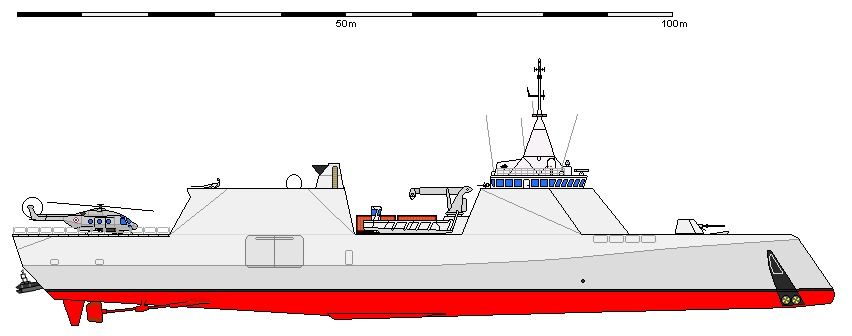
All-in-all, the premise appears to be that there are many many conflicts involving low-tech, assymetric opponents. These “wars” are too intense for OPVs (what with the odd Grad rocket salvo, suicide attack, land-based missile launch, or low-end fighter-bomber…), but are a waste of a high-end frigate’s ASW or air defense capabilities. Some examples: Yougoslavia to Irak, Syria, Lebanon, Libya & Somalia. All failed states, border wars, terrorism, piracy or trafficking…
(Yes, there are many small countries with modern forces, including token numbers of jets and/or submarines, but they are rarely balanced, well-trained, AND dangerous. As for real “hot wars”, they can only be caused by a handful of usual suspects (China, Russia, India, Iran…), best handled by deterance, alliances and existing high-end warships.)
By: Arabella-Cox - 29th July 2013 at 06:03
I don’t think it’s likely.
1. In addition to QE class carriers, there’s also the planned replacement of Type 23 frigates and Vanguard SSBN submarines and associated missiles, replacementPatrol, MCM and hydrography ships and replacement of some of the larger RFA replenishment vessels (Fort Rosalie and Fort Victoria)class .
That’s a lot of money that needs to be spent.
By that stage (i.e. 2020s), there will be other defence projects that will need looking into – armour (replacement/upgrade of Challenger 2s), Eurofighter replacement, trainer aircraft (EMB-312 and Hawk replacements) etc.
2. Problem is British military has been in terminal decline since 1991. Unless you have a massive change in conventional threat level, the RN will at best stay at current planned levels or at worst likely to continue to shrink.
3. Politicians being politicians will probably not see the need for a third smaller aircraft carrier. An LHD is not a carrier though, but politicians generally won’t know the difference.
This is especially the case if one of the QE is laid up in reserve or used only in a humanitarian/helicopter roles – this obviously relates to the fact that future of HMS Prince of Wales is to be decided at SDSR 2015 (http://www.publications.parliament.uk/pa/cm201213/cmhansrd/cm120510/debtext/120510-0001.htm#12051029000006).
Hard to say at this stage because much can change in another 10 years. Yet, don’t forget how the HMS Ocean was designed and built. Clearly, a replacement could follow the same path!


 Sign In








 July 19, 2013 at 1:24 am