Check out this article on the Armstrong Whitworth AW.56 tailless jet V bomber proposal of 1947 at RetroMechanix.com:
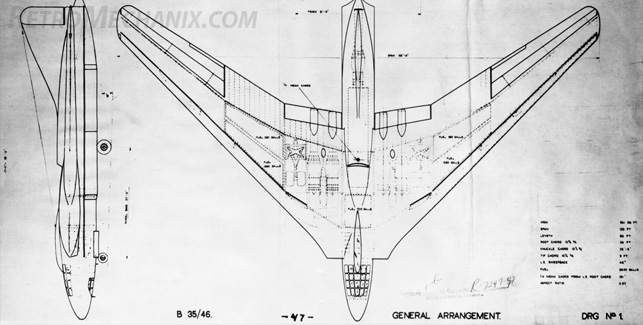
The article is based on an intelligence report provided to the U.S. Air Force Deputy Chief of Staff by the American Military Attache in London and features seven high resolution drawings of the aircraft and its various components.
-Jared

By: spitfireman - 4th January 2012 at 21:02
I guess Iran may be looking at reverse engineering a RQ-170 after being given one recently:rolleyes:
By: spitfireman - 4th January 2012 at 21:02
I guess Iran may be looking at reverse engineering a RQ-170 after being given one recently:rolleyes:
By: Bager1968 - 4th January 2012 at 20:31
Are there any other flying wings currently in development, apart from the F117 and B2 the latest military aircraft seem to be reverting to a more conventional layout of flying surfaces.
Northrop Grumman X-47 (both the tail-less delta X-47A and the flying wing X-47B):
http://www.airforce-technology.com/projects/x47/
http://www.defenseindustrydaily.com/cv-ucavs-the-return-of-ucas-03557/
Note that the X-47B is intended for operation from aircraft carriers.
Lockheed Martin RQ-170 “mini B-1”:
http://www.airforce-technology.com/projects/rq-170-sentinel/
Boeing “Phantom Ray”:
http://en.wikipedia.org/wiki/Boeing_Phantom_Ray
BAe Taranis, Corax, & Raven:
http://www.airforce-technology.com/projects/tanaris/
http://air-attack.com/page/74/BAE-Corax-UCAV.html
Dassault nEUROn:
http://en.wikipedia.org/wiki/Dassault_nEUROn
By: Bager1968 - 4th January 2012 at 20:31
Are there any other flying wings currently in development, apart from the F117 and B2 the latest military aircraft seem to be reverting to a more conventional layout of flying surfaces.
Northrop Grumman X-47 (both the tail-less delta X-47A and the flying wing X-47B):
http://www.airforce-technology.com/projects/x47/
http://www.defenseindustrydaily.com/cv-ucavs-the-return-of-ucas-03557/
Note that the X-47B is intended for operation from aircraft carriers.
Lockheed Martin RQ-170 “mini B-1”:
http://www.airforce-technology.com/projects/rq-170-sentinel/
Boeing “Phantom Ray”:
http://en.wikipedia.org/wiki/Boeing_Phantom_Ray
BAe Taranis, Corax, & Raven:
http://www.airforce-technology.com/projects/tanaris/
http://air-attack.com/page/74/BAE-Corax-UCAV.html
Dassault nEUROn:
http://en.wikipedia.org/wiki/Dassault_nEUROn
By: inkworm - 4th January 2012 at 10:22
Would they have produced scale flying models during the post war period or would the information from the 52 have all been based on wind tunnel tests, given the date on the first document being not long after the 52 flew then much of the work would have been done before that first flight.
Are there any other flying wings currently in development, apart from the F117 and B2 the latest military aircraft seem to be reverting to a more conventional layout of flying surfaces.
By: inkworm - 4th January 2012 at 10:22
Would they have produced scale flying models during the post war period or would the information from the 52 have all been based on wind tunnel tests, given the date on the first document being not long after the 52 flew then much of the work would have been done before that first flight.
Are there any other flying wings currently in development, apart from the F117 and B2 the latest military aircraft seem to be reverting to a more conventional layout of flying surfaces.
By: pagen01 - 4th January 2012 at 09:27
Fascinating stuff yet again and thanks for finding and posting Jared.
I didn’t think British designs were so well covered on that site.
I’m not sure that much info would have been fed back from the A.W.52 at that stage, apart from perhaps some wind tunnel data, it didn’t fly until late ’47, that with the 52G glider had a far more moderate sweep back on the wing.
With the degree of sweepback shown in this project I wonder if some data came from the G.A.L. flying wing gliders?
The whole layout seems to share a striking resemblance to the swept wing Shorts PD.1 (?) project which the SB.4 Sherpa tested the wing design and isoclinic control system.
I wonder why the standing ‘lookout’ position was deemed as necessary?
By: pagen01 - 4th January 2012 at 09:27
Fascinating stuff yet again and thanks for finding and posting Jared.
I didn’t think British designs were so well covered on that site.
I’m not sure that much info would have been fed back from the A.W.52 at that stage, apart from perhaps some wind tunnel data, it didn’t fly until late ’47, that with the 52G glider had a far more moderate sweep back on the wing.
With the degree of sweepback shown in this project I wonder if some data came from the G.A.L. flying wing gliders?
The whole layout seems to share a striking resemblance to the swept wing Shorts PD.1 (?) project which the SB.4 Sherpa tested the wing design and isoclinic control system.
I wonder why the standing ‘lookout’ position was deemed as necessary?
By: inkworm - 4th January 2012 at 08:47
Interesting configuration, I’d imagine a lot was learnt from the AW 52G by this stage
By: inkworm - 4th January 2012 at 08:47
Interesting configuration, I’d imagine a lot was learnt from the AW 52G by this stage
By: wieesso - 4th January 2012 at 07:25
Amazing! Thanks again for finding and posting!
picture 3: cockpit supporting parachutes – for emergency use?
Martin
By: wieesso - 4th January 2012 at 07:25
Amazing! Thanks again for finding and posting!
picture 3: cockpit supporting parachutes – for emergency use?
Martin


 Sign In








 January 4, 2012 at 6:12 am