Since years the Rafale’s MMI is subject to controversal discussions. A certain journalist repeatedly claims to have interviewed mostly foreign pilots who were reportedly displeased with the Rafale’s MMI, with no names given however. Rafale fans raise doubts and counter with articles were pilots praised Rafale’s MMI with names being given on some of them. French pilots seem to be happy and highlight the MMI as one of the aircrafts strengths and even foreign pilots such as the former british RAF and test pilot Peter Collins or the former RAF chief Sir Glenn Torpy were impressed.
Let’s throw all of this over board and let’s start our own assessment of the Rafale’s MMI. At this point I want to note that this assessment is neither complete nor definite, as there are a lot of holes. The following analysis is neither meant to hype nor to bash the Rafale’s MMI and reflects my impression of it only.
Feel free to contribute information or criticise inaccuracies.
It is prohibited to repost or print this post elsewhere, but feel free to link the web address to the article if you like.
cheers
Scorpion
P.S.: I hope we can get a better understanding of the Rafale’s MMI.
—————————————————————————————————————————————————-
Rafale’s cockpit is compact and not overly spacy, though it’s said that it is comfortable mainly due the comfortable ejection seat and the ECS. The visibility is good due the canopy shaping and high seat position, albeit the view is obscured by 2 metal frames.
For g-protection of the crew Dassault opted for a high seat inclination and high mounted side controls with limited travel, a solution pioneered by the F-16. The french seem to believe that this is sufficient, though one aircraft is believed to has been lost due G-LOC. Interestingly there were a lot of fatal accidents in the early days of the F-16, which were overcome by proper preparation and training of the pilots. Yet the americans opted for a new g-suite for its F-22 pilots, which employs the same ideas of seat inclination and side controls.
The side consoles look not to disorderly and according Peter Collins all relevant controls are located within the 9 to 3 o’clock area.
A particular interesting feature is the joystick like single throttle. It may have been selected on grounds of g-protection and allows for fully synchron throttle settings. The disadvantage is that the pilot has to toggle a switch to control the left, right or both engines and in combat asymetric throttle settings are difficult to achieve quickly.
There are some 36 buttons and switches on throttle and stick allowing the pilot to keep his hand on the controls most of the time. The switches for the most important functions are large and easily recogniseable according Peter Collins. HOTAS allows for full flight controls, including the airbrake, communications, sensor managment, weapons and defensive aids control and display control via a “mouse” like cursor steered over the displays.
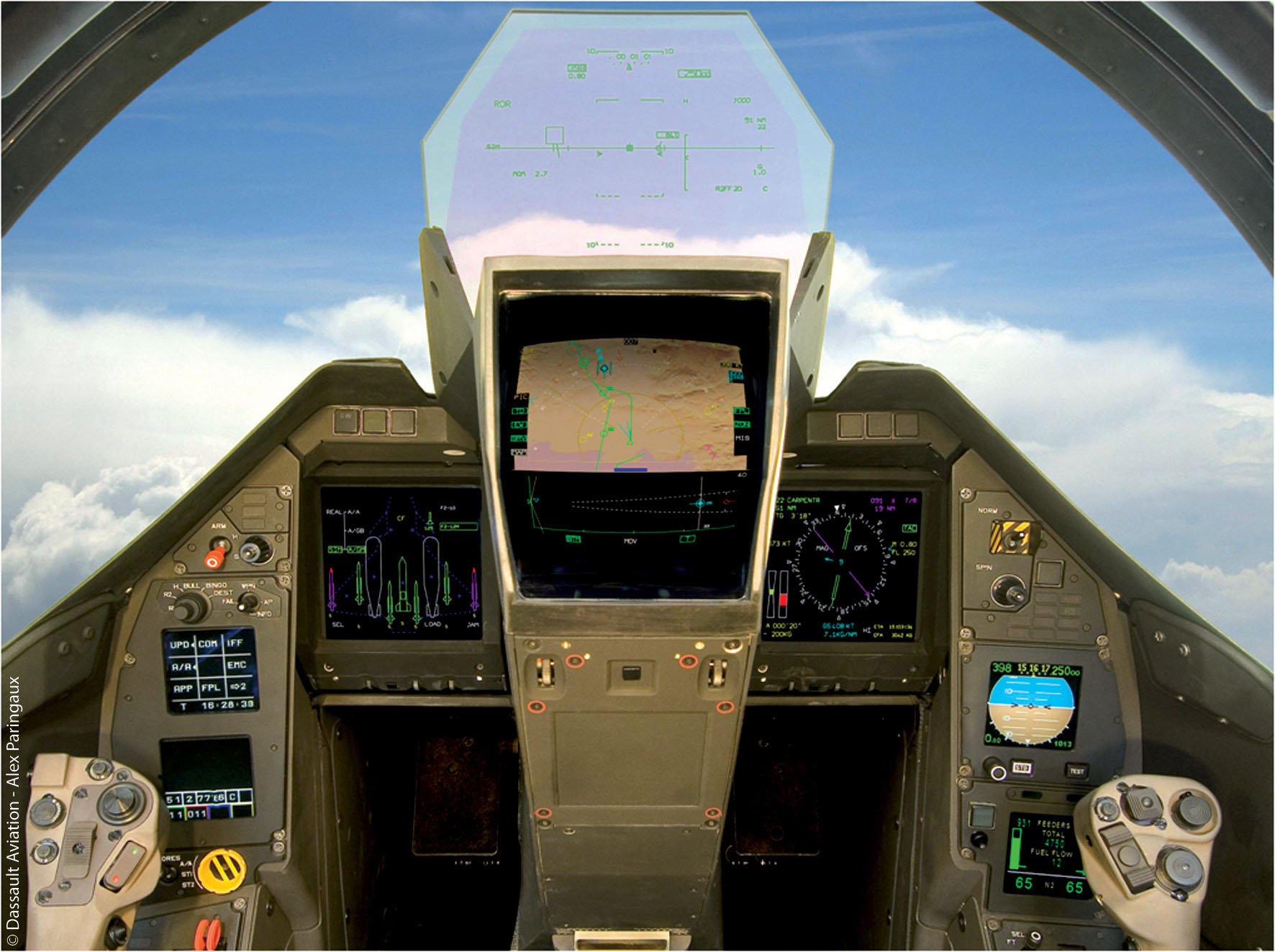
One of the most interesting features of the Rafale cockpit is the Head Level Display (HLD) on the front panel. It’s a coloured display with a size of 254 mm x 254 mm and a resolution of 1000 x 1000 pixel. The HLD is focussed to infinity allowing steamless transition from HuD to HLD, without refocussing the eyes. The HLD acts as the aircraft’s primary situational awareness display, presenting fused sensor pictures overlayed on a moving map. This tactical sensor display can occopy the entire HLD or it can be resized to present an elevation view of the airspace and even a target image from the OSF on the bottom at the same time.
The HLD is flanked by two touchable LCDs with a size of 127 mm x 127 mm and a resolution of 500 x 500 pixel. These displays can present a number of display formats including HSI, engine status, hydraulic status, SMS, RWR, EO camera/video images, sensor settings selection and pylon safety control page. It appears that there is no “flip back” icon on most pages and that the display formats has to be selected in another way possibly by the small touch screen to the left side. It’s also not known weather display formats switch automatically or if the pilot has to access all of them manually. There appear to be no check lists either, meaning the pilot must rely on conventional paper check lists for start ups, emergency procedures and approaches etc.
To the left side of the front panel there are two touchable smaller displays acting as avionics interfaces. The bottom one has been claimed to be dedicated to Spectra control. The upper one allows the pilot to select various sub systems such as the IFF, radios and possibly even to switch the MFD formats.
To the right side there are the flight instruments also in form of coloured displays. The upper one presents the ADI and other flight parameters such as speed, altitude and heading, while the lower one presents engine data and fuel status. While attitude is also presented on the HuD the pilot needs to look down right to see the fuel status and engine data which might be less desireable in combat situations.
Last but not least there is the CTH 3022 wide angle head-up display (HuD). The metal frames are small and thin and don’t obscure the much at all. The HuD has a FoV of 30° x 22° and can present FLIR imagery as well. It presents flight parameters and other data which are usually presented by modern HuDs in an uncluttered manner.


 Sign In








 December 2, 2009 at 1:01 pm