Despite all the research I have done on aircraft over the years, this particular aircraft escaped my notice until just recently.
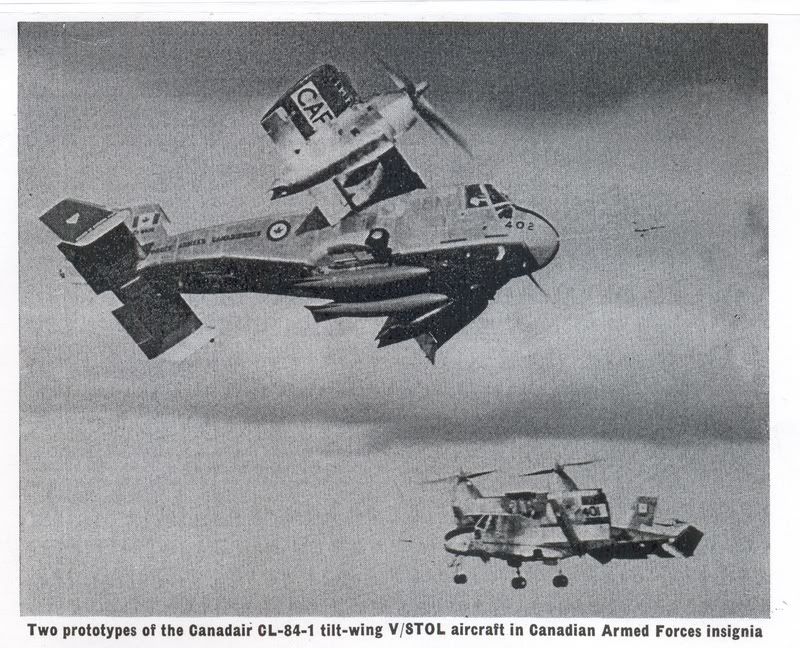
In 1965, Canadair (a subsidiary of General Dynamics) flew an aircraft they had been developing since the early 1950s… a twin-engined tilt-wing designated CL-84.
This aircraft strongly resembled the slightly-earlier Vought/Hiller/Ryan XC-142A, as you will see.
The planned production version was to be an ASW/AEW aircraft, with a range of 1,400 nm with full payload.
How would this aircraft have changed things if it had been produced?
Here is an edited version of the Wiki-waki entry, with additional info found in the 1964-65 & 1974-75 issues of Jane’s All the Worlds Aircraft.
Canadair CL-84
The CL-84 was a Canadian V/STOL turbine tilt-wing monoplane designed and manufactured by Canadair between 1964 and 1972. Only four of these experimental aircraft were built with three entering flight testing. Two of the CL-84s crashed due to mechanical failures, but no loss of life occurred as a result of these accidents. Despite the fact that the CL-84 was very successful in the experimental and operational trials carried out between 1972 and 1974, no production contracts resulted.
Between 1957 and 1963, Canadair carried out research in VTOL (vertical takeoff and landing) technology with the assistance of the National Research Board (NRB) and the Defense Research Board (DRB) of Canada. The studies pointed the way to a unique tilt-wing design. The wing and the powerplants of the aircraft could be tilted hydro-mechanically (recirculating ball actuator) so that the wing incidence changed through 100 degrees from a normal flight angle to those for STOL and VTOL. The incidence of the tailplane (or stabilizer) was automatically altered to deal with trim changes as the wing-incidence varied. The two sets of blades were locked in a fore and aft position in conventional flight.
Contra-rotating rotors on a vertical axis in the tail provided fore-and-aft (pitch) control during hovering and transitional flight. The propulsion and lifting propellers were handed (ie revolved in opposite directions) and were interconnected by shafts through a central gearbox from which the tail rotors and accessories were also driven. The thrust from the propellers was matched automatically except when over-ridden by the pilot for lateral (roll) control in slow or hovering flight. A mechanical “mixing” unit was used to adjust the functions of the various controls in the different modes of flight. The flap/ailerons gave yaw control when hovering. In the cockpit fore and aft stick was always pitch, side to side was always roll and the rudder pedals were always yaw, irrespective of the wing position through its full range.
Two 1,500 shp Lycoming T53 shaft-turbines were used to drive the two 14 ft four-bladed propellers. The engines were interconnected by cross shafts, so that in the event of the failure of one engine, it automatically disconnect (through torque spring clutches) and both propellers would be driven by the remaining engine.
There were two main reasons for the technical success of the CL-84 design. Aerodynamic considerations were given a very high priority, and the controlling of power was kept as simple and direct as possible.
The propeller disks extended slightly beyond the wingtips, so the whole of the wing (except for the portion above the fuselage) was immersed in the propeller slipstream. This, together with full-span leading edge and trailing edge flaps which were programmed with wing tilt angle, ensured that the wing was never stalled. Trim changes were minimized by programmed tilting of the tailplane. All programming was based on extensive testing in the wind tunnel and on an outdoor mobile test rig.
The power of both engines was controlled by a single “power lever” in all flight regimes. To provide crisp thrust control during hover, movement of the power lever caused a direct adjustment of blade angle, analogous to the collective pitch control of a helicopter, with the propeller cpu governor making a follow-up adjustment of blade angle to maintain the selected rpm. The direct adjustment of blade angle was faded out automatically as the blade angle increased with increasing forward speed.
The only unfamiliar control function the pilot had to deal with was the wing tilt control, which was a switch on the power lever (and took the place of controlling the flaps). The combination of smooth aerodynamics and simple power control made it easy for fixed-wing pilots to perform transitions between hover and wing-down modes on their first flight in the CL-84.
CF-VTO-X, the CL-84 prototype first flew in hover on 7 May 1965, flown by Canadair Chief Pilot Bill Longhurst. On 12 September 1967, after 305 relatively uneventful flights, CF-VTO-X was at 3,000 ft when a bearing in the propeller control system failed. Both pilot and observer successfully ejected but the prototype was lost. Canadair redesigned its replacement, the CL-84-1 incorporating over 150 engineering changes including the addition of dual controls, upgraded avionics, an airframe stretch (1.6 m, 5 ft 3 in longer) and more powerful engines (boosted by 100 hp).
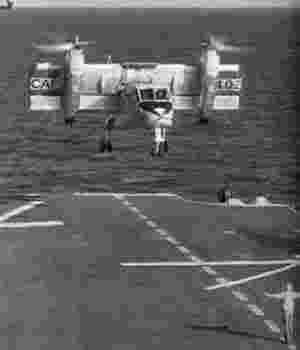
The first newly designed CL-84-1 (CX8401) flew on 19 February 1970 with Bill Longhurst again at the controls. He continued with the CL-84 program until his retirement from active flying in January 1971. Doug Atkins then assumed the role of chief test pilot. At about the same time, at the height of the Vietnam War, the US Navy expressed interest in the concept. Atkins was dispatched on a cross-country tour that took a CL-84-1 to Washington DC, Norfolk, Virginia, Edwards Air Force Base and eventually full-blown trials on the USS Guam. The CL-84-1 performed flawlessly, demonstrating versatility in a wide range of on-board roles including troop deployment, radar surveillance and anti-submarine warfare.
The potency of the CL-84-1 as a gun platform was dramatically accentuated in a Canadair promotional film. Fitted with a General Electric SUU 11A/A pod with a 7.62 mm mini-gun, Adkins maintained a rock-steady position as he sprayed a ground target. The rotating six-barrel “Gatling” gun delivered 3,000 rounds per minute, ripping up the target.
Continuing Tripartite trials by Canadian, US (Navy/Marine) and RAF evaluation pilots at the US Navy’s Patuxent River Experimental Test Center showed that the CL-84-1 was a suitable multi-mission aircraft. RAF Flight Lieutenant Ron Ledwidge became the first to make a descending transition from hovering to conventional flight and back to hovering while on instruments.
On 8 August 1973, the first CL-84-1 was lost when a catastrophic failure occurred in the left propeller gearbox in a maximum power climb. The US Navy and US Marine pilots aboard ejected safely. Canadair representatives were sure something was wrong – the entire propeller and supporting structure of the gearbox had broken away during the climb. It was rumoured that the pilots had attempted to set an unauthorized climb record to 10,000 ft to take that distinction away from the F-4 Phantom that had held it. The second CL-84-1 (CX8402) was rushed stateside to complete the Phase 2 trials onboard the USS Guadalcanal. In the face of gale storm conditions, the “84” performed magnificently in tasks such as ferrying troops and “blind-flight.” Phase 3 and 4 trials proceeded immediately after, but, despite rave reviews from over 40 pilots, the CL-84-1 did not land any production contracts.
The end of the Vietnam War meant a scaling back on military requirements, but Canadair designer Fred Phillips had been cognizant of other factors gravitating against the “84.” The first and most crucial was the “NBH” (not built here) factor; Canada had overcome it with other sales to the US military but the de Havilland Canada Beaver, Otter and Caribou loomed as exceptions to the rule. It was also “a prop job in the age of jets” and, lastly, the CL-84 “tilt-wing” concept did not have a “grand champion” who would fight for it in boardrooms and military procurement offices.
Canadair had tried to sell the Dynavert to others – Germany, Holland, Italy, Scandinavia and the United Kingdom were all courted, but, in the end, the Canadair CL-84 died in 1974 for lack of interest, not even in Canada.
A prototype CL-84 and three evaluation CL-84-1 aircraft had been built. The three CL-84s that flew made a total of over 700 flights and were flown (besides Canadair test pilots) by 36 pilots from Canadian, UK and US civil and military agencies. The two surviving CL-84s ended up in museums: CX8402 resides in the Canada Aviation Museum in Ottawa alongside another faded dream of technological greatness in Canada – the Avro Arrow, CX8403 was never flown; it was donated to the Western Canada Aviation Museum. Shipped as two main sections: fuselage and wings, the last CL-84 has never been restored and only the fuselage sits forlornly in the main display gallery. Visitors sometimes take time to read the display that tells the story of one of Canada’s greatest achievements in V/STOL development and wonder “what if?”
· Wing Span: 33ft 4in (10.16 m)
· Maximum width over propeller tips: 34.66 ft (10.56 m)
· Length: (tip of instrumented nose boom to tip of tail prop) 53.62 ft (16.34 m)
· Height overall (wing at 0° tilt): 14ft 1.5in (4.34m)
· Maximum height over propellers during wing tilt: 17ft 1.5in (5.36 m)
· Diameter – main propellers: 14.0ft (4.3 m)
· Diameter – tail propeller: 7.1ft (2.2 m)
· Weight empty (equipped, less crew): 9,023 lb (4,093 kg)
· Max T/O Wt (VTOL): 12,600 lb (5,710 kg)
· Max T/O Wt (STOL): 14,500 lb (6,580 kg)
· Payload: VTOL 1,480 lb (671 kg); STOL 3,145 lb (1,426 kg)
· Max Speed: 279 kt (321 mph, 518 km/h)
· Max rate of climb @ S/L: VTOL 4,200 ft/min (1,280 m/min); STOL 3,300 ft/min (1,006 m/min)
· Take-off run: STOL 140 ft (43m); STOL [to 50 ft] 500 ft (153 m)
· Landing run: STOL 150 ft (46m); STOL [from 50 ft @ AUW of 12,000 lb (5,440 kg)] 400 ft (122m).
· Max Range with max wing fuel, & 10% reserves: VTOL 356 nm (421 miles, 677 km); STOL 356 nm (410 miles, 660 km)
· Max Range with max wing fuel, full payload, & 10% reserves: VTOL 295 nm (340 miles, 547 km); STOL 279 nm (322 miles, 519 km)
At the time of the CL-84 project, Canadair was a subsidiary of General Dynamics. Someone at General Dynamics thought it would be clever for all their products to have names starting with “Dyna-“, and as the CL-84 was a vertical take-off aircraft, it was christened “Dynavert.” This moniker was received at Canadair with a mixture of amusement and derision – mostly the latter. The name was never used within the project – the aircraft was always referred to as the “84.”
CL-84-1 landing on USS Guadalcanal
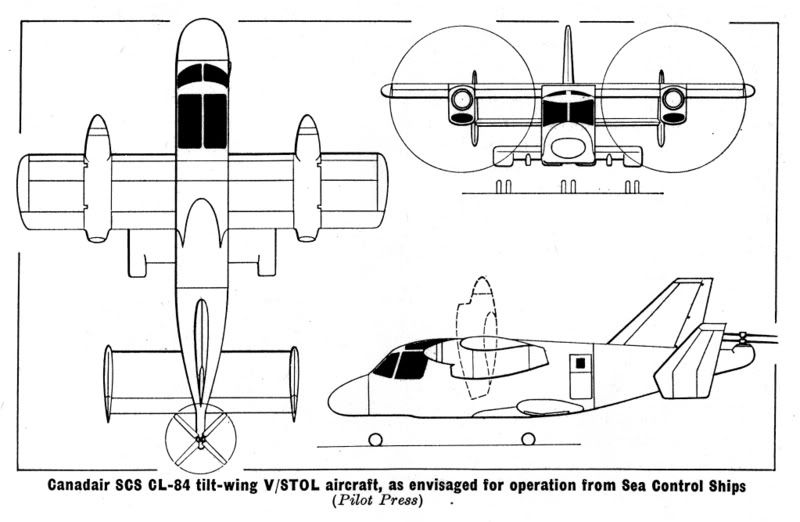
CL-84 SCS (Sea Control Ship version)
This was the planned production version being developed when the program was cancelled in the aftermath of the cancellation of the USN SCS program.
The CL-84/SCS was intended as an ASW/radar surveillance aircraft for operations from a short flight deck, like the various Spruance DDV proposals, the Sea Control Ship (see the Spanish CVS Principe de Asturias), the USN’s LPH/LHAs, or the RN’s Invincible class “ASW Through-Deck Cruisers” (as they were then called).
· Wing Span: 42 ft 0in (12.80 m)
· Width wings folded: 27ft 0in (8.23m)
· Length: 50ft 8in (15.44 m)
· Length of fuselage: 47ft 8in (14.53m)
· Height overall (wing at 0° tilt): 18ft 8in (5.69 m)
· Diameter – main propellers: 16ft 6in (5.03 m)
· Diameter – tail propeller: 7ft 9in (2.36 m)
· Weight empty (equipped, less crew): 16,500 lb (7,483 kg)
· Max T/O Wt (VTOL) @ sea level: ISA* 29,000 lb (13,154 kg); 32°C 26,500 lb (12,019 kg)
· Max T/O Wt (STOL), 250ft (76m) deck run, zero wind, ISA; or 20 kt (23 mph 37 km/h) wind, 32°C : 36,000 lb (16,329 kg)
· Payload: VTOL 3,300 lb (1,494 kg); STOL 7,000 lb (3,175 kg)
· Max Speed: 375 kt (432 mph, 695 km/h)
· Best-range speed: 265 kt (305 mph, 491 km/h)
· Best-endurance speed: 220 kt (253 mph, 408 km/h)
· Max rate of climb @ S/L: 6,500 ft/min (1,980 m/min)
· Service ceiling: 30,000 ft
· Range @ 10,000 ft (3,050 m) w/7,000 lb (3,175 kg) payload, STO as above: 1,400 nm (1,612 miles, 2,595 km)
· Ferry Range: 2,650 nm (3,050 miles, 4,910 km)
· Endurance @ 10,000 ft (3,050 m) w/7,000 lb (3,175 kg) payload, STO as above: 6 hours
The CL-84 SCS was to be powered by 2 GE T64 engines, producing over 3,000 shp each (an uprated version of the same engine as the Vought/Hiller/Ryan XC-142A 4-engine tilt-wing transport). This engine also powers the CH-53A, etc.
*ISA = International Standard Atmosphere, a tabulation with altitude of the standard variation of pressure, temperature, density, viscosity, temperature, etc, appropriate to mid latitudes, released by the ICAO.

By: Obi Wan Russell - 25th December 2007 at 15:06
Hermes is generally cosidered to be able to operate up to thirty harrier sized aircraft as well as a few helos. In her fixed wing days she operated around 10-12 Sea Vixens, 6 Buccaneers, 4 Gannets and six wessex. The Vixens and Buccs were a lot larger than any of the Harrier family even when folded.
By: EdLaw - 25th December 2007 at 13:09
Very nice! Six hours is plenty for tactical AEW (okay, you might want more for long endurance surveillance, a la NATO E-3s during Kosovo etc…), and would give the carriers so equipped a massive capability boost. I would expect an Invincible class carrier to be able to operate a dozen Sea Harriers, four of these aircraft, and a couple of Sea Kings for AEW. A Hermes sized carrier would be even better, being capable of carrying at least sixteen Sea Harriers, four of these, and four or so Sea Kings! Pity the Invincibles weren’t simply built as modern versions of the old Centaur class (i.e. at least as big as Hermes…).
By the way, Happy Christmas to everyone!
By: Bager1968 - 25th December 2007 at 01:28
The only issue is whether the aircraft would have sufficient endurance to be useful – if it only has, say, two or three hour endurance, then thats not great, but if it has five or six hour endurance, thats good enough.
Max T/O Wt (STOL), 250ft (76m) deck run, zero wind, ISA; or 20 kt (23 mph 37 km/h) wind, 32°C : 36,000 lb (16,329 kg)
· Payload: VTOL 3,300 lb (1,494 kg); STOL 7,000 lb (3,175 kg)
· Max Speed: 375 kt (432 mph, 695 km/h)
· Service ceiling: 30,000 ft
· Range @ 10,000 ft (3,050 m) w/7,000 lb (3,175 kg) payload, STO as above: 1,400 nm (1,612 miles, 2,595 km)
· Ferry Range: 2,650 nm (3,050 miles, 4,910 km)
· Endurance @ 10,000 ft (3,050 m) w/7,000 lb (3,175 kg) payload, STO as above: 6 hours
By: swerve - 24th December 2007 at 13:14
on that 3/4 cutaway where would the radar go:confused: it can’t go on the top as whole wing moves would there be space for a retractable mount as theres all those drive shafts.
…
Would have been a big issue back when this was designed, but it’s no longer such a problem. One of the advantages of AESA is that you don’t need to have a single big antenna. Conformal arrays diistributed around the the airframe are possible.
By: EdLaw - 24th December 2007 at 09:56
Anyway, dorsal mountings aren’t really necessary, a ventral mounting would work fine. The only issue is whether the aircraft would have sufficient endurance to be useful – if it only has, say, two or three hour endurance, then thats not great, but if it has five or six hour endurance, thats good enough.
By: Wanshan - 23rd December 2007 at 23:42
on that 3/4 cutaway where would the radar go:confused: it can’t go on the top as whole wing moves would there be space for a retractable mount as theres all those drive shafts.
looks like a mantance nightmare
Arrangement as on AEW version of Sikorsky HH3 Sea King would do.
By: harryRIEDL - 23rd December 2007 at 17:23
There’s a certain resemblance to aircraft like the OV-10 Bronco and GAF Nomad in the three view! Nice looking design, I have to wonder what effect they might have had if the Royal Navy had bought them for the Harrier carriers in the ’70s! An AEW aircraft might have helped a lot, pity they didn’t pick up the project…
on that 3/4 cutaway where would the radar go:confused: it can’t go on the top as whole wing moves would there be space for a retractable mount as theres all those drive shafts.
looks like a mantance nightmare
By: EdLaw - 23rd December 2007 at 15:00
There’s a certain resemblance to aircraft like the OV-10 Bronco and GAF Nomad in the three view! Nice looking design, I have to wonder what effect they might have had if the Royal Navy had bought them for the Harrier carriers in the ’70s! An AEW aircraft might have helped a lot, pity they didn’t pick up the project…
By: Wanshan - 23rd December 2007 at 12:10
How hard would it be to develop a modern day variant based on that basic design? Would it be expensive to do so? How much time would it take? Or would it be smarter to start from scratch, or use V-22 as base?



 Sign In








 December 23, 2007 at 2:38 am