The Avia was in short a czechoslovakian version of the BF-109G, but with a Jumo 211 F engine and propeller as fitted to the HE 111.
It is said (on Wikipedia, for instance) to posess evil characteristics, especially under take off and landing due to the “lack of resposiveness of the engine…and the torque created by the massive paddle-bladed propeller”.
What makes the Jumo so much less responsive – and is the wooden propeller really that much heavier than a G-model Messerschmitt propeller?
I have also seen the sheer weight of the Jumo given responsability for the planes prospensity to stand on its nose during landings – but the figures I have seen for the weight of a Jumo and a DB 601 are not THAT different, 585 kg vs. 590 – a DB 605, as fitted to a 109G even weighs 756 kg, making the Jumo seem a real lightweight engine.
So is the Avias evil reputation deserved – and if, why really was it so bad?
Or was the problem elsewhere?
Jon

By: Jon Petersen - 16th January 2013 at 12:44
Found this to be an informative and entertaining read on the Avias operated by the Israeli Air Force. My apologies if already posted previously.
Thanks!
Great reading.
My interests in the “Mezek” comes partly from the fact that I have a model kit of it – and this:
http://books.google.dk/books/about/Mezek.html?id=pOVrLwEACAAJ&redir_esc=y
A really good graphic novel for adults.
Jon
By: Flying_Pencil - 16th January 2013 at 04:11
Another problem was that the propeller was rather large and the both the Bf 109 and the Avia had very small rudder area to counter any swing on take-off, which in the hands of a novice would cause the aircraft to go scooting off in the wrong direction. Apparently though, once airborne, the Avia was pleasant to fly according to one account I’ve read.
I read an recent article about 109E, and I presume 109 in general, all models where handful on ground, but great in air.
By: nuuumannn - 16th January 2013 at 03:02
The two engines weighed about the same, but the Jumo drove the massive VS 11 propeller that produced much more torque and P-factor (airflow twisting force) than the standard fighter propeller married to the DB 605. The VS 11 was wood coated with a thin layer of plastic with leading edges of brass.
That’ll explain the torque issues; I suspect the author of the book I have has gotten it wrong when describing the prop torque; instead of being in a different direction, the paddle blade prop of the Avia produced a greater amount of torque than the VDM prop fitted to the Bf 109, which would have caught pilots by surprise and would have been a handful to counter with such a small rudder area on take off or landing.
By: tbyguy - 16th January 2013 at 02:18
Found this to be an informative and entertaining read on the Avias operated by the Israeli Air Force. My apologies if already posted previously.
By: bazv - 15th January 2013 at 23:06
‘Flying under two flags’ by Gordon Levett may give an insight into the S199
He was an ex RAF pilot who flew for israel post WW2.
He was not impressed might be a suitable precis 😉
Since one of the senior Luftwaffe pilots described the handling characteristics of the later Me109 as malevolent (take off/landing) then any degradation in handling would be disastrous – extra torque/weight/build quality (sic) was obviously enough to make the S199 a real ‘Mule’
By: Jon Petersen - 15th January 2013 at 22:33
So, the bad characteristics of the Avia generally stems from the cheaper materials and therefore heavier construction of the airframe – and maybe an engine, slower to react on throttle inputs (why?) and a heavier propeller (how?)
Regards
Jon
By: nuuumannn - 15th January 2013 at 22:04
No, I wasn’t getting the Buchon and Avia confused – I’ve read that the Jumo’s crankshaft turned in the opposite direction to the DB, but just looking at images of He 111s, its props are also right hand turning.
By: Mike J - 15th January 2013 at 21:55
Whatever gives you that idea Bruce? :confused:
By: Bruce - 15th January 2013 at 09:25
Not a fan of the Buchon then Mike?
By: Mike J - 15th January 2013 at 08:27
I think you’re all confusing the issue with the Hispano-built Ha-1109, which had a Hispano-Suiza engine which turned the opposite way to the DB. Apparently Hispano modified the airframe (fin profile) to counter this, and it was these modified airframes which were used for the hideously ugly abortion of a bodged lash-up known as the Buchon. Therefore, when fitted with Rolls-Royce’s sublime Merlin (which turned the propeller the same way as the DB) but with the offset fin, the result was the well-known unpleasant handling characteristics of the Buchon. Ugly is as ugly does, as they say!
By: DazDaMan - 15th January 2013 at 07:58
I’ve also read the same thing regarding DBs and Merlins.

Again :confused:
By: nuuumannn - 15th January 2013 at 06:53
Hmm, Darren, you have a point there… I wonder why then, a few sources I’ve read say the same thing? I had to double check against images of Bf 109s in books and pics of the Avias… It is generally claimed that the Jumo 211’s crankshaft turned in a different direction to the DB 605, unless the Jumo had an rgb that turned the prop in a different direction, then the question is why? 🙁
By: DazDaMan - 14th January 2013 at 17:55
Avia S.199 front end: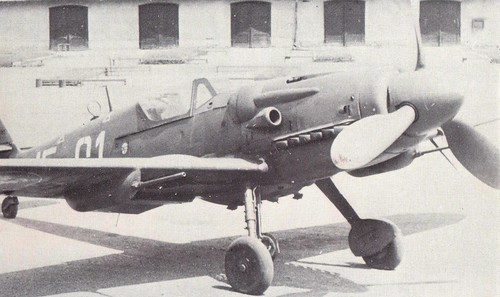
Bf109G (model) front end: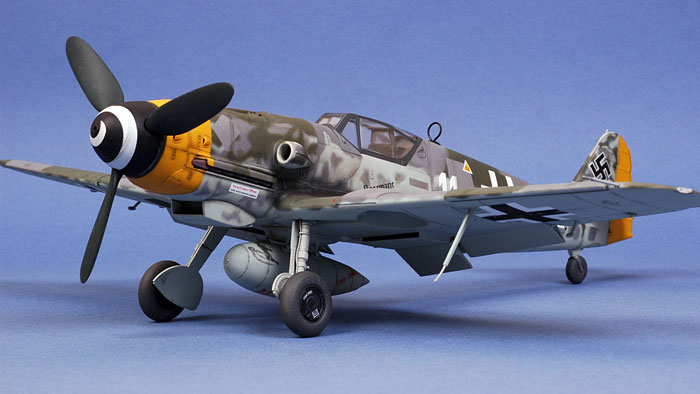
I’m puzzled as to why you say that the Jumo turns the opposite direction to the DB? :confused:
By: nuuumannn - 14th January 2013 at 16:01
A part of the nasty handling characteristics of the S-199 was that the Jumo turned in the opposite direction to the DB in the Bf 109. The Czechs actually assembled Bf 109Gs and Ks powered by DB605s and introduced them into service as the Avia C-10, later the S-99; when they got their Jumo powered Avias, the results were predictable. Another issue was that the landing speed of the S-199 was very high for the time; up to 200 km/h.
Another problem was that the propeller was rather large and the both the Bf 109 and the Avia had very small rudder area to counter any swing on take-off, which in the hands of a novice would cause the aircraft to go scooting off in the wrong direction. Apparently though, once airborne, the Avia was pleasant to fly according to one account I’ve read.
Structurally, the S-199 was beefier than the standard Bf 109 also, because the quality of materials used to built the aircraft was weaker, which resulted in a heavy airframe. Add to this the redesigned nose, which was less streamlined than that of the Bf 109, as well as other modifications, like the fin being ‘bulged’ to the port side in an attempt to counter swing on take-off and the Avia was aerodynamically ‘draggier’ than the Messerschmitt.
Israeli pilots did not like the narrow undercarriage and ground loops were common, apparently, there are also stories of the gun synchronisation system failing on the nose mounted guns, causing pilots to shoot off their own propellers – that mustn’t have endeared them to their pilots. The Israelis also commented on the type’s poor build quality, things broke too frequently.
By: Jon Petersen - 14th January 2013 at 15:15
Thanks for taking time to answer my question.
Your answer points to the same points as I have seen before, so it may not be possible to get closer to the finer points.
But still a 211 is lighter than a 601, and almost 200 kg lighter than a 605 – so that wooden propeller must have been really heavy.
Is the reason for the Jumos unsresponsiveness to be found in the fuel management system?
The underwing armament will not have helped the Avias agility at all, no.
Jon
By: ChernKStewfan - 14th January 2013 at 01:10
Someone with better knowledge on the subject would probably correct me or elaborate more on it, but the Jumo 211 was designed primarily as a “bomber” engine, used mostly for medium bombers and night fighters, where torque was of equal or more importance than top end power. Hence, as it was designed for larger, usually multi-engined aircraft, the 211 wasn’t well suited for a single seat fighter.
Also, it must be considered that the most powerful version of the 211 made 1350-1400 bhp, while the DB 605 made from 1450-2000+bhp. So the power loading figures were probably different and not in the favor of the S-199 with the Jumo engine, which lacked the power of the DB 605. The Jumo 213, which wasn’t much heavier than the 211 from which it was developed but capable of making far more power (more than that of most DB 605 variants) would’ve been a better choice, but it wasn’t in any supply, while the S-99 (Czech built Bf-109G with the 605) used up remaining stocks of the 605s still stockpiled in the former Czechoslovakia. And it wasn’t like what Hispano Avicon in Spain did with their license built Me-109s (which were fitted with Rolls-Royce Merlin 500 engines) or how Fiat got the G59, by fitting Merlin 600 engines in G55 airframes (the G55 used both German and Italian built DB 605s), because of Soviet domination of most of eastern Europe by that time. And, for whatever reason, the Czechs couldn’t get Klimov M-105 or VK-107 engines (much modified Russian built Hispano-Suiza 12Y-based engines, which Avia also built the 12Y in prewar years. Also, the M-105 in it’s most powerful form only made 1300-1360bhp, but it was much lighter than any of the German designed V12s). So the Jumo 211 was what they had to make do with.
Either way, the Me-109 airframe and Jumo 211 engine was a bad mismatch in terms of performance. And having to mount MG-151 cannons under the wings (since the Jumo 211 had no provision for an engine mounted cannon) added drag and weight, the latter now helping with the 109’s fairly high wing loading for the time in addition to the engine being seemingly underpowered and not suited for a single seat fighter.


 Sign In








 January 13, 2013 at 10:32 pm