G’Day folks,
Some may remember me – I’ve been away for a while, for reasons various, but I’m back, in part because there are a few questions I’ve been asked that I hope the Key Historic brains trust can help solve. However, they’re for later.
One of the main things I’ve been concentrating on is supporting help for the completion of the RAAF Museum’s Bristol Military Biplane (Boxkite to most!) by Project 2014 for the Museum. The replica has taken a huge amount of work by various generous and remarkable people, led by the redoubtable Group Captain Ron Gretton AM, RAAF (Retired) and Wing Commander Geoff Matthews RAAF (Retired) project manager and designer respectively.
Exciting times lie ahead; the replica was built to fly on the 1 March 2014 at RAAF Point Cook, Victoria, Australia on the 100th anniversary of the first flight of an Australian military aircraft, at Point Cook. The RAAF also noticed this anniversary, so they’re going to put on the annual main RAAF Airshow, this time at RAAF Point Cook – and it’s called the Centenary of Military Aviation, or ‘CMA14’ on the 1 & 2 March 2014. It’s going to be a big show for Australasia, with, promised, a full array of the current RAAF grey pointy things(TM) and a magnificent array of vintage machinery, much of it in action.
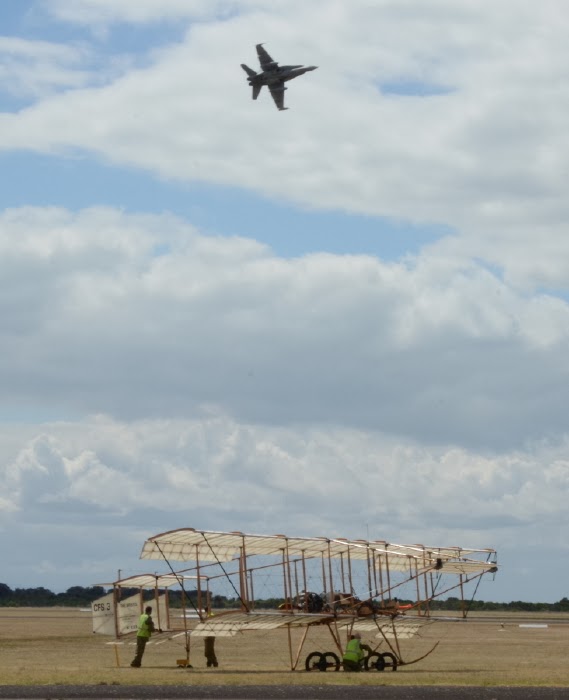
For the first time since about 1917, there will be replica examples of all three of Australia’s first military aircraft on show; the Boxkite, a Deperdussin and a B.E.2a. The BE and Dep are static exact replicas built by remarkably dedicated chaps, while the Boxkite is a flyer, and, fingers crossed, weather dependent etc, etc, we hope it will be flown on the day.
Anyway, that’s the bones of the saga, there’s more news and interesting items to share, but till they get posted, I’m more than happy to answer what questions I can – fire away!
Regards,

By: JDK - 7th March 2014 at 12:57

Two natty-dress chaps. Front is Lieutenant Eric Harrison, the pilot of the first flight of the Australian military Boxkite on 1 March 1914. Here he is in the original Boxkite CFS 3 with Brigadier General John Gordon on 5 March 1914. Gordon was the Chief of General Staff at the time, and one of several early VIP passengers to fly from the new ‘federal aviation station’ at Point Cook, as The Age called it. [RAAF Museum Archive image]
Regards,
By: JDK - 2nd March 2014 at 11:57
Yesterday, Saturday 1st March, at exactly 7.40 am (local) the replica Bristol Military Boxkite VH-XKT took off and flew at Point Cook, Victoria, Australia, exactly 100 years to the minute after the first flight of an Australian Military aircraft.
There has been a lot of hard work, by a lot of people to make this commemoration happen. I thank them for doing so.

The Boxkite project at the RAAF Museum had many genuinely interested visitors today, Sunday 2nd March, eminent among whom was Her Excellency the Honourable Ms Quentin Bryce AC, Governor-General of the Commonwealth of Australia. Seen here with Group Captain Ron Gretton AM RAAF (Ret’d) on the left, and Wing Commander Geoff Matthews, RAAF (Ret’d) the builders of this remarkable, airworthy replica of Australia’s first military aircraft.
Regards,
PS: Thanks Adrian, I’ll take a look at that soon.
By: Lazy8 - 28th February 2014 at 13:16
Going back to the question of why the engine was mounted t’other side of the propeller, the following early items in Flight may be interesting, showing:
That Farman did it too, and it was thought a bit odd even then.
http://www.flightglobal.com/pdfarchive/view/1909/1909%20-%200640.html
So odd that a letter was written about it, to which there wasn’t (to my mind anyway) a complete response.
http://www.flightglobal.com/pdfarchive/view/1909/1909%20-%200785.html
http://www.flightglobal.com/pdfarchive/view/1909/1909%20-%200786.html
Although the idea that it afforded easier access to the engine is interesting.
And finally, I found this piece about propellers interesting.
http://www.flightglobal.com/pdfarchive/view/1909/1909%20-%200021.html
I had worried about how narrow the hub looked on the 1908 photo, particularly since it had to have a hollow shaft run through it carrying the fuel/air/oil mixture for the engine. “Wood is finding favour … with many experimenters…” so was the original prop made of metal?
By: JDK - 28th February 2014 at 11:31
Hoping we get to fly the Boxkite 100 years on – tomorrow!

By: JDK - 27th February 2014 at 11:52
I’d just like to point out that one reason for being able to share all these Boxkite factoids is the book we’ve just produced. No big fuss, more details on the Boxkite builder’s project page: http://boxkite2014.org
For instance we found some great period ‘Boxkite Flying Hints’, which include gems like:
“Be very careful in turning corners not to turn too quickly, or the machine will turn over sideways.”
And another piece of perennially good advice:
“Always remember that it is not difficult to fly, you need ‘pluck’ and coolness, take plenty of time to do everything and do not overdo it. The personal danger is very small as long as you do the right thing at the right time.”
So please, remember your ‘pluck’ and ‘coolness’ today and everyday…
Regards,
By: JDK - 27th February 2014 at 02:34
Thanks chaps. Very creative, but I don’t think any are the answer (which we can only prove with actual evidence, but bright ideas help in looking)!
I don’t think engine shortages or compromises would be the reason (pre-W.W.I) for Bristol messing about with Gnomes. Because:

“Great Britain and the Colonies” Ah, those were the days…
By: bazv - 26th February 2014 at 21:17
Trouble is they made both ‘Tractor’ and ‘Pusher’ versions of basically the same engine…so we have seen photos of both types of installation !
Some of the potential reasons I can think of for the ‘ass about face’ tractor/pusher’ installation would be…
Shortage of ‘Pusher’ engines !
Large existing stock of ‘Tractor’ engines !
Wanting to standardise the ‘gyroscopic effect’ of the rotary engines,by having them turning same direction as (say) an avro 504!
Not sure if there would be a cooling effect from the prop because the engine is turning at same rpm as prop !
Or as Aeronut says…it would certainly keep the prop cleaner LOL
rgds baz
By: Arabella-Cox - 26th February 2014 at 15:01
My twopen’th on the prop in front of the engine debate.
Wouldn’t such a configuration keep the propellor out of the way of the majority of the contaminating oil / exhaust coming out of the engine.
By: JDK - 26th February 2014 at 12:46
This is a rather neat bit of woodwork.

And, while obviously a wing section, it’s also rather unusual as it is a foreplane, and as you’d expect in this thread, was the one built for the Boxkite.
One of the things that makes the Boxkite very unusual is the pitch control with this foreplane and an elevator, and the fact that, as well as the wings, it has a forward lifting surface (the controllable foreplane) and a (biplane) lifting-surface tail unit. Adds a little interest to lift calculations, I’m sure.
Regards,
By: JDK - 26th February 2014 at 01:19
You need a lot of bits to build a Boxkite. And there’s a lot of metal bits in a wood and fabric aircraft. This is some…

Interestingly, you could buy these ‘off the shelf’ in 1910, there were several retailers that would sell replacement parts up to a full Farman biplane. At what seem very reasonable prices today, but the phone doesn’t seem to be being answered in the 21st Century.
Regards,
By: JDK - 25th February 2014 at 11:09
We’ll see what we turn up Baz. I’ve hopes of flushing out more Boxkite data soon.

Meanwhile, messing around with old aeroplanes at dawn can have an upside. These kind of images may not be editors or rivetees favourites, but I like them. The RAAF Museum’s Boxkite replica in Jan 2014. Taxi tests.
By: bazv - 25th February 2014 at 06:57
Problem is we know how it was, we can theorise as to why, but it would be nice to know, which I think would require a contemporary document or account.
Absolutely agree James !
I was thinking along the lines of thrust forces/thrust bearings but with a rotary perhaps also the induction system for fuel/air mixture etc – but my knowledge of rotaries is err vague to say the least !
rgds baz
By: Buzzard Bait - 25th February 2014 at 01:18
Here’s the Shuttleworth Boxkite in July, 2002…[ATTACH=CONFIG]225833[/ATTACH]
By: JDK - 24th February 2014 at 23:44
That’s an interesting point Baz, I’ll discuss it with the guys today. Thanks!
Problem is we know how it was, we can theorise as to why, but it would be nice to know, which I think would require a contemporary document or account.
By: bazv - 24th February 2014 at 22:48
JDK;
The second thing to note is that the front of the aircraft is to the left, and thus the rotary is hanging off the BACK of the propeller – even more removed from the airframe than your standard tractor-type rotary. We’ve not found a reliable reference as to why it has this configuration, but an obvious possibility is that the slipstream is desired / required to cool the engine; something there would be far less of if the prop were aft of the metal. Anyone know better?
My very unreliable guess might be that the Gnome was built as a Tractor engine and mounting it as a tractor might avoid a redesign/modification to Pusher config…or of course it might be beneficial to be behind the prop ; )
By: JDK - 24th February 2014 at 12:25
Well one thing we now know is that the Boxkite Replica flies – this is a shot from one of the two circuits undertaken on 23 January 2014.

Until these flights, and the pictures we’re able to view, no-one has seen a full-span ‘military’ Boxkite in action for over 90 years. (Of course all credit to Shuttleworth who have been flying their ‘standard’ Boxkite replica for about a half-century, far, far more activity than any other Boxkite ever got near achieving.)
Fingers are very much crossed that weather will allow us to see the Boxkite in action at the Centenary of Military Aviation airshow on 1 & 2 March 2014; after all that’s a great part of what Project 2014 built the Boxkite for the RAAF Museum for.
And I hope to be able to share a bit more Boxkite ‘news’ in the next couple of days…
Regards,
By: JDK - 21st February 2014 at 12:38
Dawn…

By: JDK - 20th February 2014 at 12:11
My apologies, I’d overlooked looking it up. The wing area is correct – however there’s several places quoting stats on the replica, and I’m not sure where they’re from – I think they’re old projected, not actual. So I’d be wary of some items quoted, like weight. Speed is out (noted as projected by Rotec) as it’s been clocked at over 40 mph.
By: topspeed - 20th February 2014 at 11:58
So here’s a bit about Boxkite engines. Most original Boxkites were equipped with a seven-cylinder 8 litre 50 hp Gnome rotary.
Shuttleworth’s Boxkite has always had ‘flat’ engines, currently a Rolls Royce Continental of 100 hp. The apparent excess power of the replicas does not translate into whizz, but is a function of the different nature of engines and use then and now – but that’s another story…
Have you found the wing area yet ?
—
Edit; http://www.rotecradialengines.com/customers/Boxkite.htm
Ok here we go…10.86 kg/m2…about same as Solar Impulse…or 2 kilos more !
By: JDK - 20th February 2014 at 11:44
Time for a shot of the whole Boxkite replica.

This is one of my favourite photographs. After all the hoopla of the first flight, presentations and publicity, last September, and everyone’s heading off, Ron (left) and Geoff look back at a job well done. The sky and patch of sunlight are an illustrative bonus.


 Sign In








 February 17, 2014 at 11:23 am