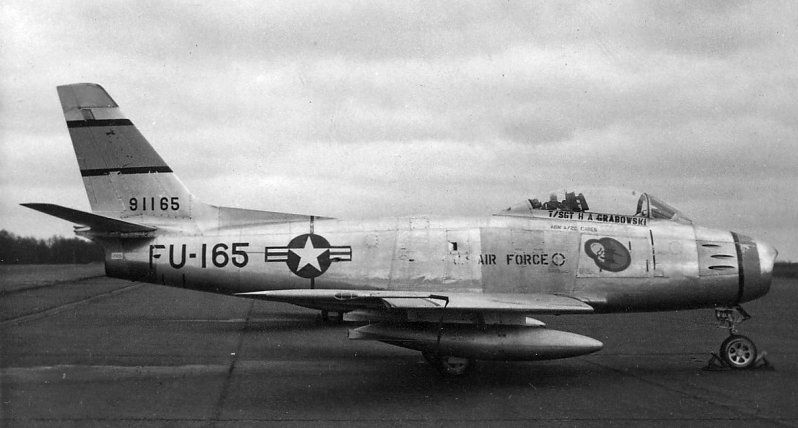
Reading the postings on the archaic canopy/ejection seat design for the Lightening really highlights the weaknesses of bad design in a system which should by any reasonable measure be absolutely totally fool proof in its operation when it is needed.
Sadly, the F86 Sabre also had a design flaw with the front edge of the canopy de-capitating pilots as it slide back on its rails during the ejection sequence.
The Canadians I believe created a fix for their Sabres by having the rails rise up to clear the pilots head whilst here in Australia our Avon Sabres had a large spring loaded bolt shatter the canopy first with the pilot then ejecting straight through the remains of the canopy.
Any other examples?

By: Dev One - 6th January 2016 at 08:16
Re TSR.2: without delving into various tomes to be absolutely certain, IIRC the resonance on the first flight was due to the early ‘not really cleared for flight’ development engines, nothing to do with the airframe, and was expected. What wasn’t expected was that the frequency would be exactly right – or wrong – so Bee Beamont couldn’t see.
The undercarriage problems, I think, were due to the 180° rotation required and took some solving but aircraft after XR219 had an extra link. As they never flew, who knows…
From memory & being in the middle of the book the sequencing problem seemed to have been sorted quite easily, but the vibration on touchdown was 90% cured by changing the angle of the fore/aft beam so that the front wheels touched down just ahead of the rears & thats what the link was doing. A rigid one was tried & there was then a telescopic one designed & fitted but not flown. Seems gyroscopic reaction of wheel spinup was the cause. Also mentioned once but not referred to again as being a possible cause, was that the steel material for the prototypes legs were not as specified because of lack of availability, so possibly more flexible?
Keith
By: dhfan - 5th January 2016 at 23:47
Re TSR.2: without delving into various tomes to be absolutely certain, IIRC the resonance on the first flight was due to the early ‘not really cleared for flight’ development engines, nothing to do with the airframe, and was expected. What wasn’t expected was that the frequency would be exactly right – or wrong – so Bee Beamont couldn’t see.
The undercarriage problems, I think, were due to the 180° rotation required and took some solving but aircraft after XR219 had an extra link. As they never flew, who knows…
By: Dev One - 5th January 2016 at 20:12
I follow a TSR-2 fan page on Facebook, and often see posts of an ‘if only…’ nature, usually with images of TSR-2s in fictitious camouflage finishes carving up the countryside at zero feet. From what I’ve read, it seems that the TSR-2 had such major issues with undercarriage sequencing that the first trial flights were flown with the gear extended, and that subsequent flights encountered other issues with the landing gear not locking into place correctly. I’ve also read that at certain throttle settings the pilot would be blinded as the aircraft was matching the resonant frequency of the human eye. The latter might have been an unforeseen phenomenon, but the former seems avoidable, which leads me to think that the undercarriage infrastructure on the TSR-2 was poorly designed. Were there other design issues with the TSR-2? On the fan pages the notion is always that a perfectly designed aircraft was killed off by meddling, and downright treasonous, civil servants. I imagine the truth is slightly less clear cut.
I’m reading Damien Burke’s story of the TSR2 Britains Lost Bomber, a very in depth history & a lot of problems I was not aware of even though I was part of the Weybridge Design Office team on the forward fuselage. I would suggest a read of this is essential in order to gather an overall respect for the project & the issues involved. (Sorry, but Tim Mclellands version of the story is lightweight in comparison.) It must also be remembered that it was responsible for shot gun weddings of existing aerospace companies (with all that entails) & the wrong choice of engine by the Ministries, as well as being the very first weapons system project where there were no previous examples for the civil servants (with all of the inertia that goes with them) to refer. Camo colours were not fictitious, they were researched & very possible examples drawn up after calculations of A Bomb flash temperature increase possibilities on the structure. Trouble is it always looks better in white!
Keith
By: Beermat - 5th January 2016 at 19:49
Ah, sorry. Paranoia?
By: J Boyle - 5th January 2016 at 19:22
Bit harsh, Mr. Boyle. Assuming you meant me….
Wrong assumption.
My comment was directed to people in general who are amazed that combat aircraft of three quarters or a half century ago don’t have the ” ‘ealth and safety” features you might find in an Airbus.
By their very nature, all aircraft contain compromises…warplanes even more so. Early jets were terribly dangerous as safety records of the period indicate.
I’m sure 50 years from know, students of aviation history will bemoan the crudeness and danger of the Eurofighter.
With cold war jets, it’s almost as if the new technology took combat aircraft flying back to the pre-WWI level of danger, the engineers and designers had to start over and learn a new set of rules and limitations.
By: Beermat - 5th January 2016 at 18:28
Bit harsh, Mr. Boyle. Assuming you meant me, what do you have to counter my polystyrene-cement-fume-addled answer to the OP’s question?
The ‘state of the art’ was beyond this particular issue, based on the work of Muttray, Ower and others and published from 1928 onwards, and which one doesn’t necessarily have to have built anything to have read.
By: Arabella-Cox - 5th January 2016 at 18:15
Did not the Russian VTOL fighters (Yak 36/38) have automatic ejection seats fitted ? I remember watching a short film sequence of a 38 rolling off the bow of a carrier, the system initiating and depositing the pilot back on deck – and he didn’t even get his shoes wet,
Yes the Yak-38 did have a seat that would fire automatically when the attitude or roll/pitch/yaw rates exceeded certain parameters, or one of the lift jets failed- it saved a few lives I recall.
By: J Boyle - 5th January 2016 at 18:06
I’m currently reading a Christmas gift, German Fighter Since 1915, by Rudiger Kosin, a Putnam publication of a German language book.
The author, a wartime aeronautic engineer for a couple of firms, is very critical of Luftwaffe types, even printing extracts from official test reports.
He doesn’t have much good to say about the flying qualities of the Bf-109, and engineering issues with other types such as the BMW engine in early Fw-190s.
But, being a war on, they had to make do. The “state of the art” was primitive as might be expected coming only about 35 years after the Wright Brothers.
Something that should be remembered by posters who have never built anything other than an Airfix kit.
By: Meddle - 5th January 2016 at 17:48
I follow a TSR-2 fan page on Facebook, and often see posts of an ‘if only…’ nature, usually with images of TSR-2s in fictitious camouflage finishes carving up the countryside at zero feet. From what I’ve read, it seems that the TSR-2 had such major issues with undercarriage sequencing that the first trial flights were flown with the gear extended, and that subsequent flights encountered other issues with the landing gear not locking into place correctly. I’ve also read that at certain throttle settings the pilot would be blinded as the aircraft was matching the resonant frequency of the human eye. The latter might have been an unforeseen phenomenon, but the former seems avoidable, which leads me to think that the undercarriage infrastructure on the TSR-2 was poorly designed. Were there other design issues with the TSR-2? On the fan pages the notion is always that a perfectly designed aircraft was killed off by meddling, and downright treasonous, civil servants. I imagine the truth is slightly less clear cut.
By: 91Regal - 5th January 2016 at 01:21
Did not the Russian VTOL fighters (Yak 36/38) have automatic ejection seats fitted ? I remember watching a short film sequence of a 38 rolling off the bow of a carrier, the system initiating and depositing the pilot back on deck – and he didn’t even get his shoes wet,
By: skyskooter - 4th January 2016 at 21:50
True, but I was a schoolboy. Is it not conceivable that a computerised inertial sensor continuously monitoring airspeed, flight attitude and altitude could be programmed according to set parameters to fire the ejection seat up or down in order to give the pilot the best chance of survival.
I was moved at the time by the death of Iven Kincheloe flying a prototype F 104 which flamed out soon after take off. It was equipped with a downward ejection seat but he was at low altitude. He attempted to half roll the aircraft before firing the seat but did not quite make it.
I concede you are right about the complexity of such a seat however.
By: Beermat - 4th January 2016 at 21:15
P-38. Terrible double-convex shape at the aft end of the fuselage pod, terminating at the wing trailing edge and holding the aircraft back with oodles of ‘interference’ drag (itself a misnomer). Kelly Johnson and team had a massive blindspot over this aerodynamic gaffe – even Teddy Petter wrote to Lockheed to explain the problem, but it was ignored. 50% more power only yielded 5% more speed throughout the aircraft’s development, and it needed planks under the wings to stop this horrible shape from pitching the Lightning uncontrollably downwards and fairings to increase pressures over the central part of the wing junction to stop the thing shaking itself apart in dives. The problem was quietly dealt with in the ‘Chain Lightning’ and Swordfish development aircraft, thanks to work by NACA Langley to establish the error beyond doubt using full size aircraft and amending the shape in a wind tunnel.
By: skyskooter - 4th January 2016 at 20:11
When I was a boy doodling in my school exercise book by designing jet planes it suddenly occurred to me why don’t they fit an upward/downward ejection seat with the option of being fired either by the pilot or automatically according to the speed, attitude and altitude of the aircraft.
By: Duggy - 4th January 2016 at 18:43
Northrop XFT-1/XFT-2
XFT-2: While back at the Northrop Aircraft plant in El Segundo, a 650-hp Pratt & Whitney R-1535-72 double-row radial engine was installed in a modified cowling. The fuel capacity was reduced from 120 US gallons (454 liters) to 80 gallons (303 liters) to offset the heavier engine weight. Modifications were also made to the shape of the vertical tail surfaces to increase the area of the fin and rudder to improve the aircraft’s handling. In this form, the aircraft was designated XFT-2 and was delivered to NAS Anacostia in April 1936.
During Service tests, the XFT-2 was found to have only slightly improved performance, but the troublesome spin problems continued to plague it. In July 1936, the XFT-2 having failed to satisfy the Navy, was ordered back to the factory at El Segundo, California. Plans were made to ship the aircraft back to El Segundo, California, but test pilot Mosher ignored his instructions and took off for California. On 21 July 1936 during the ferry flight to California, turbulence was encountered over the Allegheny Mountains and the aircraft went into a spin and crashed near Altoona, Pennsylvania. The contract was subsequently closed out.
More info here – http://www.axis-and-allies-paintworks.com/e107_plugins/forum/forum_viewtopic.php?13000
By: Sabrejet - 4th January 2016 at 17:39
Re the earlier comment about F86 Sabre canopies.
I photographed this rather battered (look at the wrinkling of the fuselage and the iffy paint job) USAF Manston-Based F86F of USAF 406th FIW at Biggin Hill during the 1955 Royal Observer Corps “Recognition Day”. The canopy looks fairly conventional and if opened at speed during the ejection sequence I would assume the slip-stream would lift it well clear of the pilot’s head.
Rather puzzling is the absence of the red “Ejection Seat” triangle alongside the cockpit. Did perhaps the USAF adopt the red warning triangle later? R.A.F. Meteors I photographed at the same time (1955) quite clearly display the red triangle.
Just noticed this: it’s not a Manston-based F-86F but a 92nd FBS F-86A from Shepherds Grove. Nice shot though!
PS – no ejection triangles prior to circa mid-60s.
By: gabby - 4th January 2016 at 10:37
Re the earlier comment about F86 Sabre canopies.
I photographed this rather battered (look at the wrinkling of the fuselage and the iffy paint job) USAF Manston-Based F86F of USAF 406th FIW at Biggin Hill during the 1955 Royal Observer Corps “Recognition Day”. The canopy looks fairly conventional and if opened at speed during the ejection sequence I would assume the slip-stream would lift it well clear of the pilot’s head.
Rather puzzling is the absence of the red “Ejection Seat” triangle alongside the cockpit. Did perhaps the USAF adopt the red warning triangle later? R.A.F. Meteors I photographed at the same time (1955) quite clearly display the red triangle.
The T33 seat was also poor. Aircrew needed to be measured to see whether it was safe for them to wear a back parachute in the front seat. If their femur was too long, the instrument panel would remove their kneecap if they had to eject! So they were told to wear a seat chute instead.
Extreme disorientation due to tumbling of the seat post ejection caused many aircrew to fail to separate from their seat in early USAF designs such as the T33 and F84 series, since no MB style stabilisation drogues were fitted .
By: Stepwilk - 6th September 2012 at 17:55
We need to get the “two-holer outhouse” adopted as the standard unit of measurement of external size of fuel tanks!
The image occurred to me because the bladder is much taller than it is wide, since the Skyraider is such a huge airplane; the entire cockpit is essentially on the “upper floor,” and the bladder extends from the basement to the roof…
By: baj - 6th September 2012 at 13:09
And here’s another famous tragedy……. due in part to the bad design of the manual release handle of the Scimitar canopy.
http://http://www.youtube.com/watch?v=Qg0Jj-2x5rM
.
By: baj - 5th September 2012 at 09:19
Re the earlier comment about F86 Sabre canopies.
I photographed this rather battered (look at the wrinkling of the fuselage and the iffy paint job) USAF Manston-Based F86F of USAF 406th FIW at Biggin Hill during the 1955 Royal Observer Corps “Recognition Day”. The canopy looks fairly conventional and if opened at speed during the ejection sequence I would assume the slip-stream would lift it well clear of the pilot’s head.
Rather puzzling is the absence of the red “Ejection Seat” triangle alongside the cockpit. Did perhaps the USAF adopt the red warning triangle later? R.A.F. Meteors I photographed at the same time (1955) quite clearly display the red triangle.
The front rim of the canopy as it slide back would take off the pilots head from the eyebrows up…….shorter vertically challenged pilots were generally OK……..the RAAF lost 3 pilots to this design flaw before the bolt through the canopy was quickly introduced
By: Bager1968 - 5th September 2012 at 07:28
Re the earlier comment about F86 Sabre canopies.
I photographed this rather battered (look at the wrinkling of the fuselage and the iffy paint job) USAF Manston-Based F86F of USAF 406th FIW at Biggin Hill during the 1955 Royal Observer Corps “Recognition Day”. The canopy looks fairly conventional and if opened at speed during the ejection sequence I would assume the slip-stream would lift it well clear of the pilot’s head.
Rather puzzling is the absence of the red “Ejection Seat” triangle alongside the cockpit. Did perhaps the USAF adopt the red warning triangle later? R.A.F. Meteors I photographed at the same time (1955) quite clearly display the red triangle.
The F-86 canopy was basically a WW2 design… it wasn’t rear-hinged like modern bubbles, it slid directly aft like the canopy on a P-51 or Sea Fury.
Therefore, the wind did not catch hold and help it clear away, as the leading edge was inside the “wind shadow” of the front windscreen. If it wasn’t slid back far enough the pilot hit it. To make matters worse, the pilot had to manually eject the canopy before activating the ejection seat. Having two perform separate actions slowed the ejection process, further increasing the likelihood of incorrect ejection.
There is a really good pic here that illustrates this: http://acepilots.com/planes/f86_sabre.html but it won’t allow direct linking, so here is another:

http://www.airplane-pictures.net/images/uploaded-images/2008-2/29/11299.jpg


 Sign In








 September 1, 2012 at 9:59 am