Something I have thought about over the last few years !!! having seen the BBMF Dakota fly past at several venues on several occasions …. I have seen, along with millions of others, the crew member standing at the ‘seemingly open’ door, waving and pleasing the enthralled audience !
My question is …. is it an ‘open door’ or is it a cutaway section within the framework of the original door ? with a perspex, plexiglass, whatever, cover ??? I seem to think that I have a photo of that crew member with the waving hand outside of the boundaries of the door ? but as yet I cannot find it !!!! So to the present time …. ZA947 arrived at Norwich this weekend, for the attentions of ‘Air Livery’ giving me the opportunity to collect some photos of ‘that’ door …… So a couple of the landing … clearly showing the ‘open’ door …
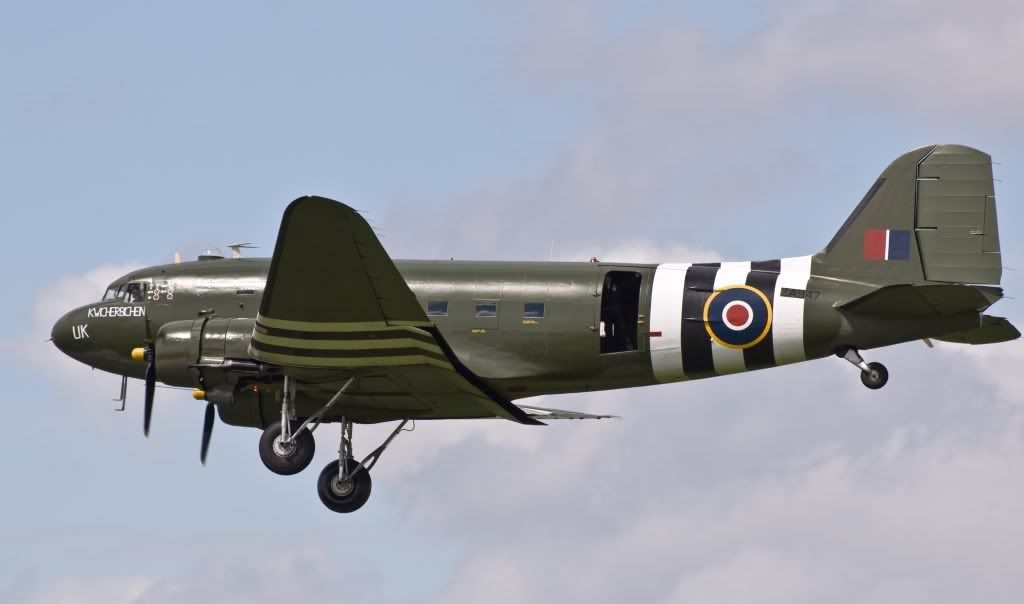
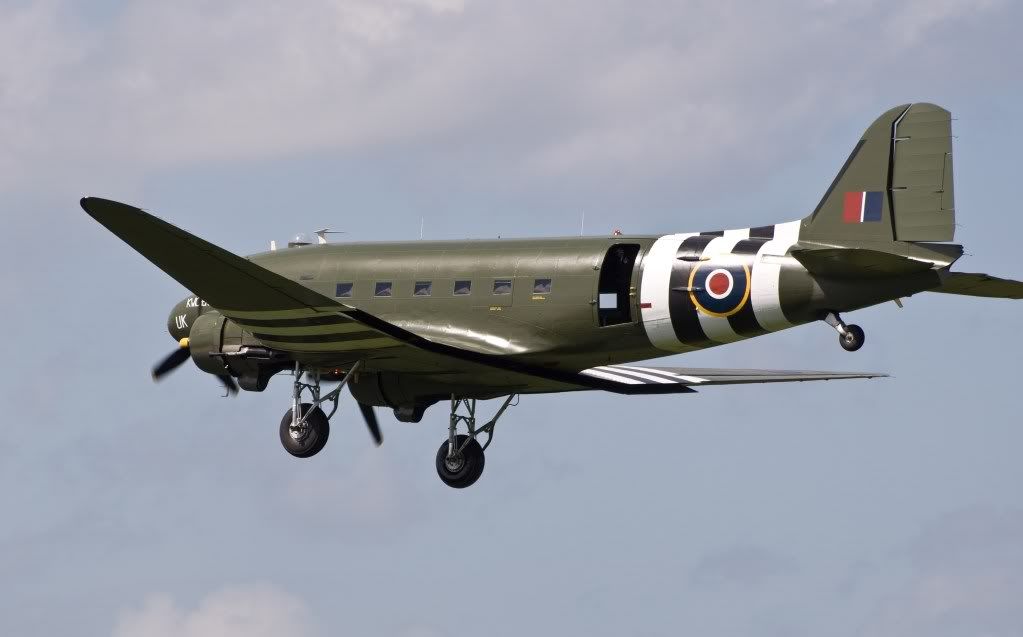
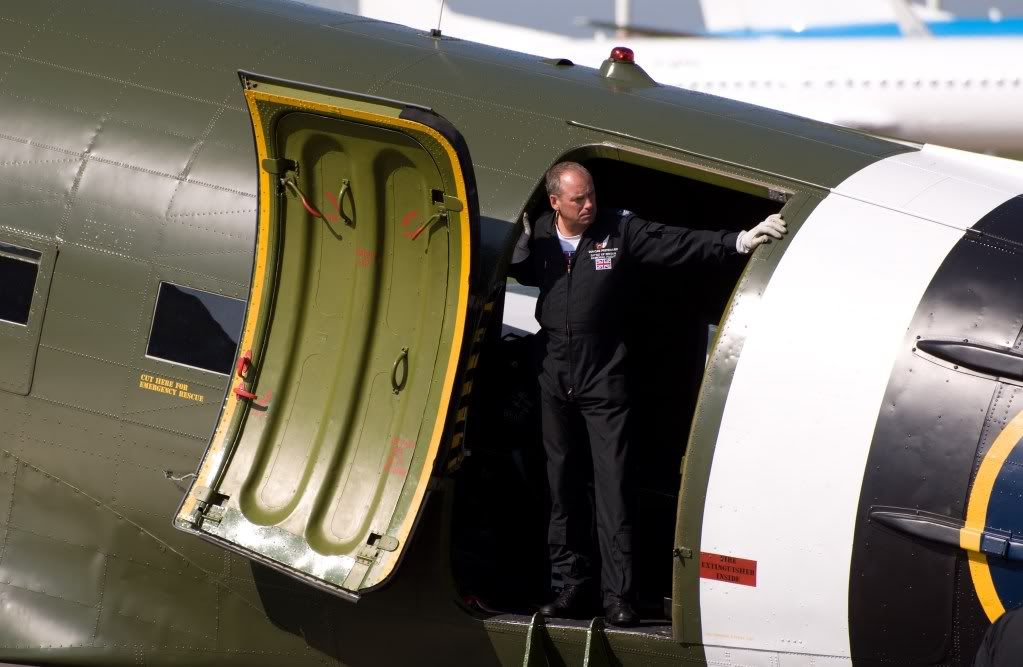
And a close up of the inside of ‘that door’ with what looks like a removeable section ?? thanks to Sgt. Duncan Pritchard …. LM on his badge … ‘Load Master’ ??

By: pagen01 - 30th July 2011 at 09:53
You are misunderstanding what I’m getting at. It was certainly NOT normal – but equally, there seems to be some secondary evidence that removing all the doors for paradrops is not unknown…
Yes I was, apollogies:o
I have just reread your post and I can now see what you mean.
Just to reiterate what I said way back at post #15,
The C-47 Skytrain and Dakota has two large cargo doors, both the forward and aft doors hinge outwards and both are removable on the ground for loading larger freight and can be left removed for air dropping – though that seems quite rare.
The forward cargo door has within it a smaller removable door panel (you can see the grab handles in KN pics) which during flight can be unlatched, lifted upwards and inwards, and stowed out of the way for paratroop drops.
So I’m aware of the flexibility in the door arrangement, and have always stressed that I think that the normal (ie not absolutely exclusively) paratroop exit procedure is simply the removal of that inset door panel* – it was probably that post that resulted in the posting of that dodgy skydiving pic!
Thanks to JB for posting the extract above, that and Aeronut & Oscar Ducks posts confirm the opertaing proceedures nicely.
I’m also mindfull that whenever aircraft, Air forces, Army and troops come together there can be all sorts of non standard approaches conjured up to get on with the task at hand!:eek:
*Oxford English Dictionary definition of door, ‘a hinged, sliding, or revolving barrier at the entrance to a building, room, or vehicle, or in the framework of a cupboard.’
More correctly I’m thinking that the C-47 has a removable panel as opposed to door.
By: J Boyle - 30th July 2011 at 04:48
To quote my father’s copy of the C-47 Technical Order
(T.O. 1C-47-1, 1 March 1957).
Section IV
Description and Operation of Auxiliary Equipment.
Troop Carrying Equipment
Parachute Exit Panel
On some aircraft, the inside panel of the forward half of the main cargo door is removable inward by turning the handles near the top of the door and lifting it out.
This is used as the exit for parachute troops.
Four hooks and bungee rings installed on the right side of the fuselage, opposite the main cargo handling door, are provided for stowing the panel while using the exit.
Emphasis added.
And some have questioned about bail-out procedures…
Section III
Emergency Procedures
Bail-out Procedures (abridged)
Primary exit will be through the main cargo forward door, which can be jettisoned from the aircraft.
Under the checklist for the navigator it reads…
3. Kick down on the yellow emergency release latch ast the main cargo door forward end and push the door from the aircraft.
Hopefully,this should clear things up…
By: JDK - 30th July 2011 at 02:15
You do say that it was ‘normal for paratrooping’ to have both doors removed, I personally don’t agree with that.
You are misunderstanding what I’m getting at. It was certainly NOT normal – but equally, there seems to be some secondary evidence that removing all the doors for paradrops is not unknown. I’m interested in tracking down further information proving (or not) the latter, because it’s a) unusual and b) not covered with primary data here, yet. But that does not mean (nor am I seeking to show) that it was ‘normal’. It was not.
The trim tab is evident on the starboard aileron of the skydiving Dak, the quality of the image isn’t worth arguing that it ‘proves’ any thing, and as I said as it was posted, it is irrelevant to proving whether both doors were ever removed for W.W.II paradrop operations. It is a complete distraction, real or not, as it’s well known that both doors could be and were removed for other operations (As Oscar’s said) and later.
Regards,
By: Creaking Door - 29th July 2011 at 17:18
Having spent several years as a ‘Boffin’ testing parachute systems people like that were the bane of my life. I’d spend months working on a system making sure it was safe for the aircraft and all persons involved only for the aircrew or army despatchers to revert to type and try and use the procedures from the old systems (usually dating back to WW2).
I can understand your frustration; maybe this inexperienced pilot was one of the few exceptions in the hundreds of pilots that took part in the D-Day drops.
CD it may seem improbable to you, but it was the most common (& recommended) way that it was operated for para dropping and was suitable for task, the door maybe smaller than the orifice left when the cargo door is removed but it was still big enough for the job. The exit wouldn’t have existed if it was deemed as unsuitable.
I take your point; why have the door if it wasn’t satisfactory? The book I quoted from (the only book I’ve read about large paratroop operations) goes to great length to stress how loaded the troops were and how difficult is was for them to move; I guess that could have been emphasised for effect but I quoted the door removal account because it was a first hand account and it proves that it was done on D-Day. There are only two mentions of doors in the book; one on, one off so it is hardly an indicative sample!
By: Resmoroh - 29th July 2011 at 14:45
Aeronut 2008 (re post #59),
Looks like you and I were at opposite ends of the same problem at (roughly?) the same time? You had to get the Grunts/Stores out of the a/c in a safe fashion. Having done that (and assuming the Drivers, Airframe, got the a/c into the right place (in 3 dimensions) and the Nav put the “Green On” quickly, and the PJI ‘Bouncer’ got the Grunts out quickly) then my lot took over to get the blokes/loads from the a/c to the right place on the ground! Many interesting drops in that period!!
HTH
Resmoroh
By: FarlamAirframes - 29th July 2011 at 13:32
Dilemma over – I think this may be the missing door…..
By: pagen01 - 29th July 2011 at 13:20
CD it may seem improbable to you, but it was the most common (& recommended) way that it was operated for para dropping and was suitable for task, the door maybe smaller than the orifice left when the cargo door is removed but it was still big enough for the job. The exit wouldn’t have existed if it was deemed as unsuitable.
Many images even show the main cargo doors and their hinges heavily covered in tape etc to help avoid snagging when leaving the dedicated para exit.
This image shows the norm for paratroop and smaller para supply drops
By: Arabella-Cox - 29th July 2011 at 13:17
[HTML]case the pilot of one C-47 at least was astute enough to appreciate that the paratroops may wish to have the option of a quick exit so offered to remove the door(s).[/HTML]
Having spent several years as a ‘Boffin’ testing parachute systems people like that were the bane of my life. I’d spend months working on a system making sure it was safe for the aircraft and all persons involved only for the aircrew or army despatchers to revert to type and try and use the procedures from the old systems (usually dating back to WW2). The real joke was that these ‘procedures’ had been put in place to stop them from screwing up the drop in the first place.
By: Creaking Door - 29th July 2011 at 13:04
Just to clear up what I thought:
It seems improbable (to me) that fully-equipped paratroops would be able to exit quickly through the smaller in-flight (inwardly) removable door but it seems from this account (‘Band of Brothers’) that some aircraft operated that way on D-Day.
By: pagen01 - 29th July 2011 at 12:55
I perhaps picked on your points in an over zealous way CD, but your post as it reads to me suggests that the door opens (like a normal door) and gets in the way of normal paratroop exit (which you actualy say you think is improbable!) – it doesn’t and that is why it is an inset removable in flight for purpose paradrop door.
By: Creaking Door - 29th July 2011 at 12:54
Considering that the leg bag was designed so that a paratrooper could use it jumping from a Halifax and Whitley floor exit the doorway of a Dakota would not be a hinderence.
I didn’t know that the leg-bag was designed for use with Whitley and Halifax floor-exits but that makes it sound less cumbersome than it sounds from the accounts in ‘Band of Brothers’. In that account the American paratroops think that the leg-bag is a very good idea but then were extremely critical of it (see below).
Although paratroops needed to deploy fairly rapidly it had also had to be conducted in an orderly fashion from a safety point of view, just the normal para door being removed ensures good control of this, aswel as being a reasonable distance from the tail, ie it ensured nicely controlled para exiting from the aircraft with the maximum safety margins. I would also think (but don’t know) that having either of or especially both of the larger door sections removed would cause buffeting inside the aft fuselage, uncomfortable on longer flights, but more importantly not condusive to clean drops and allowing the risk of people/items falling nearer the tail than desirable.
One thing is apparent that the actual parachute drops on D-Day, although being probably the most planned during WW2, didn’t go at all according to plan. Certainly the accounts from the above book describe aircraft dropping troops from a wide range of altitudes and at far greater speeds than were planned. Many paratroops had the leg-bags torn from them and as a consequence lost much of their kit, including their weapons! The overall experience seems to be of aircraft manoeuvring at all sorts of attitudes under intense ground-fire and the paratroops being eager to exit the aircraft as soon and as quickly as possible. The C-47 crews were completely without combat experience but even that being the case the pilot of one C-47 at least was astute enough to appreciate that the paratroops may wish to have the option of a quick exit so offered to remove the door(s).
I am not disputing what you say when it comes to the design of the doors or how they were planned to be used in ideal circumstances but in actual combat situations troops nearly always use equipment outside the parameters for which it was designed.
By: Creaking Door - 29th July 2011 at 11:54
CD please re-read the thread again, I went at pains to differentiate and point out that the only door that is removeable in flight is the small inset one in the fwd cargo door, it is completely removeable, and stowed out of the way, and not inward opening so as not to foul the path of the exiting paratroopers.
I’m not sure where you think my post contradicts your earlier post? At no point have I mentioned an inwardly opening door. :confused:
I was joking about the camouflage. It seems to me that replacement ailerons were fitted to this aircraft at some time that do not match the aircraft but coincidentally match the background very well in this photograph. The overall appearance of this aircraft doesn’t seem to be that important to the user since the US national markings can be seen crudely painted-out. Just my guess.
By: oscar duck - 29th July 2011 at 10:13
Quite normal to remove the para door in flight. Also you can take whole door off [on the ground] and fly. Depends on what was being dropped. The AC-47 doors are not “open” but rather removed says I who operated three Daks in a past life. When doing fodder drops during flood work we removed the front door completely and aft door on occasions to facilitate dropping and quick turnarounds on loading.
By: pagen01 - 29th July 2011 at 09:44
You do say that it was ‘normal for paratrooping’ to have both doors removed, I personally don’t agree with that. It is of course possible, and in some cases desirable (ie large load dropping) to have both cargo doors removed for flight, but I have seen very few images of C-47s/Dakotas in that condition during normal service flight.
In fact many of the images I can find of the main doors being removed was for other reasons ie gun mounting (Spookys’) and Speaker mounting (phsych warfare) etc.
Aeronut raises an issue that I was going to mention and that is the control of paratroop drops. Although paratroops needed to deploy fairly rapidly it had also had to be conducted in an orderly fashion from a safety point of view, just the normal para door being removed ensures good control of this, aswel as being a reasonable distance from the tail, ie it ensured nicely controlled para exiting from the aircraft with the maximum safety margins.
I would also think (but don’t know) that having either of or especially both of the larger door sections removed would cause buffeting inside the aft fuselage, uncomfortable on longer flights, but more importantly not condusive to clean drops and allowing the risk of people/items falling nearer the tail than desirable.
If it was as straight forward as just leaving off the fwd cargo door for normal para drops then I would think that the the inset door would have been deleted, or even not devised in the first place.
I’m not entirely devoid of humor, I’m sorry but unless there is something wrong with my computor that image isn’t what it purports to be to my mind no matter how bad the printing reproduction is, even what appear to be ghost impressions of the aileron trailing edges are wrong as they are parallel with the aileron leading edges, which of course the Dak dosen’t feature.
By: JDK - 29th July 2011 at 09:19
I can’t really concur with JDK that both doors (am assuming fwd & aft cargo doors?) being removed was that common,
I’m not suggesting it was common – quite the opposite. But it appears not unknown.
CD & J.Boyle, either I’m missing your humour or that would be highly effective camoflage as the ailerons match exactly the detail in the backgorund! Why would you just camouflage the ailerons anyway?
Camouflage was a joke, the ailerons are there, it’s just an artefact of the low quality newsprint.
By: Arabella-Cox - 29th July 2011 at 08:51
[HTML]It seems improbable that fully-equipped paratroops would be able to exit quickly through the smaller in-flight (inwardly) removable door especially when wearing the British-designed ‘leg-bags’ containing much of their equipment (and weapons) but it seems from this account that it happened on D-Day.
[/HTML]
Considering that the leg bag was designed so that a paratrooper could use it jumping from a Halifax and Whitley floor exit the doorway of a Dakota would not be a hinderence. The despatch cadance of paratroops is important, too slow and the troops are thin on the ground, too fast and the paratroops could collide and become entangled, which considering the UK didn’t use reserve parachutes until 1956, could prove fatal.
I’ve checked my AFEE reports and for paratrooping it was only ever the removable panel in the door that was approved to be used as an exit. Supply dropping may be another matter but even here when the roller floor was used it was again just the removable panel that was used as a despatch exit.
By: pagen01 - 29th July 2011 at 08:36
It seems improbable that fully-equipped paratroops would be able to exit quickly through the smaller in-flight (inwardly) removable door especially when wearing the British-designed ‘leg-bags’ containing much of their equipment (and weapons) but it seems from this account that it happened on D-Day.
CD please re-read the thread again, I went at pains to differentiate and point out that the only door that is removeable in flight is the small inset one in the fwd cargo door, it is completely removeable, and stowed out of the way, and not inward opening so as not to foul the path of the exiting paratroopers.
In photographs this does seem to be the most common approach to para dropping.
I can’t really concur with JDK that both doors (am assuming fwd & aft cargo doors?) being removed was that common, certainly from all the pictures that I have seen.
CD & J.Boyle, either I’m missing your humour or that would be highly effective camoflage as the ailerons match exactly the detail in the backgorund! Why would you just camoflage the ailerons anyway?
By: J Boyle - 29th July 2011 at 04:14
Something a bit odd about that pic (besides way too many people hanging on to it!:eek:), like both of the ailerons appear to be missing!:confused:
The ailerons are fabric colvered, probably painted silver, so they’re duller than the bare metal structure.
By: Creaking Door - 29th July 2011 at 01:59
I rechecked the account in ‘Band of Brothers’ and:
The pilot gave the paratroopers a choice; they could ride with the door off, giving them fresh air and a chance to get out if the plane was hit, or ride with the door in place, which would allow them to smoke. They chose to take the door off…
I’m not sure which door, or doors, were removed but on another aircraft (whilst in flight):
The crew chief removed the door…
It seems improbable that fully-equipped paratroops would be able to exit quickly through the smaller in-flight (inwardly) removable door especially when wearing the British-designed ‘leg-bags’ containing much of their equipment (and weapons) but it seems from this account that it happened on D-Day.
By: JDK - 29th July 2011 at 01:22
My point was only that there’s no news in Daks flying with both doors removed; but an earlier discussion was whether it was common – and on what basis – it was normal to fly with both doors removed for paratrooping in W.W.II.
It’s an interesting picture, certainly! (Just of a more than slightly worrying practice…)


 Sign In








 July 25, 2011 at 10:49 pm