Hi folks,
One of those irritating little questions has come up. When an aircraft’s props hit the ground (or water) which way will they bend? We expect to see them bent aft, but apparently when hitting water at speed, it’s common for them to be bent forward. Anyone got chapter & verse on this?
Cheers

By: Dave Homewood - 30th April 2006 at 21:48
Dave,
Sorry to go off-topic but having flown up front in Consul G-AIKR during its time with the Rapid Flying Group at Baginton UK, I was delighted to see it’s still safe as depicted in the background to your shot. I became reacquainted with it only a few years ago when I photographed it in store at Ottawa. I’ve looked at the Wigram link from your own excellent website but what progress can you report on its restoration to Oxford status – the Wigram site only illustrates the wing centre-section?
Regards
Tim
Hi Tim,
The Consul is undergoing a major restoration, estimated to be about ten years in length (and is about 2 years into that) to restore it to Oxford status. It belongs to a Canadian museum but is on long term loan to the RNZAF Museum at Wigram. The restorers are doing a really stunning job, in what looks to be a painstaking restoration. The main woodworker chap, Brian, was saying it’s a big job because so much was changed when it was converted to a Consul and now they’re changing it back, but trying not to destroy too much original material. They’re combining the Consul with the remains of at least one RNZAF Oxford to get the result of a complete Oxbox.
You can see some more photos of it on my forum here:
http://rnzaf.proboards43.com/index.cgi?board=Airshows&action=display&thread=1145936302
By: Arabella-Cox - 30th April 2006 at 21:08
Tony King sent me this photo of a Hastings TG52? I reproduce it with his kind permission The Hastings was flying from Cyprus very low over the Med, there was a glassy sea, the pilot decided to see how low he could go, he got more than he bargained for.
# 2 and 3 inboard prop tips touched the water and peeled them back, immediately both engines were shut down and the props feathered, the pilot made an emergency landing at Akrotiri.
The Sunderlands we worked on received a lot of prop damage from water, I was a young erk at the time aged 18 and one of those jobs was to ‘feather file’ the chips out of the tips of the leading edges of the blades
By: Camlobe - 30th April 2006 at 14:26
Wish I knew how to attach pictures. The fixed-pitch-two bladed prop from my aircraft has one blade bent forward and one bent backward!!!
Dave Burke and Stuart gowans, you are both correct. If the engine is producing power when the propeller comes in contact with less resisting media such as water or boggy terrain, they tend to pull the tips forward in relation to the propeller arc. Hard terrain tends to bend the blades rearward due to the stopping of the propeller, then dragging the blades.
Not too well described but hope you get the idea.
By: italian harvard - 30th April 2006 at 13:40
it probably depends on when the prop itself stops spinning..
If the prop hits the ground while the plane is advancing they will surely bend backwards, but if the plane impacts a surface like water, which of course is less dense than ground and allows the props to spin even when the plane finally comes to a stop, it is plausible that they may bend forward. But I guess this is only possible in water..Unless u r taxiing backwards (pilatus anyone?) and yr landing gears collapse :rolleyes:
By: stuart gowans - 30th April 2006 at 13:25
The blades are still working when they touch the water, unless they are feathered, simply put they are pulling at the air in flight and continue to do so as they enter the water,it being denser than air, exerts a greater force on the blade than it can take resulting in the bend; the ground on the other hand isn’t just dense its plain hard! the blade reaches its critical point almost instantly, it has no chance to pull or claw at the ground and is forced back ,although marshy land by definition falls somewhere between the two ,and the wetter it is the more likely that the blade will get purchase on contact and bend forward. (of course I could be wrong!)
By: Consul - 30th April 2006 at 13:25
Dave,
Sorry to go off-topic but having flown up front in Consul G-AIKR during its time with the Rapid Flying Group at Baginton UK, I was delighted to see it’s still safe as depicted in the background to your shot. I became reacquainted with it only a few years ago when I photographed it in store at Ottawa. I’ve looked at the Wigram link from your own excellent website but what progress can you report on its restoration to Oxford status – the Wigram site only illustrates the wing centre-section?
Regards
Tim
By: Dave Homewood - 30th April 2006 at 13:03
James, I photographed this the other week at Wigram. Though it wasn’t signposted and I didn’t ask, I am certain thi is the engine from a crashed Hudson that was pulled from the Tasman Sea last year. The aircraft struck the water and disappeared.
You can see the direction the props have bent on it.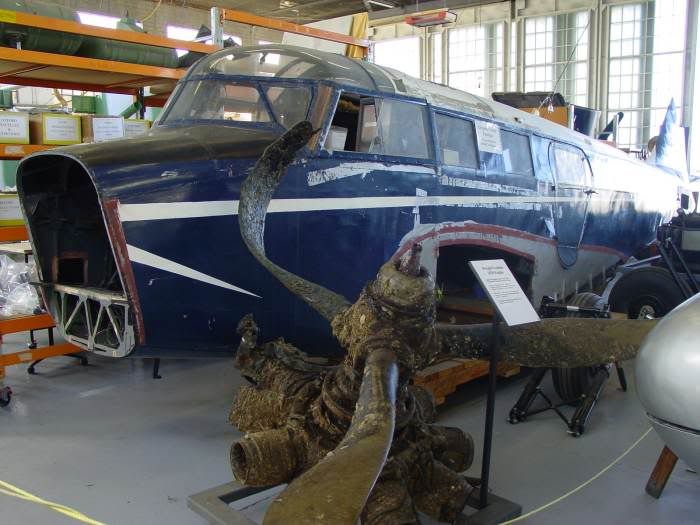
By: DCK - 30th April 2006 at 12:56
Marius Eriksen of 332 Squadron during WW2 took off from North Weald once and retracted his undercarriage a bit too fast…the props barely touched the ground and they were bent forward, not backwards. They didnt see it until he came back from his sortie.
Very lucky chap.
By: bazv - 30th April 2006 at 12:52
May be one of those questions without a simple answer
Some of the variables might be….
Airspeed,Groundspeed(or waterspeed?),prop RPM(if any)
Angle of entry of prop or aircraft.
Prop RPM would also cover power on or power off entry.
By: David Burke - 30th April 2006 at 12:20
Just a guess but with a propellor blade entering water the blades are still working in the same way but water being far denser exerts a greater pressure on the blade bending it in the direction of least pressure on the blade i.e top surface ala aerofoil.


 Sign In








 April 30, 2006 at 12:14 pm