I’m sorry if I seem to go on endlessly about aircraft recovery, but for a large extend, thats where a number of warbirds have come from.
This thread is intended to “uncover” the great recovery stories and amazing finds, that have (and hopefully will continue to) inspire that branch of aviation history.
Here is one of my favourites. A B-29 left in the north of greenland. Unfortunatly the recovery did not go well, but it nevertheless showed a great effort and unconventional thinking. This is not meant to inspire a discussion of this recovery in detail.

By: bri - 28th March 2008 at 10:27
Can we please use the name Fokker instead of …….the other one.
Being Dutch this hurts, auch:p
Cheers
Cees
Sorry Cees – I must have been asleep. Fokker it is!
Bri 😮
By: Cees Broere - 23rd March 2008 at 17:19
Can we please use the name Fokker instead of …….the other one.
Being Dutch this hurts, auch:p
Cheers
Cees
By: Mondariz - 23rd March 2008 at 13:13
The disappearance of the ‘Southern Cloud’ one of Kingsford Smith’s ANA airliners brought down the company and the wreck was only discovered many years later.
http://en.wikipedia.org/wiki/Southern_Cloud
Yes, in an air-conditioned glass hangar.
The RAAF Museum’s Hawker Demon A1-8 was crash-landed into a Tasmanian hillside, the crew surviving, in the 1930s. The a/c then had all the movable fixture removed and set on fire by the RAAF recovery team, standard operating procedure. In the 1970s the wreck was recovered, and rebuilt, being rolled out in the presence of the original pilot 50 years after the accident. I’m proud to have got to know Ron Gretton, the lead restorer on this aircraft quite well.
Regards
I like the recovery stories, where survivors are given a chance to see the aircraft again. Unfortunatly this is often not possible, due to the nature of the aircraft loss.
I found a picture of the “Southern Cloud” memorial and some text on Wikipedia:
“The Southern Cloud’s fate remained a mystery until the wreck was located by accident on 26 October 1958, 27 years after its disappearance. The crash site was in heavily timbered mountainous terrain within the Snowy Mountains about 25 km east of the direct Sydney – Melbourne route. Investigations concluded that the severe weather conditions at the time of the flight most likely contributed to the crash.”
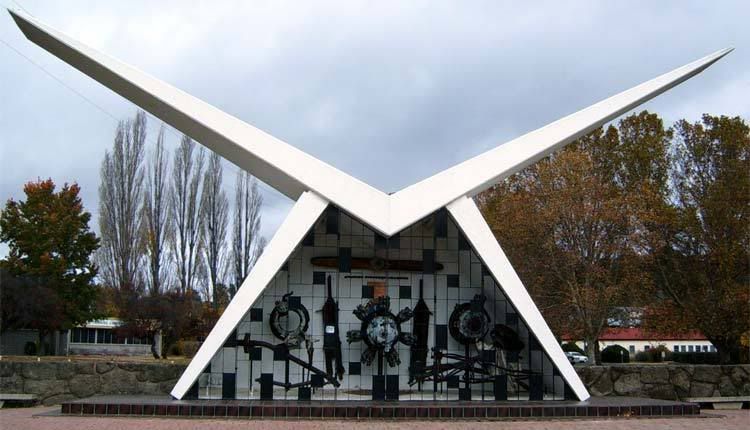
Will look for a picture of “Southern Cross”.
By: JDK - 23rd March 2008 at 12:29
How about the Focker that was recovered in Australia, after being lost for 30 years or more. I think it was either ‘Southern Cross’ or a sister ship.
The disappearance of the ‘Southern Cloud’ one of Kingsford Smith’s ANA airliners brought down the company and the wreck was only discovered many years later.
http://en.wikipedia.org/wiki/Southern_Cloud
By the way, is the real Southern Cross still preserved at Brisbane airport?
Yes, in an air-conditioned glass hangar.
The RAAF Museum’s Hawker Demon A1-8 was crash-landed into a Tasmanian hillside, the crew surviving, in the 1930s. The a/c then had all the movable fixture removed and set on fire by the RAAF recovery team, standard operating procedure. In the 1970s the wreck was recovered, and rebuilt, being rolled out in the presence of the original pilot 50 years after the accident. I’m proud to have got to know Ron Gretton, the lead restorer on this aircraft quite well.
Regards
By: bri - 23rd March 2008 at 11:17
Ant chance you could elaborate a bit on that?
I’m still not sure if its a ship or an aircraft :p
Sorry, no. I thought perhaps some of our Aussie readers could fill that in. The plane in question was the same type of Focker as the Southern Cross, and it was located either in northern NSW or southern Queensland. That’s all I remember.
It flew at a rate of knots, and has port and starboard sides… 😉
Bri 🙂
By: Truculent AME - 22nd March 2008 at 00:07
This was the first company that I worked for as an AME. I was not a part of this particular rescue operation – but was part of the subsequent repairs completed to get the aircraft flying again. Some where I have a photo of DBJ on arrival at Thompson – I do remember that we pulled out the jacks from the hangar to the ramp just in case there was a problem with the gear locks having some damage. The only external signs of damage were the loss of the beacon on the belly and the right hand engine oil cooler assembly being pushed up into the nacelle. Saved the insurance company a lot of money by saving the aircraft.
Link here; http://www.douglasdc3.com/lamb2/dc3lamb2.htm
Jack Lamb is the author of the story and has published a book about the exploits of the company (Lambair) – called “My Life In The North”. It is a good read if you are interested in early aircraft operation in the Canadian north. Many stories about aircraft rescues – including one of their Bristol Freighters.
Link here: http://members.shaw.ca/artbookbindery/mylifeinthenorth.htm
Truc
By: Mondariz - 21st March 2008 at 18:16
How about the Focker that was recovered in Australia, after being lost for 30 years or more. I think it was either ‘Southern Cross’ or a sister ship.
By the way, is the real Southern Cross still preserved at Brisbane airport?
Bri 🙂
Ant chance you could elaborate a bit on that?
I’m still not sure if its a ship or an aircraft :p
By: bri - 21st March 2008 at 13:48
How about the Focker that was recovered in Australia, after being lost for 30 years or more. I think it was either ‘Southern Cross’ or a sister ship.
By the way, is the real Southern Cross still preserved at Brisbane airport?
Bri 🙂
By: Arabella-Cox - 21st March 2008 at 13:22
Recovered about 1979ish from memory. Shot down May 1940. Fg Off Peter CAZENOVE PoW. I had the armoured windscreen until recently which I have now been able to pass on to John Romain for incorporation in the rebuild….probably the only externally visible original bit when it eventually flies.
By: Z1pp0 - 21st March 2008 at 13:12
P9374?
Can someone enlighten me about this one? Seems to be a good sorce for a modeling diorama. 😛
\Dan
By: Radpoe Meteor - 21st March 2008 at 12:52
Not a recovery of epic proportions, but when we fetched the Vampire from Sibson upto Firbeck it was transported on the back of 3 car trailers:D 😀 .
By: Mondariz - 21st March 2008 at 10:03
It was fun, believe me! Not so the Delhi belly though:mad:
A great adventure….been there, done that, got the tee shirt!!
Getting Gladiator wrecks off Norwegian mountains was fun, too, if not a little colder than Rajasthan!
Please Tangmere1940! tell us about when you got Gladiators from Norway 🙂
By: Fournier Boy - 20th March 2008 at 13:20
Thats a cool recovery too. maybe not a great adventure (although Ireland can be quite an adventure).
How about a few pictures (before and after maybe).
I have a website which has been completely re-vamped and is due to go live in the next week or two. There has been some coverage in flypast recently with pictures, as well as LAA magazine.
I’ll post a link when everything kicks off.
FB
By: Arabella-Cox - 20th March 2008 at 12:27
One of my favourites has got to be the D.H. 9 which was recently unveiled at Duxford. Given by the british Govt to a Maharaja just after the first world war,found rotting in an Elephant stable by a tourist(who was fortunately an aviation entheusiast), lost:eek: , re-found, brought back to the UK and restored.:)
It was fun, believe me! Not so the Delhi belly though:mad:
A great adventure….been there, done that, got the tee shirt!!
Getting Gladiator wrecks off Norwegian mountains was fun, too, if not a little colder than Rajasthan!
By: TEXANTOMCAT - 20th March 2008 at 12:06
One of my favourites has got to be the D.H. 9 which was recently unveiled at Duxford. Given by the british Govt to a Maharaja just after the first world war,found rotting in an Elephant stable by a tourist(who was fortunately an aviation entheusiast), lost:eek: , re-found, brought back to the UK and restored.:)
I totally agree – brought back memories of Indiana Jones and the Temple of Doom!
LOL!
TT
By: Mondariz - 20th March 2008 at 08:20
A friend’s Boeing 40 transport.
Manufactured in March 1928, it crashed in dense fog onto the summit of Canyon Mountain in Southern Oregon on October 2, 1928.
The pilot was badly burned, the passenger, a diamond merchant from California, was killed. Most, but not all, of the diamonds were recovered.
The pilot recovered from his injuries, but never flew again. He remained with United Airlines, the successor to Pacific Air Transport, until retiring in 1968.
As you might expect of the time, locals visited the crash site taking souvenirs. The rear of the steel tube fuselage was taken away and served as a piece of ad hoc playground equipment in a nearby town.
Eventually, it was forgotten.
The wreck lay abandoned until the mid 90s when an Oregon historic aviation group recovered it.
After storing the wreckage in a number of places, including a horse trailer, they heard that antique aircraft restorer Addison Pemberton was looking for a Boeing 40. Hoping to place the remains in a good home, the wreckage was sold to him. Pemberton, the owner of an aerospace manufacturing firm, had been looking for a Boeing 40 for years. He had begun restoring aircraft while still in university; in the years since he had restored everything from a T-6, to several wartime Stearman trainers and a rare 1931 airmail Stearman, to an award-winning Beech Staggerwing.
Eight years and 18,000 hours later, last month, the Boeing flew for the first time in almost 80 years.
A couple of years ago, a woman from Oregon appeared at Pemberton’s workshop. She showed him her a diamond ring. The stone was found by her father at the crash site. He searched for months hoping to find one so he could give it to his fiancé. It was the only way he could afford a diamond during the depression.
It’s the only flying Model 40, out of three survivors, and the oldest operational Boeing aircraft.
Great story complete with a tale of an actual diamond treasure 😎
Sometimes I tend to forget, that historic aviation is more than WWII.
I’m happy to hear that a Boeing 40 is flying again, it would be an aircraft I would like to see.
By: Radpoe Meteor - 20th March 2008 at 08:07
One of my favourites has got to be the D.H. 9 which was recently unveiled at Duxford. Given by the british Govt to a Maharaja just after the first world war,found rotting in an Elephant stable by a tourist(who was fortunately an aviation entheusiast), lost:eek: , re-found, brought back to the UK and restored.:)
By: J Boyle - 20th March 2008 at 00:31
A friend’s Boeing 40 transport.
Manufactured in March 1928, it crashed in dense fog onto the summit of Canyon Mountain in Southern Oregon on October 2, 1928.
The pilot was badly burned, the passenger, a diamond merchant from California, was killed. Most, but not all, of the diamonds were recovered.
The pilot recovered from his injuries, but never flew again. He remained with United Airlines, the successor to Pacific Air Transport, until retiring in 1968.
As you might expect of the time, locals visited the crash site taking souvenirs. The rear of the steel tube fuselage was taken away and served as a piece of ad hoc playground equipment in a nearby town.
Eventually, it was forgotten.
The wreck lay abandoned until the mid 90s when an Oregon historic aviation group recovered it.
After storing the wreckage in a number of places, including a horse trailer, they heard that antique aircraft restorer Addison Pemberton was looking for a Boeing 40. Hoping to place the remains in a good home, the wreckage was sold to him. Pemberton, the owner of an aerospace manufacturing firm, had been looking for a Boeing 40 for years. He had begun restoring aircraft while still in university; in the years since he had restored everything from a T-6, to several wartime Stearman trainers and a rare 1931 airmail Stearman, to an award-winning Beech Staggerwing.
Last month, eight years and 18,000 hours later, the Boeing flew for the first time in almost 80 years.
A couple of years ago, a woman from Oregon appeared at Pemberton’s workshop. She showed him her a diamond ring. The stone was found by her father at the crash site. He searched for months hoping to find one so he could give it to his fiancé. It was the only way he could afford a diamond during the depression.
It’s the only flying Model 40, out of three survivors, and the oldest operational Boeing aircraft.
By: Mondariz - 19th March 2008 at 17:38
I’d say for certain it was the recovery of Piper L4H 44-79580 from a barn in the back end of Ireland with its subsequent mighty return to england….
….but thats only because I did it, and I own it! It was nothing special to most, but it was special to me.
FB
Thats a cool recovery too. maybe not a great adventure (although Ireland can be quite an adventure).
How about a few pictures (before and after maybe).
By: Mondariz - 19th March 2008 at 17:35
And for me that was working on AD4 Skyraiders in Chad in 1988 with didier chable, we’ve been staying there for weeks working in harsh conditions in order to get these birds back into order…the first pre-oil then startup happened at night, all the air force people stationned there were looking at that event…i have such wonderful videos about that adventure…
Hi Yakman,
Any links or pictures from that recovery?
Able Dogs are on my top 10 list (strangely there are almost 100 aircraft on my top 10 list :p )


 Sign In








 March 19, 2008 at 11:18 am