The Messerschmitt Bf 109 G-4 (MAC) was yesterday destroyed during a landing accident. The pilot, Sigi Knoll (69) is ok. 🙁 🙁 🙁
German sources with photos:
http://www.suedwest-aktiv.de/region/zak/freizeit/1701715/artikel.php?SWAID=4f554c5c882b00a93cbe56e1c82b46e8
http://www.nonstopnews.borgmeier-media.de/meldung.php?ID=2470&JG=0&sst=2470
For remembrance:
http://www.messerschmitt-bf109.de/php-uebersicht/ueberlebende-ausgabe.php?flugzeug=83
VERY SAD!!!!!


By: markstringer - 23rd January 2007 at 12:35
Does anyone know if its scheduled for a return to the air in the summer? i’m sure i read a long time ago that that was the timescale for it. Looking good though.:)
By: Mark V - 21st January 2007 at 10:02
note that the Mk XIV retained only the basic fuselage and horizontal stabilizer form from the earlier Spit models, with a completely different engine, wing, and vertical stabilizer designed to cope with the gobs of torque produced by that massive Griffon.
Thats not really correct. There were airframe improvements and changes, the fin/rudder being the most obvious one from an external appearance point of view and there were also many features incorporated to strengthen the airframe and upgrade armamanet and equipment. However, apart from this (and the engine prop combination) the Mk XIV was remarkably similar to the preceding marks and certainly did not have a completely revised wing – that did not come along until the 20 series aircraft.
By: QldSpitty - 21st January 2007 at 08:42
BoB movie
Wonder what it felt like for the dummy that was thrown out of the two seat Buchon (IIRC) during the BoB movie!!:eek:
Sorry had a big hot day out at the workshop so my brain is a little fried….:cool:
By: DazDaMan - 20th January 2007 at 15:56
As for the two seater, I believe Eric ‘Winkle’ Brown flew one, and found it a rather nerve racking experience whilst flown from the back seat, pretty much for the reasons Tester mentions.
Cheers
Paul
Would be interesting to see what could be said about the two-seater Hispano….
By: Bradburger - 19th January 2007 at 22:19
I think Tester summed the up the take off and landing issues with the 109 very well.
I’ve read many modern day pilots reports on flying the 109/Buchon, and it seems they all agree that once the drama of the take off is over (the landing you can worry about later!), and whilst heavy on the controls (especially the elevator), it is actually a nice aircraft to fly.
The main reason it’s ground handling/directional stability is so poor is that the CoG is so far aft of the main wheels, which means it will swap ends without any provication, hence the tailwheel lock. Combine this with the U/C design & layout, you have all the ingredients for a nasty accident, as many wartime and current 109 pilots have found out!
As for the two seater, I believe Eric ‘Winkle’ Brown flew one, and found it a rather nerve racking experience whilst flown from the back seat, pretty much for the reasons Tester mentions.
Cheers
Paul
By: WebPilot - 19th January 2007 at 21:11
Lynn – I disagree with you on a couple of counts – the fundamental flaw with the 109 was really related to undercarriage geometry. The Spitfire’s geometry was fairly good – the aircraft is stable on takeoff and landing with good directional control.
Also the wing on the Spitfire XIV wasn’t really a new design as far as I’m aware. It had a few fairly superficial modifications such as the shortening of the ailerons, but was fundamentally the same structure as the earlier Spitfire wing.
As with the tail – new shape but same basic structure. Bf109G2 – “finest fighter”? Hard to be that absolute, I think. Certainly German combat veterans have said the 109G was “malicious” in the landing configuration (Green – Famous Fighters of WW2)
By: Eddie - 19th January 2007 at 18:52
Lynn – I disagree with you on a couple of counts – the fundamental flaw with the 109 was really related to undercarriage geometry. The Spitfire’s geometry was fairly good – the aircraft is stable on takeoff and landing with good directional control.
Also the wing on the Spitfire XIV wasn’t really a new design as far as I’m aware. It had a few fairly superficial modifications such as the shortening of the ailerons, but was fundamentally the same structure as the earlier Spitfire wing.
By: one0nine - 19th January 2007 at 18:30
No indeed. As a design, the 109 is fundamentally flawed and wasn’t really suited to further development. It probably would have been superceded as a front line type had the war not started in 1939. I wonder why the type wasn’t dropped as the FW190 came on stream and the resources pushed at that and other types – the continuing need to produce large numbers of machines presumably as the war position became more and more desperate for the Germans.
No more flawed than the Spitfire, being the same basic configuration. The aircraft had reached the end of it’s development life in it’s current configuration by mid-1943 with the G-6/AS and G-14/AS; note that the K retained the same exact configuration, with only minor internal equipment arrangement differences (and of course more horsepower). To put it in parallel with the Spitfire, the Mark IX would probably be a close equal in terms of development; note that the Mk XIV retained only the basic fuselage and horizontal stabilizer form from the earlier Spit models, with a completely different engine, wing, and vertical stabilizer designed to cope with the gobs of torque produced by that massive Griffon.
The 109 was the finest fighter in the world through early 1943, with the development peaking with the G-2… only the Mark 21 Zero would have a legitimate claim for equal greatness in the same time period. Every 109 model afterwards was a reactive development rather than proactive, including the /AS models. The basic G-6 was a step backwards in many ways, sacrificing manouverability and performance for firepower, and the K-4, while a very capable aircraft, still lacked a number of features which were considered standard on Allied combat aircraft at that time, including cockpit adjustable aileron and rudder trim, gyro-stabilized gunsights, and much more reliable all-weather capability. Credit the Allied bombing campaign for creating such a pressure-cooker environment that Messerschmitt and it’s various satellite factories were forbidden to explore any significant developments as it might interfere with production of the current models.
The 190 was a fine aircraft as well, but the BMW 801 crapped out above 18,000 feet or so… lots of work took place to try and rectify this through the war, but it wasn’t until the lashed-up D-9 entered service that the 190 got any kind of decent high-altitude performance.
By: Skyraider3D - 19th January 2007 at 13:43
The images on their site are terribly small and not terribly useful, but it’s good some progress is being made on getting her back into the air 🙂
By: James D - 19th January 2007 at 11:19

(Image stolen from their website)
This certainly looks encouraging. They have their new spinner, chin sheetmetal, radiators and the fixing point for the wing is now sorted. Shouldn´t be too long now with a bit of luck.
By: WebPilot - 19th January 2007 at 10:42
And yet all attempts by the designers during the war to combat these problems didn’t do much to help – especially given that the more powerful DB engines exacerbated the torque/landing gear issues the type’s always had.
No indeed. As a design, the 109 is fundamentally flawed and wasn’t really suited to further development. It probably would have been superceded as a front line type had the war not started in 1939. I wonder why the type wasn’t dropped as the FW190 came on stream and the resources pushed at that and other types – the continuing need to produce large numbers of machines presumably as the war position became more and more desperate for the Germans.
By: DazDaMan - 19th January 2007 at 10:15
The problem with the 109 undercarriage is not just the narrow track but the way in which the wheels are mounted to the undercarriage legs which results in the wheels being slightly toed out from one another, thus exascerbating the problems of the narrow track. Plus, the type has a small rudder and empennage and poor vision from the cockpit due to the heavy framing. All this adds up to make for a machine that is known to be a handful on or near the ground.
And yet all attempts by the designers during the war to combat these problems didn’t do much to help – especially given that the more powerful DB engines exacerbated the torque/landing gear issues the type’s always had.
By: WebPilot - 19th January 2007 at 09:59
In answer to a previous question, compared to the 109 the Wildcat is very straightforward for directional control on take-off and landing. The problem with the Wildcat in a crosswind is poor lateral control.
The problem with the 109 undercarriage is not just the narrow track but the way in which the wheels are mounted to the undercarriage legs which results in the wheels being slightly toed out from one another, thus exascerbating the problems of the narrow track. Plus, the type has a small rudder and empennage and poor vision from the cockpit due to the heavy framing. All this adds up to make for a machine that is known to be a handful on or near the ground.
The Wildcat by contrast has the wheels running parallel to one another, a bigger rudder and fin plus less power, all of which makes it less of a handful!
By: markstringer - 19th January 2007 at 09:41
http://shop.me-air-company.de/index.php?cPath=2_4_10
check out the progress on red 7! looking good and is edging closer to completion. Can’t be far away now surely?
By: Merlinmagic - 30th October 2005 at 21:14
Tester you beat me to it!
Please observe the wide streak of yellow that would appear down the back of my flying suit if it was suggested that I be the responsible pilot in the back of a 109 T-bird
I entirely agree with your views. A good, and varied, vintage/warbird type background and thorough pre-flight briefing is the clue here.
MM
By: DazDaMan - 30th October 2005 at 16:24
gregv,
I understand why you think that a two-seater trainer may help, but It may not. I have never sat in the back of a 2-seat 109 but I suspect that the field of view is very poor. If that is the case, it would be very difficult for an instructor to tell when things were going wrong during take-off and landing and thus to take control effectively. Likewise, demonstrations of take-off and landing techniques would almost certainly be impossible. Therefore, little effective training could be performed. Perhaps that is why there were very few trainer variants of this class of aircraft. Suitable experience in other warbirds, careful briefing and close supervision of the first few sorties are the best way of training a pilot to fly a 109.
There were, of course, several two-seaters that were made up during the war, dubbed the Bf 109G-12. They had the second cockpit installed behind the first one – but with no effort to move the cockpit forward unlike the trainer Spitfire. The instructor in the rear had a modified hood which allowed him to see forward, but not much.
Have a look at this pic from www.hsgalleries.com 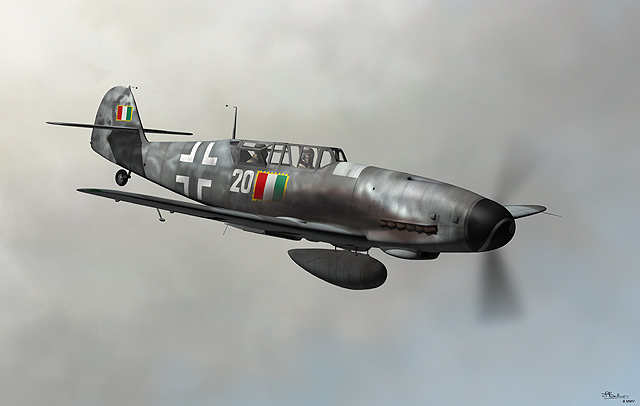
You’ll see the instructor’s cockpit hasn’t got much in the way of a view forward, either.
By: Tester04 - 30th October 2005 at 15:41
gregv,
I understand why you think that a two-seater trainer may help, but It may not. I have never sat in the back of a 2-seat 109 but I suspect that the field of view is very poor. If that is the case, it would be very difficult for an instructor to tell when things were going wrong during take-off and landing and thus to take control effectively. Likewise, demonstrations of take-off and landing techniques would almost certainly be impossible. Therefore, little effective training could be performed. Perhaps that is why there were very few trainer variants of this class of aircraft. Suitable experience in other warbirds, careful briefing and close supervision of the first few sorties are the best way of training a pilot to fly a 109.
By: DazDaMan - 28th October 2005 at 21:21
seems to me that a two-seat dual-control 109 type is what is needed, and there happens to be one, in storage somewhere…I am of course referring to the Buchon trainer that was (or is) owned by Connie Edwards, I think. Anybody have more info on this aircraft’s current disposition? Inquiring minds want to know.
cheers
greg v
Connie offered some of his collection for sale a few years ago, included were a number of the Buchons and the ex-BofB movie Spitfire, MH415.
Haven’t heard anything about the two-seater moving on since then, so I guess he may well still have it. Anyone else?
By: HP57 - 28th October 2005 at 18:45
And back on the ground in 2 yaers and one day unless things change
We have a saying here in Holland:
A donkey never hurts himself on the same stone.
Hope they have a similar saying in Germany. Although Hals und Beinbruch (break a leg) doesn’t count.
Cheers
Cees
By: Andy Mac - 28th October 2005 at 18:40
Will it be at…. 😀
. . . don’t say, don’t you dare . . . 😀 😮 😮 😮


 Sign In








 July 16, 2005 at 11:19 am