-Corrections and constructive feedback welcomed-
Some armchair web research and Google Earth loitering….
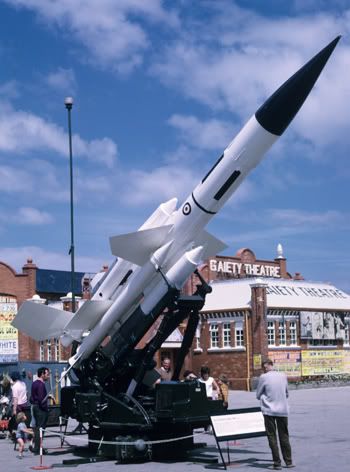
The Bloodhound was a surface to air missile deployed by the British and several other countries from the 1958 through to the 1999. It was, at face value, similar to the more conventional Thunderbird SAM used by the British Army, but mounted two Thor ramjet engines above and below a fuselage. It was unusual for a SAM in having a monoplane configuration (see CIM-10 Bomarc for a similar layout) .
The Bloodhound SAM was loosely equivalent to the Soviet SA-2 and American Nike Hercules, deployed from fixed sites to defend against medium and high altitude targets at medium/long range. In terms of performance it was shorter ranged than its American equivalent, but still almost twice the range of the Soviet counterpart. A basic stats comparison is a good place to start:
Range:
1st. Nike Hercules: 140km
2nd. Bloodhound: 80km
3rd. SA-2D Guideline: 50km
Speed:
1st. Nike Hercules: Mach 3.65
2nd. SA-2D Guideline: Mach 3.5
3rd. Bloodhound: Mach 2.7
Overall length (at launch):
1st. Bloodhound: 8.5m
2nd. SA-2D Guideline: 10.6m
3rd. Nike Hercules: 12.5m
But, behind the stats there are some interesting similarities and differences. At first sight the Bloodhound appears the smallest of the three missiles, but the length is misleading, because unlike the others its launch boosters are mounted beside the fuselage not behind it. In the final ntercept stage all missiles are about the same overall dimensions, although the Nike Hercules is noticeably fatter than the other two:
(top: Bloodhound, middle: Nike Hercules, bottom: SA-2)
And again, in launch configuration:
Of the three systems the SA-2 was most mobile although all three were regarded as static systems throughout the cold war. Whilst the’ rose’ of SA-2 positions is regarded as the classic SAM site, the Bloodhound and Nike Hercules also had distinctive site layouts. The Bloodhound, being an RAF missile, was deployed at air fields, but rather than simply parking the launch turntables on taxiways and aircraft dispersals, the RAF built special purpose circular pans, connected to access roads, in groups of four. Two grounds of four (rarely, six) dispersals would be connected to a single fire control radar which was often mounted on a mast. Missiles at one quad could be rearmed whilst firing was commencing from the other. Each launch position would have a single missile on a turntable.:
There were no blast embankments as per the SA-2, and the system could be deployed on any flat concreted surface. But whilst the trim airfield grass and neat concrete pans might seem luxurious compared to the dirt of many SA-2 sites, it was nothing compared to the incredible complexity of the Nike Hercules which actually required underground bunkers underneath the launching positions:

Consequently, even when redeployed into a warzone, Nike Hercules sites would still take days to become operational, and were particularly vulnerable to low-level attack. The RAF countered this problem by having two radar choices; a large search radar for fixed positions, and a smaller one for mobile positions. When the radar was mounted on a skeleton tower the system was relatively capable even at lower altitudes. And towers became the norm.
Random fact: In RAF service each missile was regarded as an aircraft of a squadron.
Contrary to popular imagination, where the SAM flies directly upwards at the target, systems such as the Bloodhound and Nike Hercules were launched high up above their targets and dived down – this is in part how such long ranges were achieved, but it made the missiles unsuitable for the evolving battlefield where threats were increasingly low altitude high speed maneuvering targets.
Whilst the Nike Hercules was replaced by the Patriot, and the SA-2 superseded by the SA-5 and then the infamously potent SA-10, the Bloodhound was destined to be retired without meaningful replacement. Sob.
Like the SA-2 and Nike Hercules, some Bloodhound sites are still visible from Google Earth.


(a-typical layout)


Other British Bloodhound bases, mostly where launch positions are no longer visible:
RAF North Luffenham: 52°37’50.26″N, 0°35’48.85″W
RAF Newton (training unit): 52°57’33.92″N, 0°59’25.93″W
RAF Woodhall Spa: 53° 8’3.49″N, 0°11’47.24″W
RAF Dunholme Lodge: 53°17’39.99″N, 0°29’37.25″W
RAF Lindholme: 53°32’51.57″N, 0°58’9.87″W
RAF Donna Nook (secondary): 53°27’37.40″N, 0° 8’58.55″E
RAF Carnaby: 54° 3’38.67″N, 0°15’17.91″W
RAF Watton: 52°34’2.14″N, 0°52’20.08″E
RAF Kuching, Malaysia: 1°29’9.19″N, 110°20’49.10″E
RAF Seletar, Singapore: 1°25’5.15″N, 103°52’2.47″E (also location of Singaporean battery?)
RAF Episkopi, Cyprus: 34°41’0.78″N, 32°50’54.06″E
RAF Bruggen, Germany: 51°11’51.04″N, 6° 8’0.78″E
RAF Wildenarth, Germany: 51° 6’58.94″N, 6°13’8.41″E
Bloodhound in other countries (example sites)
Sweden:
Switzerland (note the missiles):

By: 124brat - 19th March 2021 at 05:40
A Royal Australian Air Force battery of No.30 Squadron at Williamstown or Darwin. (Anybody know which?).
By: stendec7 - 18th December 2010 at 20:24
Great information Planeman6000, really like the airborne shots. My Dad, who sadly passed away recently, used to work on Bloodhound support systems when employed by Ferranti in the 1960s. He always spoke fondly of those days.
By: BIGVERN1966 - 18th December 2010 at 01:45
Woodhall Spa Bloodhound Site
–
Other British Bloodhound bases, mostly where launch positions are no longer visible:
RAF Woodhall Spa: 53° 8’3.49″N, 0°11’47.24″W
Most of the actual missile site is now RAF Coningby’s Golf Course, however a LCP and Work Service Building from one of 222 Sqn’s fire units are still standing, plus the location some of the missile pads can still be seen from the air.
By: BIGVERN1966 - 10th April 2009 at 15:34
In Feb,50 US offered UK licences for Sparrow AAM, Nike/Ajax and Terrier. Gen.Templer instead did a data exchange Agreement: RN landing mirror/steam catapult/angled deck went West; Bloodhound was infused with data from Boeing Bomarc ramjet/Convair Terrier controls/wing. That is a cause for poor Bloodhound exports – US could deny export licences. As well as Sweden/Switzerland, only RAAF took new-build Bloodhound; Singapore took over ex-FEAF assets. (No Seaslug new-build sales – some on used Counties to Chile; some Thunderbirds diverted from BAOR to RSa.AF). NATO and other Allies were offered various Hawks on attractive terms, inc. licence/technology transfer.
Indeed the Red Duster program did kick off with a team from Bristols visiting the US teams working on Bomarc and Naval SAM (Talos was the main US Navy weapon that the Bristol team looked at and took the wing platform off according to a document written by David Farrar). Orginal BB1 ramjet used on first XTV4 engine test rounds was based on a scaled down design for Bomarc, though some Bristol ideas on the fuel metering system did help solve problems that Boeing were having. Bomarc and Bloodhound teams did share development data thoughout the development of both weapons which did overcome problems with both systems. US did try to block the sale of BH2 to the Swiss due to tech transfer of a couple of items, namely Thermal Battaries and the Con-Rod warhead, However US finally gave in after UK picked up the point that the US had no problems with the sale to the Swedish. (FO document at the time states that the Swedish most likely got the OK for BH2, because they were also getting HAWK, which the Swiss were not).
By: alertken - 5th April 2009 at 20:59
SAM origins: it’s all babble
(Main sources: S.R.Twigge, Early Devt.of GW in UK,Harwood,’93; A.R.Adams, Good Company,BAC(GW),1976).
RN’s anti-Kamikaze SAM originated in 1944 – obviously. Wasserfall then attracted Army/RAF interest (and USSR’s, inspiring SA.2). MoS Spec. issued 3/48 generically as Red Heathen, was to be deployed on large vessels, airfields (fixed) and Army Field Units (mobile). Industry showed little interest. RAE’s Morien Morgan caused HSAL to create a new AWA team, at Whitley, receiving in March,49 the development contract for (to be) Seaslug I with Sperry UK controls and GEC guidance, RPE Westcott booster and sustainer motors. RAE had hoped to do all GW, re-inventing the Royal Aircraft Factory as the Guided Ordnance Factory. France and US Army (Redstone IRBM) put such work into Arsenals and/or Universities (Johns Hopkins U. thought up Terrier/Tartar/Talos, Convair bashed under direction). MM was having none of it, and strong-armed EE (with their Marconi subsidiary) into the Field Defence project as Red Shoes: “detach some of your best men to work on something which is a doubtful starter, politically vulnerable, and perhaps even unprofitable”. EE agreed, provided they “would not have to put capital into the venture”. ITP 19/3/49 to EE at ex-Napier Luton, to “put up their own buildings – or more accurately (for MoS to fund) the operation” Adams,Pp4/28/61. He put the Army airfield-defence SAM, now Red Duster, to Bristol (to be Bloodhound I).
In Feb,50 US offered UK licences for Sparrow AAM, Nike/Ajax and Terrier. Gen.Templer instead did a data exchange Agreement: RN landing mirror/steam catapult/angled deck went West; Bloodhound was infused with data from Boeing Bomarc ramjet/Convair Terrier controls/wing. That is a cause for poor Bloodhound exports – US could deny export licences. As well as Sweden/Switzerland, only RAAF took new-build Bloodhound; Singapore took over ex-FEAF assets. (No Seaslug new-build sales – some on used Counties to Chile; some Thunderbirds diverted from BAOR to RSa.AF). NATO and other Allies were offered various Hawks on attractive terms, inc. licence/technology transfer.
BV’s point on BAC internecine warfare: (in 1960 at Vickers as BAC was formed: ) “junior partner of the Aircraft side (a) poor relation.” Special Director/Weybridge G.Edwards “wasn’t particularly interested in GW” Adams,P70
By: BIGVERN1966 - 5th April 2009 at 13:32
Vern
Interesting to hear about Marham,the area highlighted is next to what was (or perhaps part of !!) the MSF (missile servicing flight) when I was at Marham in circa 1976,we had the misfortune to be moved there from Cottesmore.
I was on 231ocu and the large frying pan with the glider parked on it was one of our parking bays (i vividly remember a night engine surge up on there…very spectacular :D)
Our old (condemned/shored up) building was just out of the top of your pic (up the small footpath) and we also used the single ‘spectacles’ by the rwy threshold for parking.
Boy did the place shake when a full fuel load Victor 2 slammed full bore to get moving up to the top of the ‘hill’ (RWY).regards baz
Well here is the Vailant and 242 Sqn site photo, and looks like the photo was taken from the ATC tower.

From what I’ve been told the building with the two sloped roof in the top right of the photo on my pervious post (just to the right of the far right HAS) was used by the 242 Sqn Missile Servicing Section, so it dates from the Bloodhound era of the Station.
By: bazv - 5th April 2009 at 08:38
Vern
Interesting to hear about Marham,the area highlighted is next to what was (or perhaps part of !!) the MSF (missile servicing flight) when I was at Marham in circa 1976,we had the misfortune to be moved there from Cottesmore.
I was on 231ocu and the large frying pan with the glider parked on it was one of our parking bays (i vividly remember a night engine surge up on there…very spectacular :D)
Our old (condemned/shored up) building was just out of the top of your pic (up the small footpath) and we also used the single ‘spectacles’ by the rwy threshold for parking.
Boy did the place shake when a full fuel load Victor 2 slammed full bore to get moving up to the top of the ‘hill’ (RWY).
regards baz
By: ollieholmes - 5th April 2009 at 03:15
Very interesting collection here. Ive seen the one at Barkston Heath a few times but i never realised what it was for.
By: BIGVERN1966 - 5th April 2009 at 00:31
242 Sqn RAF Marham
One Bloodhound site not in Planeman’s list is the one at Marham (strange seeing that one of the most seen photos of early RAF Bloodhounds is the shot of a 214 Sqn Valiant being towed past the 242 Sqn site). Somebody at another forum has worked out where the site was and posted it on that Forum. Unfortunaty, its now a HAS site.
By: BIGVERN1966 - 4th April 2009 at 23:14
A well presented piece of research but with a bit of a mis-statement at the start. There was no such thing as a Bristol Thunderbird. T-bird was a product of the Guided Weapons Division of English Electric Aviation and while it was indeed more conventional with its cruciform wing layout, it certainly was not closely related to Bloodhound. Apart from the obvious differences in power and control, there was great competitive animosity between the two teams. (I should know; I was an aerodynamicist on the EE side based at Luton and then at the GW wind tunnel at Warton.)
Indeed there were differences in size, power plant and control. However both weapons were born out of the Army’s Red Heathern studies, and at the git go were ‘Army’ Weapon projects for the same operational requirement. RAF got involved after a bun fight with the Army over operational control of UK based Air Defence assests (RAF wasn’t keen on the Army shooting long range SAM’s into the middle of thier air battles, while the Army wasn’t keen on giving control of thier forces to the RAF). Defence Council forced the issue in late 1952, and gave SAM development to the Air Ministry. Army wanted Thunderbird because it was simpler and more moblie than Bloodhound, while the RAF thought the Army’s Spec for the two systems left a lot as reguards range and method of guidance, and reckoned Bloodhound could be soupped up to meet thier requirement.
No Doubt Alertken will add a quick fire summary if he reads this post.
As for animosity between the two teams, what happened between them during the development of the Mk 1 systems was nothing compared to the in house fighting when EE and Bristol became BAC, from what I’ve read in certain documents.
By: BIGVERN1966 - 4th April 2009 at 22:40
RAF Watton: 52°34’2.14″N, 0°52’20.08″E
Watton had two Bloodhound related sites. The HQ of 24 ADM Wing was located to the north west of the Airfield on the Norwich road. It became an ATCRU (Eastern Radar) in 1966. Unfortunatly, the Buildings no longer exist after the main ops building was burnt out by arson shortly after Eastern Radar was closed. The SAM site of 263 Sqn with their 32 Bloodhound Mk 1’s, was to the south south west of the airfield near the Village of Griston, so I’ve been informed, and is now the site of Weyland Prison.
Both locations shown on the photo below.
By: BIGVERN1966 - 4th April 2009 at 16:45
Swiss Bloodhound Mk 2 Sites
The Swiss had 5 Operational Bloodhound Mk 2 sites, plus a Training unit that could be used Operationally if required.
The Swiss designation of the system was Boden-Luft-Lenkwaffen 64 (Ground to Air Guided Weapon (19)64 (year of planned service entry)), which was shortened to BL-64. The 6 sites known as Boden-Luft-Lenkwaffenstellung 64, followed by the name of the Canton in which they were located in german, hence the site’s names were shorted to BL-64 followed by the two letter code for said Canton.
Hence the sites at
Bettwil in Aargau was known as BL-64AG
Torny-le-Grand in Freiburg was known as BL-64FR
Emmen in Luzern was known as BL-64LZ
Laupersdorf in Solothurn was known as BL-64SO
Menzingen in Zug was known as BL-64ZU
Schmidrüti in Zürich was known as BL-64ZH
3 sites had 2 full Fire Units (Swiss used the BH1 term for a missile battary) with 16 launchers and two radars.
2 sites had a single fire unit with 8 launchers and one radar.
While the training unit at Emmen had one radar and four launchers.
The site at Menzingen, is actually near a village called Gubel and actually has 8 missiles on lauchers as one of the fire units on the site has been preserved as a museum (along with the scorpion radar (T87), Launch control cabin and other equipment including a fully operational simulator and a cutaway missile).
Aerial views of five of the six sites below (can’t find the Emmen site at the mo). Planeman’s aerial view of the BL-64 site at Schmidrüti, is actually the site at Bettwil (Schmidrüti only had one fire unit, like Laupersdorf).
By: BIGVERN1966 - 4th April 2009 at 15:01
RAF Episkopi, Cyprus: 34°41’0.78″N, 32°50’54.06″E
112 Sqn’s HQ was at Episkopi, but its Missile site was at Paramali West and the pads are still there.
Some good photos of Bloodhounds on Cyprus here – looks like some Bloodhound Mk 2 were painted in a colour other than White or Green.
By: BIGVERN1966 - 4th April 2009 at 14:29
More on Bloodhound overseas
Quite a good view of how the Swiss operated Bloodhound Mk 2 (BL-64) from hardened sites can be found on these two videos on Youtube (Audio in German).
By: bazv - 4th April 2009 at 14:14
Hi.
Nobody came up with the answer to the location of this shot in that thread:D
Is it a butlins site ??
they had gaiety buildings ??
By: BIGVERN1966 - 4th April 2009 at 14:04
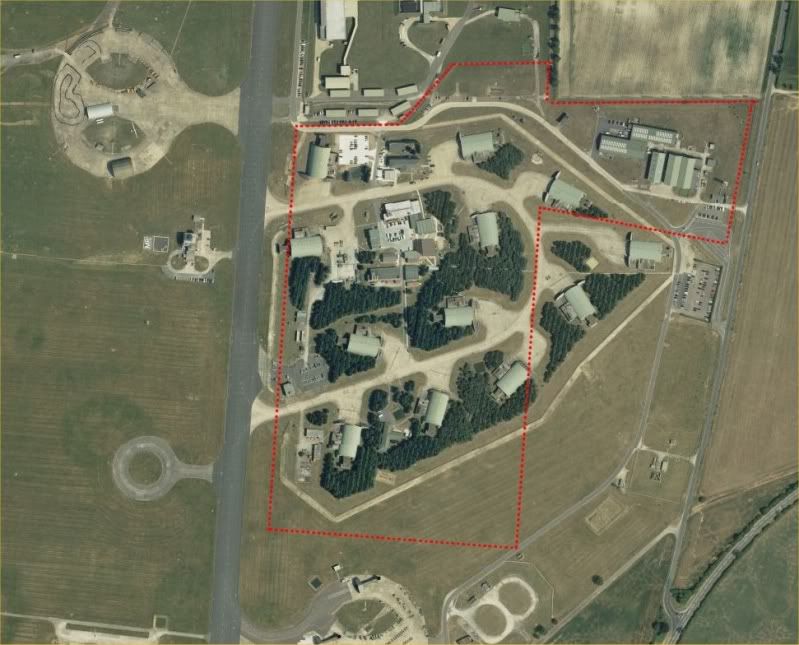
Nice view of our cricket pitch there at Newton outside the hangar to its left. I spent about a year there being trained on the T87 radar (the BIG one – about 50 tons of it) which I think can be seen immediately to the right of the red rectangle. After that I got married, went to Woodhall Spa (first son born), then to Aberporth (second son born). Hectic!
I’ve got some photos of the compond at Newton at home somewhere, the site was quite small, and had a T87, T86, LCP and launcher in it (Plus a few auxcillary items). The MOTE was in a prefab building between the two hangers (not in the photo).
By: Papa Lima - 4th April 2009 at 13:52
Nice view of our cricket pitch there at Newton outside the hangar to its left. I spent about a year there being trained on the T87 radar (the BIG one – about 50 tons of it) which I think can be seen immediately to the right of the red rectangle. After that I got married, went to Woodhall Spa (first son born), then to Aberporth (second son born). Hectic!
By: BIGVERN1966 - 4th April 2009 at 13:47
Overseas
Swedish got Bloodhound Mk 1 for evaluation in 1960 under the local designation of Rb-365. Swedish Army trials were carried out by Luftvarnsregemente (Lv) 3 at Norrtalje. the 8 missile pads used for the trials are still on google maps. Swedish Air Force also operated a small Rb-363 trials unit at Wing F2 (much like the set up at RAF Newton). Swedish Army were not impressed with the Rb-365, and ordered the MIM-23 Hawk, while the Air Force did get the Bloodhound 2.
Luftvarnsregemente LV 3 Rb-365 site below
By: BIGVERN1966 - 4th April 2009 at 13:02
North Luffenham / Lindholme / Newton
North Luffenham (151) and Lindholme (21) didn’t have Bloodhound Mk 1 missile Sqn’s based on the stations, but were home to the Air defence missile wing HQ’s, Tactical Control Centres (TCC) and Tactical Control Radars (Tower mounted Radar Type 82), which are still standing. Watton and North Coates also had Wing HQ’s, but in the case of North Coates the TCC was built inside an exsiting Hanger and the T82 Radar was in a single storie building.
Newton’s Bloodhound launcher and radars were on a hardstanding next to the MT Hanger (5 hanger) while the Missile school was in 4 hanger.
By: pagen01 - 4th April 2009 at 12:32
Thanks for the updates, re GE and maps, they can be well out of date, St Athan is depicted pre 2003.


 Sign In








 December 18, 2007 at 2:10 am