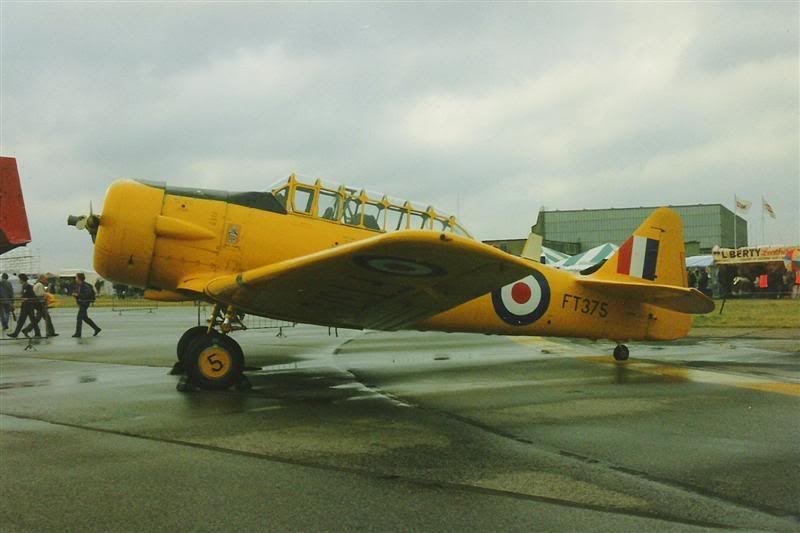
A few pics from the Battle of Britain Airshow at Boscombe Down, 9th June 1990,
Harvard, FT375
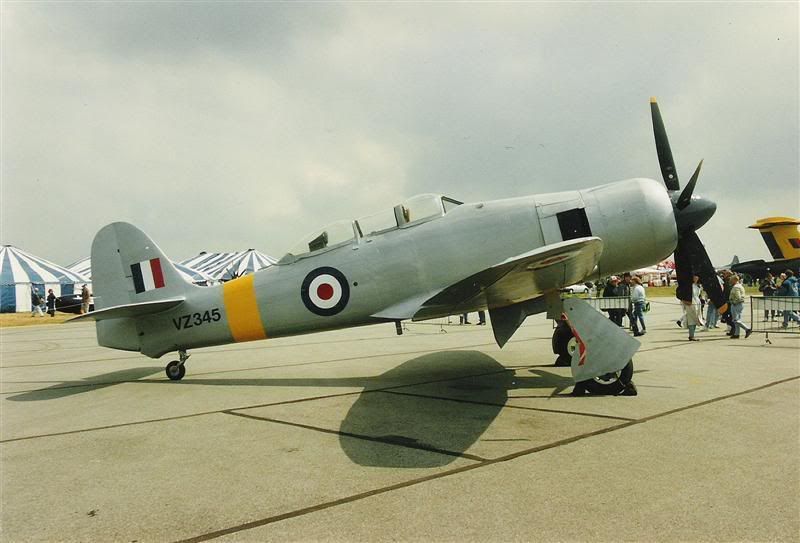
Sea Fury, VZ345, now with Royal Navy Historic Flight as a source for spares,
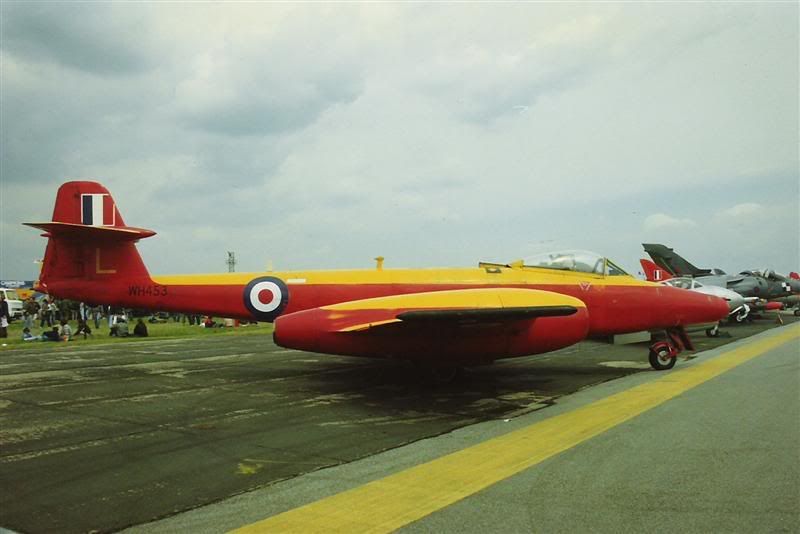
Meteor U16/D16 WH453, now at Bentwaters for restoration and display.
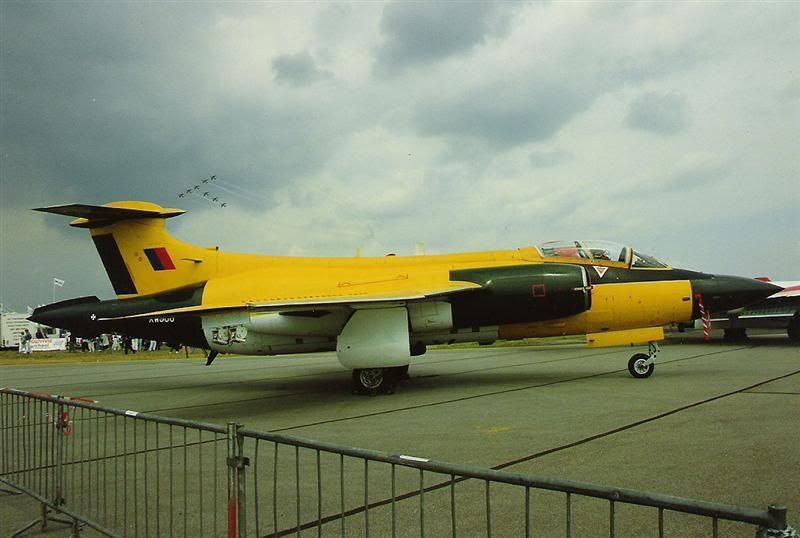
Buccaneer S.2B, XW988 now in South Africa as ZU-AVI

By: ALBERT ROSS - 25th October 2006 at 20:34
If one is going to publish pictures electronically on the Internet, then unless the photo clearly has “copyright of Mr Xxxxxx” layered across it, one has to assume that it will be copied.
It is extremely simple to layer a signature or copyright and just as easy to copy and re-produce elsewhere.
Anyone daft enough to think that they can TOTALLY enforce copyright on an image reproduced on the Internet is deluded.
For goodness sake stop moaning about copyright if your image is not layered with such or does not contain your exif tag (if it is taken using a modern digital camera it will have this embedded within the jpeg file).
Rant over!
Well said Buster! At last someone that has applied common sense and logic…now go and tell the MoD that! :rolleyes:
By: Buster The Bear - 25th October 2006 at 20:28
If one is going to publish pictures electronically on the Internet, then unless the photo clearly has “copyright of Mr Xxxxxx” layered across it, one has to assume that it will be copied.
It is extremely simple to layer a signature or copyright and just as easy to copy and re-produce elsewhere.
Anyone daft enough to think that they can TOTALLY enforce copyright on an image reproduced on the Internet is deluded.
For goodness sake stop moaning about copyright if your image is not layered with such or does not contain your exif tag (if it is taken using a modern digital camera it will have this embedded within the jpeg file).
Rant over!
By: EN830 - 23rd October 2006 at 19:32
Interesting subject.
Out of interest how does this affect various Historic Aviation Magazines?
Some publish photo’s from ‘Joe Bloggs’, during his time in the forces, whilst he was stationed at some ‘exotic’ location, during the 50’s/60’s.
I guess going by the letter of the law as I read it, they should be considered Crown Copyright, if taken by a serviceman on active duty. However I doubt whether the authorities would expel the energy and expense of chasing after, and proving that, every snap by a serviceman was Crown Copyright.
However if the revenue from publishing such photographs starts going through the roof, watch out they’ll be claiming Crown Copyright all over the shop.
I think the problem really being discussed by this thread is the plagiarism of more recent pieces of work, and the posting of such pictures on/in other media forms without the permission of the copyright owner, which I hope the legal snippets that I have posted helps to clarify.
By: WP840 - 23rd October 2006 at 17:25
Also WP840 if you just put the link to the picture on here next time then we’ll all be able to see the pictures and nobody will get upset. Then hopefully we could have some more discussion on this event and hopefully some more pics. 🙂
That sounds like a brilliant idea DGH, voila….
By: DarrenBe - 23rd October 2006 at 13:30
Interesting subject.
Out of interest how does this affect various Historic Aviation Magazines?
Some publish photo’s from ‘Joe Bloggs’, during his time in the forces, whilst he was stationed at some ‘exotic’ location, during the 50’s/60’s.
By: Yak 11 Fan - 23rd October 2006 at 08:01
Another thread ruined….
Nice to see your pics LAHARVE, thanks for sharing.
By: EN830 - 23rd October 2006 at 07:23
Ok, firstly – any photos I took myself whilst on MOD land during my RAF service I assume to fall under this “Crown Copyright” then? :confused:
Secondly – would this also apply to ANY photos taken at Airshows taking place on MOD land too??? It all sounds a bit much to me – how the forum’s many excellent photographers come under this I can’t imagine :confused:
From what I can gather it is while on duty, which as Damien has mentioned is while wearing a uniform of one her Majesties Armed Services and/or Civilian Security Services.
By: hunterxf382 - 23rd October 2006 at 03:37
Whilst I was a bit taken aback to read the heated debate over copyright issues detracting from the original reason for this post – it raised a concern which I can’t fathom due to lack of intimate knowledge, despite trawling through the Government website 😮
Ok, firstly – any photos I took myself whilst on MOD land during my RAF service I assume to fall under this “Crown Copyright” then? :confused:
Secondly – would this also apply to ANY photos taken at Airshows taking place on MOD land too??? It all sounds a bit much to me – how the forum’s many excellent photographers come under this I can’t imagine :confused:
Oh gawd, it’s the early hours after a long late shift – and now my minds gone – sorry 🙁
By: DGH - 22nd October 2006 at 16:47
While this is all very interesting may I just say thanks to LAHarve for posting his pic’s they are great to see.
Also WP840 if you just put the link to the picture on here next time then we’ll all be able to see the pictures and nobody will get upset. Then hopefully we could have some more discussion on this event and hopefully some more pics. 🙂
From a personnel point of view if you copy and paste the pictures and then say what sight there from I cant see what a jot of difference it’s going to make in real terms. (although I know it’s illegal and I wouldn’t do it myself)
By: EN830 - 22nd October 2006 at 16:37
EN830 – Rather useful stuff !
I hope so. 😉 I’m in the process of doing a law related diploma and have had to trawl through a lot of these websites for info. I must say, don’t take it as gospel; I have found many glaring errors in relation to what I am studying, on some “allegedly” reputable sites.
By: David Burke - 22nd October 2006 at 15:55
EN830 – Rather useful stuff !
By: EN830 - 22nd October 2006 at 13:56
A few more that maybe able to help
Although a few countries require that a work be marked with the international © mark followed by the name of the copyright owner and year of publication, this is not essential in most countries, including the UK. However, marking in this way may assist in copyright infringement proceedings.
Ultimately this is a matter for the courts to decide. However, it may help copyright owners to deposit a copy of their work with a bank or solicitor or send a copy of their work to themselves by special delivery (which gives a clear date stamp on the envelope), leaving the envelope unopened on its return; this could establish that the work existed at this time. (Further details of special delivery should be available at Post Offices).
Although you are not obliged to do so it will usually be sensible, and save time and money, to try to resolve the matter with the party you think has infringed your copyright. If you cannot do this, then you may need to go to court. Before doing so, you should consider obtaining legal advice. Courts may grant a range of remedies, such as injunctions (to stop the other person making use of the material), damages for infringement, or orders to deliver up infringing goods. If infringing copies are being imported from outside the European Economic Area, you may ask HM Customs and Excise to stop them
Deliberate copyright infringement may be a criminal offence. If the copyright infringement is on a large scale (e.g. pirate or counterfeit copies of CDs are circulating) then it is worth informing the police or your local trading standards department. They can decide whether action by them, including possible prosecution, is justified.
And a couple to be aware of :-
Usually, but not invariably. The UK is a member of several international conventions in this field, notably the Berne Convention for the Protection of Literary and Artistic Works and the Universal Copyright Convention (UCC). Copyright material created by UK nationals or residents is protected in each member country of the conventions by the national law of that country. Most countries belong to at least one of the conventions, including all the Western European countries, the USA and Russia. A full list of the conventions and their member countries may be obtained from the Copyright Directorate. Protection overseas can also arise from obligations in the agreement on Trade Related Aspects of Intellectual Property Rights (TRIPS), which forms part of the World Trade Organisation (WTO) Agreement
Generally, when you put your work on a web site, it is probably a good idea to mark each page of the web site with the international © mark followed by the name of the copyright owner and year of publication. In addition, you could include information on your web site about the extent to which you are content for others to use your copyright material without permission. Although material on a web site is protected by copyright in the same way as material in other media, you should bear in mind that web sites are accessible from all over the world and, if material on your web site is used without your permission, you would generally need to take action for copyright infringement where this use occurs.
Personally I don’t have to worry about Copyright, as my work isn’t of a grade where anyone in their right mind would want to copy it.
By: EN830 - 22nd October 2006 at 13:44
This may help in this debate
www.direct.gov.uk Crown copyright is copyright material which is produced by employees of the Crown in the course of their duties. Therefore, most material originated by ministers and civil servants is protected by Crown copyright
and just in case there’s any doubt the same definition from www.opsi.gov.uk
A. Copyright material which is produced by employees of the Crown in the course of their duties. Most material originated by ministers and civil servants is protected by Crown copyright. For guidance about a range of copyright and access issues see the Crown copyright guidance notes.http://www.opsi.gov.uk/advice/crown-copyright/copyright-guidance/index.htm
From www.is4profit.com
The general rule is that the author is the first owner of copyright in a literary, dramatic, musical or artistic work. In the case of films, the principal director and the film producer are joint authors and first owners of copyright. The main exception is where a work or film is made in the course of employment, in which case the employer owns the copyright. The copyright in sound recordings, broadcasts and published editions generally belongs to the record producer, broadcaster or publisher.
No. Copyright exists independently of the medium on which a work is recorded. So if, say, you have bought or inherited a painting, you only own any copyright in it if that also has been transferred to you.
Is material on the Internet protected by copyright?
Yes. Under UK law (the position in other countries may differ) copyright material sent over the Internet or stored on web servers will generally be protected in the same way as material in other media. So anyone wishing to put copyright material on the Internet, or further distribute or download such material that others have placed on the Internet, should ensure that they have the permission of the owners of rights in the material.
Copyright in a literary, dramatic, musical or artistic work (including a photograph) lasts until 70 years after the death of the author. The duration of copyright in a film is 70 years after the death of the last to survive of the principal director, the authors of the screenplay and dialogue, and the composer of any music specially created for the film. Sound recordings are generally protected for 50 years from the year of publication. Broadcasts are protected for 50 years and published editions are protected for 25 years.
For copyright works created outside the UK or another country of the European Economic Area, the term of protection may be shorter. There may also be differences for works created before 1 January 1996.
By: JetBlast - 22nd October 2006 at 12:39
Its a good job that we have got clearance to use Crown material, it only took around 5 phone calls and 3 letters to those we needed to contact.
By: Hatton - 22nd October 2006 at 12:34
here is a passage from wikipedia (not always the most reliable of sources admittedly),
“The duration of Crown copyright varies depending whether material is published or unpublished. Unpublished material was originally subject to copyright protection in perpetuity. However, the 1988 Act removed this concept from British law. Transitional provisions apply for 50 years after the entry into force of the 1988 Act which mean that no unpublished material will lose its copyright protection until January 1, 2040. New Crown copyright material that is unpublished has copyright protection for 125 years from date of creation. Published Crown copyright material has protection for 50 years from date of publication. Those works protected under Letters Patent have perpetual copyright claimed over them despite being published. Works where copyright is assigned to the Crown by an author are subject to the normal term of protection for that particular type of work, for example life of the author plus 70 years for a literary work”
so does this mean that any image taken prior to 1956 is therefore usuable without fee or have I got this completely wrong?
thanks in advance, Steve
By: Hatton - 22nd October 2006 at 12:29
Rather than continue the arguements in this manner, would someone be as kind to include a link to the definitive rules of crown copyright.
I have found this site
but have yet to find a clear definition of how crown copyright material may be used, what payments (if any) need to be made and what the official time period must pass before it is public domain.
Would be beneficial to learn something from this thread,
kind regards,
Steve
By: Mark12 - 22nd October 2006 at 12:20
, I have yet to hear of anyone being prosecuted for publishing someone elses photo.
I think one of the contributors to this thread can remember a significant and very expensive prosecution.
Speak.
Mark
By: ALBERT ROSS - 22nd October 2006 at 09:46
Andy,
I quite agree with you! The whole process is flawed and in many cases practically unenforcable. If you hold an original negative, then no one else can claim copyright. However in the digital world, these is even more flawed.
For example, go to a ‘photocall’ on an RAF Station and stand beside dozens of other photographers taking identical shots. How on earth can one person claim copyright on the one he/she took if they are all identical unless they add some invisible ‘watermark’ on the image? Furthermore, MoD are now trying to make EVERY photograph taken on their property ‘Crown Copyright’. The whole issue is a farce!
By: Arabella-Cox - 22nd October 2006 at 09:38
Not wishing or really able to add to the debate on copyright issues relating to the internet, I am often perplexed by the IWM’s claim to copyright on pictures they hold. For example, I hold original prints and negatives of a number of 1940 period images that were given to me by the photographer and yet the IWM hold copy prints and, presumably, copy negs. I know that they claim “Copyright” on these images but think that the argument is often somewhat flawed. Andy
By: ALBERT ROSS - 21st October 2006 at 23:38
Wouldnt it be a good idea for you to check, I’d hate for your collection be to Crown Copyright (I can see no reference to a time limit on the Government website which explains the rules for publishing CC material.)
You DO realise that they have only just drawn these rules up and cannot suddenly make every photo taken by a serviceman since 1st April 1918 CC!!! 😮


 Sign In








 October 16, 2006 at 1:48 pm