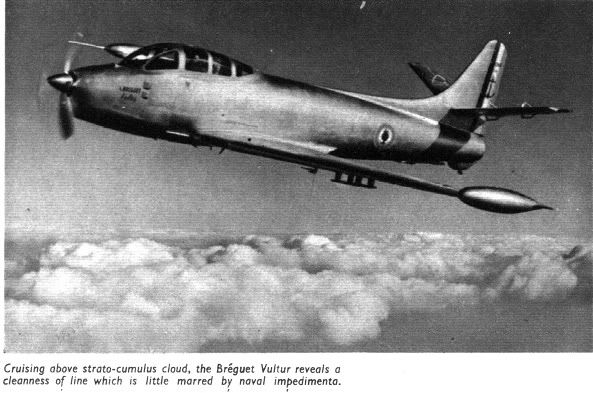
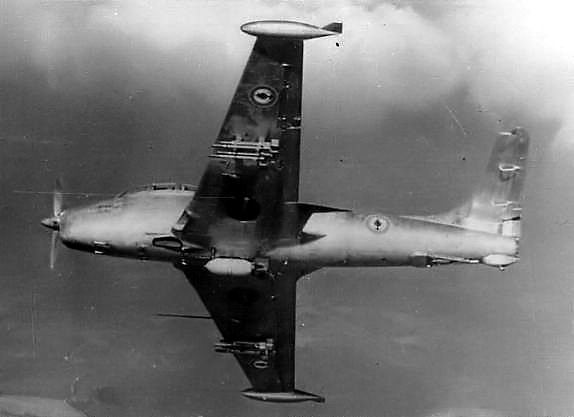
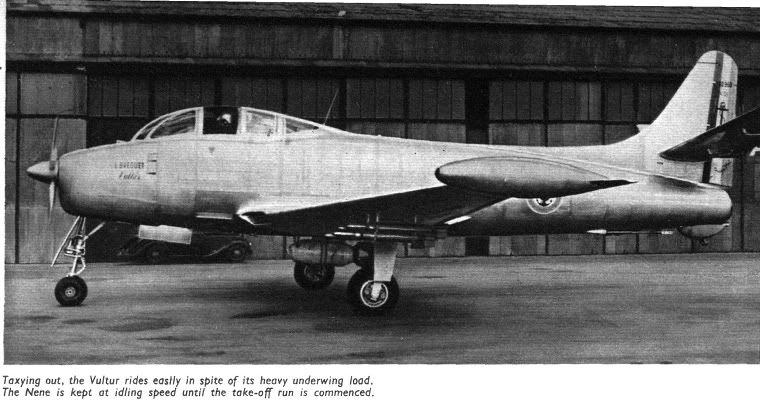
Just read about the Breguet 960 Vultur today. Lovely aircraft and very interesting what-if. Had it entered service, IMHO it just might have been the best naval fighter-bomber of the mid 1950s. A cross between the Skyraider and the Hawker Sea Hawk….
Remember, this was a time when many CVs didn’t have angled decks. In addition, there were a lot of small escort carriers in service. These carriers were pushed to their limits by jet-powered fighter-bombers such as the F9F Panther, F2H Banshee and Hawker Sea Hawk. As a result, prop-driven attack aircraft such as the Skyraider, Bearcat and Westland Wyvern continued to serve until the end of the 1950s.
The Vultur was an attempt to bridge the gap, by combining a turboprop with a jet engine. It had a lower approach speed than any of its prop-driven competitors (75 kts vs. 85-105kts), but its slightly swept wing would have given fighter performance close to its straight-wing jet-engined contemporaries (max speed 900km/h). For the A2G role, it had an armored cockpit (14mm + 80mm canopy), similar to the AD6 Skyraider which first flew around the same time, as well as radar and a co-pilot to guide air-to-surface missiles. It could cruise on its turboprop for four hours, and use its jet engine in combat. Its biggest flaw was the lack of an internal gun (used an external pod instead), as well as limited range using its jet engine but hopefully these would have been fixed in service?
The Vultur would have been perfect for the Colussus/Majestic class carriers… 😎
Here’s a very interesting flight test by Flight International:
http://www.flightglobal.com/FlightPDFArchive/1953/1953%20-%200612.PDF
http://www.flightglobal.com/FlightPDFArchive/1953/1953%20-%200613.PDF
http://www.flightglobal.com/FlightPDFArchive/1953/1953%20-%200614.PDF
http://prototypes.free.fr/fr1/fr1-10.htm

By: Bager1968 - 1st January 2010 at 00:07
Looking at the shape of that I’d say it was the basis of what became the Alize
As Wanshan posted in the second post (first reply) in this very thread!
Ya might wanna read the whole thread before posting… just saying.
The Breguet 690 Vultur was a mixed-powerplant design incorporating an Armstrong Siddeley Mamba turboprop in the nose and a Hispano-Suiza Nene turbojet in the rear fuselage. The jet provided additional thrust for combat performance and take-off.
Experience with the Vultur, first flown on 3 August 1951, led the French navy to abandon the idea of such a powerplant for a strike aircraft. Instead, Breguet was contracted to develop a three-seat carrier-based anti-submarine aircraft from the Vultur [the Breguet 1050 Alize].
http://www.aviastar.org/air/france/breguet_vultur.php
This three-seat carrier-borne anti-submarine hunter-killer was derived from the 960 Vultur naval strike aircraft.
The first prototype [of the Breguet 1050 Alize] flew on 6 October 1956 and was followed by five pre-production aircraft. Orders for 75 production Alizes were placed by the French Navy and the first was officially delivered on 20 May 1959. Sixty-five were in service by May 1961. A further contract for Alizes was received subsequently from the Indian Navy and 12 were delivered, plus two ex-French aircraft. Two French Navy squadrons operated Alizes on board the carriers Foch and Clemenceau.
By: mike currill - 31st December 2009 at 21:18
Just read about the Breguet 960 Vultur today. Lovely aircraft and very interesting what-if. Had it entered service, IMHO it just might have been the best naval fighter-bomber of the mid 1950s. A cross between the Skyraider and the Hawker Sea Hawk….
Remember, this was a time when many CVs didn’t have angled decks. In addition, there were a lot of small escort carriers in service. These carriers were pushed to their limits by jet-powered fighter-bombers such as the F9F Panther, F2H Banshee and Hawker Sea Hawk. As a result, prop-driven attack aircraft such as the Skyraider, Bearcat and Westland Wyvern continued to serve until the end of the 1950s.
The Vultur was an attempt to bridge the gap, by combining a turboprop with a jet engine. It had a lower approach speed than any of its prop-driven competitors (75 kts vs. 85-105kts), but its slightly swept wing would have given fighter performance close to its straight-wing jet-engined contemporaries (max speed 900km/h). For the A2G role, it had an armored cockpit (14mm + 80mm canopy), similar to the AD6 Skyraider which first flew around the same time, as well as radar and a co-pilot to guide air-to-surface missiles. It could cruise on its turboprop for four hours, and use its jet engine in combat. Its biggest flaw was the lack of an internal gun (used an external pod instead), as well as limited range using its jet engine but hopefully these would have been fixed in service?
The Vultur would have been perfect for the Colussus/Majestic class carriers… 😎
Here’s a very interesting flight test by Flight International:
http://www.flightglobal.com/FlightPDFArchive/1953/1953%20-%200612.PDF
http://www.flightglobal.com/FlightPDFArchive/1953/1953%20-%200613.PDF
http://www.flightglobal.com/FlightPDFArchive/1953/1953%20-%200614.PDF
http://prototypes.free.fr/fr1/fr1-10.htm
Looking at the shape of that I’d say it was the basis of what became the Alize
By: H_K - 31st December 2009 at 05:24
No responses. I must be the only person interested in the turboprop vs. turbojet debate… :p
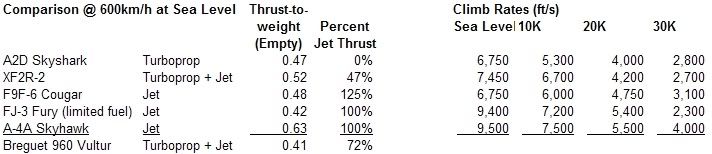
I’ll just keep going then. 😉 After reading up on the difference between horsepower and thrust, I realized that I overestimated the performance advantage of turboprops at higher speeds. I thought that there was a constant relationship between HP and thrust (about 2.6lb per HP), but as it turns out turbojet thrust decreases with speed. So the ratio of 2.6lb/HP is only true at 185km/h. In fact, at dogfighting speeds of 600km/h, it’ll be closer to 1lb/HP.
I reran the turboprop vs. turbojet comparison at 600km/h, and the turboprop advantage disappears. However, the Mamba + Nene combo is still competitive versus the Sabre’s J65.
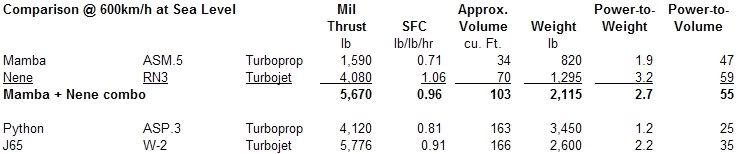
The thrust-to-weight ratios now make a lot more sense and are more aligned with each aircraft’s climb rates. The Vultur’s thrust-to-weight at 600kmh is pretty good, and only gets better at lower speeds (i.e. as fighters bleed energy in a dogfight), so it should be able to compete in a dogfight with jets if it can survive the initial high speed pass.
By: H_K - 30th December 2009 at 08:39
IMHO, a turboprop+turbojet combo actually doesn’t seem so bad for a low altitude strike aircraft. I ran some numbers and the results were interesting. 😀
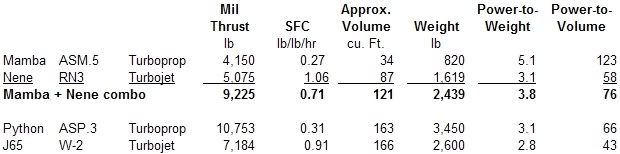
* First, turboprops have 3-4 times lower specific fuel consumption. So by relying on a turboprop for cruise, with the turbojet off or on a low thrust setting, you can design a smaller/lighter fighter bomber with less internal fuel. Or you can fly farther/longer. Both are good for a naval aircraft.
* Second, turboprops have much better thrust response, especially at slow speeds (they use blade pitch), so that is useful in a dogfight, as well as for carrier approaches.
* Third, turboprops offer more power density relative to their size & volume, and in the 1950s smaller engines were generally more efficient, so it makes sense to use a small turboprop + small turbojet combo rather than a large turbojet or a large turboprop.
Of course, turboprop performance trails off at high speed/high altitudes due to lower propeller efficiency, but that shouldn’t be a problem for most dogfights under 20,000ft, which is where you’d expect a fighter-bomber to operate.
Here are some comparisons, assuming a conversion factor of 2.6lb thrust to 1 SHP (used in Flight International at the time, and probably accurate for dogfight conditions at low altitudes when the prop is at high efficiency). The first table is a snapshot of engine technology in 1953, showing how a turboprop+turbojet combo was better than either a big turboprop (e.g. Westland Wyvern) or a big turbojet (FJ-3 Fury).
The second table shows how aircraft with turboprops or turboprop+turbojet combos had very respectable climb rates. This is actually a bit of an unfair comparison, sincee the F9F-6 Cougar and FJ-3 Fury were swept wing fighters/interceptors, and the best naval fighters of the mid-1950s. But I’m intentionally setting the bar high. 😉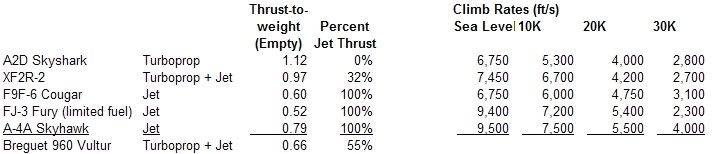
Compared to the A2D Skyshark and XF2R-2, the Breguet 960 Vultur was heavier and more attack oriented, with a lower thrust-to-weight ratio. However, IMHO its fighter performance should have been at least as good. It had a lower drag design, thanks to a smaller, more compact turboprop and slightly swept, high-lift wing. Also, the Vultur relied more on jet thrust, so performance would have dropped off less at high speeds or altitude. This superior performance is anecdotaly confirmed by the fact that the Vultur had a higher top speed of 900km vs. the low 800s.
So IMHO until the A-4 Skyhawk, Scimitar and more angled deck carriers came along , I think this was a pretty good solution. :diablo:
By: H_K - 29th December 2009 at 20:32
The Vultur may have been a dead end concept, but then again so were all prop-driven aircraft at that time, and that didn’t stop the F4U Corsair and A-1 Skyraider from providing sterling service into the 1960s. 😉
Here’s some quotes I found on the Vultur:
On the power of both engines, the second Vultur attained a maximum speed of 559 mph, and 248 mph on the power of the Mamba alone, and more than met the requirements of the specification but owing to the rapid increase in performance of the fighters by which the Vultur was likely to be opposed, the French Navy abandoned its requirement for a strike aircraft.
The Breguet 960-02 later completed a series of dummy deck landings and catapult-assisted take-offs at Farnborough, and proved fully capable of completing its designed role. As is so often the case, this role was then abandoned, because of the rapid increase in performance of opposing fighters”
The window of opportunity for the Vultur was 1954-1958, before most of the Colossus/Majestic carriers were reequipped with angled decks and before superior jet-engined fighter-bombers such as the Scimitar and Skyhawk entered service. Even after 1958, it wouldn’t have been completely obsolete, since it would have been a good choice for navies that soldiered on with the slower Skyraider and Corsair.
As for the Sea Venom, it was clearly a better fighter, but a rather limited fighter-bomber, carrying only guns & eight rockets. Also, it didn’t have the low speed CAS ability and carrier landing caracteristics of prop-driven aircraft, so not a perfect comparison.
By: TinWing - 29th December 2009 at 15:49
The de Havilland Sea Venom was altogether superior, which explains the MN order. Putting aside the fact that the compound prop/jet fighter was a doomed concept, the lack of a suitable space for an air-to-air radar set would have precluded the night fighter role, the one role where an early straight wing jet could still compete against early swept wing types.
By: Merlock - 29th December 2009 at 12:38
Well, the idea of an airdraft combining a turboprop with a jet engine, proved a not-so-good idea, but the Vulture remains a most beautiful looking aircraft, thank for posting about it, H_K… 🙂
________
Alaska Dispensaries
By: Wanshan - 29th December 2009 at 12:26
The Breguet 690 Vultur was a mixed-powerplant design incorporating an Armstrong Siddeley Mamba turboprop in the nose and a Hispano-Suiza Nene turbojet in the rear fuselage. The jet provided additional thrust for combat performance and take-off.
Experience with the Vultur, first flown on 3 August 1951, led the French navy to abandon the idea of such a powerplant for a strike aircraft. Instead, Breguet was contracted to develop a three-seat carrier-based anti-submarine aircraft from the Vultur [the Breguet 1050 Alize].
http://www.aviastar.org/air/france/breguet_vultur.php
This three-seat carrier-borne anti-submarine hunter-killer was derived from the 960 Vultur naval strike aircraft.
The first prototype [of the Breguet 1050 Alize] flew on 6 October 1956 and was followed by five pre-production aircraft. Orders for 75 production Alizes were placed by the French Navy and the first was officially delivered on 20 May 1959. Sixty-five were in service by May 1961. A further contract for Alizes was received subsequently from the Indian Navy and 12 were delivered, plus two ex-French aircraft. Two French Navy squadrons operated Alizes on board the carriers Foch and Clemenceau.


 Sign In








 December 29, 2009 at 8:21 am