Im modeling a C-47 (or DC-3 whichever name you like) for a game mod, and I need some information on how to model and animate it. Basically I cant figure out how the landing gear folds into the wheel well. If you look at the picture below you can see that the wheel must rise at an angle that pivots on the axis of the rear retaining strut. But the main strut doesnt appear to have any hinge in the middle of where it folds, so Im wondering how it can retract. If someone knows the answer to this and it is difficult to explain how it works, please draw a diagram on paper and scan or draw with your mouse using MS Paint.


here is what my model looks like if youre curious

By: pagen01 - 22nd April 2008 at 21:17
…maybe helpful
http://www.robart.com/retracts/drawings/162.pdf
Martin
Better than my drawings!:o
By: wieesso - 22nd April 2008 at 20:56
…maybe helpful
http://www.robart.com/retracts/drawings/162.pdf
Martin
By: mixtec - 22nd April 2008 at 18:46
thanks all for this info
By: J Boyle - 22nd April 2008 at 18:01
About windows…
If you’re making a DST (Douglas Sleeper Transport, the original DC-3), remember the small rectangular windows above the main windows for the sleeping berths.
By: keithnewsome - 22nd April 2008 at 17:27
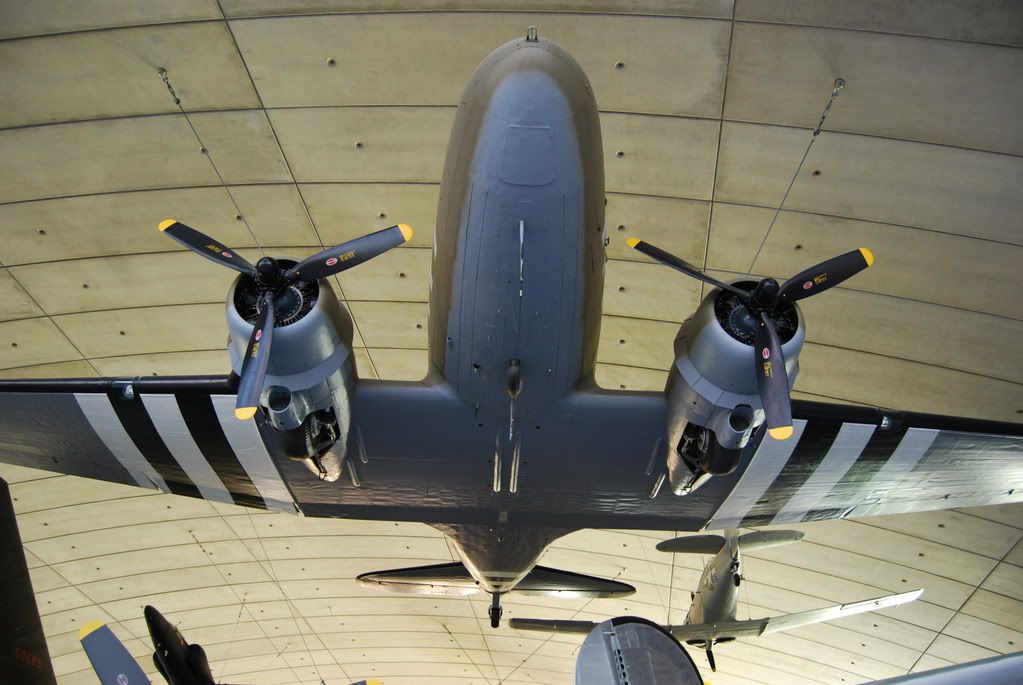
My photo of a DC 3, C 47, Dakota !!!!!! with it’s wheels tucked up, I see some benefit from “hanging” aircraft now ? Hope this helps a little. Keith.
By: pagen01 - 22nd April 2008 at 16:08
I found these original Douglas plans… only joking
Just a very rough sketch on how the undercarriage retracts.
Point A is the U/C mount at the top of the front spar (S), point B is the main leg break knuckle, and point C is the fulcrum point of the rear strut. The rear strut remains a constant length, as the retraction jack pulls the upper part of the main leg forwards the rear strut causes the knuckle to snap and the lower part of the main leg to move rearwards in effect.
Because the upper part of the leg is significantly longer than the lower part it causes the wheel to sit further forward when retracted than when it is lowered, this is where confusion between forward and backward motions can occur.
The clever thing is all this is designed to happen without causing any cut out to the main spar
Hope this helps, can do a better illustration if needed!
By: mark_pilkington - 22nd April 2008 at 14:25
DC-2’s and pre-war DC-3’s used single row Wright Cyclone (1820) engines with significantly different engine cowls and narcelle intakes to the wartime C-47 which used Pratt & Whitney twin row Twin Wasp (1830) Engines.
The wright Cyclone results in a wider radius cowling.
The DC3 at Moorabbin is one of three original pre-war DC-3’s surviving in Australia.

Many pre-war DC-3’s also had their passenger doors on the starboard or RHS, this being inherited from the original American Airlines specification (VH-ANH was built as a RHS door example for American Airlines but modified post war in Australia to a port or LHS entry door). Note DC-2’s were predominately on the LHS.
some civilian DC-3s were built with the pratt and Whitney twin row engine, these were DC-3A models.
JDK’s link in his previous posts show a DC-3 (DST) and DC-3A with the differing engine cowls.
The early DC-3 (DST) in JDK’s link shows a Wright Cyclone with the top area covered in as per DC-2’s this was discontinued early on DC-3’s and even later DC-2’s (there was a period of concurrent production).
All C-47’s were built with the twin row engine and therefore the “narrower” engine cowl.
DC-3’s, C-47’s and C-47A’s had a different engine narcelle structure to the later C-47B. The C-47B the most numerous model built – was designed to fly over the mountains with high altitude engines and have large intake structures behind the engine on the engine narcelles for the superchargers.

(HARS C-47B example – astrodome retracted and therefore not obvious – but note large supercharger intakes over narcelle)
Many C-47’s were modified back to civil airliner configuration post war and re-defined as DC-3’s.
Most were converted to LHS passenger entry doors and retained their Pratt & Whitney twin row wasps thereby approximating DC-3A’s, some retained their cargo doors for freight use.
In Australia the RAAF disposed of the C-47’s and C47A’s but retained their C-47B’s.
Many of the C-47’s and C-47A’s were obtained by ANA and Ansett Airlines who had purchased quantities of low hour Hudson engines and converted their former RAAF aircraft back to full DC-3 configuration by replacing the Pratt & Whitney Twin Wasps with Wright Cyclones as well as fitting the LHS passenger door in place of the cargo doors.
As commented by others the square windows were a feature of the DC-2, DC-3 and C-47 family so there is no differentiation between the two based on that feature.
In summary the features to examine depending on the particular model being depicted would be engine type and associated cowl, door type and side, and narcelle intakes, as well as the astrodome on the top of the cockpit on the C-47 military versions, (although again in some cases retained on post war civilianised “DC-3” ‘s !
Below is an image of a preserved RAAF / RAN C47A similar to the headline photo at the start of the thread showing the streamlined nacelles of the earlier versions of the C-47 “Skytrain”, as compared to the C-47B above, but also note the unique and original C-47/C47A cowlings with the large carb air intake (often deleted on the civilian conversions) as compared with the DC-3A and C-47B, also note the retracted astrodome mounting.
Regards
Mark Pilkington
By: JDK - 22nd April 2008 at 13:00
Pembroke- Does the main leg fold forward or backwards?
The two halves fold forward at the hinge.
From (in profile) something like: l / to < /
Search on Google images <1 min.

Note this example has the later undercarriage doors fitted, NOT an original production feature.
Doors. The Military types had a two part cargo door that split, opening forward and aft, or could be removed, in which was inset a passenger door in the fwd cargo door. Very obvious in the pic.The DC-3 had ONLY a passenger door.
Another difference is that the DC3 has round passenger windows and C-47s ‘square’ ones.
It did? News to me… Not sure what you mean. Certain of the military types had small ‘plugs’ so the soldiers could fire their guns from the windows, but otherwise they were essentially similar, AFAIK.
The DST had ‘slot’ upper windows for the sleeper berths. High res DST here:
http://www.stinsonflyer.com/avphoto/dc3-04b.jpg – note the starboard passenger door and window arrangement, also the different (DC-2) style engine cowls on that other engine type.
DC-3, showing the square windows and port passenger door. http://www.stinsonflyer.com/prop/dc3-06.jpg
There are literally thousands of good references on the family, on the web, and books – try your local library.
Cheers,
By: bri - 22nd April 2008 at 10:10
Another difference is that the DC3 has round passenger windows and C-47s ‘square’ ones.
Bri 🙂
By: mixtec - 22nd April 2008 at 09:45
JDK- I see now where that hinge is youre talking about. Cant believe that supports 13 tons of aircraft. Also interesting you pointed out the cargo doors because that had me fooled too, I thought it opened up as one piece considering the large hinges on the left side, but then I saw a pic that shows it opens split on each side.
Pembroke- Does the main leg fold forward or backwards?
If anyone has any WW2 pics of C-47s they could post that shows all the radio antennas, Id appreciate it as all the photos Im finding on the net are of pics being taken by people of birds still in service.
By: PembrokeC1 - 22nd April 2008 at 08:25
Main leg “breaks” and pivots in the middle allowing wheel to move forward and up into the wheel well
By: JDK - 22nd April 2008 at 08:24
…you can see that the wheel must rise at an angle that pivots on the axis of the rear retaining strut. But the main strut doesnt appear to have any hinge in the middle of where it folds…
…but it does. The top of the lower ‘A’ with the bar across its top, that bar is the hinge – in your lovely colour photo you can see the end of the hinge clearly as a round bump. The two halves fold forward at the hinge.
Be careful of the subtle differences – a DC-3 has a passanger but no cargo door, some in fact having a door on the starboard side, while the C-47 (Dakota) etc. designations are generally the same external airframe.
HTH


 Sign In








 April 22, 2008 at 7:53 am