Can anyone ID the Gruppe and what colours it may have been please?
Ok, this is what is known about the plane:
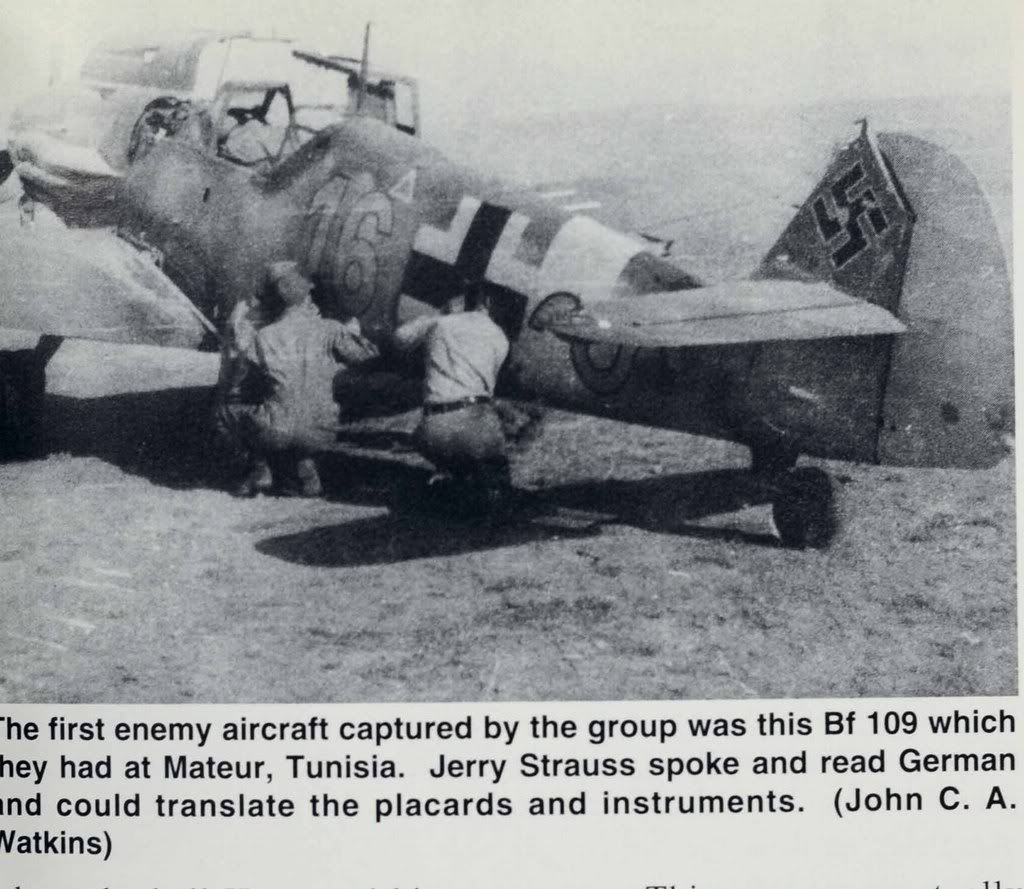
The 109G had been found in a Wheat field after the surrender of Germany in North Africa. It was taken to a nearby British Airfield by t he 325th FG.
It had been landed by a mortally wounded but was relatively intact. A 20mm shell had gone through the longeron on the Port side and exploded in the cockpit, another had exploded against the pilots armour plated seat and one had gone through the rudder. One tyre was flat due to the landing, but that was all.
A new battery was fitted to it, and the damage patched up, and the 325th FG had their first 109G
That’s all the info I have, but here is a picture:
and here’s another image showing a better profile:

Not sure if it’s a G2/4 or 6. It looks from the air-filter to be a tropical conversion.
One point that has thrown a few people I have asked is the location. However, I believe it was taken to the base, and the location may not be as relevant to the markings of the Gruppe that flew the plane?
I can offer no more information, and hope that someone can ID the plane Gruppe, Model version and finally the colour of the markings. I can see the White Rudder and band around the fuselage, along with No.16 and the marking behind the band.
Any thoughts appreciated, cheers, MP.

By: fw190uk - 3rd July 2008 at 22:14
According to the book If you disagree your argument is with the authors not me.
Well, its great if you have the book in front of you in it, i was doing it from from looking at a photo with no book telling me exactly what it was.:diablo:
As far as i`m aware there has been no argument, mike currill just wanted to know how i came about my guess. Which is all it was, an educated guess.
I thank you.
By: antoni - 3rd July 2008 at 20:01
There were two types of black-and-white film in use in WW II, orthochromatic and panchromatic. Ortho film is not sensitive to the red and yellow part of the visible spectrum and so they appear as very dark tones. Panchromatic is sensitive to all colours of the visible spectrum so yellow appears as a light tone. The yellow outer ring of an RAF roundel shows the difference between the films extremely well.
According to the book the aircraft was in standard European camouflage. The profile looks like all over RML 76 with grey mottle. Underneath of the nose and rudder yellow. 16 and squiggle yellow with black outline. Spinner, underneath of wing tips, band around the fuselage white. Wheel hubs dark grey RLM 66. If you disagree your argument is with the authors not me.
By: mike currill - 3rd July 2008 at 12:15
Right, it all makes sense to me now. Yes it certainly looks like it, well done.
By: fw190uk - 3rd July 2008 at 11:07
How you can have any idea what colour that ’16’ is beats me but I’ll bow to your knowledge and accept that you are correct.
The 16 is a slightly darker colour than the white spinner, wing tips rear band. so use that as a referance point.
The 16 is not in black.
Also red would also be dark (depending on exposure red can look like black)
Through my experience (my 1st job was a photo journalist) and working with black and white film stock you can get a good idea of colour, exposure etc. Looks like my guess/hunch was right from the infomation antoni put on.
By: mike currill - 3rd July 2008 at 07:25
I would say G6 trop, white theatre band, wing tips and spinner, upper surface is RLM 79, lower RLM 78 while the dark mottled patches on the upper fuselage would be RLM 80. The 16 to me looks like its in yellow “yellow 16”.
How you can have any idea what colour that ’16’ is beats me but I’ll bow to your knowledge and accept that you are correct.
By: Mysticpuma - 30th June 2008 at 22:38
antoni, excellent detail, and thank you for your input, that helps me out a lot!
Gratefully yours, MP.
By: antoni - 30th June 2008 at 20:45
From Captured Me 109s , Polish book written in quaint English. I’ve tried to tidy up the grammar as best as I can.
In May 1943 the first enemy aircraft captured by the 325 FG USAAF was Me 109 G6/Trop. (“Yellow 16” of 9./JG 77) in Mateur, Tunisia. Jerry Strauss knew German and was able to translate the placard and instruments which helped mechanics to restore the machine into flying condition. The Messerschmitt was repainted overall flat black with a red spinner, rudder, and ailerons. It was also given USAAF markings and named “Hoimann” in honour of Hermann Goring.
The plane was remembered by the American pilots after a curious military action – a simulated attack on Lightning’s base (1st FG USAAF). Near the 325th FG twin-engined P-38 Lightning units were based. P-38 pilots had a bad habit (especially pilots of 14th Fighter Group) of attacking all single-engined aircraft in the air as they treated them as the enemy planes. The result was P-40 pilots of 325th FG “Checkertails” were often “victims” of P-38 attacks. What is more, they used to leave their charges and leave them at the mercy of German fighters. The situation was not funny for “Warhawk’s'” pilots as they were often a laughing stock. The capture of Me 109 created a devil’s spawn in the”Checktailers” commander’s head as he desired to take revenge. After P-40s return from the mission, Colonel Robert L. Baseler ordered to prepare “Hoimann”, About three kilometers from “Checktailers'” base P-38s were stationed. Their airfield was based at the foot of hills. He flew very low over the parked P-38s so that their pilots would see without any doubts what sort of plane it was. He turned back and did it once again. Some of the American pilots were having a dinner. When they had noticed that the plane is turning back they immediately ran for cover. Baseler later recalled the scene as being: “Like a bunch of chickens after they had seen the shadow of chicken hawk on the ground”. After that, Baseler landed at 325th FG airfield and ordered to put the plane back to its place. In the middle of a night Col. Ralph B. “Egghead” Garmin arrived at the 325th FG base and wanted to see the commander of the unit. Garmin was CO of 1st FG USAAF at the time. It soon turned out, that Baseler made his flight not over hated 14th FG base but over the base of 1st FG. Both commanders got into an argument. Baseler did not admit that he “attacked” the wrong base but told Garmin that his pilots were often attacked by P-38 pilots in the past. That was quite irritating situation for them. “Egghead” agreed and told Baseler that he will talk with commanders of other P-38 units. The Baseler’s “attack” with Me 109 was fully successful. Never more similar incidents have happened in the future.
By: fw190uk - 30th June 2008 at 17:59
I would say G6 trop, white theatre band, wing tips and spinner, upper surface is RLM 79, lower RLM 78 while the dark mottled patches on the upper fuselage would be RLM 80. The 16 to me looks like its in yellow “yellow 16”.
By: mike currill - 30th June 2008 at 17:54
Your guess that it is a trop variant is correct if that filter is anything to go by. I’ve often wondered if these filters were all factory fitted or if some were field fitted.


 Sign In








 June 30, 2008 at 5:27 pm