HQ-9 (Exported version name: FD2000) is an active radar homing, long range surface to air missile that have been already in service in PLA for some years.
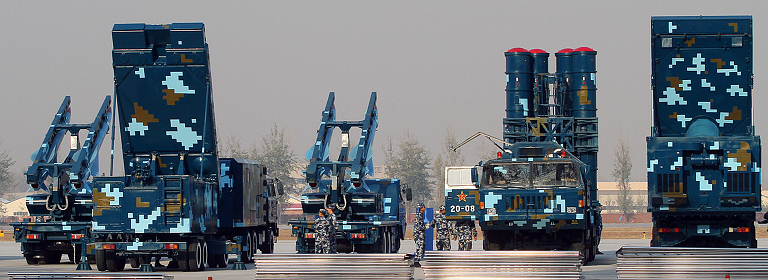
Now news come out Turkey is more interesting in this air defense system over several western or Russian SAMs
Let’s fingers crossed for the event unfolding…
Turkey May Adopt Chinese Air Defense System
ANKARA — Turkey is strongly leaning toward adopting a Chinese long-range anti-missile and air defense system, Turkish procurement officials said, even though it may be impossible to integrate the system with its existing NATO architecture.
One senior procurement official familiar with the program said the Turkish government has concluded that the Chinese proposal was technologically satisfactory, allowed technology transfer and was much cheaper than rival proposals.
The decision to select the Chinese contender awaits final approval from Defense Minister Ismet Yilmaz and Prime Minister Recep Tayyip Erdogan.
The decision would be finalized and officially announced at the next meeting of the Defense Industry Executive Committee, chaired by Erdogan, which oversees major procurement decisions. No date has been set for the meeting.
In January, Turkey restructured the $4 billion program, dubbed T-Loramids, which had originally been constructed as an off-the-shelf purchase. The contenders’ bids would remain valid, but the Undersecretariat for Defense Industries (SSM) procurement office would ask bidders to submit parallel, co-production solutions. Erdogan ordered the launch of feasibility studies on “potential co-production” of the system.
T-Loramids consists of radar, launcher and intercept missiles.
The same month, SSM wrote to the bidders and asked them to send letters of intent for any co-production deal. The bidders are a U.S. partnership of Raytheon and Lockheed Martin, offering the Patriot air defense system; Russia’s Rosoboronexport, marketing the S-300; the China Precision Machinery Export-Import Corp., offering its HQ-9; and the Italian-French consortium Eurosam, maker of the SAMP/T Aster 30.
T-Loramids, has been designed to counter both enemy aircraft and missiles. Turkey has no long-range air defense systems.
But diplomats and analysts warn that Turkey may not be allowed to integrate the Chinese-Turkish system into Turkey’s mostly NATO-owned early warning assets.
“I cannot comment on how the [US] administration would react to that. But I can tell you that integrating a Chinese or Chinese-Turkish air defense system into NATO assets may not be a good idea,” a US diplomat here said.
A Western industry source said that US officials have warned the Turkish bureaucrats several times about the potential difficulties in achieving interoperability if Turkey decided to go for a Chinese or a Russian architecture.
“I see that the Turks remain defiant. But I do not think it would be practically possible to integrate either the air defense or the anti-missile components of the planned Turkish-Chinese architecture into NATO radars,” a London-based Turkey specialist said. “The Turks would have the same problem if they chose the Russian system, but I think for the Americans, China represents a more direct threat.”
About half of Turkey’s network-based air defense picture (radars) has been paid for by NATO, said a Turkish defense official familiar with NATO work. They are part of the NATO Air Defense Ground Environment. He did not comment on potential problems if Turkey wanted to make the planned system interoperable with these assets.
To defend against missile threats, Turkey needs satellite and dedicated ballistic missile detection and tracking radar like the NATO radar deployed last year in Kurecik.
For the anti-aircraft component, Turkey needs an overall picture for data fusion. The Patriot system, for instance, can detect threats with its own radar. So does the Chinese system. But without integrating into a full air picture, the Chinese system could not work efficiently, officials said.
“Turkey can always decide to build a stand-alone system. But in that case, abstracting the air defense system from NATO assets would mean that Turkey will lose half of its radar capabilities,” said one defense analyst here.
He said Turkey would need interface data to make its own air defense architecture interoperable with NATO assets, primarily data on the identify friend or foe system.
“This is top secret and cannot be installed into any Chinese system,” the analyst said.
Another major question, he said, is “how would Turkey have in its possession a made-in-China IFF system, and how would that system be integrated into its fleet of F-16 aircraft?
“There is an important degree of incompatibility here and all in all any Chinese-Turkish co-production program would look problematic,” he said.

By: HAWX ace - 2nd October 2013 at 16:12
Turkey’s China deal on missile system not finalized, says President Gül
That purchase is not definite. There is a shortlist, and China is at the top of it. We should look at the conditions, but there is no doubt that Turkey is primarily in NATO. These are multi-dimensional issues, there are technical and economic dimensions and on the other hand there is an alliance dimension. These are being evaluated. Turkey needs a defense system,” Gül said while onboard a plane that was en route to Turkey.
By: totoro - 1st October 2013 at 14:28
It was a pattern for 2009 parade, so basically for PR purposes. Probably some pieces remained painted for various expos, etc. Everyday units do have green/brown camo.
By: Vnomad - 1st October 2013 at 08:07
Not to derail the topic, but what’s the thinking behind that camouflage pattern. Shouldn’t it be green or brown. Maybe grey, if its to blend onto concrete. Something drab basically.
By: El_Indigo - 28th September 2013 at 09:49
Indeed TR.
Chinese won because their offer was billion dollars cheaper than the other contenders and tech transfer. Nothing to do with fabled misses of patriot or a system that wasn’t there or won’t be up for export for a long time.
By: TR1 - 28th September 2013 at 06:00
S-400 didn’t take part in any field tests in Turkey.
Nice try though.
By: JSR - 28th September 2013 at 05:50
The above news not reliable as S400 export ban so highly unlikely to be tested for foreign buyers as there is no export version developed yet. than there is production capacity limitations untill new factories comes online.
http://www.dailyairforce.com/1162/export-version-of-s400-to-be-ready-in-2017.html
An export version of the S-400 Triumph air defense missile will have been developed by 2017 with the Chinese to be the first clients,” the source said.
http://in.news.yahoo.com/no-400-missile-exports-2015-russia-110018814.html
No S-400 missile exports before 2015: Russia
By: Pinko - 28th September 2013 at 02:21
Well, it seems the answer is “yes” to the Q in topic, at least one good thing: we’ll know more open data on HQ-9A :
decides to buy 4B USD worth of Chinese HQ-9 missile systems
because HQ-9’s hit all targets while Patriot and S-400 miss some in field tests. :dev2:
Google translate
Turkish Defense Minister Yilmaz Thursday (26 May) announced that China Precision Machinery Import and Export Corporation, has won the Turkish manufacturing range air defense and missile defense system tender.
To participate in this project worth about $ 4 billion bid for air defense missile systems: American Patriot, Russian S-400, France, Italy, the European air defense missile’s Samp-T, as well as China’s FD-2000 (Sina Editor’s note: the Chinese HQ-9 air defense missile export version).
The reason why the red flag 9 wins, mainly in the tender scene shooting live ammunition in all hit, while the Patriots and S300 are repeatedly off-target, fabled,
Read more at http://www.liveleak.com/view?i=b91_1380261032#SV5ymXuiYPfEqMuM.99
By: HAWX ace - 26th June 2013 at 20:36
There wqasn’t any trouble with Greece adopting Russian systems (or Turkey for that matter or South Korea – ok , the latter is not NATO but similarly US ally)
It’s a free market!
The only Russian systems we bought on purpose were a few Tor M1s (the man who bought them is now in jail over a bribe scandal), Kornet ATGMs and 3 zubr LCACs (plus 1 from Ucraine), mostly because there was no real equivalent in western inventory – only two of these zubrs are operational. That’s about it. Nothing of strategic importance. SA8s, Zu-23s and BMP1s were inherited for free by former East Germany surplus. The only real big time procurement was the 450 BMP3s in 2007, and we all know the fate of that government.
S300s were never procured on purpose, instead they were inherited from Cyprus for free and traded over for other equipment, in fact our Air Force never wanted them, because it prevented the procurement of additional Patriot batteries and had to support two totally different hi-sam systems. 15 years later, our S300 batteries have not fired not a single missile in exercises, not even for certification, to see if the damn thing actually works.
It’s not really a free market… politics make the world go round. You can’t have your allies depending on your enemies for their defense, it’s a contradiction in terms.
By: Jinan - 26th June 2013 at 00:14
Since… always?
There wqasn’t any trouble with Greece adopting Russian systems (or Turkey for that matter or South Korea – ok , the latter is not NATO but similarly US ally)
It’s a free market!
By: F-18Growler - 25th June 2013 at 23:53
Since when does NATO have a problem with China?
Mabye always. 😉
By: HAWX ace - 25th June 2013 at 23:49
Since when does NATO have a problem with China?
Since… always?
By: wrightwing - 24th June 2013 at 12:50
Since when does NATO have a problem with China?
They can. The more important question is why would they want to? They would then have to develop another network, to allow full functionality, instead of something that already works. Seems to be a rather inefficient allocation of resources.
By: Rii - 24th June 2013 at 11:17
Since when does NATO have a problem with China?


 Sign In








 June 24, 2013 at 7:26 am