What led to the development of sticking a tail skid/wheel at the back of an aeroplane? Was it just convention? What led to the introduction of the nose gear? Were there any early aircraft that went against the convention by having nose gear?
I have some ideas and would be particularly interested to know the first nose gear fitted aeroplane.

By: Deryck - 26th December 2007 at 21:10
Early nosegear aircraft.
It seems to me that the General Aircraft Cygnet and the Owlet, from the early WW II era, were some of the earliest nosegear jobs that I can remember.
By: Archer - 23rd December 2007 at 16:21
The Stearman-Hammond Y-1S was a fairly early design (1937), later than the Curtiss pushers of course but certainly before the nosewheel design became commonplace. IIRC Dutch airline KLM bought one for use by its pilots to train them in operating this ‘novel feature’.
By: galdri - 23rd December 2007 at 00:13
Were there any early aircraft that went against the convention by having nose gear?
I have some ideas and would be particularly interested to know the first nose gear fitted aeroplane.
Well, the first nosegear fitted aeroplane to fly, would have to have been the Curtiss (or Aerial Experimental Association) June Bug that first flew in June 1908.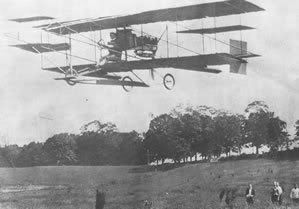
The Curtiss design continued to be utilized for a long time in the form of the Beachy “Little Looper”. I think that one was built in some quantity up to around 1914, If anyone knows how many, and how long it was produced, I would be happy to know. Here is a picture of a reproduction flying in the late 60´s early 70´s.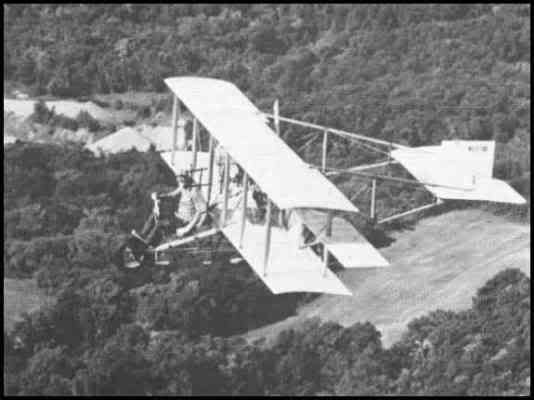
In Europe, the Voisin family of aircraft had nosegears from the earliest aircraft. The exact date of first flight of Voisin is something I do not know of the top of my head and am too lazy to check. I would guess it was around 1909. Here is a Voisin 3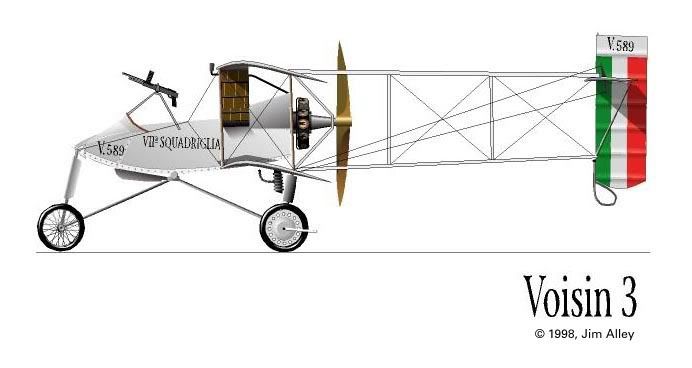
These photos have been “stolen” by me over the years and live on my computer. I have long since forgotten where I got them from, so if the copyright holder has objections I will pull them right away!
As can be seen, all the first nosegear aircraft were pushers. I guess when people started the convention of putting the engine at the front, they really didn´t have much choise but to put the wheel at the back since the slow reving engines of the first aircraft needed a big propeller to create enough thrust. To build a nosegear aircraft would have resaulted in a very long leg at the front, and that would have been very difficult to build strong enough with the materials at hand.
By: Vega ECM - 22nd December 2007 at 15:07
As aircraft’s flying speeds and mass increased it become vital to use more braking to slow you down once you have touched down (or rejected a take off). Tricky business to use heavy braking with a tailwheel A/C because the braking tends to pitch the nose down, so you need to balance the braking against the nose pitching. Get it wrong and the aircraft gets flipped upside down. This problem goes away with a nose wheel. Apart from a few cg related special case aircraft prior to the 1940’s this was the reason for the more general adoption of this arrangement post this date.
By: bazv - 22nd December 2007 at 13:16
Hi BR
the reason that I said it was a good question is that i think there was more than one factor.
Another factor might be that virtually all prewar airfields were grass and since the noseleg is usually the weakest of all then i dont think there was much point in designing a tricycle gear until proper paved runways were available.
As TT said in his post ,you get more ground clearance with a tail dragger and on a bumpy grass surface that is useful!!
A nosewheel fits in well with a multi engine or jet a/c,but to try and stuff it into a single engine a/c which you are trying to make as streamlined as poss is very difficult!!
By: BlueRobin - 22nd December 2007 at 12:50
So did it seriously take until about WW2 for someone to think, “hold chaps if we fiddle with the engine mount area, we can stick a wheel there!” Would the driving factor be high performance military aircraft being flown by low houred pilots?
By: bazv - 21st December 2007 at 20:27
front engine + nose gear might end up looking as ‘good’ as this baby;)
By: bazv - 21st December 2007 at 19:39
I would imagine there are a few reasons but 4 might be…
Big engine in nose = not much room for nose leg!;)
There might be fwd CofG problems 😉
Longer landing run??(more drag if you can get tail down!)
In the days of fixed landing gear… less drag with no nose leg!
It is a good question BR
cheers baz
By: TEXANTOMCAT - 21st December 2007 at 16:04
IIRC it was as simple as keeping a very large prop away from the ground….it was as simple as that!
TT


 Sign In








 December 21, 2007 at 3:56 pm