
By: SWR - 20th December 2010 at 15:54
Lets hope they get the forthcoming Hawker Fury (43 Squadron) right….!
Black/White checks or silver/white checks…..although, in fact, the white when it was used was an off-white cream colour. Old English white, I think its called. Very often the “white” squares were left silver, though, with just the black checkers painted and this scheme often catches people out who ASSUME they were white squares. They weren’t!
Nobody ever gets the 43 Squadron markings quite right!
Thats my rant over….
Any idea when the change from silver to white checks took place?
By the way, if there are any complaints about the forthcoming model they should be addressed to HobbyMaster rather than Hornby.:)
By: PaulR - 30th November 2010 at 23:38
Fascinating discussion of modelling research!
And such a pity that not only did Corgi get the aircraft wrong, they also added wings (under the body) to the nose art.
By: Frazer Nash - 30th November 2010 at 22:04
Is this a Sidcot?
I think that’s a Taylor suit. Bomber Command gunners’ issue.
By: WJ244 - 30th November 2010 at 21:50
Andy – If you drop Hornby an email I am sure they would be interested in the information. The only problem could be that models are often produced in China some time before they are actually released so if they have made the error it could already be too late.
I remember walking into the workshop of a British Touring Car Championship team. ASSUME NOTHING was painted on the wall in very large letters across one end of the preparation bays. It worked for them as they won the championship that year – maybe it should be adopted by all model / kit manufacturers and their researchers.
By: Arabella-Cox - 30th November 2010 at 18:01
Lets hope they get the forthcoming Hawker Fury (43 Squadron) right….!
Black/White checks or silver/white checks…..although, in fact, the white when it was used was an off-white cream colour. Old English white, I think its called. Very often the “white” squares were left silver, though, with just the black checkers painted and this scheme often catches people out who ASSUME they were white squares. They weren’t!
Nobody ever gets the 43 Squadron markings quite right!
Thats my rant over….
By: WJ244 - 30th November 2010 at 17:37
Good post, sums up things pretty well.
There is of course the option of keeping your money in the wallet.
Thanks! While I would have the consolation of knowing that each of the notes in my wallet was almost certainly entirely accurate (and was never likely to be dumped at a silly price due to over production) a collection of notes has has never had quite the same appeal as my diecast aircraft collection!
Seriously though it should also be remembered that any model can only accurately represent the subject at one particular moment in time.
I spent much of my career in the model trade selling specialist 1/43 metal / resin kits of model cars. In many sportscar races the cars could change during the course of a race with teams running several different sets of wheels and even changing body sections when cars were involved in accidents.
Le Mans was the race where biggest changes were likely to be noticed. I used to go to scrutineering and practice as well as the race. It wasn’t unusual for a car to appear at scrutineering on Tuesday virtually plain with just one or two major sponsors. During practice and even right up until race morning more and more sponsorship deals would be done so the car acquired more and more logos. When researching a particular car to make an accurate model using references produced by other people it could be hard to sort out the practice pictures from the race pictures.
A good example was the Porsche 956 stars and stripes which ran in 1986 which had the entire rear body painted to represent the stripes from the US flag which was involved in an accident a few hours after the start. The car got back to the pits and ran with a plain white rear body. The original was repaired and then put back on later in the race but had bits of duct tape and other marks from the crash and repairs so it was possible to model the car in 3 different versions all of which are correct.
I am sure similar things must happen with aircraft particularly during combat duty where things may change from one day to the next as a result of maintenance or repairs. It just makes life all the harder for the researchers.
By: SWR - 30th November 2010 at 11:06
Five years ago Corgi would have been owned by a company who seemed to know little about diecast models in general. They paid what seemed to be quite a bit of money to acquire a company that appeared to be producing healthy numbers of each new release and looked to be very viable.
Those involved in diecast retail knew that Corgi had been over producing for a long time (particularly on many of their vehicle ranges) and had been selling off over produced stock at very low prices. The stock had to be sold off or scrapped as Corgi no longer had their own warehousing so they had to pay rent on the storage space for unsold stock at a third party warehouse.
The people who managed Corgi at that time honestly believed that the more devout collectors wouldn’t notice that they could buy a model for around half price (or less in some cases) provided they were prepared to accept a model without a limited edition certificate and were also prepared to wait a few months for the over produced stock to get into the market.
Many collectors got wise to the way this worked and simply sat on their hands and kept their money in their pocket until the clearance stock came along. This meant fewer customers for each new release at the full retail price which meant more clearance stock to sell off cheap.
Many in the retail side felt it was only a matter of time before this situation would result in Corgi destroying their own market which was pretty much what happened.
The management sold out to new owners who, having taken stock of what they had bought, realised quite quickly that they hadn’t bought the money spinner they believed they had acquired. After battling on for a while the inevitable happened and the money ran out because sales of new releases weren’t paying the bills. Had it not been for Hornby it is quite likely that Corgi would no longer be with us.
Incidentally, the major players who were in Corgi management at the time when the over production problem was at its worst moved on to run airfix and the rest of that story is well known – Thanks again Hornby!
References can be difficult and in some cases contradictory when researching any colour scheme but there isn’t any excuse for getting things completely wrong. I am sure Hornby do consult quite widely when researching each model but it is inevitable that the occassional minor mistake creeps in particularly when the product is manufactured in a country where English is, at best, a second language.
I collect diecast because I don’t have the time and no longer have the eyesight to build from kits to what I regard as a good standard. I accept that diecast models will never be as perfect as a model built from a kit by a highly skilled modelmaker but I get far more pleasure from my diecasts (and accept that they do have some short comings) than I used to get from drawers full of unbuilt kits.
Good post, sums up things pretty well.
There is no doubting that errors are there but the same applies to plastic kits. It is also true that kit makers can do their own research and improve a model – at a cost and with no guarantee of perfection. Even they are in are in a minority so diecast is a perfectly good alternative for many.
There is of course the option of keeping your money in the wallet.
By: FarlamAirframes - 30th November 2010 at 09:48
On my youngest sons CORGI Al Deere Spitfire the starboard Kiwi is facing the wrong way !
It faces to the rear on the Corgi – where as the wartime photo shows it pointed forward.
http://www.aviationclassics.co.uk/issues/3-spitfire/preview1-5.jpg
By: steve_p - 30th November 2010 at 09:30
Thanks for the info regarding Sidcot suits chaps. Never too old to learn. 🙂
By: pagen01 - 30th November 2010 at 09:15
Thanks for the flying suit info, so in that first shot the guys running in white are in pre-war suits and the darker (olive?) suits were recent at the time?
It looks to me like Clowes is wearing a straight forward white overalls type suit similar to test-pilots get up, where as the other pilots are wearing a heavier/thermal type.
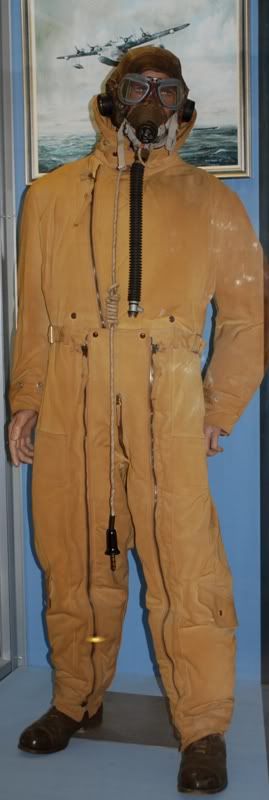
Is this a Sidcot?
By: Arabella-Cox - 30th November 2010 at 04:21
FYI the Corgi 45th FS Mustang “Stinger VII” is also pretty far off, if you look at some of the original photographs – but not as far off as that little 1/72 Chinese kit!
Ryan
By: Frazer Nash - 30th November 2010 at 01:10
My apologies for leaving the thread, but…….Sidcot suits (invented by Sidney Cotton) were quite a padded affair of kapok. From what I can see in my limited book collection, the white suits were a standard pre-war RAF issue.
By: Rocketeer - 29th November 2010 at 22:45
Sidcot suits were not white, but a greeny browny colour (sorry, been in technical meetings all day and used up my technical words!!)…they were used in 40s…later war were heated versions.
The white flying suits were pre-war and somewhere I have a pic of my grandfather wearing one when he was in ULAS.
By: Russ - 29th November 2010 at 22:10
Well I was being sarcastic, and Hornby always get it right now don’t they Russ?
Also if you are accusing me of being an ‘Osprey expert’ you are very wide of the mark.
😀
Jess, my apologies I didn’t read you comment as sarcasm.
Never said Hornby always get it right, not sure who does in any walk of life.
Can’t see where I have reffered to you directly as an ‘Osprey Expert’ I don’t even know you.
I was just trying to put some additional perspective on the model.
By: WJ244 - 29th November 2010 at 21:03
Five years ago Corgi would have been owned by a company who seemed to know little about diecast models in general. They paid what seemed to be quite a bit of money to acquire a company that appeared to be producing healthy numbers of each new release and looked to be very viable.
Those involved in diecast retail knew that Corgi had been over producing for a long time (particularly on many of their vehicle ranges) and had been selling off over produced stock at very low prices. The stock had to be sold off or scrapped as Corgi no longer had their own warehousing so they had to pay rent on the storage space for unsold stock at a third party warehouse.
The people who managed Corgi at that time honestly believed that the more devout collectors wouldn’t notice that they could buy a model for around half price (or less in some cases) provided they were prepared to accept a model without a limited edition certificate and were also prepared to wait a few months for the over produced stock to get into the market.
Many collectors got wise to the way this worked and simply sat on their hands and kept their money in their pocket until the clearance stock came along. This meant fewer customers for each new release at the full retail price which meant more clearance stock to sell off cheap.
Many in the retail side felt it was only a matter of time before this situation would result in Corgi destroying their own market which was pretty much what happened.
The management sold out to new owners who, having taken stock of what they had bought, realised quite quickly that they hadn’t bought the money spinner they believed they had acquired. After battling on for a while the inevitable happened and the money ran out because sales of new releases weren’t paying the bills. Had it not been for Hornby it is quite likely that Corgi would no longer be with us.
Incidentally, the major players who were in Corgi management at the time when the over production problem was at its worst moved on to run airfix and the rest of that story is well known – Thanks again Hornby!
References can be difficult and in some cases contradictory when researching any colour scheme but there isn’t any excuse for getting things completely wrong. I am sure Hornby do consult quite widely when researching each model but it is inevitable that the occassional minor mistake creeps in particularly when the product is manufactured in a country where English is, at best, a second language.
I collect diecast because I don’t have the time and no longer have the eyesight to build from kits to what I regard as a good standard. I accept that diecast models will never be as perfect as a model built from a kit by a highly skilled modelmaker but I get far more pleasure from my diecasts (and accept that they do have some short comings) than I used to get from drawers full of unbuilt kits.
By: steve_p - 29th November 2010 at 20:23
Hi Tim, I noticed the other day pics of BoB era pilot wearing whites, why is this?
These are Sidcot suits, I think. They seem to have been popular in the 1930s but disappeared during WW2.
By: pagen01 - 29th November 2010 at 20:05
In fact that whole Corgi Hurricane looks ghastly to me, wrong shape profiles, wrong colours, as Tim raises wrong nose art, and not even any thought given to adding the stripe on the prop.
This is one reason why I would never give up plastic modelling for collecting diecast, I know there are some good exceptions, but to me most just look wrong.
If you are buying a diecast you would kind of expect the research to be done properly, as you are receiving a finished product purporting to be a particular aircraft.
The difference with building a model kit is that even if the kit markings are incorrect (quite rare in my experience) the builder can research and correct markings and inaccuracies, it is finished as well as the buyer wants it to be.
By: cotteswold - 29th November 2010 at 20:03
Back to the other bit of the thread – more of the same………..
Damned sight more sensible than flying in your No1s as we did!!
By: BSG-75 - 29th November 2010 at 19:49
The model was produced five years ago. The company has since been taken by Hornby.
I spend a lot of time on a die cast forum and I think it’s worth mentioning now that Corgi, and other manufacturers such as Hobby Master do consult now on a far wider basis, making pro-production models and images available for discussion and feedback.
take a look here to see a case in point.
http://forums.diecast-aviation.eu/showthread.php?t=13578
This mistake was avoidable, but they have learned from it (and others) and are sourcing knowledge from a far wider audience.
By: Monsun - 29th November 2010 at 19:39
Well I was being sarcastic, and Hornby always get it right now don’t they Russ?
Also if you are accusing me of being an ‘Osprey expert’ you are very wide of the mark.


 Sign In








 November 29, 2010 at 1:03 pm