I need some clear photos of F-18E prototype and F-18L s. If you have posted please give me link, if not, would u please post here? I really need it because I have most of photo of fighter prototype but SuperHornet and F-18L. Thanx in advance.

By: haavarla - 29th November 2016 at 13:20
Never heard anybody call the F-15’s wings “weak” before, nor the F100 engine described as incredibly badly engineered. The early F100 had issues with compressor stalls and flame-outs but it was pushing the technological envelope.
The worst issue with early F100 was the bad spool-up time though..
By: Gerard - 29th November 2016 at 12:41
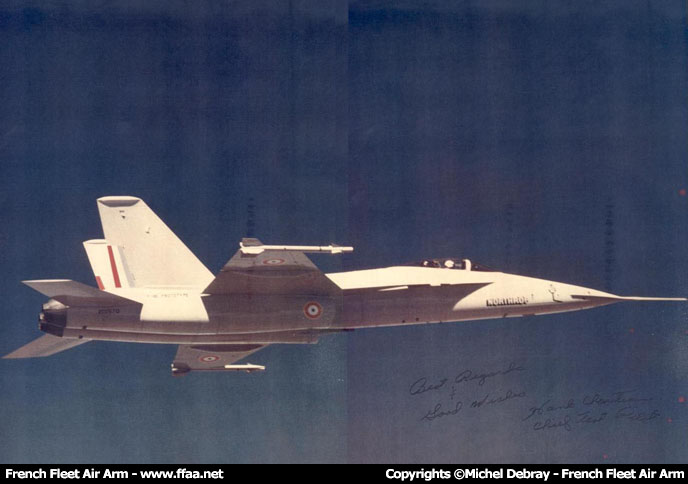

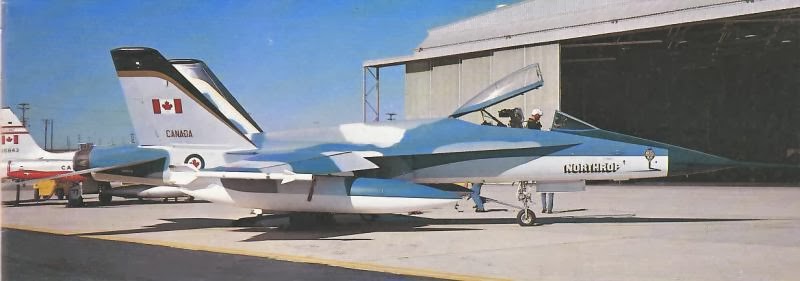
By: Hotshot - 29th November 2016 at 07:51
The F-18L wouldn’t have had the same burn and turn capability of the F-16, but it could have been equipped with the VTAS HMS.
According to the wiki article it became an effective system:
VTAS received praise for its effectiveness in targeting off-boresight missiles, but the U.S. did not pursue fielding it except for integration into late-model Navy F-4 Phantoms equipped with the AIM-9 Sidewinder.[1]
Perhaps the AIM-9M could have been modified with a gimballed seeker with like 30 degrees off boresight angle, while keeping the same motor and aerodynamics to put it in service quickly.
By: LastOfGunfighters - 29th November 2016 at 01:41
Never heard anybody call the F-15’s wings “weak” before, nor the F100 engine described as incredibly badly engineered. The early F100 had issues with compressor stalls and flame-outs but it was pushing the technological envelope.
By: MadRat - 29th November 2016 at 01:26
You sound like you basically wanted a Flanker-like high wing F-18L but retain a scaled down weight class same as the original Hornet yet using A-6E ish wings
By: LEG - 28th November 2016 at 23:37
Consider what happens if the Iranian Revolution occurred two years earlier and the Shah’s Save of the F-14 program fails to emerge. Congress cancels the dubious VG ‘missileer’ fighter program (the Israelis routinely beat the F-14 with unmodified A-4 Ahits in sales trials, so did F-4S with better DECM and VTAS) and puts their foot down over “NO! We told you to select ONE fighter from LWF/ACF, not BOTH!”…
Having no other Sparrow shooter option, the USN will absolutely refuse to take the F-16 because even if it could carry the GWH, they had had enough of narrow track, short wheel base types with the F-8 and A-7 thank you very much. And of course, for SARH, ERPs are everything and they simply cannot afford to face off with a clone of the AWG-10 as the Sapfir with a 24″ radar pedestal and a less than 2KW of output power when tackling the new MiG-23/25. Not to mention the 4G assymetric maneuver limit which later beset the F-16ADF with just two AIM-7s, firing LSL sequentially.
Comparatively, the USAF has already bought into the A-7D as a stopgap on the A-X ‘because we don’t do enough CAS’ (read: everyone knew the A-10 was worthless) which promptly added another 500 A-7E to their program of merit as common avionics/engines and so would have had to look at ‘who had the bigger inventory payoff’ in terms of an all-18 shared inventory, 20 years earlier than originally planned, on Navy decks.
The F-15 is safe as a symbolic ‘best of class’ buy and being a twin doesn’t suffer as much from short-buy on the Pratt engine which is incredibly badly engineered anyway (.7 BPr = instant duct stall from throttle slams and burner hardlight inherent to a 1:1 machine, only the fact that it was ‘one of two’ and fed by a variable ramp intake system kept Rodan from having _exactly_ the same engine loss rates as the Viper. Albeit with still a horrific Hangar Queen reputation in the F-15A with it’s ‘squared and balanced’ weak-wings).
Yet if the Blue Suiters go with even just MacDac 800 F-18 vs. the 1,200 F-16s (and 300 NATO) that they promised GD; they get to add-on another 600-800 squidian F-18s, depending on whether the USN sticks with the A-7E as light-attack or activates the A-18 clause of the R&D as separate-variant contract.
Point Blank: The USAF gets more bang-from-buck cost relief from a joint USN program than they do from the F-16 (initial sales) alone. Just like they did with the F-4C/D and then E/G work which was ONLY possible because of the backing B/N/J. Having a higher end LWF does somewhat ruin your FMS opportunities but then again, that’s what the F-20 was for…
Why is this important? Well, the Hornet can carry two AIM-7F/M on the outboard LAU-115 without much assymetrics trouble, in addition to the shoulder stations which have to compete with the targeting pods only in offensive strike warfare. Which is to say a minimum 3-5 days after warstart as constant DCA ops over a crumbling HAWK belt and multiple OMG breakouts.
This radar missile option gives it F-15 equivalent BVR capability in an operational environment which is socked in from about November through March in Central Germany and not really that much better, even in ol’ Blighty across the Channel.
The Russians love snow. They don’t feel cold like we do and were becoming increasingly adept at night operations with image intensification replacing active lamp IR, throughout the 1970s. Do you REALLY WANT to play sidewinder games with a 15-20,000ft hard base and running scud in the 3-8,000 range beneath that _at 0D30_?
There is a reason why Ramstein’s gate sign had three conditions: ‘Snow, Sleet, Rain…’ you know.
The APG-65, while by no means as powerful as the APG-63 (and later further degraded by espionage) was a full rather than elliptical 27″ array and like all Navy jets, had genuine vs. HPRF emulant CW. Since you now have a sideband illuminator, as soon as you go to strapdown in the AIM-7MH, you can have a smart-datalink ability to trajectory tailor shots with lofting. This is _a good thing_, at a time when the APG-63/AIM-7F was basically a ‘mind the step’ (big notch) system which a simple break-back maneuver would spoil the tracking of because the Conscan was cyclic dependent on Hz rates in the interleave rather than monopulse capable of single-look tracking within the pulse train.
Now look at the wings and the retained LEX slot. Having a straight wing is stupid in any jet which wants to cruise fast in the clutter but a thin section wing (indicated by the 7,780lb instead of 10,000lb internal fuel load, nominally suicidally low as a fraction on a twin engine aircraft) with spoilers and suction relief through the large boundary slots can use structural mode control similar to the B-1B to control ride and particularly porpoising/lunging by means of low lift coefficient wing area further spoiled by lift dumping so that whenever the LEX start to rise or fall through the microbursts, they control their own lift gradient losses by _reversing flow_ through the slots as a kind of ejector and then the wing spoilers simply have to equalize the bent-through-middle torsional effect of the wing punching through the same burble. If you go to a flaperon (ala F-16) instead of a simple slotted mechanism as on the Naval Hornet, you can likely deflect the entire wing camber into low-ride mode.
Add to this the payload factors: as those are NOT 330 gallon but _600 gallon_ tanks and you are carrying the equivalent of an A-6 in MER’d ordnance and external fuel which means you have an exceptionally high wingloading accompanied by the active dampening on a very torsionally stiff wing to control ride function with. Obviously, a lot will depend on rapidly transitioning from the dual electromechanical/CAS system to a full up FBW but since this happened, eventually, anyway, there is no real problem here either.
I would also add that the F-16 really never was suited to all weather strike in the Euro threat environment either, the combination of terrain masking flight in a region saturated with high tension power lines, no imbedded TFR (as the APQ-126 gave the A-7D/E) and a nominally ENORMOUS radar surface and air threat environment all point towards single pilottage tactical flight without even a COMED or hold-bias assisted autopilot as being exceedingly stupid. BAM, the Hornet’s real leverage: it’s marvelous out of the box weapons system and cockpit interface gives you everything an F-111D /wishes/ they had, including the option to look up, shoot up, with near range equivalence as well as firing big-missile SEAD weapons which it would take the F-16CJ 15 more years to really do.
About the only thing you are missing here is the original PWIV as Planar Winged Weapon and LOCPOD/LAD systems to provide at least a minimum of standoff rather than relying on highly draggy and threat exposed overflight/laydown.
As much as the Viper /eventually/ became something to be proud of (on the verge of obsolescence in the face of the Eurocanards) the MSIP program failed utterly to bring in the kinds of network comms (SINCGARS, JTIDS), internal jammer (ASPJ), ARH-BVR (AMRAAM, 12 years late) for the wingtips and of course LANTIRN and AGM-65D in time to be useful in a NATO operational environment.
We would have been _vastly_ better off, in terms of everything from single vs. twin loss statistics (90% of all Viper losses to date have been pilot related do to lack of GCAS in a high energy flight environment especially. But of the rest, more than 33% are single-engine related) to a more realistic tactical perspective on what 1980s combat required in an ‘under the GBAD radar’ ‘through Wx’ and ‘pop the enemy OCA from below’ LDSD environment relative to what the technological SOA could actually achieve.
Without MMIC/VHSIC/VLSI, as Pave Pillar, the rabbit-swallows-lion trick of the Blk.40 and later F-16 avionics systems was never going to be able to support a tactical, single pilot warfighter, particularly as an adjunct to the limited Bitburg/CNA F-15 force in securing DCA freedom of operations over /our/ lines. Never mind Poland.
Thus the Window Of Vulnerability had to be slammed shut on the WARPACs fingers with the fireball politics of Gryphon and PII which is a helluva way to call someone’s already extant SS-20/21 bluff with a deepstrike nuke capability of your ‘Cry Havoc!’ own.


 Sign In








 September 1, 2006 at 10:00 am
