Well, almost. LockMart’s RATTLRS offering.
Mach 3 missile advances
Flight International 04/07/06
Lockheed Martin is nearing the critical design review on a technology demonstrator for a Mach 3-plus cruise missile that could be air, ship and submarine-launched. The missile would be accelerated from subsonic launch to supersonic cruise by a turbine engine, and could fly 920km (500nm) or more in 15min to attack time-critical targets.
The demonstrator is being designed for the US Office of Naval Research (ONR) under the Revolutionary Approach to Time-critical Long-Range Strike (RATTLRS) project. Lockheed’s Skunk Works is prime contractor. Rolls-Royce’s Liberty Works is building the YJ102R high-Mach turbine engine for the demonstrator.
First ground runs of the complete engine are planned for early next year, says Lockheed programme manager Craig Johnston. Construction of the integrated vehicle will begin around the same time, with the first launch from a Lockheed NC-130F planned for late next year in the Pacific test range off Pt Mugu, California.
Before the end of this year, sled tests are planned to demonstrate payloads planned for an operational weapon – including subsonic and supersonic submunitions dispensing and supersonic penetrator delivery – says ONR programme manager Lawrence Ash.
Johnston says the goal of RATTLRS, which is a US Navy-led joint project with the US Air Force, Defense Advanced Research Projects Agency and NASA, is to reduce risk to where development of an operational weapon could be launched before the end of the decade.
Ash says the YJ102R has six times the specific thrust of the Pratt & Whitney J58 that powered the Lockheed SR-71, and will accelerate the missile to M3 without reheat. The airframe is similar in shape and size to an SR-71 engine nacelle, but the YJ102R is only 330mm (13in) in diameter yet produces half the dry thrust of the four times larger J58, at 6% of the weight, he says.

By: Jonesy - 6th August 2006 at 03:09
“3000 mph at sea level with a turbine engine”
Back in 1967 the original engine for Granit was designed for M4 speed,later with the use of KR-93 engine redused to M2,2.But all this speeds are in medium cruise altitude,in sea level with KR-93 the speed is M1,5.
Spot on that man. This looks a lot like a vague hotchpotch of facts muddled together for flashy journalistic copy. RATTLRS was originally being designed as a hypersonic areoballistic profile weapon intended to hit short-duration ground targets before they could move off i.e it was pure land attack and fixed target.
Now because it looks like a P700 there seems to be an assumption that it is one?
The LockMart article suggests no such thing it says:
As a component of the hypersonic “pillar,” RATTLRS has an initial goal of testing a flight demonstration vehicle at Mach 3, and plans call for a second flight demonstration that will reach speeds greater than Mach 4 — or more than 3,000 m.p.h. at sea level.
…which means that M4 IS about 3000mph at sea level NOT that the missile will DO 3000mph at sea level. Have to read closely guys!
It seems an interesting capability to have. Certainly a short transit precision land-attack missile with 600nm of range is going to be useful in certain conditions but I dont see it as replacing the SSN/Mk48 combination as the USN’s premier shipkillers in anyway!!!!
By: sferrin - 5th August 2006 at 13:54
Is it just me that think that this “revolutionary” missile is just modernized Granit?
Probably.
By: pesho - 5th August 2006 at 12:16
Is it just me that think that this “revolutionary” missile is just modernized Granit?
I’m not coming with the “russians was first” crap,i just think that missile using better engine and electronics with the overall shape of Granit is just a modernization.And the article just forget missiles like P-35,P-500 and P-1000.Also one thing bother me.They are so proud what speed the missile will achieve but the fact that the cruise altitude is 21 km and the missile “vary” it’s speed just don’t impress me.Cruising in high altitude that will help to reach 800 km range,and diving for final low level stage is nothing new(again).Here is the stupid part.They are so proud of this MILESTONE,the ability to change it’s speed,that they say that missile like Brahmos are maybe obsolete.Well Brahmos and Sunburn just use the same principle.In high altitudes they have more range,dive for final stage and that is it.Russian use the same thing since P-6(nearly 50 years ago).
“3000 mph at sea level with a turbine engine”
Back in 1967 the original engine for Granit was designed for M4 speed,later with the use of KR-93 engine redused to M2,2.But all this speeds are in medium cruise altitude,in sea level with KR-93 the speed is M1,5.
And they are now in mockup stage,so soon they will expirience the real difficulties in making this missile ready.In that time if there is not enough support the part that disturbes sferrin(and me) will come to light.Somebody will come up with “there is no need and bla bla” and the only place for the project will be museums and i-sites…
By: SOC - 5th August 2006 at 05:04
RATTLRS knows how to pop out bombs at high speeds:
http://www.lockheedmartin.com/wms/findPage.do?dsp=fec&ci=17813&rsbci=0&fti=111&ti=0&sc=400
By: sferrin - 12th July 2006 at 20:17
This is the part that is disturbing
“There’s just one problem: A customer. Although the missile is designed for placement on everything from a B-52 to the Joint Strike Fighter to a destroyer to a submarine, Congress has yet to express interest in the missile.”
That would be par for the course. Breakthrough technology but “the Tomahawk did such a good job in Iraq and Afghanistan so we don’t need those new things” :rolleyes: Wouldn’t be the first time they did something that stupid (ASALM anybody?)
By: aerospacetech - 12th July 2006 at 19:15
By: turboshaft - 11th July 2006 at 02:01
This might possibly be an ancestor of RATTLRS.
Probably part of the DoD-funded JETEC effort. The J102 does indeed owe its heritage to this program.
By: sferrin - 10th July 2006 at 23:49
Geez. . . 3000 mph at sea level with a turbine engine.
http://www.lmaeronautics.com/lmaerostar/feature-4.html
RATTLRS kicks up cruise missile technology
By Colin Bab
When launched at a target at maximum range, today’s Tomahawk cruise missile takes almost two hours to reach its target. This duration is okay when your target doesn’t budge. But what happens when your target doesn’t sit still for two hours? What happens when it is a vehicle? Or a specific person?
Over the past six decades — since being introduced by the Germans in World War II — cruise missiles have required mostly subsonic speeds to accomplish their missions. The world, however, is changing, and the Office of Naval Research, the Air Force and NASA are working with Lockheed Martin to increase the speed, flexibility and capabilities of U.S. cruise missiles. The Revolutionary Approach to Time-Critical Long Range Strike (RATTLRS) is a technology demonstration project to design and test a supersonic cruise missile that will reach speeds in excess of Mach 3.
Supporting future needs today RATTLRS is a part of the National Aerospace Initiative, a joint Department of Defense/NASA program established in 2004 to “ensure America’s aerospace leadership” by coordinating efforts to develop and demonstrate technologies that enable:
Responsive, safe, reliable and affordable access to and from space
Air-breathing hypersonic flight
Transformational and responsive in-space capabilities
As a component of the hypersonic “pillar,” RATTLRS has an initial goal of testing a flight demonstration vehicle at Mach 3, and plans call for a second flight demonstration that will reach speeds greater than Mach 4 — or more than 3,000 m.p.h. at sea level. The propulsion technology for such a missile will have applications beyond weaponry. It could eventually lead to reusable hypersonic aircraft that can reach any location in the world in a matter of hours.
“RATTLRS was intended to enable two things: a high-speed expendable weapon for time-sensitive or time-critical strike, but also to demonstrate a class of technologies that would enable space access,” said program manager Lawrence Ash.
Supersonic cruise missiles are not new; there are a number already in service around the world. The Russians have long had supersonic anti-ship cruise missiles, such as the SS-N-22 Sunburn and SS-N-26 Yakhont. The Chinese have the HY-3 Sawhorse. Also, a Russian-Indian cooperative project has produced the BrahMos, which recently was fitted on the Indian Navy destroyer Rajput. Such systems are even able to achieve a level of accuracy similar to Western missiles by taking advantage of GLONASS (the Russian equivalent of GPS).
What these missiles lack, however, is the versatility of RATTLRS’ speed and range, largely because existing supersonic cruise missiles use boosters and ramjets to achieve their high speeds. RATTLRS, in contrast, will have only a turbine engine for propulsion.
Revolutionary propulsion
The difference is crucial. Ramjets — which have no moving parts — are less sophisticated mechanically than turbines and are capable of exceptional velocities, but they use more fuel, have shorter ranges and are very limited in ability to vary their speeds. RATTLRS will combine all the advances in accuracy and targeting that have been developed over the past several decades for conventional cruise missiles with high speed, the reliability of proven turbine technology (the project will use the Allison YJ102R non-afterburning turbojet engine, which has six times the specific thrust of the engine on the SR-71) and high fuel efficiency.
With the ability to vary its speed, a turbine-driven missile can loiter at subsonic speed, extend its range by going at low supersonic speed or dash to its target at maximum speed when range is short. These features will allow the missile to tailor its flight configuration according to its mission. In addition, another significant feature of RATTLRS will be its ability to be launched from air, surface or subsurface platforms.
High-speed advantage
A weapon system developed from RATTLRS would have a number of advantages allowing it to meet needs currently unfulfilled.
A high-speed system would give combatant commanders the ability to strike targets existing conventional cruise missile are too slow to hit — for example, the mobile Iraqi SCUD launchers that proved elusive targets during the 1991 Gulf War. And because of its versatility, platforms that currently are unable to launch cruise missiles could have a new strike capacity.
“It brings a new level of capability to the warfighter’s hands that is complementary to existing systems,” said Lawrence. “Speed is one aspect of this. It’s really the joint warfighter that is starting to talk about high-speed weapons, and it’s a conglomerate of different capabilities. It needs to be useful, in the sense that it carries the right payload. It needs to be useful in the sense that it has the right range. It needs to be survivable, and speed adds to that. . . . This is really meant to be a prolific weapon, one that can be on as many platforms as the warfighter might want.”
Recently, a full-size mock-up of the RATTLRS test vehicle was built for platform tests to see how it fits on various aircraft. Next ahead for RATTLRS is the vehicle Critical Des-ign Review set for November 2006. The first test flight of the missile is planned for late 2007.
By: sferrin - 10th July 2006 at 23:28
Found this looking for more info on RATTLRS.
By: sferrin - 9th July 2006 at 03:09
This might possibly be an ancestor of RATTLRS. Back in the late 80s Allison was making some SIGNIFICANT progress on turbine engines and it appeared that they might be a contender for the ATF engine but then they kind of fell of the radar suddenly. This photo was from around that time frame and the caption read that it ran at 1000 degrees above the then state of the art and would be a potential cruise missile engine. Didn’t say it was an Allison engine but it seems to fit and it doesn’t appear to have an afterburner.
By: sferrin - 7th July 2006 at 21:26
Who cares if it was a copy or not.. But it does seem that the US (thank god) military mind (not the scientist working in research but the idiots who decide what to research) have realised the potential of high mach missiles.
Maybe they see the need of these against a strong emergent chinese Navy, and also as answer to a non nuclear bunker buster?
And who cares if it makes the Brahmos pale in comparison? Is this missile going to fight against a Brahmos or Vice Versa on its way to oblitorate a target?
Will it make the Brahmos less capable in destroying a ship?
I don’t think it was so much that they didn’t realize the potential but that there really hasn’t been a need. The existence of the Aegis system is proof that they understand the potential. As for comment regarding Brahmos etc. it was just a way of putting it in perspective. It doesn’t make Brahmos or Shipwreck or Suburn any LESS impressive.
By: matt - 7th July 2006 at 19:01
Who cares if it was a copy or not.. But it does seem that the US (thank god) military mind (not the scientist working in research but the idiots who decide what to research) have realised the potential of high mach missiles.
Maybe they see the need of these against a strong emergent chinese Navy, and also as answer to a non nuclear bunker buster?
And who cares if it makes the Brahmos pale in comparison? Is this missile going to fight against a Brahmos or Vice Versa on its way to oblitorate a target?
Will it make the Brahmos less capable in destroying a ship?
By: pesho - 5th July 2006 at 20:25
sferrin
In one source they write that the original body of SA-5 cannot endure for long such high speeds.
Now off to watch the game….Go France,go!!!
By: SOC - 5th July 2006 at 17:14
ok i used to google around and it seems that russian had those missiles in service some 20years ago than american.maybe this time american were the thiefs
Uh, Talos was first test-fired in 1952, what Russian missile test fired before 1952 was it a copy of?
By: edi_right_round - 5th July 2006 at 16:50
None of these are anymore a copy of Granit than Granit is a copy of Talos :p
ok i used to google around and it seems that russian had those missiles in service some 20years ago than american.maybe this time american were the thiefs 🙂
By: sferrin - 5th July 2006 at 16:16
sferrin in several threads you pointed out that Russian make mistake by using H2 and you are right,but only if you think that H2 will be used in all future rockets/planes.Russians use H2 forced by few reasons.The main purpose in all their experiments is to test engine combustion in speeds above M5.But there is a problem with the heat.Here is small table that show you how important is flight altitude for heat level.
Mach number 1,0 1,5 2,0 2,5 3,0 5,0 10,0
Height of flight 50 м
Speed m/s 340,3 510 681 851 1021 1701 3403
Speed km/h 1225 1837 2450 3062 3675 6125 12250
Heat level ,К 346 418 519 648 807 1729 6051
Heat gain ,К 58 130 231 360 519 1441 5763Height of flight 11 km
Speed m/s 295,0 442 590 737 885 1475 2950
Speed km/h 1062 1593 2124 2655 3186 5310 10620
Heat level ,К 250 314 390 487 606 1300 4550
Heat gain ,К 43 97 173 270 389 1083 4333Why i posted this?Because all russian experiments are done in high altitudes,where O2 is low but the heat also is low.That is why they use H2 and liquid O2 in their test vehicles.The most important thing right now is to understand the principles behind supersonic combustion.Heat level is known how to “fight” in their half century experience in space.In future,when there is knowledge how to make stable engine capable of atleast several minute flight,there will be new fuel.As you may know Kh-31 use solid fuel,and also Russians have wide experience in using two-component fuels.Yes that means that the future rockets may suffer from using two component fuels,but that is necessary if you want high speed (M>7) soon.NASP X-30 also use H2 and O2,forced by the lack of oxygen in high altitudes.Here is some experiment vehicles that they build over the years(in short):
“Holod”(Cold)
Used to test H2 use in rockets/planes.Development begin in 6 Mart 1979.First flight 28 November 1991 in Khazakstan.Achievements.
[PHP]Date: Speed, m/s Heigh, km Mach number Engine running time, s
27.11.91 1653 35 5,6 ———-
17.11.92 1535 22,4 5,35 27,5
1.03.95 1712 30 5,8 41,5
1.08.97 1832 33 6,2 ———–
12.10.98 1863 33 6,2 77[/PHP]
The last flight was limited by the maximum flight time of the rocket,engine proved to be capable of more than that.
I wasn’t so much trying to say it was a “mistake” because for some purposes H2 would be the way to go. Just not for a weapon. BTW what does that mean “flight was limited by the maximum flight time of the rocket”? Was the rocket motor assisting in maintaining the speed? The reason I ask is because the SA-5’s flight time could normally be well over 77 seconds given it’s range.
Three of the experiments was with partners from NERA, Aerospatiale, SNECMA-SEP(France) and NASA.This live tests compared with the 15s HyFly engine run is quite impressive.
Perhaps you were referring to the X-43? That was a different engine and vehicle altogether.
This missile is equiped with hydrocarbon based fuel(kerosine).Speed M4-5,with range around 3000km in altitudes between 7000-20 000 meters.The missile is developed by “Raduga” design bureau,creators of AS-4,AS-6,AS-16,AS-9,SS-N-22,AS-15,AS-11 missiles.
Later some information about other projects.
This is a ramjet powered vehicle IIRC.
By: sferrin - 5th July 2006 at 15:50
Looks like they are re-inventing the Jindivik
Well would you look at that, it’s virtually a carbon copy? :rolleyes:
By: sferrin - 5th July 2006 at 15:46
so now americans to close the gap decided to copy the Granit? :dev2:
nice missile however
None of these are anymore a copy of Granit than Granit is a copy of Talos :p
By: pesho - 5th July 2006 at 14:12
sferrin in several threads you pointed out that Russian make mistake by using H2 and you are right,but only if you think that H2 will be used in all future rockets/planes.Russians use H2 forced by few reasons.The main purpose in all their experiments is to test engine combustion in speeds above M5.But there is a problem with the heat.Here is small table that show you how important is flight altitude for heat level.
Mach number 1,0 1,5 2,0 2,5 3,0 5,0 10,0
Height of flight 50 м
Speed m/s 340,3 510 681 851 1021 1701 3403
Speed km/h 1225 1837 2450 3062 3675 6125 12250
Heat level ,К 346 418 519 648 807 1729 6051
Heat gain ,К 58 130 231 360 519 1441 5763
Height of flight 11 km
Speed m/s 295,0 442 590 737 885 1475 2950
Speed km/h 1062 1593 2124 2655 3186 5310 10620
Heat level ,К 250 314 390 487 606 1300 4550
Heat gain ,К 43 97 173 270 389 1083 4333
Why i posted this?Because all russian experiments are done in high altitudes,where O2 is low but the heat also is low.That is why they use H2 and liquid O2 in their test vehicles.The most important thing right now is to understand the principles behind supersonic combustion.Heat level is known how to “fight” in their half century experience in space.In future,when there is knowledge how to make stable engine capable of atleast several minute flight,there will be new fuel.As you may know Kh-31 use solid fuel,and also Russians have wide experience in using two-component fuels.Yes that means that the future rockets may suffer from using two component fuels,but that is necessary if you want high speed (M>7) soon.NASP X-30 also use H2 and O2,forced by the lack of oxygen in high altitudes.Here is some experiment vehicles that they build over the years(in short):
“Holod”(Cold)
Used to test H2 use in rockets/planes.Development begin in 6 Mart 1979.First flight 28 November 1991 in Khazakstan.Achievements.
[PHP]Date: Speed, m/s Heigh, km Mach number Engine running time, s
27.11.91 1653 35 5,6 ———-
17.11.92 1535 22,4 5,35 27,5
1.03.95 1712 30 5,8 41,5
1.08.97 1832 33 6,2 ———–
12.10.98 1863 33 6,2 77[/PHP]
The last flight was limited by the maximum flight time of the rocket,engine proved to be capable of more than that.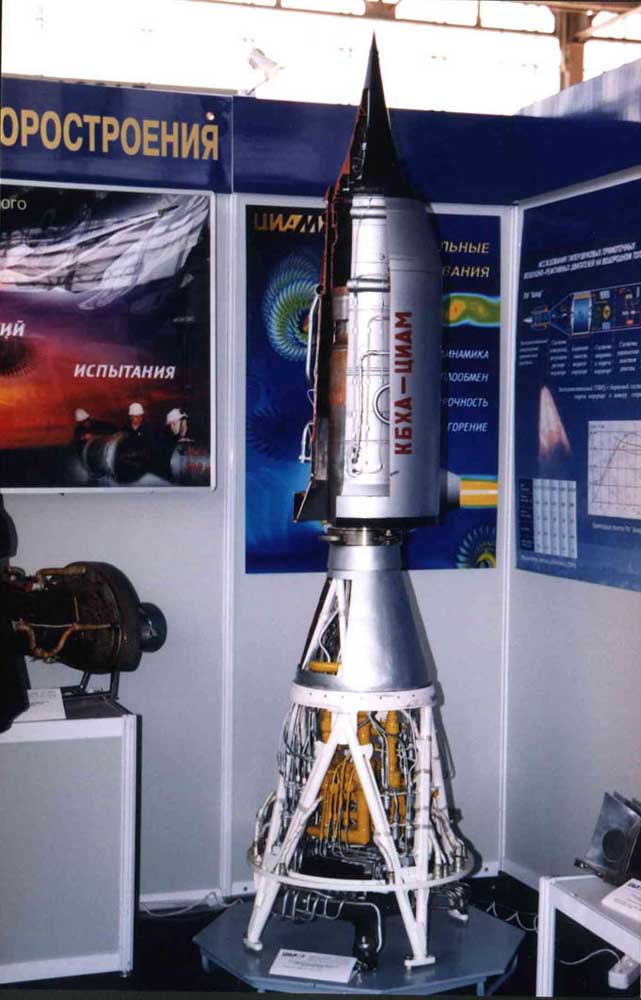
Three of the experiments was with partners from NERA, Aerospatiale, SNECMA-SEP(France) and NASA.This live tests compared with the 15s HyFly engine run is quite impressive.
Kh-90
This missile is equiped with hydrocarbon based fuel(kerosine).Speed M4-5,with range around 3000km in altitudes between 7000-20 000 meters.The missile is developed by “Raduga” design bureau,creators of AS-4,AS-6,AS-16,AS-9,SS-N-22,AS-15,AS-11 missiles.
Later some information about other projects.
By: mose - 5th July 2006 at 11:01
Looks like they are re-inventing the Jindivik


 Sign In








 July 3, 2006 at 8:42 pm