Just got hold of some very dark photographs of a Defiant at Finningley some are dated September 1968 and some dated September 1970. Anyone know how it got there? or if it was resident there or was it flown to be at the airshows. Would this be the aircraft now at Hendon or was there more about in the 60/70’s? Also a Lanc and a Spit on some photographs dated 1969 All at Finningley anyone know any more? Thanks

By: Mark12 - 28th May 2007 at 13:08
JDK,
Linking A to B with Photoshop/PSP clone, brings home the point.
Mark

By: JDK - 28th May 2007 at 11:49
Thanks to both of you, most interesting.
N3437. The slightly shiny finish looks very much like other Defiants finished in DTD 308. It reminds me of one photograph in particular of N3328/DZ.Z (the one with the shark’s mouth) of 151 Squadron taken in 1941. The paint is also chipped away on the leading edges of the wings in a similar way. Because of a shortage of paint some aircraft received a first coat of DTD 308 and a top coat of RMD 2A. If that happened to N3437 and the RDM 2A wore off than perhaps the underlying DTD 308 might be a little transparent and the original camouflage show through. However it is quite possible that it ws finished in DTD 308 only. It is a black and white photograph but the tone of the spinner and the red of chessboards are identical. 307 Squadron did not seem to make a habit of colouring the spinner of their Defiants as none of the other in the few photos that there are have them. Perhaps it was a legacy from its previous owners. 264 Squadron’s original intention was to paint the spinners in flight colours but they never seem to have gotten around to that. Some photographs do show Defiants with red spinners but I don’t know of any other clours being used. There has been some argument in Poland about what scheme this aircraft had as revealed by Wojciech Butrycz in the December 2003 edition of SAMI. He is also of the opinion that N3437 was black overall with a red spinner. Apart from late and post war Mustangs the only instances of coloured spinners being used regularly by Polish squadrons are on Wellingtons, especially the Mk II. Sometimes they are shown as yellow and sometimes red.
[My bold] A very good analysis, but (we knew that was coming, didn’t we?) the red conclusion is not based on hard evidence, but a probable scenario and a tonal match. Nothing wrong with either – in fact I’d essentially agree, but it can only be stated that, by this analysis, the spinner may probably be red. Not having that caveat in there implies greater certainty than one can have.
For those focussed on the tonal match, I’d point out the tonal similarity in the last photo on the 307 Sqn ‘Their aircraft’ page of the chessboard on the camouflage as seen on the nose of the NF.30 Mosquito. (Here: http://www.geocities.com/skrzydla/) Whatever the match, the chessboard’s probably red and white, but the camouflage isn’t red.
And see:
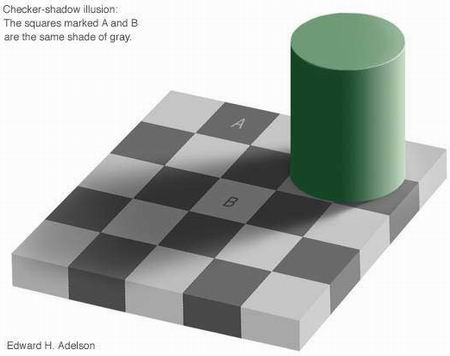
‘A’ and ‘B’ are the same tone. Therefore, the surrounding squares are not. (Thanks to Mark.12 for originally posting the link to this little photo-interpreter’s headache.)
The serial numbers are those listed by Cynk in the appendix of his book The Polish Air Force at War The Official History. I suspect that the reason not many of the code letters are known is because they are not mentioned in the ORB. Possibly Polish researchers may have obtained some by comparing the ORB with other documents such as pilots’ logbooks. They may also have a few unpublished souvenir type photos from veterans or their families.
Thanks for that. Lack of codes in the ORB are one of the perennial problems, as most researchers know, ORBs often have serials, or code letters, but only very rarely both. A good, but secondary source, with no attribution to specific data in that listing, then.
As you will gather from the points above, I’m very wary of placing too much faith or emphasis on colour profiles. They’re a good thing, but ALWAYS secondary data, almost always based on other information that is partial and interpreted, as we’ve discussed. Doesn’t mean they are all ‘wrong’ but that they aren’t often as ‘true’ as the look.
I’ve contacted the other members of the publishing team, and they are most interested and intrigued by the discussion, but unavailable for a few days. When they’re back, I’ll pass on any comment I can. In the meantime, thanks for opening the discussion.
Regards,
By: antoni - 28th May 2007 at 10:31
The accident was 1st January 1942, Beaufighter Mk II R2438. Apparently the same aircraft was involved in a forced landing a few days before on 29th December 1941. There were a number accidents at this time and the second week of February became known as the “Black Week” after three crashes and five fatalities. Beaufighter MK IIs were not liked by the crews due to the poor performance on one engine and unreliability of the Merlin engines built at the new factory at Crew. There was at least one fatal accident caused by an engine cutting out on take-off. In the middle of April 1942 the squadron’s CO asked for them be to replaced with Beaufighter Mk VIs They received their first seven on 1st may 1942 and had reequipped within a week.
By: RAF Millom - 27th May 2007 at 19:33
Richard provided this photo with the squadron names
http://www.geocities.com/Mohikanie/307/gallery/EW1.html
He is Sgt Danilo-Sniezowski and was an instructor at Debin before the war.
He had a near fatal accident not long after this photo in a Flying Coffin
After recovering he was with No 10 AGS and finished of in 304 squadron
He is real gentleman and and very modest, he has spent his life since the war upholding the memory of his fallen collegues and recording his memories of leaving Poland via Romania through France (was in a bomber squadron down in the south), but never talks about his personal wartime experiances only when they involve another.
By: antoni - 27th May 2007 at 17:41
Thanks RAF Millom. The ORB is most interesting. The five Defiants sent to Squires Gate on the 9th January were the first aircraft with the squadron to have chessboards painted on them. Relations with 9 Group at this time were not good, as Cynk explains in the official history.
“By early March 1941 differences of opinion between S/Ldr Grodzicki – who thought that, with operational duties and extensive training running concurrently, too much was expected of No.307s crews – and No.9 Group – who pointed to a large number of accidents and problems with radio communications, arising from language difficulties, and suggested that the Poles might not be well suited for night operations – became more intense. At the same time the crews grew more and more frustrated by the lack of any success with night interceptions.
On 7 March No.9 Group decided to limit the operational duties of the squadron to six aircraft, which were to be kept on “Readiness” only during the hours of darkness, in order to make more time available for practice flying. Training for “Shortshrift” – the night fighting tactics involving five aircraft formed one above the other with 1,000 ft vertical separation and the lowest flying at 17,000 ft – which began towards the end of February, was stepped up and cooperation with searchlights was also expanded. GICpt Pawlikowski, Polish Liaison Officer HQ Fighter Command, visited the squadron to help to resolve its difficulties.”
Your friend might be interested to know that there is a history of 307 Squadron published by Bellona (in Polish) ISBN 83-11-10112-4 about two years ago. More recently AJ-Press Monographie Lotnicze 101 D.H. Mosquito has a whole chapter on 307’s Mosquito operations with many photographs that I am sure have not been published before. Both books should be available from Midland Counties.
You can put some faces to names at the Polish Squadrons website http://www.geocities.com/skrzydla/ and there are a couple of Polish ones worth a visit as well.
http://www.roman.biskupin.wroc.pl/rafmenu.html
http://www.psr.netfriend.org/mysliwcy/
The last one has some film clips from films made by the Polish Film Unit. Put the pointer on Misliwcy PSP and click on Filmy.
N3437. The slightly shiny finish looks very much like other Defiants finished in DTD 308. It reminds me of one photograph in particular of N3328/DZ.Z (the one with the shark’s mouth) of 151 Squadron taken in 1941. The paint is also chipped away on the leading edges of the wings in a similar way. Because of a shortage of paint some aircraft received a first coat of DTD 308 and a top coat of RMD 2A. If that happened to N3437 and the RDM 2A wore off than perhaps the underlying DTD 308 might be a little transparent and the original camouflage show through. However it is quite possible that it ws finished in DTD 308 only. It is a black and white photograph but the tone of the spinner and the red of chessboards are identical. 307 Squadron did not seem to make a habit of colouring the spinner of their Defiants as none of the other in the few photos that there are have them. Perhaps it was a legacy from its previous owners. 264 Squadron’s original intention was to paint the spinners in flight colours but they never seem to have gotten around to that. Some photographs do show Defiants with red spinners but I don’t know of any other clours being used. There has been some argument in Poland about what scheme this aircraft had as revealed by Wojciech Butrycz in the December 2003 edition of SAMI. He is also of the opinion that N3437 was black overall with a red spinner. Apart from late and post war Mustangs the only instances of coloured spinners being used regularly by Polish squadrons are on Wellingtons, especially the Mk II. Sometimes they are shown as yellow and sometimes red.
The serial numbers are those listed by Cynk in the appendix of his book The Polish Air Force at War The Official History. I suspect that the reason not many of the code letters are known is because they are not mentioned in the ORB. Possibly Polish researchers may have obtained some by comparing the ORB with other documents such as pilots’ logbooks. They may also have a few unpublished souvenir type photos from veterans or their families.
By: RAF Millom - 27th May 2007 at 10:57
Some notes on No 307 squadron
http://www.rafmillom.co.uk/14112006/307_SQUAd.pdf
Also have a friend who was a pilot with 307
By: JDK - 27th May 2007 at 04:56
First off, thanks for a most interesting and detailed post antoni, much appreciated.
I can’t speak for Mark Ansell – I’m sure he’ll be along shortly – but I am one of the MMP publishing team, producers of Mark’s Defiant book.
The only photographs of a 307 Squadron Defiant for which the codes and serial numbers are known for certain is N3437/EW.K. They were taken in late April 1941 and given to some wartime girl friends only to be rediscovered a few years ago. They were published in a Polish magazine and caused some controversy as it was suggested that they showed the aircraft in a strange scheme with camouflaged upper surfaces and night under surfaces with a green spinner. Others think it was night overall with a red spinner. One of these photographs appears on page 106 of Mark Ansell’s book captioned as serial and code unknown. On the next page is a colour profile of the aircraft in the controversial scheme. To me the Defiant appears to have been painted RMDA 2A over DTD 308 but with most of the RMDA 2A worn away. I am sure the spinner is red. The code letters were painted much thinner than usual.
Thanks for that analysis. It makes good sense to me, my only question would be could you elaborate on why you’ve drawn the conclusions you have? It’s a black and white photograph, and I agree it could be a red spinner, but it could also be another colour – unless you have evidence?
There are a couple profiles of 307 Squadron Defiants in Mark Ansell’s book in addition to N3437 but I do not know what the evidence is for the codes, serial numbers tie-up. Perhaps new information has come to light recently. My initial impression is that there may be some documentary evidence but the schemes are based on what can be seen in the few photographs that exist. EW.H/T3991. Not much to find fault with as photographs show the usual night finish. I would expect the chessboards to be both sides of the fuselage though. Sometimes when there is not one on the starboard side people have assumed that they are on the port side only. EW.A/N1559. This also has a Sky/Duck Egg Green spinner. I suspect it may be a misinterpretation of the white spinner on the K coded Defiant in the 1940 photographs. It is of course possible that more than one Defiant had a white spinner but I think sky is highly unlikely. The squadron formed of the 5th of September and roundels under the wings were ordered on the 6th of September. So it is possible that in the next two weeks aircraft arrived with or without them but they were probably added in accordance with orders at sometime. So this aircraft may or may not have had them.
I don’t have details myself to hand, but I can say that the artist, Artur Juszczak, is Polish, and we do try and get the Polish schemes, in particular, right!
307 Squadron Defiant serial numbers and code letters where known.
14/09/1940: L7035, N1559, N1560,N1624, N1639 to N1643, N1671, N1675, N1682 to N1684, N1686, N1695,N1696, N1704, N1545 F;
January – February 1941: N1809, N3314, N3315 C, N3320, N3339, N3390, N3391, N3401, N3402, N3432, N3437 K, N3439 A;
April 1941: T3980, T3990 to T3992, T3999, T4058;
June 1941: T3946; T4002, T4010, V1108, V1129
Can you state the sources for this information? Again, it’s an interesting list.
If any anyone knows the history of L7035 and N3437 or any of the other 307 Defiants or knows what evidence there is for the profiles in the Mark Ansell’s book I would be delighted to be enlightened.
I’ll contact the Polish part of the team, and Mark, and see what other information we can provide. Part of the reason for being somewhat vague at this stage is that I understand the research for these profiles was done in Polish, in Poland, and not conveyed to me as yet, as there’s been no need until now. We’ll see what we can share.
Regards,
By: antoni - 26th May 2007 at 20:51
A detailed of history of N1671 was published in Wingspan International No 30 a few years ago. It was with 307 Squadron from 17th September 1940 until 14th June 1941 when it went to Reid and Sigrist for repair after suffering category 3 damage on the 9th June. 307 Squadron reequipped with Beaufighters in August 1941 so N1671 went to 46 MU after repair and then to 153 Squadron on 30th October 1941. Between 14th January and 13th March 1941 N1671 was away from the squadron being fitted with VHF and IFF. There was a certain amount of antagonism between the squadron and 9 Group and it was not until January 1941 that it was decided that 307 Squadron would become a night-fighter squadron and be equipped with aircraft fitted with VHF. Until then operations had been confined to convoy protection. Most of the squadron’s existing Defiants were returned for modification and they received a total of fifteen VHF fitted Defiants as replacements.
There are very few photographs of 307 Defiants and most show them painted in all over in black. It is likely that N1671 was in temperate land scheme when it joined the squadron but must have also been repainted black at some point. I can see the point of painting the undersides only black if the squadron was carrying out both day and night operations but Cynk makes no mention of the aircraft being painted this way in his official history of the Polish Air Force nor have seen it mentioned elsewhere.
The only photographs of a 307 Squadron Defiant for which the codes and serial numbers are known for certain is N3437/EW.K. They were taken in late April 1941 and given to some wartime girl friends only to be rediscovered a few years ago. They were published in a Polish magazine and caused some controversy as it was suggested that they showed the aircraft in a strange scheme with camouflaged upper surfaces and night under surfaces with a green spinner. Others think it was night overall with a red spinner. One of these photographs appears on page 106 of Mark Ansell’s book captioned as serial and code unknown. On the next page is a colour profile of the aircraft in the controversial scheme. To me the Defiant appears to have been painted RMDA 2A over DTD 308 but with most of the RMDA 2A worn away. I am sure the spinner is red. The code letters were painted much thinner than usual.
Another profile of N3437 has appeared in recent years; supposedly of it in September 1940 in temperate land scheme with the earlier half black half white undersides. I first saw it in April 2003 edition of Scale Aviation Modeller International and it has also appeared in other publications since then such as Warpaint 42. It owes more to somebody’s imagination and lack of observation than to actuality. I know of two photographs of a 307 Defiant taken in September 1940 in temperate land scheme and coded EW.K. The assumption must be that because N3437 was coded K it must the same aircraft. N3437 is not listed in the serial numbers of Defiants issued to 307 Squadron in 1940. Mostly likely it was one of the replacements that joined in January 1941. There are also major differences between the aircraft in the photographs and the profile. There does not seem to be any yellow tips on the propeller blades. The spinner is white with a black base. This aircraft has the normal 3 stub exhausts whereas the April 1941 aircraft has 6 stubs. The under surfaces are sky (or duck egg green/blue) and there are A type roundels under the wings. I am mystified as to how anyone could mistake the under surfaces for being white but if you do then you are bound to think the other side was black. The squadron codes are the normal RAF type not the emaciated style of the profile and they read EW.K on the starboard side not K.EW. The aircraft in the profile has also been given a chessboard on the side of the fuselage but they were not painted on any Defiants until January 1941. The appearance of the Defiant in the photographs is identical to those of 264 Squadron who left Kirton-in-Lindsey about the same time as 307 Squadron arrived. Could the 307 Defiant have been transferred from 264 Squadron or originally destined for 264 Squadron? For the initial period, September to December 1940, all nineteen of the squadron’s Defiants have serial numbers beginning N15, N16, or N17 except for L7035. Many of the Defiants in 264 Squadron had serial numbers in the L7020s or L7030s. Could L7035 be the Defiant in the photographs?
There are a couple profiles of 307 Squadron Defiants in Mark Ansell’s book in addition to N3437 but I do not know what the evidence is for the codes, serial numbers tie-up. Perhaps new information has come to light recently. My initial impression is that there may be some documentary evidence but the schemes are based on what can be seen in the few photographs that exist. EW.H/T3991. Not much to find fault with as photographs show the usual night finish. I would expect the chessboards to be both sides of the fuselage though. Sometimes when there is not one on the starboard side people have assumed that they are on the port side only. EW.A/N1559. This also has a Sky/Duck Egg Green spinner. I suspect it may be a misinterpretation of the white spinner on the K coded Defiant in the 1940 photographs. It is of course possible that more than one Defiant had a white spinner but I think sky is highly unlikely. The squadron formed of the 5th of September and roundels under the wings were ordered on the 6th of September. So it is possible that in the next two weeks aircraft arrived with or without them but they were probably added in accordance with orders at sometime. So this aircraft may or may not have had them.
307 Squadron Defiant serial numbers and code letters where known.
14/09/1940: L7035, N1559, N1560,N1624, N1639 to N1643, N1671, N1675, N1682 to N1684, N1686, N1695,N1696, N1704, N1545 F;
January – February 1941: N1809, N3314, N3315 C, N3320, N3339, N3390, N3391, N3401, N3402, N3432, N3437 K, N3439 A;
April 1941: T3980, T3990 to T3992, T3999, T4058;
June 1941: T3946; T4002, T4010, V1108, V1129
If any anyone knows the history of L7035 and N3437 or any of the other 307 Defiants or knows what evidence there is for the profiles in the Mark Ansell’s book I would be delighted to be enlightened.
By: Mark Ansell - 16th May 2007 at 20:41
Here’s a few details which answer some of the questions above, some from the aircraft movement card mentioned by JDK and some from various sources:
07AUG1940 – Delivered to 6 MU
17AUG1940 – 307 (Polish) Sqn, Kirton-in-Lindsay
307 Sqn was to be the third day-fighter Sqn equipped with Defiants, so at least some aircraft would have originally been in a daytime camouflage scheme. As we know, things did not turn out favourably for day-fighting Defiants and so they were then switched to night-only fighting(although they had been intended to fight at night too anyhow).
From surviving pictures and crew accounts, it is known that the undersides were painted night(black) with some extending this partly up the fuselage sides. At some point, all the aircraft were painted night overall.
I think I’ve only seen wartime pictures of N1671 in the night overall scheme but this does not necessarily mean it was never camouflaged in daytime colours.
30OCT1940 – move to 153 Sqn, Ballyhalbert – Army Coop duties
22JUN1942 – move to 285 Sqn, Wrexham, Army Coop duties
23FEB1943 – Repaired in workshop
16MAY1943 – 10 MU
08SEP1944 – 52 MU
21JAN1947 – SOC
1954-1958, as listed by JDK
??????1960 – On show at St.Athan, in day camo upper and night lower.
02JUN1965 – 60MU take aircraft to Warton
14JUN1965 – 60MU take aircraft to Binbrook, Queens presents new Sqn standard
23JUN1965 – 60MU take aircraft back to St.Athan
??DEC1967 – Decision to refurbish at St.Athan
14JUN1968 – Exhibited at Abingdon RAF 50th Anniversary(now night overall but no Sqn codes yet)
15JUN1968 – second day at Abingdon
Then Finningly, Hendon as listed by JDK
(Jack Long painted the 307 Sqn Owl in Crescent Moon motif and Polish checks on the port side while at Finningly, not sure if the codes were also added at this time)
Mark
By: JDK - 16th May 2007 at 11:38
I have heard that she did never wear the night fighter colours, i.e. all black, during her squardon service career.
She did in fact wear a camo scheme
Anyone care to confirm or de-bunk this bit of information
Certainly, at one stage in preservation it was painted in a (bad) camouflage scheme, before the current colour. As to its original details, I have a copy of the RAFMs data card, but I can’t lay hands on it. I’ll ask Mark Ansell…
By: jbs - 16th May 2007 at 10:49
JBS in ‘ask a non -Spitfire question’ Shocker!!!! :diablo:
Cheeky 😀
Don’t worry, I took the medication and I feel much better now, it won’t happen again 😉
By: paulmcmillan - 15th May 2007 at 17:15
I have heard that she did never wear the night fighter colours, i.e. all black, during her squardon service career.
She did in fact wear a camo scheme
Anyone care to confirm or de-bunk this bit of information
JBS in ‘ask a non -Spitfire question’ Shocker!!!! :diablo:
By: jbs - 15th May 2007 at 15:45
I have heard that she did never wear the night fighter colours, i.e. all black, during her squardon service career.
She did in fact wear a camo scheme
Anyone care to confirm or de-bunk this bit of information
By: Dan Hamblin - 15th May 2007 at 15:32
From Warbirds Directory 4:
Mk. I N1671 RAF del. 7.8.40
I wonder what squadron this aircraft was first delivered to?
Regards,
Dan
By: Mark12 - 15th May 2007 at 15:18
A shot from the ‘press day’ at the Abingdon Royal Review of 1968.
Mark

By: RPSmith - 15th May 2007 at 14:35
Although that directory says “stored”, RAF Finningley was one of a number of RAF stations that had historic collections – Gaydon, St. Athan and Colerne were three others – usually “run” by enthusiastic volunteers from the station’s personnel.
40 years ago Finningley’s collection was run by Flt. Lt. Jack Long and, around that time, they built a flyable(?) replica of the Wright Flyer. They also rescued Avro 707A WZ736 (currently on display at Manchester) as a result, I believe, of my photo of it being published in “Control Column” showing it lying on the firedump at RAF Colerne.
Anyone know if Jack Long is still around?
Roger Smith.
By: JDK - 15th May 2007 at 13:17
The RAFM’s N1671 was (and is) it for complete, original Defiants.
From Warbirds Directory 4:
Mk. I N1671 RAF del. 7.8.40
RAF Cardiff: packed for future museum use 8.9.44
Air Historical Branch, RAF Stanmore 54
RAF Wroughton: stored 55
RAF Fulbeck: stored 58
RAF St.Athan: displ 60/67
(displ. St.Athan 60 as “N1617”, corrected by 61)
RAF Finningley: stored 7.68/71
RAF Museum, Hendon: arr. 1.4.71/02
(displ. as RAF “N1671/EW-D”)


 Sign In








 May 15, 2007 at 1:05 pm