http://www.spaceflightnow.com/delta/d310/index.html
—

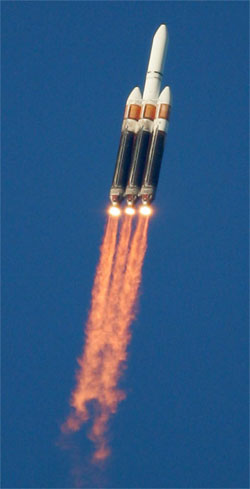
Delta 4-Heavy hits snag on test flight
BY JUSTIN RAY
SPACEFLIGHT NOW
Posted: December 22, 2004
The test launch of Boeing’s Delta 4-Heavy rocket began with a breath-taking blastoff from Cape Canaveral Tuesday afternoon but lower-than-expected performance during the initial minutes of flight ultimately caused the mission to fall short of its intended orbit. Nonetheless, Boeing officials called the demonstration flight a success.
The 23-story rocket roared to life while enveloped in a hellish fire at pad 37B as free hydrogen from the three Rocketdyne RS-68 engines ignited. As the countdown reached zero, a dozen bolts that held the rocket to the pad for the past year popped and the 1.6-million pound vehicle thundered into a clear blue sky.
The highly complex launcher, which takes three so-called Common Booster Cores and strapped them together to create a powerful triple-body rocket, ascended atop three pillars of super-hot golden flame, flickering more than 20-stories long.
Gulping three tons of propellant per second, the engines won the battle against gravity to blast the rocket away from Earth as the powerplants raged at full throttle.
Nearly four minutes after liftoff, tracking cameras following the launch showed the starboard and port boosters shut down their engines and peel away from the rocket’s core. But the engine cutoff and subsequent booster separation came about 8 seconds prematurely, based on the advertised timeline.
After the center booster finished firing and dropped away, the cryogenic upper stage of the Delta 4-Heavy ignited for what was supposed to be a 7-minute firing to reach an initial parking orbit around Earth. As the scheduled completion time for that burn came and went, there were indications that something was not right. The upper stage was being forced to fire much longer than anticipated to make up for a performance shortfall earlier in the launch.
The unplanned overtime firing used fuel needed for later burns to reach geosynchronous orbit. The stage’s final burn Tuesday evening was supposed to last three minutes and 14 seconds to inject its cargo into the desired orbit, but the motor ran out of fuel before completing the maneuver.
“I don’t know the exact, final orbit or how much shorter the final burn was. We’re going to look at the data and get those answers,” Boeing vice president for Expendable Launch Systems, Dan Collins, said in an interview Tuesday night.
Collins said it was too early to say exactly what triggered the performance shortfall.
“We’re going to have to dig in to know for sure. I’m going to hold off comment until we have a chance to look at it in the morning. It’s been a relatively long day. From the data we have seen, we are have high confidence that we are going to be able to track this down and make whatever adjustments are necessary. But you want to give it a day or so of looking at the data.”
The Air Force awarded Boeing a $141 million contract to conduct this demonstration flight of the Delta 4-Heavy as a means of testing the rocket before critical national security payloads begin flying aboard the vehicle. Two operational launches are scheduled for August and December 2005 carrying the final Defense Support Program missile warning satellite and a classified National Reconnaissance Office payload, respectively.
“I’ve spent the entire day with our customer…I can tell you we’ve got a very, very happy customer. We demonstrated all phases of this mission and we got a huge amount of data that allows us to move forward with high confidence towards the DSP mission next summer,” Collins said.
“I can’t put words in the customer’s mouth but everybody in the Mission Director’s Center characterized the demonstration mission as really a truly great success. Our objective in this launch was to gather data and run through the entire mission profile. From that respect, we had a great day and a great flight. it is going take some data review for us to know exactly where we ended up.”
This was the fourth launch of the Delta 4 rocket family, which Boeing created as part of the Air Force’s Evolved Expendable Launch Vehicle program for next-generation vehicles to loft government payloads over the next two decades. The Delta 4, which has flown previously in its medium-lift configuration with just one Common Booster Core, is joined in the EELV stable with Lockheed Martin’s Atlas 5.
Tuesday’s launch featured a 13,383-pound instrumented satellite mockup, called DemoSat, as the rocket’s main payload. The 6-foot tall, 4.5-foot diameter shiny aluminum barrel was filled with 60 brass rods for ballast. Sensors on the satellite collected data on the vibrations, temperatures and pressures during ascent, plus measure the shock felt at separation.
Hitching a ride on the side of DemoSat was a pair of nanosatellites nicknamed Ralphie and Sparky. Built in collaboration between Arizona State University, New Mexico State University and the University of Colorado at Boulder, the canister-like nanosats were originally supposed to launch aboard a space shuttle mission in 2003. But the Columbia accident and grounding of the shuttle fleet led to the Air Force proposing an alternate route to orbit on Delta 4.
The nanosats were deployed but their status was not immediately known. They were to operate for a day, conducting imaging, micropropulsion and intersatellite communications experiments before tumbling into the atmosphere.
The Air Force decided to finance the test flight and not fly a real satellite after it became clear there wouldn’t be a commercial customer to purchase the inaugural launch.
“The original strategy for demonstrating the Heavy capability was to utilize the perceived burgeoning commercial market. In 1998, this vehicle would have been a big player in what was projected back in those times. So the Air Force was in a great position. They were going to be able to benefit from the commercial launches,” Collins said.
“When that commercial launch market started to go away and signs that it wasn’t going to allow the demonstration to happen, the Air Force stepped in and said ‘hey, we’ve got some important payloads to go. We want to get data before we put those on top of the rocket.’ So they came in and purchased an amendment to the development of the contract for this mission.”
Besides future military missions, Delta 4-Heavy is being studied along with Atlas 5, space shuttle-derived concepts and completely new space vehicles to launch missions in NASA’s Vision for Space Exploration that aims to return astronauts to the moon and ultimately send the first humans to Mars.
The Delta 4-Heavy is capable of delivering 48,000 pounds of cargo into low-Earth orbits, including that of the International Space Station, 28,000 pounds into geosynchronous transfer orbit used by communications satellites, 22,000 pounds for Trans Lunar Injection routes to the moon and 17,600 pounds on Mars-bound trajectories.
“The biggest help we’re being at this point is by providing (NASA) information about the system, what its growth possibilities are, where its limitations are, so that they have the best set of data to match up with planning an overall exploration program,” Collins said of Boeing’s ongoing discussions with NASA.
“We’re working hard with them but really in an information exchange situation and helping them get educated and smart on what the existing Delta capabilities are and then how Delta can grow.”

By: Arabella-Cox - 25th December 2004 at 01:45
You know, that is really insane:
They shoot up that “Demosat” filled with tons of brass rods. I mean, who does such things? Why couldn’t they just use a block of concrete? NASA really is slightly nuts.
if it is lost in space, do you know the difference between brass and concrete? 😎
By: Distiller - 22nd December 2004 at 12:00
You know, that is really insane:
They shoot up that “Demosat” filled with tons of brass rods. I mean, who does such things? Why couldn’t they just use a block of concrete? NASA really is slightly nuts.


 Sign In








 December 22, 2004 at 11:56 am