Gents,
Having modeled G-AEDU (1:6 scale RC) I am pretty familiar with the aircraft’s current configuration but a friend has unearthed some photos of the aircraft in South African service before its refurbishment a few years ago. The photos show three tubes in the port wing root that appear to bleed some of the high pressure air under the leading edge away to the upper surface. The aircraft no longer has these and there is no explanation accompanying the photos so I am puzzled as to what the purpose of these tubes was.
The photos are at http://www.dehavilland.co.za/DH90_Dragonfly.html
Can anybody enlighten me?
Or perhaps one of you knows who did the restoration work and may therefore be able to supply the answer?
In confident expectation, thank you!

By: RPSmith - 9th April 2012 at 01:00
thanks E4W re info about fuel tanks.
Roger Smith.
By: eye4wings - 8th April 2012 at 07:53
Well so much for my powers of observation!
Perhaps I haven’t looked for them before… I must have looked at half a dozen photos from a similar angle – although not of such good quality as Tim’s.
Thank you again Tim – and gents all!
By: wieesso - 8th April 2012 at 01:13
The photos show three tubes in the port wing root that appear to bleed some of the high pressure air under the leading edge away to the upper surface.
Photo showing only two tubes in the port wing root
http://www.flickr.com/photos/phototram/6211010267/sizes/o/in/photostream/
By: Consul - 8th April 2012 at 00:24
Tim is right, they are Venturis for the instruments.
They are still installed in the port leading edge of G-AEDU to this day, but it is back to the standard two.
Ben
Hi Ben
Here’s a view indicating the pair in EDU
Tim
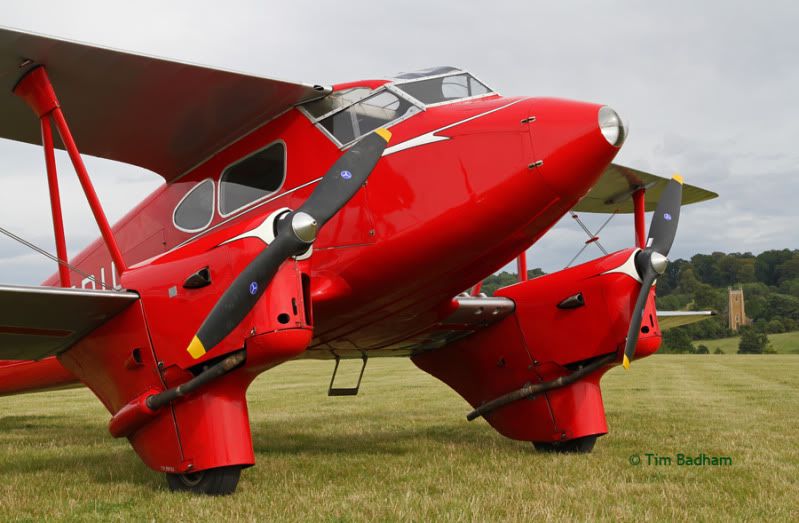
By: Stan Smith - 7th April 2012 at 23:24
Yes they are venturis. The Rapide has them mounted on the engine nacelle/fuselage strut and the standby is provided by one operated by the exhaust. Our Dragon also used to have them on the strut but as the engines were changed to Gipsy Major Mk 10-2’s we now have an engine driven vacuum pump on the stbd engine. I presume that is also the case with the Dragonfly and the reason there are no “tubes” evident. As an aside, our Miles Gemini also has a vacuum pump mounted on the port engine instead of external venturis. Most of the restoration was done by Cliff Lovell when he was based at Coombe Bisset and later at Chilbolton .
By: Gipsy 1 - 7th April 2012 at 23:06
Tim is right, they are Venturis for the instruments.
They are still installed in the port leading edge of G-AEDU to this day, but it is back to the standard two.
Ben
By: eye4wings - 7th April 2012 at 22:33
Roger, I can tell you why the step-down… A number of Dragon Rapides were lost to fire and a design change was made in the Dragonfly to re-site the fuel tanks in the wing in stead of immediately behind the engines. As a consequence the inboard section had to be thickened considerably… and only one Dragonfly was ever lost to fire.
Tim, thankyou – what a boon an extensive library is! I thought they looked like they could be venturis, the inner tubes are visible in one of the photos – but that still left the question ‘why three?’
So the reason the aircraft no longer has those features is either that Mr Norman had no wish to do blind flying or that modern instruments are electric powered. (or perhaps both).
I would still be interested to learn where the restoration was done if anyone can tell me. Some photos of the work in progress would be very informative.
Thanks again gentlemen.
Robin
By: Consul - 7th April 2012 at 21:46
This feature can be seen in photos of several DH 90s prior to their delivery so it’s not a mod.
According to a review of the type printed in “Flight” January 23 1936:
” The gyro instruments are driven by two venturi tubes mounted in openings in the port lower wing root, where the airflow is of high velocity, thus enabling the blind-flying instruments to be used for the take off.”
Tim
By: RPSmith - 7th April 2012 at 20:59
Curious.
Just a guess – could it be anything to do with parachuting out of the aircraft?? Although this would be counter-productive if the cabin door was left on!
Have never noticed before the way the lower wing steps down outboard of the engines.
Roger Smith.


 Sign In








 April 7, 2012 at 8:22 pm