We have listed in the parts manual for the Whirlwind Dzus FJ46, FJ56, FJ70 and FJ80 fasteners.
We know that the FJ series is countersunk, and have seen all of the more modern references, which all give the same two-part numbering system, FJX-XX, eg. FJ7-60 being a size 7 (defined by shaft diameter), 0.6 inches long.
I am sure that just ‘FJ70’ etc meant something once as a complete descriptor of a fastener. Does anyone have an old (wartime) catalogue, or know off the top of their head the modern equivalents in the new system?
Thanks,
Matt

By: TonyT - 14th November 2014 at 10:49
My pleasure. 🙂
By: Beermat - 14th November 2014 at 10:24
Lovely!! Just what we needed and numbering mystery solved – the FJ had a standard diameter back then, and the number referred to length only. Thanks!
By: TonyT - 14th November 2014 at 09:51
Mine tells you how to calculate the length, Email sent.
Edit…. have put another one on here along with smaller version of emailed one
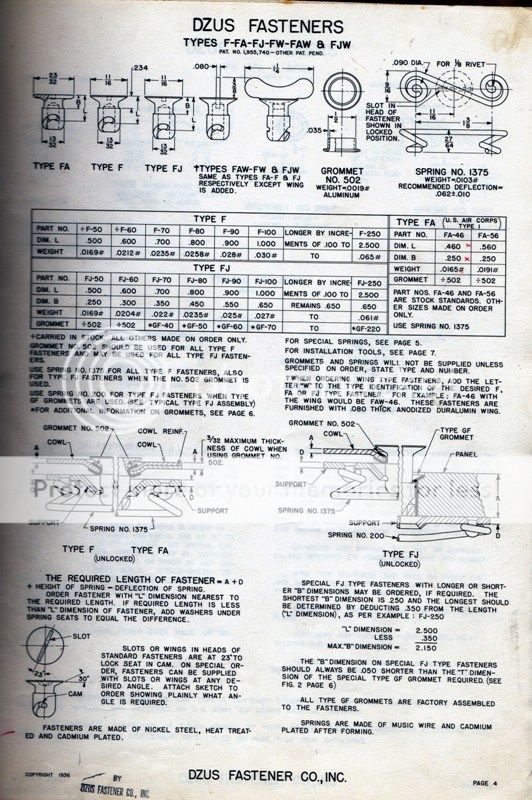
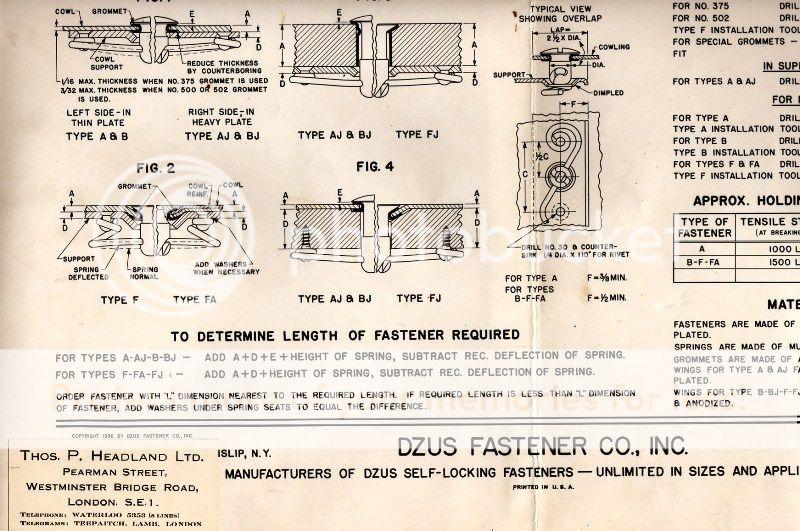
By: Beermat - 14th November 2014 at 09:23
Hi there,
Please find attached the Hunting Percival Aircraft Ltd Design Office Handbook Section DB-09-02 dated 11/11/52 regarding countersunk DZUS fasteners.
I don’t think it gives you any further information than you already know, but thought I’d include it.
Just a thought, in your parts manual are the Sec/Ref numbers for the fasteners in there as well as the p/n, should be Sec 28FP for Aircraft Fasteners and Quick Release Pins, if there are can you list them please and I’ll look in my copy of AP1086 Sec 28FP
Regards
Dave
Hi Dave – That pretty much sums up what we have, useful single-page reference, though. In our AP parts list they are 27H/, bit odd. No further numbers, nothing after the slash. Looking forward to seeing the 1938 reference, Tony, and hoping it’s not the same!
By: TonyT - 13th November 2014 at 19:50
Mines 1938
By: radarsdesk - 13th November 2014 at 18:47
Hi there,
Please find attached the Hunting Percival Aircraft Ltd Design Office Handbook Section DB-09-02 dated 11/11/52 regarding countersunk DZUS fasteners.
[URL=”
Hunting Percival DB-09-02 DZUS Fasteners
“]
Hunting Percival DB-09-02 DZUS Fasteners
[/URL]
I don’t think it gives you any further information than you already know, but thought I’d include it.
Just a thought, in your parts manual are the Sec/Ref numbers for the fasteners in there as well as the p/n, should be Sec 28FP for Aircraft Fasteners and Quick Release Pins, if there are can you list them please and I’ll look in my copy of AP1086 Sec 28FP
Regards
Dave
By: Beermat - 13th November 2014 at 18:30
Sure does. PM-ing my addy. Cheers!
By: TonyT - 13th November 2014 at 17:56
That would be perfect – thanks Tony 🙂
Drop me an email , I will scan the FJ page for you at work tomorrow… Does that help?
By: Beermat - 13th November 2014 at 16:44
That would be perfect – thanks Tony 🙂
By: TonyT - 13th November 2014 at 16:32
I bought an old catalogue off evil bay…. original one too. will have a look tonight.
By: Beermat - 13th November 2014 at 15:17
..although 7/16 across and 10/16 long might be feasible. Thanks, Sabrejet..
By: Beermat - 13th November 2014 at 14:53
Thanks Sabrejet. Yes, I was thinking the tenths thing is quite modern, it’s the way they do it, though, clearly and consistently described in the Dzus/Southco literature one can find on the net. I don’t know what was used in 1942, though I suspect you might be right about 16ths.
The problem with making an FJ76 an FJ7-60 is what one does about an FJ70. FJ7-10 is smaller than any Dzus fastener is ever likely to be (1/10″), and would probably be called an FJ71 anyway, and FJ7-100 is an inch long (and is much bigger than anything in any catalogue).. and (edit) would not fit the area it’s for (radio hatch) anyway. We are looking in the range 0.4 to 0.5″ for our FJ70.
By: Sabrejet - 13th November 2014 at 14:10
Just a thought: doesn’t an FJ7-60 equate to an FJ76 (where the first number is diameter and the second is length)? I can’t see the part numbering changing too much, since it’s pretty much a universal standard to state length/grip length/threaded length and diameter in this way.
However I think that length expressed in tenths must be a modern idea: more likely in 1/8, 1/16, 1/32 or 1/64th graduations surely?


 Sign In








 November 13, 2014 at 2:00 pm