See
They tested the plane in Macapa first, in sea level. But surely they have a better and more similar airport at home!
Where is it easier to land – London City or Santos-Dumont?
And how does Toronto airport compare?

By: Arthur Pewtey - 9th April 2009 at 14:12
I can maybe provide a few answers here. I was involved in steep approach certification on both the BAe146 /RJ and the Jetstream 41.
The length of the runway is in itself irrelevant however combined with a steep approach of 5.5° as it is at LCY makes it relevant.
What happened on the certification programmes I was involved in was that initially handling trials were carried out using visual approach aids (not at LCY) at 5.5, 7.5 and 9.5° approach angles The higher angles were required for abuse case, tailwinds etc. The aircraft handling and ability to flare were assessed. Factors such as airbrakes, flaps, thrust (with engine antice on, it puts the idle thrust up), CG position , landing weight were all assessed. Only when all these tests were completed, tests at LCY were flown to assess the aircraft when the autopilot was coupled to the ILS, something that couldn’t be done anywhere else due to the glideslope. At LCY factors such as ground handling, noise etc can be assessed as well.
On the 146, the aircraft has to be set up in the landing configuration before descending on the glideslope otherwise it will not be able to slow down during the approach. There is a steep approach switch in the flight deck. It gives an indication of when the aircraft is in the correct configuration for the approach and desensitizes the GPWS Mode 1 “Sink Rate” call out. The Jetstream 41 steep approach switch did something similar.
The approaches use standard VREF values so are no faster or any more hazardous than normal approaches
The flare is awkward as the aircraft has to be rotated through a larger angle than during a normal 3° approach and if the flare is not correct, the aircraft may float – that is when the short runway becomes a factor. LCY has touch down lights set so that if you are not on the ground by these lights then you go-around for another attempt.
I assume Embraer will have gone through a similar test process and I believe the aircraft has had to be modified to allow steep approach certification.
I hope this helps clarify a few points.
By: chornedsnorkack - 9th April 2009 at 13:17
Lugano´s runway length is quoted as 1323 m. So how does this compare against LCY? Then again, Lugano is not a big city compared to Rio de Janeiro or Toronto.
By: EGTC - 8th April 2009 at 15:50
Yes, as an example Runway 31 at Plymouth has a recommended glide path of 3.5 degrees which is practically standard. (Typical glide angle is 3 degrees. LCY’s is approx 5.5 degrees).
I’m sure I heard in the past it was more than that at one point. Im not entirely sure if it was just a test or what. I’ll have a look on another forum and see if I can find any info.
By: rdc1000 - 8th April 2009 at 11:34
In quoting runway figures there appears to be some misunderstanding, and I’m sure some of the pilots on here would chip in on this. Although LCY has 1508m of concrete, the entire length of this is neither available for take-off, nor landing. The runway has the following declared distances…
TORA: 1199m; TODA: 1319 (most restrictive); and LDA: 1319. (there is also the ASDA but less important for this comparison. The TORA is the length of concrete available to be used for take-off, that is to say pilots at LCY know they must be off the ground by a given point 1200m along the runway to ensure they are in the air and at an adequate height by the time they need to clear obstacles and allow adequate RESA areas where some of this is included in the runway. The TODA figure is the take-off distance available and makes an allowance for aircraft which are airborne, but not yet able to climb fully, i.e. still accelerating beyond V-R. So it’s a clearway distance really, but you’ll notice the upper limit of this is still 1319 (although 1385 in the opposite direction but for balanced field length considerations you take the lower).
You also have to bear in mind that aircraft can be payload limited for operations at such airports based on both passenger load and fuel. Modern regional jets (E-jets and C-series) have whopping ranges and are very capable aircraft, but do not require this range to reach destinations within the scope fo LCY (even MXP/MAD) and so you can pro-rata decrease the fuel load and this reduces the take-off roll required. Also bear in mind that with LCY being dominated (although decreasing) by business travel, the typical passenger is relatively light because they tend to only carry a laptop/briefcase/overnight bag and are not lugging 20Kgs of sandals, sunhats and shorts with them, which again is a factor in reducing the payload aiding operations from LCY.
Chornedsnorkack….a lot of fuss is made about LCY because of the approach angle which is highly unusual worldwide, and is made worse because of the short Landing Distance after a steep/fast approach. Aircraft need to be certified to operate to LCY and in some cases need to be modified in order to do so, for example, the Jetsream 41’s of BA which operated into LCY had an override switch which prevented the aircraft from taking avertive action when placed in such a steep decline.
Hope some of this helps.
By: Edi ff - 8th April 2009 at 10:46
i do believe that LCY has a very steep decent down do its runway, and i am concerned that over the years taller buildings will be built, and LCY’s runway heading will possibly be changed
By: tomfellows - 6th April 2009 at 14:14
I seem to remember reading the same about Plymouth on another forum. However I dont think they do anymore?
Yes, as an example Runway 31 at Plymouth has a recommended glide path of 3.5 degrees which is practically standard. (Typical glide angle is 3 degrees. LCY’s is approx 5.5 degrees).
By: EGTC - 5th April 2009 at 17:46
I think Lugano and Plymouth both have/had steep approaches approved.
I seem to remember reading the same about Plymouth on another forum. However I dont think they do anymore?
By: Arabella-Cox - 5th April 2009 at 16:50
I think you have hit the nail on the head. The fact that the plane was painted up specially for it and the fact that it is being seen flying in an out by other operators whom my just be interested in aquiring one at some point suggests that there is an element of marketing going on as well as some landing / take off and ground handling tests.
That might be a part of it, but probably a very small part. All aircraft that fly into LCY have to be certified to do so first (there’s a list of certified types on the airports website). I believe it’s unique in the world, however if it is not then the reason it’s been certified here is that no major carrier based at the other airports has requested a large order dependant on its ability to master the approach.
By: Super Nimrod - 5th April 2009 at 14:48
Probably because LCY is, at least for its size, an important and high profile airport. SDU and YTZ most definately are not.
I think you have hit the nail on the head. The fact that the plane was painted up specially for it and the fact that it is being seen flying in an out by other operators whom my just be interested in aquiring one at some point suggests that there is an element of marketing going on as well as some landing / take off and ground handling tests.
By: YakRider - 5th April 2009 at 10:30
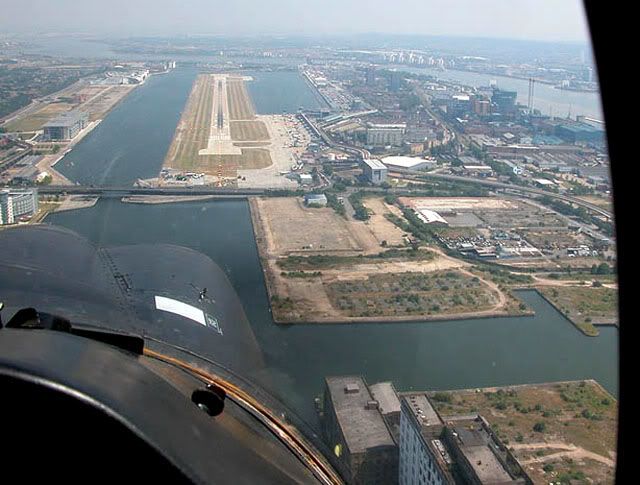
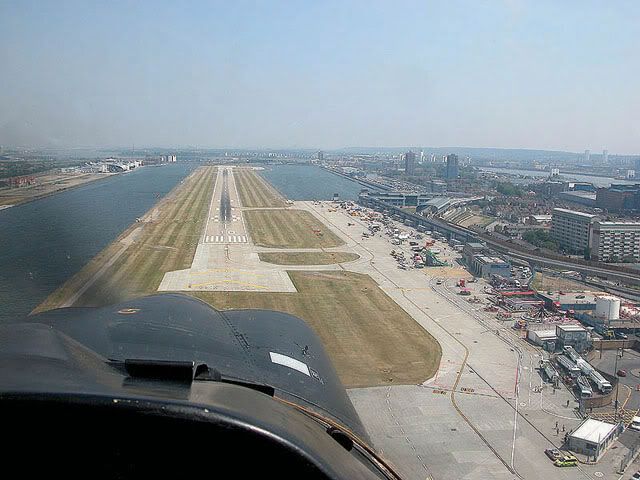
Here is the the approach to LCY 10, so you can get an idea of the obstacles. Taken from a Bulldog.
By: Newforest - 5th April 2009 at 08:40
I think Lugano and Plymouth both have/had steep approaches approved.
By: Arabella-Cox - 4th April 2009 at 23:00
I think the runway length is the limiting factor
No, the runway is not the problem here, it’s the approach into the airport. Apparently it’s unique in the world for requiring such a steep approach.
By: tenthije - 4th April 2009 at 20:35
My point is that London is not the only big city with a rather central, but short, airport in the harbour.
Why is LCY certification so much talked about? Seeing how SDU and YTZ are shorter?
Of course, having fewer obstacles on the approaches might, or might not allow planes to take bigger useful load at SDU than at LCY.
Probably because LCY is, at least for its size, an important and high profile airport. SDU and YTZ most definately are not.
By: chornedsnorkack - 4th April 2009 at 20:08
My point is that London is not the only big city with a rather central, but short, airport in the harbour.
Why is LCY certification so much talked about? Seeing how SDU and YTZ are shorter?
Of course, having fewer obstacles on the approaches might, or might not allow planes to take bigger useful load at SDU than at LCY.
By: PMN - 4th April 2009 at 18:19
The underlying sarcasm to any of chornedsnorkack’s threads, just my entitled opinion… :diablo:
Again, you’re entitled to your opinion but I can guarantee I’m not alone in my thoughts that suspect this thread will turn into another waste of bandwidth.
Paul
By: PMN - 4th April 2009 at 18:13
Paul, I think you are being a bit harsh!
You’re entitled to your opinion but I didn’t understand the point of the post, hence me asking.
It’s quite simple really. :rolleyes:
Paul
By: PMN - 4th April 2009 at 17:47
Some data:
YTZ longest runway is 1219 m
LCY is 1508 m
SDU is 1323 m.
The point of that being…? :confused:
Paul
By: chornedsnorkack - 4th April 2009 at 17:20
Some data:
YTZ longest runway is 1219 m
LCY is 1508 m
SDU is 1323 m.
By: Grey Area - 4th April 2009 at 16:03
YYZ is somewhat bigger. 😀
Paul
And in Canada.
By: PMN - 4th April 2009 at 15:57
And how does Toronto airport compare?
YYZ is somewhat bigger. 😀
Paul


 Sign In








 April 2, 2009 at 9:24 pm