I was watching the documentary movie distributed in Poland and found something interesting – some frames showed Hawker Hurricane I wearing German crosses under the wings. Anybody guess how many Belgian Hurricanes were took over by Germans? Are there any other pictures of the early Hurricanes used by Luftwaffe?

By: adrian_gray - 3rd January 2008 at 10:57
The only Erprobungstelle that tested this Hurricane was Warner Brothers. The aircraft is a Canadian built Hurricane painted up to represent a Bf 109 for the wartime movie “Captains of the Clouds” starring James Cagney.
Yay – half right! I don’t look as daft as I am!
Adrian
By: Gretza - 2nd January 2008 at 11:47
The only Erprobungstelle that tested this Hurricane was Warner Brothers. The aircraft is a Canadian built Hurricane painted up to represent a Bf 109 for the wartime movie “Captains of the Clouds” starring James Cagney.
Anybody knows more details about Canadian Hurricanes starring Messerschmitts in this movie?
By: G-ASEA - 30th December 2007 at 15:24
I found this photo of an early Hurricane in my collection, taken in 1940
By: Keith Gaff - 28th December 2007 at 21:12
Early Hurricane 1 in German markings
Hey, Luftwaffe fans, what about this Hurricane in Luftwaffe markings… Any guess which Erprobungstelle it was tested?:)
[EMAIL=”[IMG]http://i193.photobucket.com/albums/z208/kgaff_2007/hurricanegerman.jpg[…]”]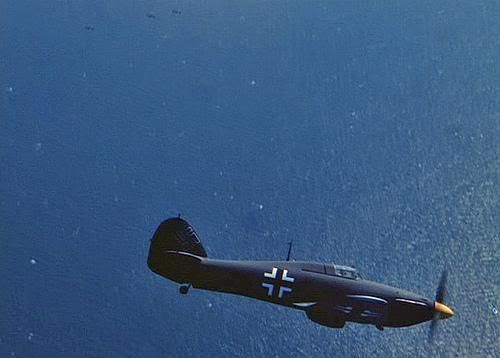 [/EMAIL]
Hello Gretza,
The only Erprobungstelle that tested this Hurricane was Warner Brothers. The aircraft is a Canadian built Hurricane painted up to represent a Bf 109 for the wartime movie “Captains of the Clouds” starring James Cagney. Cagney plays a knockabout Canadian bush pilot who ends up ferrying Lockheed Hudson bombers to England. Because the movie was made during the war and in brilliant colour it is a visual feast for aircraft enthusiasts. It’s a pity that the story line is rather average. It plays on Australian pay TV every so often and if you get a chance to see it you should.
By: Thunderbird167 - 27th December 2007 at 16:53
No 1 Sky Blue or Duck Egg Blue and Eau De Nil or Duck Egg Green were both used whilst Sky Type “S” was being introduced as there was a shortage of Sky Type “S”. Widespread application of Sky Type “S” did not happen until late August 1940.
I have not seen reference to it being used before the fall of France and therefore would be suprised to see it on a two blade RAF Hurricane. However, history often proves us wrong
By: XN923 - 27th December 2007 at 11:37
The black/White colour scheme was superceded from 6th June 1940 by the introduction of Sky Type S.
All the two bladed RAF Hurricanes would have been delivered prior to this date and would therefore have been in the white/black scheme.
This information is from “Camoflague & Markings” Vol 2 by Paul Lucas
True, but didn’t some Hurricane squadrons paint their own aircraft with light blue undersides (probably an Armee de l’Air colour) before the official introduction of Sky?
By: Thunderbird167 - 26th December 2007 at 23:25
Yugoslav Hurricanes
I note from the Romanian Military History Site that three out of six of the captured Yugoslav Hurricanes were passed by the Germans to Romania.
Of the others, two of the aircraft went to Luftflotte 4 in April 1941. These were all originally delivered with two blade Watts props, but it is not clear if they retained these at the time of capture. For the record all of the Romainan aircraft had three blade props.
http://www.worldwar2.ro/forum/index.php?showtopic=1857&st=60
By: Thunderbird167 - 24th December 2007 at 23:50
Underside Colours
The black/White colour scheme was superceded from 6th June 1940 by the introduction of Sky Type S.
All the two bladed RAF Hurricanes would have been delivered prior to this date and would therefore have been in the white/black scheme.
This information is from “Camoflague & Markings” Vol 2 by Paul Lucas
By: Gretza - 24th December 2007 at 23:29
Here is detailed Preucil’s story:
http://news.bbc.co.uk/2/hi/uk_news/2962494.stm
By: antoni - 24th December 2007 at 20:25
Hi folks;
I don’t remember where but i’ve seen a pic of a mk1 in the
museum in Berlin say late 39 or 40. The a/c was on a stand
and one could see the DO/X in the background.
I think the story was a young pilot lost his way over thr channel
from an otu. Hope this helps.More info would be great.
Merry Christmas y’all!
Wolfgang.
The Berlin Museum Hurricane belonged to a Czech pilot that defected. He was in fact a German agent who decided it was time to go back. After the war he was convicted of treason and hanged. The Hurricane was destroyed by allied bombing.
By: oshawaflyboy - 24th December 2007 at 18:37
Hurri’s
Hi folks;
I don’t remember where but i’ve seen a pic of a mk1 in the
museum in Berlin say late 39 or 40. The a/c was on a stand
and one could see the DO/X in the background.
I think the story was a young pilot lost his way over thr channel
from an otu. Hope this helps.More info would be great.
Merry Christmas y’all!
Wolfgang.
By: Fedaykin - 24th December 2007 at 17:48
I’ve heard this and I still think it’s myth put about by a few ‘experten’ who don’t like to think that their aircraft had flaws. The slats were an anti stall device. They deployed automatically and invididually, and the pilot had no control over them. They worked on negative air pressure and popped out when the wing was about to stall. In all probability, one would deploy before the other leading to ‘grab’ and the aircraft being thrown off aim. It would take an incredibly skilled pilot in my view to turn so precisely that the slats deployed at exactly the same time and then keep it on that knife edge before they retracted again. And even then I’m not sure the much more highly loaded 109 could stay with, let alone outturn, a Spitfire or Hurricane.
I’ve never seen any stats to bear this out, just one or two accounts. Erwin Leyhauf, for example, who says ‘this advantage soon changed when improved Spitfires became available’ – despite the fact that no changes to the Spitfire’s turning ability were made while the original planform remained and if anything would be eroded because of increased weight. He also smugly points out that ‘The English later clipped the wings of the Spitfire’ to copy the 109, evidently forgetting that the Germans later added elliptical tips to the 109’s wings.
Squadrons in France and later the RAE tested 109s in mock combat with Spitfires and Hurricanes and kept coming back with the same result – the 109 cannot turn as tightly. In a turning fight, the 109 will more or less always lose. Luftwaffe tactics bear this out – high speed ‘bounce’ and get out of there before your enemy can lure you down to low speed when they will have the advantage.
As far as the ‘high energy’ turns are concerned, didn’t the 109’s elevators start to get incredibly heavy at higher speed meaning it could turn even less tightly?
Well the fact is I’m not the best qualified to talk about it:D but as during the war there were so many different variants of all these types its very difficult to get a clear answer. I think one of the German aces could certainly get more out of the 109 then your average pilot. During the Battle of Britain the Spitfire and 109 were certainly more closely matched then people give credit and the canon armament in the german type were certainly handy. The Germans during the battle of Britain suffered the same problem that the Argentines during the Falklands war lack of endurance over the battle area which in my opinion was more critical than respective turning radius, combined with some stupid tactical decisions by the German high command despite being the smaller force the RAF had the advantage.
By: XN923 - 24th December 2007 at 17:04
However, as has been pointed out by Gretza, these would almost certainly have had the shadow shading of black and white on the underside of the aircraft. So it is unlikely that it is an ex-RAF aircraft.
Does anyone know when some of the RAF fighter squadrons in France started painting the undersides blue? Fairly sure No1 Squadron’s Hurricanes were painted in this way, but might not have been until after they had upgraded their airscrews to VP.
By: CSheppardholedi - 24th December 2007 at 16:02
There was the Czech pilot, Augustin Preucil, who defected to Germany in his Hurricane in 1941 landing in Belgium. Not sure what mark it was though and the pick I saw was displaying it in it’s RAF markings. (A PA letters) Not sure what happened to it after that?!?!
By: Thunderbird167 - 24th December 2007 at 15:49
I think that it has been documented that all of the Belgian Hurricanes were destroyed either on the ground or in the air on the 10/11/12 May 1940.
The RAF certainly had two blade Hurricanes in France. The are several photographs in 12 Days in May and various other books on the Hurricane.
However, as has been pointed out by Gretza, these would almost certainly have had the shadow shading of black and white on the underside of the aircraft. So it is unlikely that it is an ex-RAF aircraft.
Yugoslavia also had early Hurricanes and there is a comment in Robert Jackson’s book that one was experimentaly modified to take a Damler-Benz DB601A engine. The fate of the Yugoslav Hurricanes is unkown. I guess therefore that the one pictured could be from Yugoslavia. If so it would be after April 1941.
By: Eye on the Sky - 24th December 2007 at 12:54
12 Days In May gives reference to the fate of the Belgian Hurricanes, cant give detail as my copy is not to hand. Hope this helps.
Dean
By: XN923 - 24th December 2007 at 09:56
There are some additional shots from the sequence of “Belgian-Luftwaffe” Hurricane. Surpisingly I noticed that there is no radio antenna mast on the top of fuselage. But all Hurris used by Belgians and RAF had it. Close-up of the engine shows very early exhaust and installation for standard four guns in the wing. I checked through every available photographs of RAF Hurricanes used during French campaign and found NO! aircraft with two bladed propellers. So, it must be an Belgian AF example. The movie sequence is more confusing than I expected.
I believe the original examples of RAF Hurricanes in France had wooden airscrews but during their time were re-equipped with DH props. There is a photograph of 87 Squadron’s machines in France dated March 1940 and every airccraft has a two bladed prop (P.23-24 Hawker Hurricane at War, Chaz Bowyer).
Interestingly, on P.26 of same there is a photograph of L1628, with two bladed prop and ‘kidney’ exhausts which force landed in Belgium when that country was still neutral in November 1939. The aircraft was not too badly damaged and was interned, apparently along with several others which did so before May 1940.
On the same page is a pic of HM the King visiting Lille-Seclin in December 1939. Clearly visible are six 85 Squadron Hurricanes with 2 bladed props.
Not sure when they changed over to 3-bladed VP. There may be a reference in ‘Fighter Pilot’
By: XN923 - 24th December 2007 at 09:46
…whilst at slow speeds it can turn very tightly utilising the automatic slats.
The thing is most German pilots were not prepared to push the 109 too hard in turns due to a fear about the structural strength and unpredictable stall characterisics at slow speed. Most average pilots would back off from the turn thinking the aircraft was about to stall despite the fact that slats hadn’t yet deployed and they still had plenty of leeway. On the otherhand the average Spit pilot would get stick judder prior to entering a stall in a tight turn allowing them more leeway to perform tight manouvres. German aces were more prepared to push hard allowing them to out turn the British types.
I’ve heard this and I still think it’s myth put about by a few ‘experten’ who don’t like to think that their aircraft had flaws. The slats were an anti stall device. They deployed automatically and invididually, and the pilot had no control over them. They worked on negative air pressure and popped out when the wing was about to stall. In all probability, one would deploy before the other leading to ‘grab’ and the aircraft being thrown off aim. It would take an incredibly skilled pilot in my view to turn so precisely that the slats deployed at exactly the same time and then keep it on that knife edge before they retracted again. And even then I’m not sure the much more highly loaded 109 could stay with, let alone outturn, a Spitfire or Hurricane.
I’ve never seen any stats to bear this out, just one or two accounts. Erwin Leyhauf, for example, who says ‘this advantage soon changed when improved Spitfires became available’ – despite the fact that no changes to the Spitfire’s turning ability were made while the original planform remained and if anything would be eroded because of increased weight. He also smugly points out that ‘The English later clipped the wings of the Spitfire’ to copy the 109, evidently forgetting that the Germans later added elliptical tips to the 109’s wings.
Squadrons in France and later the RAE tested 109s in mock combat with Spitfires and Hurricanes and kept coming back with the same result – the 109 cannot turn as tightly. In a turning fight, the 109 will more or less always lose. Luftwaffe tactics bear this out – high speed ‘bounce’ and get out of there before your enemy can lure you down to low speed when they will have the advantage.
As far as the ‘high energy’ turns are concerned, didn’t the 109’s elevators start to get incredibly heavy at higher speed meaning it could turn even less tightly?
By: Fedaykin - 24th December 2007 at 01:53
(One or two 109 pilots maintain, if I recall, that the 109 could turn inside both the Spitfire and Hurricane but as far as I am concerned the evidence doesn’t bear this out at all)
The funny thing is if you ask any person about the Spit/Hurricane vs the 109 they will bring up the turning radius.
They thing is it’s not quite so clear cut and in some respects a bit of an old wives tail.
The easiest thing to say is that a Spit or Hurricane flown by an average pilot will out turn a 109 with an average pilot. At high speed and altitude the 109 is better able to retain its energy allowing it to hold a harder turn whilst at slow speeds it can turn very tightly utilising the automatic slats.
The thing is most German pilots were not prepared to push the 109 too hard in turns due to a fear about the structural strength and unpredictable stall characterisics at slow speed. Most average pilots would back off from the turn thinking the aircraft was about to stall despite the fact that slats hadn’t yet deployed and they still had plenty of leeway. On the otherhand the average Spit pilot would get stick judder prior to entering a stall in a tight turn allowing them more leeway to perform tight manouvres. German aces were more prepared to push hard allowing them to out turn the British types.
By: Gretza - 23rd December 2007 at 22:16
There are some additional shots from the sequence of “Belgian-Luftwaffe” Hurricane. Surpisingly I noticed that there is no radio antenna mast on the top of fuselage. But all Hurris used by Belgians and RAF had it. Close-up of the engine shows very early exhaust and installation for standard four guns in the wing. I checked through every available photographs of RAF Hurricanes used during French campaign and found NO! aircraft with two bladed propellers. So, it must be an Belgian AF example. The movie sequence is more confusing than I expected.


 Sign In








 December 19, 2007 at 11:04 pm
