
By: J Boyle - 20th April 2011 at 17:31
When I was at Bentwaters…circa 1989, their was an ABDR F-101B, ex NY-ANG, 57-0270.
I have a small piece of its painted skin on one of my display shelf.
By: bigron427 - 20th April 2011 at 10:24
Underwing stores
And yeah…I have long wondered about where Mr. Gunston got the reference about mines or any other stores carried beneath the wings of the F-101. With the exception of field-modified RF-101C aircraft serving in SEA with ECM pods, I know of no example, and no mounting points, for underwing stores or pylons. My personal theory is that the intrepid Voodoo pilot would fly his aircraft beneath the stormy waves, and gently deposit the mines on the oceam floor. There. Now it’s in print (sort of…) so it MUST be right!!!! :dev2:
Ron Easley
By: bigron427 - 20th April 2011 at 10:11
F-101 weapons
Good morning!
I see Graham and maybe a couple of other familiar faces from the old Yahoo “Century Series” group! I’ve been working for a while on a book about the F-101. The main thing that got me started was the fact that there is so much contradictory and innaccurate information in print with regards to armament. I think I can shed some light on this.
F-101A/C: Identical armament. Internal armament 4 x Mk39 20-mm cannon, original intended armament was a large, McDonnell-designed store attached to the aircraft centerline, the Model 96. It was originally intended to carry a W5 fission warhead along with fuel, for a total weight of about 10,000 pounds. As the design evolved, the warhead was changed to the thermonuclear W29 warhead. F-101A 53-2427 was used for drop tests of the Model 96 pod. However, the large centerline pod caused severe interference effects on the F-101 and contributed to longitudinal stability problems. By early 1956, the MK28 was in the pipeline, offered a high yield, low drag, and none of the adverse effects on stability. The Model 96 concept was dropped and the aircraft stood alert with the MK7 until the MK28 became available. The other nuclear weapon options have been addressed in previous posts. The only addition I would make is that the MK57 weapon was designed for carriage aboard the F-101A/C, but being primarily a Navy weapon, I do not know if it was ever issued to the 81st TFW. It is not on any of the Standard Aircraft Characteristics sheets for the F-101A/C that I have seen so far. They list only the MK7, MK28, and MK43 weapons. An early SAC for the F-101A (14 OCT 1955) does make reference to the Model 96 store.
One pre-production F-101A, 53-2436, was modified with a rotary door mechanism in support of the upcoming F-101B program in 1955. Appaently, it mounted 2 x MB-1 [I]Genie missiles on one side (Kinsey, D&S Vol. 21, F-101 VooDoo, p. 41, and 3 x [I]Falcon[I] missiles on the other side. I have seen photos from the NASA archives of wind tunnel models with this configuration. During this time, the F-100 and F-104 were getting a lot of public exposure, and news of the F-101 was very rare. [I]Flight[I] magazine (9 March 1956, p. 268) published a photo of 53-2436 with the three [I]Falcons[I] and two six-tube 2.75-inch rocket launchers on either side, right about where the aerodynamic strakes of the F-101B were positioned. The photograph looks like it might have been retouched, so I am not quite sure what to make of it yet, but I think this is where the story got its “legs”. I am in contact with one of the project engineers for the F-101 during this timeframe, and hope to have a definitive answer soon. In any case, this was a one-off aircraft. The F-101A did not carry missiles as part of its normal armament.
At the time that the F-101B was conceptualized, the standard armament of missile-armed ADC interceptors (F-102A and F-89H) was 6 x [I]Falcon[I] missiles. This configuration was flight tested in both captive-carry and live fire tests. By the time the F-101B entered operational service in 1958, the armament configuration had been changed to the definitive 2 x [I]Falcon[I]/2 x [I]Genie[I]. However, the six-[I]Falcon[I] configuaration remained listed as an “alternate armament” configuration in the Standard Aircraft Characteristics for the F-101B, 26 SEP 1958. By the time the 16 AUG 1960 SAC was published, all reference to the “alternate armament” configuration had been removed. In what photos or film that I have seen of the six-missile configuration, they have always been of the early GAR-1 model of the [I]Falcon[I], which was retired in 1959 in favor of later versions with , among other advantages, a higher kill probability. It’s an educated guess on my part, but I think that the higher PK of newer missiles contributed to the decision to switch to pairs of missiles. I have heard of two pairs of [I]Falcon[I] missiles on each side but have not yet seen photographic evidence of it.
With regard to centerline stores on the F-101B, I think that I have seen in the manuals somewhere that it retained mounting points for a centerline store, but have never seen photos of anything mounted there on this model. I suppose that I might just have to go look for it….
Anyway, hope this helps, and looking forward to learning more about what was really an amazing aircraft!
Ron Easley
Sacramento, California
By: nitromaniac - 28th November 2010 at 20:25
This is what l found on the USAF Museum website.
McDonnell RF-101A and C
http://www.nationalmuseum.af.mil/factsheets/factsheet.asp?fsID=2326&page=7
By: Peter - 27th September 2010 at 02:33
No interior pics?? The seats should have been recovered..
By: Jagx204 - 26th September 2010 at 22:31
As recieved
Just so we keep things in perspective this is how it was recieved at the Midland Air Museum. I have posted these before but ages ago..
I have been endevouring to bring a better outcome for this artifact for a while and will continue to do so. However since anything of value was removed before it was loaned to the fire service its deterioration is not as bad as it may seem here.
By: brewerybod - 26th September 2010 at 20:39
Here is the same Voodoo 70270 ex Texas Air National Guard in use for battle damage repair training at RAF Woodbridge in September,1985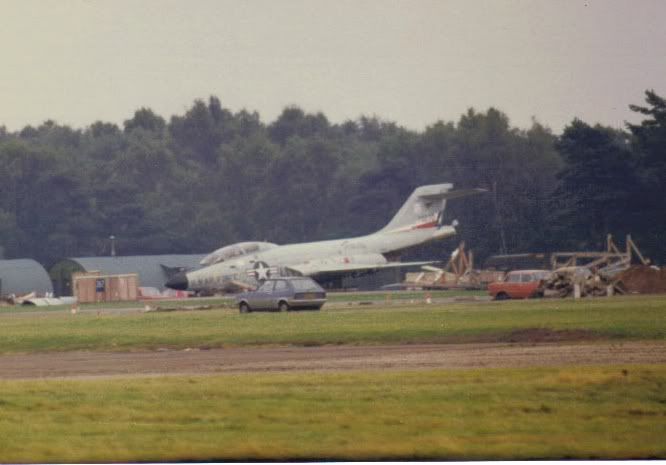
By: RPSmith - 26th September 2010 at 19:41
Thanks curlyboy.
Pagen I agree.
Roger Smith.
By: pagen01 - 26th September 2010 at 18:48
I know it’s used for valuable work, but it kind of makes you weep to see such a rare cockpit in the UK used like that.
Much prefer to see a more plentiful Hunter or Jag used intead.
By: Arabella-Cox - 26th September 2010 at 18:44
Here you go a couple of pics before the firemen threw us out


curlyboy
By: RPSmith - 25th September 2010 at 19:45
Posting just to make any UK Voodoo fan aware that the F-101B cockpit section in the fire/rescue practice area at Coventry Airport will be highly visible tomorrow to visitors to the ‘Fly In’ there. The north side entrance path into the event from the drop off/pick up point for the park and ride buses is about 50 yds away from it. Rare chance to photograph it??
Roger Smith.
By: 67Cougar - 19th March 2010 at 17:45
Thank you Andy. Outstanding shots! The damage was pretty extensive, I see now why it ended up being shipped to Ogden ALC for rebuild.
By: Arabella-Cox - 17th March 2010 at 19:16
As promised, here are the two images of the Tangmere crash. Both are stamped RAF Tangmere 11 April 1962 on the reverse.
Andy Saunders
By: Peter - 8th March 2010 at 15:41
The first two pics are of the CF101 that used to be over at the cadet camp in Trenton. She was moved over to the base just outside of the museum for storage and has since left to be dismantled for transport to CFB Gagetown
By: AVI - 8th March 2010 at 13:40
Not Alpha or Charlie …
Kinda rough …
By: lindoug - 7th March 2010 at 20:09
He agreed with Robin’s statement about the ‘fun’ of the over the shoulder. When carrying the concrete shape on this method, he would often roll his aircraft after releasing the shape, so that it was floating on its upward trajectory a few few from his canopy. Not the smartest thing to do, but then that Wing did a lot of things that weren’t particularly smart with their airplanes. From what Dad said, it was really a wild bunch, especially in the 1960-61 time frame.
Flying the RF-101 the 38th TRS took on a nuclear delivery role flying out of Ramstein in 1962. Don Karges flew with the squadron and recalls a couple of things which are relevant to our discussion.
“”Occasionally we dropped a 2000 pound concrete shape which had a drogue chute similar to the real weapon. This was much more realistic, but caused a few laughs and scary moments. If we were doing a LADD delivery, the shape would release while we were in a steep climb, the chute would deploy immediately and fall behind and below the aircraft. Our escape manoeuvre to avoid the blast was to roll inverted, pull 4gs toward the ground and escape straight at high speed/low level. BUT, once in a while the chute would not deploy and when we rolled inverted to pull toward the ground the 2000 pound concrete shape was right opposite the canopy as if it were flying formation! Obviously the shape goes into a ballistic curve and lands who knows where.”
As for the prospect of flying a two way mission:
“……if one thinks of about the hundreds of airplanes and missiles that would be airborne and reflects that everyone would need to be exactly on course, on time you knew how hopeless that would be. Frankly we didn’t expect to return.”
The regulation eye patch also caused some amusement to the pilots of the F and RF-101s. To avoid being totally blinded by the glare from the nuclear bursts that would inevitably occur around them they would wear the patch until they made their target. It was then removed and the good eye could complete the bomb release routines.
By: Atcham Tower - 7th March 2010 at 19:59
Cougar, if you haven’t already, have a look at the current thread “Interesting Old RAF pics”. The very last is a great colour shot of an 81st F-101.
By: brewerybod - 7th March 2010 at 17:53
Re: 81TFW Voodoo Accident
After a bit of research i’m certain it was a RF-101 based at Laon and found this link http://www.offshoreradio.co.uk/odds19.htm which has audio clips about the incident.
Cheers – Graham, Bentwaters Cold War Museum
By: 67Cougar - 7th March 2010 at 16:50
81TFW Voodoo Accident
I ran across a German newspaper clipping dated April 22, 1965 detailing a 81TFW Voodoo accident. I’m trying to find confirmation of it, and any details.
The aircraft was returning to Bentwaters (making it a 91 or 92TFS bird) from Laon France on April 19, 1965. A mechanical malfunction at altitude and high speed caused the pilot, Lt. John wynn, to eject about 10 miles off the coast from Bentwaters. Pilot was injured, but rescued by a British off shore radio vessel.
I have found no other information anywhere about this accident. I have no a/c written off on that date, and no other report of the incident.
Can anyone shed any light on this?
By: 67Cougar - 7th March 2010 at 16:27
Robin joined the 81st late in 1963, just after my father rotated out of the unit. His comments, while accurate for his time frame, applied to his time with the Wing. When my father arrived in 1960, the Mk.7 and the over-the-shoulder toss method were the only ones used in the Wing. As newer weapons became available (Mk.28 variations), the lay down and the retarded Mk.28 became the weapon/delivery of choice. It was far more accurate than the toss – my father told me that he had a couple of ‘shacks’ using that method with the concrete shape. However, the Mk.7 and the toss was more than accurate enough to take out their targets, given the weapon’s yield.
He agreed with Robin’s statement about the ‘fun’ of the over the shoulder. When carrying the concrete shape on this method, he would often roll his aircraft after releasing the shape, so that it was floating on its upward trajectory a few few from his canopy. Not the smartest thing to do, but then that Wing did a lot of things that weren’t particularly smart with their airplanes. From what Dad said, it was really a wild bunch, especially in the 1960-61 time frame.


 Sign In








 March 31, 2009 at 6:44 am