With so many F-5’s still in service. Wouldn’t a engine upgrade or replacements be in order? The Tiger II is a fine little fighter but, it needs more power and range. Many are still around and have been recently upgraded with new radars and avionics. With two engines and hundreds still in service. There must be a large market? Russia would be a good candidate. Along with France, Germany, U.K., etc. etc.)

By: MadRat - 16th December 2017 at 14:00
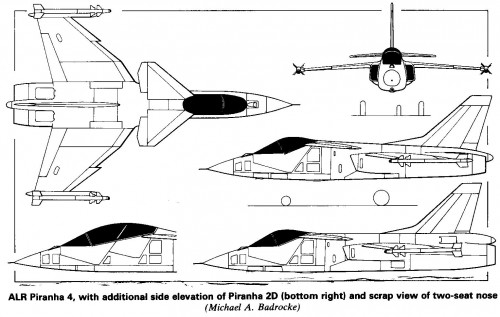
Romania liked the idea of the Larzac… https://www.rumaniamilitary.ro/alr-piranha-concept-de-avion-multirol-usor-elvetian
By: MadRat - 16th December 2017 at 13:44
The J85 used on the USAF had a flameholder redesign and a parts reduction that saves money. That kind of upgrade can probably take place with major headaches. I’d be very surprised the blades couldn’t take some kind of drop-in replacement. The turbines in a jet (e.g. axial-flow and centrifugal designs) are easy enough to upgrade something from the 1960’s by taking advantage of current materials and production methods. A redesign of the F100 to add technology from the F119 went very smooth. They only sought tweaks that didn’t change the design wholesale and ended up with dramatic decreases in spool-up time and similar increases with specific thrust. If the USAF had a considerable fleet and wanted the improvements then they would get done.
By: Z1pp0 - 16th December 2017 at 11:06
Guys dont be so fixated to specific size dimensions and stats like weight if you are gonna find a replacement engine. Air mass flow is the real limiting factor.
Nasa links
Mass Flow Rate
https://www.grc.nasa.gov/www/k-12/airplane/mflow.html
General Thrust Equation
https://www.grc.nasa.gov/www/k-12/airplane/thrsteq.html
Engine thrust is dictated by the Air Mass Flow. In reality this translates to the relation of inlet and outlet dimensions. For example consider the difference between F-5A and F-E. F-5E’s J85 had higher thrust but also required a larger airflow. The difference in requirement was not so large that the inlet redesigned was deemed sufficeint and the airframe could be (largly) left as is. However for the F-5G/F-20 the air mass flow was so large that not only the inlet but also the fuselage had to be redesigned. Airliners usually have their engines in a poded configuration outside the fuselage or wings which makes it relativly easy to replace/upgrade an engine.
There is little economic sense in investing a lot of money and time in redesigning and reengineering/modifying an old and used airframe. A drop in replacement makes more sense. But then your new engine has to have the same dimensions and air mass flow as your old engine. So whats the point in replacing an engine which is already optimised for your specific airframe?
That is why there are so very few fighter engine replacements around to talk about.
\Dan
By: Argo - 13th December 2017 at 21:07
There is one western engine I think that could make an interesting prospect for replacing J85s, that is Turbomeca’s Larzac. It’s quite small, inlet is basically the same size as a J85(per Wiki, might be wrong), weighs around 290-300 kg. In the alpha jet it makes 14 kN, but there was a higher powered FADEC version with close to 17 kN, dry, that was proposed as an upgrade. Adding an afterburning section should not be a major problem and should see it developing close to 30 kN of thrust. It would still weigh slightly more than a pair of J85s, but would offer better SFC and more thrust.
But, J85s are cheap and plentiful and still supported by GE and they do work.
By: Arabella-Cox - 13th December 2017 at 19:43
Or you could put a single modern engine in the F-5 and call it a F-20….oh wait…..
Agree that diameter and weight make a Adour swap out impossible. Amazing how much power the J85 generates for its size.
By: MadRat - 8th December 2017 at 06:41
I don’t know how modern construction couldn’t improve a 1960’s design when ceramics and composites could drop weights and raise maximum pressures and temperatures to gain a modest 20% improvement on the dry thrust alone. The J85 isn’t magic.
The truth is the centrifugal turbofans are simpler and cheaper to produce at that scale. There wouldn’t be a commercial product to sell, so there is no profit in accomplishing this boost of performance. The larger engines are the market.
The funny thing is, the volume of space for a J85 used in the F-5 is actually mostly the wet section.
![http://www.456fis.org/THE%20JET%20ENGINE/J85AB[1].gif](http://www.456fis.org/THE%20JET%20ENGINE/J85AB[1].gif)
By: Cherry Ripe - 7th December 2017 at 08:12
The only replacement for a J85 is really another J85. It’s a remarkable little engine. Perhaps only the Viper comes close.
J85-21 has an inlet diameter of 21″
As you note, the Adour is in a whole different weight class plus that weight is all distributed along the 114″ of the main casing ( rather than concentrated in the forward 52″ casing of the J85 ). Even if it was possible to squeeze that into the airframe it would so massively ruin the CoG that it would be unflyable.
Back in the mid-1970s GE were developing the successor YJ97 on contract to the USAF; 24.4″ diameter, 109.5″ long with afterburner, weight 694lb, thrust 5,270lb dry and ~8,000lb augmented.
By: kck123 - 7th December 2017 at 04:40
I understand this is a very old thread but it is still just as relevant today as 15 years ago. The Rolls Royce Turbomeca Adour MK 951/F405 has a 22 inch diameter vs the J-85-21 diameter of 19 inches I believe. I know that the nacelles in the type II-E/F were redesigned to fit the -21 over the prior J85s. The original was 17″ diameter and I couldn’t find the numbers on the 21. The length of J-85-21 is 52″ with a 60″ nozzle/afterburner section. 112″ total length. Mk951 is 114″ total length. These engines put out 8000 pounds of DRY thrust vs the 5000 of the last J85 variant at full military with flame on
It’s a 3 inch difference (1.5 inches a side) and the length will fit At 2″ longer. The largest issue is weight. The j85-21 is maybe 700 pounds with afterburner and the mk951 is 1784 pounds. That’s a 2000 pound difference. This could be the nail in the coffin for the swap. I am not sure if wiki numbers are accurate. The length listed doesn’t include the huge afterburner section I haven’t seen any specification on that. The Mk951’s would be like adding a third engine with full afterburners. Brand new model full FADEC. Over 50% thrust increase would make the F5 an absolute rocket ship. The engines are heavier Moderators I apologize for revising an old thread but I’ve spent days searching for anything on this with the turbomeca derivative. They are the closest I’ve found in months of searching dimensions. Any help/ideas/thoughts appreciated


 Sign In








 December 19, 2001 at 10:15 pm