I recently finished reading (and viewing I guess) the Osprey Frontline Color title called F-80 Shooting Star Units Over Korea.
A very good read, and of course the best part about the book is the incredible pictures! All of them are great quality, and there’s even some great shots of the ultra-rare RF-80 photo birds.
The F-80 has always been my favorite early jet fighter (I also like the F-94 and T-33 spin-offs), and I think it’s role in the Korean War is often overlooked by the exploits of the F-86 Sabre. A warplane in the truest sense of the word, the F-80 was incredibly rugged, being able to survive great amounts of battle damage. There are some really neat photos of Shooting Stars that made it back to base having sustained a ton of damage. There’s one photo of an F-80C that made it home after a MiG-15 put at least two 37-mm rounds through the center of the fuselage. There’s another photo of an F-80C that made it home after having the half the vertical tail sliced off by high-tension cables that the North Koreans had put up over a target.
The F-80 could also haul quite a large variety (and tonnage) of weapons, ranging from 5-inch rockets to bombs of 1,000 lbs. in size. There’s a neat photo of an F-80C with FOUR 1,000 lb. bombs taxiing to the runway.
I highly recommend this book to anyone who’s even remotely interested. It might give you a new respect for Lockheed’s Shooting Star as well as the men who flew and maintained her. (She even killed some MiG’s from time to time as well. 🙂 )

By: crazymainer - 21st October 2004 at 22:36
I wonder how much it would cost to own a warbird T-33? In my opinion, it’s a perfect warbird plane. Fast, agile, very aerobatic, and a legend in its own time. Plus it was based on the F-80, which was the first operational USAF jet.
Hi Phantom,
Is not the operational Cost that would kill you but the Insurance mind you I remind you of the Sacromental Ice Cream Palore crash.
You might want to pm Mr. Patterson and ask him what it cost him to operate his Mig.-17 here in the States.
Cheers Crazymainer
By: PhantomII - 21st October 2004 at 22:10
I wonder how much it would cost to own a warbird T-33? In my opinion, it’s a perfect warbird plane. Fast, agile, very aerobatic, and a legend in its own time. Plus it was based on the F-80, which was the first operational USAF jet.
By: Arthur - 21st October 2004 at 20:49
Souda was Greece’s last operational T-33 base, they were retired in 2002 IIRC.
By: PhantomII - 20th October 2004 at 04:36
They are probably in open-air storage. If I’m not mistaken, the HAF retired its T-Bird fleet not too long ago.
By: galdri - 20th October 2004 at 00:03
Since we are talking P(or F) 80 and T33’s here, I have a question. Last month I was flying into Sauda Bay on Crete. That airport is a joint Civil/Military thing, and during the turnaround, I counted about 20 or so T33 neatly parked on the military side of the airport. Does anyone know if these Greek planes are operational or are there for some other reason?
By: PhantomII - 19th October 2004 at 23:44
Nice photos.
Were these operational RCAF and USAF birds? They appear to be, but then again it could simply be a rich person’s plaything painted up to be the real McCoy.
By: Bruggen 130 - 19th October 2004 at 20:34
A few more, taken at mildenhall & woodford,
Phil. 🙂
By: PhantomII - 19th October 2004 at 18:15
That’s where I’ve seen that camo!
Didn’t RCAF CF-5’s and CF-104’s have that same paint scheme?
Since no one has really commented on my “why the F-80 is a good fighter” comments how about this question………
F-80 or Meteor? They both came along about the same time, saw combat in various wars, had similar performance throughout, and even spawned similar variants (i.e. two-seat trainers and two-seat radar-equipped interceptors).
What was the better airplane?
By: Swiss Mustangs - 19th October 2004 at 08:31
That’s the RCAF camo used mainly on T-33’s based in Germany.
Martin
By: PhantomII - 18th October 2004 at 22:07
Those are actually T-33 two-seat advanced trainers.
Orginally designated TF-80C, so they can go in this thread. 🙂
Great photos though.
Were USAF T-33’s ever painted in that camo scheme in service?
By: geedee - 18th October 2004 at 13:12
ok – another detail of the camera nose in the RF-80
Martin
Bl*m*y, must’ve been a bit crowded with the hood shut !
Hers a few I took earlier this year (not sure of the actual models, but they look like from the same family ….not up on jets really)
By: PhantomII - 18th October 2004 at 05:24
No one has anything to add?
By: PhantomII - 17th October 2004 at 22:31
Good point about pilot quality comparisons, though I do believe that the F-80 wasn’t as outclassed by the MiG as many publications have you believe. My reasoning behind this is based on several things. First off, I will admit the F-80 (and F-84 for that matter) wasn’t able to compete with the MiG at high altitudes (neither were early F-86’s for that matter), so it wasn’t a good bomber escort, but at lower altitudes I believe it was quite capable of defending itself. It has several positives going for it. First off, the pilot has that bubble canopy giving him great situation awareness. Secondly, the six Brownings in the nose are very clustered, giving a good concentration of shells making for accurate shots and a huge amount of lead hitting the target (though the MiG-15 was indeed a tough airplane). Additionally, the F-80 was a very tight turning airplane, and was able to turn inside the MiG-15 (as well as the F-84 and F-86 I believe). It had a pretty good rate of roll (higher than the MiG I believe, but probably not the F-86), and it was a very durable airplane so it could take the battle damage it might get.
Additonally, the F-80 had a fairly decent thrust to weight ratio for the time, with a slightly better TWR than the F-86A/E variants as well as the F-84E (and G) Thunderjet. That should count for something.
In short, the F-80 when operated at lower altitudes was capable of competing with the MiG-15 on much more equal terms than many “experts” would have you believe.
I just have a lot of respect for the F-80, its pilots, and the guys that worked on them.
Truly a workhorse airplane.
By: PhantomII - 15th October 2004 at 15:31
Well, the truth is that the RT-33A was indeed a single-seater, with equipment taking up the rear seat.
Additionally, I found out that the RT-33 was developed for the MAP program, i.e. it was developed mainly for export.
By: crazymainer - 15th October 2004 at 04:20
49th FIS P-80
HI All,
Here are two P-80s from the 49th The Black Knights of Aroostock County. The 49 was Station at Dow AFB Bangor Maine.
The 49 was the first all jet interceptor squadron on the East Coast.

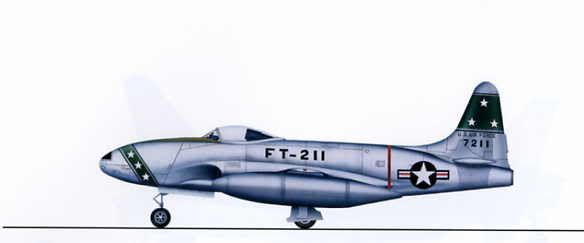
Cheers Crazymainer
By: Adrian_44 - 15th October 2004 at 02:03
RE: F-80’s
> PhantomII
> the F-80 was incredibly rugged, being able to survive great amounts of
> battle damage.
> Shooting Stars that made it back to base having sustained a ton of
> damage. There’s one photo of an F-80C that made it home after a MiG-15
> put at least two 37-mm rounds through the center of the fuselage.
That was a real surprise to aircraft armament designers, how tough jets were to shoot down. I saw a picture of a MiG.-15 that had a Sidewinder Missile impailed into the fuselage and didn’t explode and the plane landed without any trouble!
> She even killed some MiG’s from time to time as well.
That like the Corsairs that shot down MiG.-15’s testifies to the difference in quality between the two pilots.
Adrian
By: Flood - 15th October 2004 at 00:42
A bit hit or miss but the old Heller 1/72nd T33A had an RT33 option: the rear seat was occupied by some ‘black box’ stuff which I assumed at the time was cameras (despite the fact that there was nothing visible – camera ports, etc – that far back up the fuselage).
Can’t believe everything cast in plastic, of course…
Flood
By: ALBERT ROSS - 14th October 2004 at 23:25
Anyone know of any places to look for answers to my questions?
Another good question would be what’s the need for the RT-33 if you have the RF-80?
One to fly it and one to take the photos!
By: PhantomII - 14th October 2004 at 22:27
T-33 compared to F-80
I think the reason some people think they are so very different is because of the fact that you mostly see F-80’s with either the 165-gallon Lockheed tanks or the 265-gallon Misawa tanks, which are hung under the wing. The T-33, on the other hand is always seen with the 230-gallon Fletcher-style tanks which are on the wingtip itself (resulting in a reduced wingspan from 38 ft. 10 in. to 38 ft. 9 in.).
The F-80 actually could carry the Fletcher tanks though, as is shown in many of the above pictures.
In my opinion the F-80 looks the best with the Misawa tanks while I like the T-33 just fine with the Fletcher tanks.
More pictures anyone?
By: turbo_NZ - 14th October 2004 at 08:14
Thanks P.11 !!,
I was always under the (mistaken) impression that they were like the A-37 and Tweet Trainer, virtually different aircraft.
TNZ
🙂


 Sign In








 October 10, 2004 at 5:06 am