As you may well know there has been a long-standing controversy about the number of Argentine aircraft that were shot down in the Falklands War.
A year after the war respected authors Jeffrey Ethell and Alfred Price wrote a book about the conflict which cast doubts on the official figures . To give just one example the Government White Paper on the conflict stated that 14 aircraft were shot down by Rapier missiles but Ethell and Price said the true figure was just one aircraft destroyed by that weapon . Other authors have of course disputed their claims but in today’s “Daily Mail” in the letters section someone has claimed that HMS Cardiff shot down seven Argentine aircraft. Ethell and Price’s book does not mention any aircraft shot down by this vessel though in recent years it has been established that Cardiff accidentally shot down a British helicopter with Sea Dart.
Does anyone have any information on these seven kills achieved by Cardiff?
Colin

By: Griffiths911 - 21st November 2016 at 06:25
Ken
Welcome back & thanks for clarification. Now I’m not an expert on this but I thought in the early Sea Dart system the 909 had to be locked on and the Sea Dart itself receiving reflective signal to be able to commit to launch (unless it was an overridden). If it was only the 992 showing phantom reflections how would the 909 achieve lock or am I missing something?Interesting comments regarding the combat logs. I’ve complied my list of launches from individual accounts but even these can have times and details variations.
I would really like to find an above deck eye witness account of HMS Exeter attempt at engaging an Exocet on the 25 May. I’ve seen an account from the op room which records that the 909 did lock, the Sea Dart did guide and proximity fuse detonated the warhead, although most likely against the surface of the water, but nobody seems to know exactly what happened next. Very shortly after this the Exocet disappeared from radar but this was not unexpected given its very low altitude which limited the radar tracking horizon.
Another Sea Dart mystery is HMS Coventrys launch late in the day of 9th May. I have seen a log of radio information which records hearing ‘bird away, Coventry’ at 19.02. This is not mentioned in the book Four weeks in May by captain Hart Dyke which details HMS Coventry’s Falkland campaign and sinking. Incidentally this book tallies with other launch with the independent information. However the published HMS Coventry court of enquiry records an event at this time, only to then be followed by about half a page of redaction. What’s so secret about this launch, an aborted blue on blue maybe?
Thank you, it’s great to respond to you guys again.
I see where you are coming from with the lock up of spurious radar returns. And it was a great source of mystery to me when I witnessed it for real, yes I have seen the 909 radar show a lock symbol (diamond for forward and square for aft) on spurious contacts. I don’t know the answer and wish I had the balls to ask at the time!
You may not know this but Bristol’s operators picked up two spurious returns and fired at both and in a different direction to us in Cardiff (we were only tracking one) so a strange phenomenon indeed! I have always been told it was 992 mutual interference, sorry.
As for the missile having to detect the 909 radar presence before a launch can be initiated, I’m dubious about that. The 909 has a ‘pencil beam’ radar profile and with the radar being (physically) in a position on the ship that is significantly higher than the launcher, then add the fact that I have never heard a voice launch procedure to state that the missile has ‘contact’ with 909 leaves me with the opinion that the missile picks up and ‘rides’ the 909 after launch. On the other hand you could be absolutely right.
Can’t help you with the Exeter and Coventry issue, just do not know.
By: Vega ECM - 20th November 2016 at 16:37
Ken
Welcome back & thanks for clarification. Now I’m not an expert on this but I thought in the early Sea Dart system the 909 had to be locked on and the Sea Dart itself receiving reflective signal to be able to commit to launch (unless it was an overridden). If it was only the 992 showing phantom reflections how would the 909 achieve lock or am I missing something?
Interesting comments regarding the combat logs. I’ve complied my list of launches from individual accounts but even these can have times and details variations.
I would really like to find an above deck eye witness account of HMS Exeter attempt at engaging an Exocet on the 25 May. I’ve seen an account from the op room which records that the 909 did lock, the Sea Dart did guide and proximity fuse detonated the warhead, although most likely against the surface of the water, but nobody seems to know exactly what happened next. Very shortly after this the Exocet disappeared from radar but this was not unexpected given its very low altitude which limited the radar tracking horizon.
Another Sea Dart mystery is HMS Coventrys launch late in the day of 9th May. I have seen a log of radio information which records hearing ‘bird away, Coventry’ at 19.02. This is not mentioned in the book Four weeks in May by captain Hart Dyke which details HMS Coventry’s Falkland campaign and sinking. Incidentally this book tallies with other launch with the independent information. However the published HMS Coventry court of enquiry records an event at this time, only to then be followed by about half a page of redaction. What’s so secret about this launch, an aborted blue on blue maybe?
By: Griffiths911 - 20th November 2016 at 09:20
Ken
Is it possible to find out why the Bristol fired two Sea Darts? Another question did you have an IFF receiver on board?
See my recent post here and way back in this thread. Yes we did have IFF transmit and receive (attached to our 965 radar).
By: Griffiths911 - 20th November 2016 at 09:17
Thanks for comments on Sea Dart firings. Ethell and Price say that both Cardiff and Bristol fired two Darts each and the radar operator of the Cardiff describes the Boeing 707 firings very clearly. However I can find no description of the Bristol firings. Would like to explore more.
I suspect there is not much to report. Their gunnery team fired at two spurious air contacts caused by mutual radar interference (992). It was a common problem at the time but I will add that Bristol fired in a direction almost 180 degrees from us in Cardiff.
By: Griffiths911 - 20th November 2016 at 09:12
Although I’m not Ken, my research into the Sea Dart engagements might be of interest.
First of all, Bristols engagement was unusual as there was no incoming threat;- the launches were ordered when Cardiff Type 909 radar interference was mistaken for an contact.
Salvo firings were used to increase likelihood of a kill. There were numerous salvo firings but this has never recognised because of a rather embarrassing situation which existed at the time. There was a software bug in the Sea Dart system which meant that if a salvo firing was attempted with too quick an interval the second round would fail to guide. This phenomenon was first noticed during Bristol trials in 76, but had not been resolved until June 82. What I find incredible is that the captains of the Sea Dart ships were unaware of this problem until after they had received the software update which fixed it. Quite a few Sea darts were needlessly expended as a result of this issue.
I now have ships, dates and times for 32 Sea Dart combat launches in the South Atlantic, including the failed salvo missiles.
I cannot believe I am responding to this thread after so many years!
I always believed that the ‘interference’ was caused by the 992 radar on the ships fitted with it, I’m still convinced that was the case. I can clearly remember seeing ‘ghost’ air contacts on 992 when operating with other 992 fitted ships long before the war in 1982 and we were not transmitting our 909 radars at the time.
There is one thing about missile expenditure back then that puzzles me to this day. After the war HMS Cardiff reported that she fired two Sea Darts in the blue on blue helo incident 5 June 1982. I was on the bridge and can 100% remember that only one missile was fired, definitely one. Why did the warfare officers in Cardiff come up with two for their reports, I wonder if they couldn’t account for one somewhere?
By: nazca_steve - 30th January 2009 at 22:43
Thank you chaps, for clearing that one up. Looks like I was a little off-target with my info there. As always, fascinating reading. Santiago, in what way was the 125 involved in supporting the Canberra attack on the Hercules? A radio relay or nav aid?
By: santiagorivas - 30th January 2009 at 15:06
Hi, as Creaking door says, the T-24 was of the FAA and belonged to the II Brigada Aérea of Paraná. Anyway, the Learjets operated together with the civilian planes of the Escuadrón Fénix on reconnaissance and diversion missions, but as far as I know, the civilian planes never flew over the islands, only until reaching the west coast and then returning. The Mistubishi MU-2s were also used to support the Pucará planes deployed to the islands, due to better navigation equipment. Also BAe 125 LV-ALW was used to support the Canberras who attacked the Hercules tanker on June 8th.
The civil helicopters, although initially pressed into Escuadrón Fénix, were used under the command of the different Armed Forces for SAR missions from the mainland.
On the flight in which T-24 was shot down, the plan was not to fly so close to the British warships, they had to return before they did, but they continued flying closer to the islands until they saw the missiles coming.
Bets regards
Santiago
By: Creaking Door - 29th January 2009 at 23:36
…the photo of the Lear 35 with Canberra B-108…..I believe this was part of the ‘Escuadron Fenix’ that played a part in countering ‘Operation Canbelow’ by acting as decoys of a sort. A little too effectively it would seem when one was shot down on 7th June.
I think ‘Escuadron Fenix’ referred only to former civilian registered aircraft impressed into military service and although several Learjets were impressed none were lost in combat during the conflict.
The Learjet that was shot-down by one of a pair of Sea Dart missiles fired by HMS Exeter on 7th June was an Argentine Air Force aircraft, serial T-24, that had been delivered in 1980. Four aircraft were operated by Grupo 1 throughout the conflict on photo-reconnaissance missions and it was during such a daylight mission by all four aircraft that Learjet T-24 was shot-down.
HMS Exeter believed that she was engaging a flight of Canberra bombers.
By: nazca_steve - 29th January 2009 at 18:45
Hello all,
I just followed this thread after seeing Creaking Door’s link over on the other Falklands ‘What If’ thread. This is equally informative and fascinating as the other one, and I wished I’d seen this before stirring up some of the same questions regarding ‘who saw what’ on the night of the 13th June.
But anyway, the thing I wanted to address is the photo of the Lear 35 with Canberra B-108 – Santiago Rivas can probably fill you in a lot better than me on this, but as some of you may know, I believe this was part of the ‘Escuadron Fenix’ that played a part in countering ‘Operation Canbelow’ by acting as decoys of a sort. A little too effectively it would seem when one was shot down on 7th June. The human side of the conflict in this example was brought home to me a few days ago, when I was sent a wedding photos of one of the Canberra crews, in which one of the Lear crew, Major Marcelo Lotufo is shown larking around with his mates.
Steve
By: bexWH773 - 18th July 2007 at 21:05
Still thinking, the right words still essape me at the moment. Bex
By: bexWH773 - 18th July 2007 at 09:36
Ken,
Thanks for sharing those words, by what Ive just read (and Ive read it 4 times now) this is an honourable man caught in a row that does not need fighting again in public for the sake of everyone who was there, and by the look of it reading between the lines, that day is in his mind all the time.
Ok I was 8 at the time, I wasnt there but I wish I could meet the gentleman concerned, just to shake his hand and say thank you & buy him a pint ( this I would to any member of our Armed Forces )
To my inexperienced point of view, perhaps if the ships company had more experience in fighting an Air War (Skipper & XO from non surface ship backgrounds) he wouldnt have felt the need to doubt the word of the OOW and gone to check for himself the cloud base and also totally incorrect intel re: Argentine Bomb / Missile threats which due to security had to keep in his cabin.
Ive kept my comments brief as I have more to say but Im struggling to find the right words ( a problem of mine) at the moment. Bex
By: Griffiths911 - 22nd April 2007 at 08:13
One Hundred Days – Sandy Woodward
I thought it was excellent, a real insight into the thought process of the Task Force commander.
It was particularly good on the war from the viewpoint of the frontline ‘picket’ Type 42 destroyers (Woodward had once been captain of Sheffield) and also particularly good on the reasons and practicalities behind the sinking of Belgrano (Woodward was a submariner by trade).
Just finished it. A very well written and interesting book. I learned a lot of stuff that I had no idea was going on at the time.
The only problem I had was that he was a very ‘familiar’ character to me………hard to explain but all I can say is that some of his more traditional officer qualities were clearly on display here and that sometimes overwhelmed me. Make of that what you will.
In the preface to the second edition he appears to be none too happy with the fact that Major Ewen Southby Tailor, Royal Marines, who he says in his book Reasons in Writing is determined to find fault with his first edition and finds exactly one…………probably talking about earth moving historical stuff. Well, I found a basic error on page 372 (photos) where he describes Commander Christopher Craig’s ship HMS Alacrity as a Type 22 frigate. Alacrity was a Type 21. Petty I know but I can’t help myself!
That apart, a damn good read.
By: Griffiths911 - 16th April 2007 at 07:07
Thanks Damien & Creaking Door for the info………I visit HMS Coventy’s site quite regularly so was aware. I’m still reading Sandy Woodward’s book at the moment (the man and his ways are very ‘familiar’ to me!).
By: Creaking Door - 13th April 2007 at 01:43
HMS Coventry
I see that David Hart-Dyke, the captain of HMS Coventry when she was sunk in 1982, has published a book about his experiences during the Falklands War.
By: Griffiths911 - 27th March 2007 at 20:40
Good old Exeter…..again. You gotta laugh eh?
By: Creaking Door - 27th March 2007 at 13:18
Argentine Canberra B-108 shot-down 14/06/1982
Got my (May) issue of Flypast this morning.
There is a list of Argentine aircraft lost during the Falklands and…oh dear…Canberra B-108 is credited to…HMS Exeter!
By: Griffiths911 - 25th March 2007 at 09:56
LoL you cant get anymore sneaky than a sub driver, besides, they know more than just Ship Skipper :dev2: Bex
Rear Admiral MGT Harris at our 2002 reunion dinner in Cardiff…………..butter wouldn’t melt!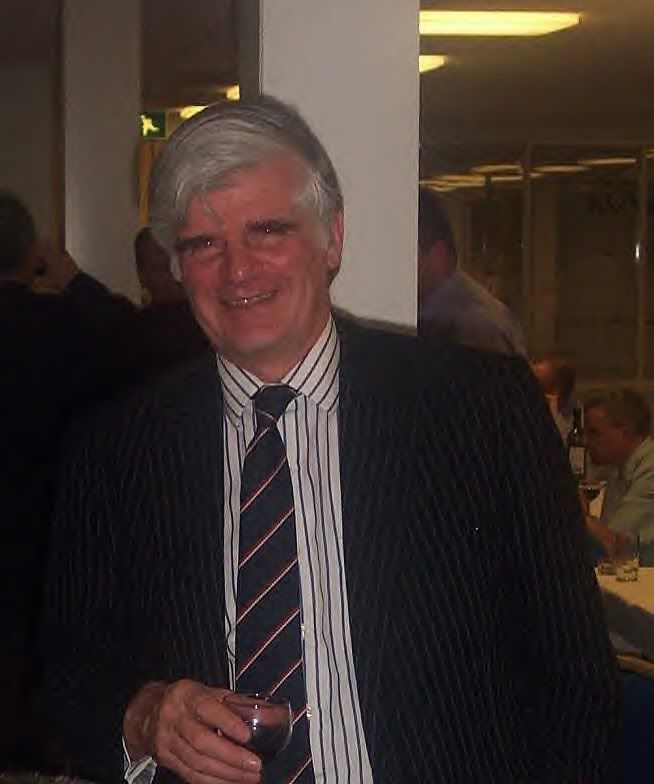
By: bexWH773 - 23rd March 2007 at 22:21
LoL you cant get anymore sneaky than a sub driver, besides, they know more than just Ship Skipper :dev2: Bex
By: Griffiths911 - 23rd March 2007 at 22:16
I thought it was excellent, a real insight into the thought process of the Task Force commander.
It was particularly good on the war from the viewpoint of the frontline ‘picket’ Type 42 destroyers (Woodward had once been captain of Sheffield) and also particularly good on the reasons and practicalities behind the sinking of Belgrano (Woodward was a submariner by trade).
Thanks, my Captain was a submariner also; I think they make excellent tacticians.
By: bexWH773 - 23rd March 2007 at 22:07
I’m going to buy it tomorrow……………….watch this space.
I will, and thank you for all your posts, they have been and hopefully will continue to be very informative. Bex


 Sign In








 February 1, 2007 at 10:55 am