How feasible would it be to use a swarm of fast attack craft in green waters to take out a larger more powerful better funded Navy?
the idea at its basic would be to assign each of the boats a speciality and equipment using fused communication and sensors between the various boats to share targets.
At the core of the of the swarm would be to have specialist instrumented boats with Sonar, Radars etc containing light self defence capabilities.
Surrounding this and protecting these boats would be the boats carrying the armaments with limited (this does not necessarily equal useless) detection capabilities to allow adequate escape routes in case the “intelligent” boats are made useless through some attack.
This would be taking the LCS methodoly to a different direction, instead of swapable modules on one ship that does everything, putting the “modules” on specific boats that are small fast and with a small crew.
This could pose problems for aggressor vessels and require greater concentration on possible targets.
Could also potentially dull the point of a Anti Ship Ballistic Missile Systems.
The profiles of the individual boats could be a lot lower allowing them to be stealthier etc…

By: Wanshan - 7th October 2012 at 22:55
The Royal Malaysian Navy’s Laksamana class have a 4 round Aspide launcher.
Correct: 675 tons full load, 2x RTN-10X fire control radar. Thanks for pointing out my oversight and strengthening the point being made.

By: fariz - 7th October 2012 at 20:14
The Thai 960 ton Rattanakosin-class corvette is the smallest ship I know with Mk 29 and Sea Sparrow.
The Royal Malaysian Navy’s Laksamana class have a 4 round Aspide launcher.
By: Wanshan - 7th October 2012 at 18:57
On long deployments of small boats: http://en.wikipedia.org/wiki/Cherbourg_Project
http://www.globalsecurity.org/military/world/israel/saar.htm
Note some were eventually sold to Chile… not the friendliest of seas around there!
By: wilhelm - 7th October 2012 at 18:10
Granted, and a point well made, if anything its easy to see why they went for frigates come replacement time!.
I’d say the above speaks more to the quality of the men crewing those boats than the suitability of the boats themselves though and, being uncharitable, the lack of a better suited boat to send in most cases?!. Hope thats fair comment!.
Completely fair.
I just wanted to point out that it has been done before.
I agree completely with you that this was driven by necessity, due to the lack of larger vessels as a result of sanctions.
Naturally, as soon as was possible, the 3600 ton Valour class programme was instituted. I’ve no doubt that combat efficiency would have suffered on such small vessels.
It must have been interesting with regards to the mess in some of those extended South Atlantic ocean trips down and around the tip of South America.
By: Jonesy - 7th October 2012 at 16:18
The South African Navy deployed a Minister class strikecraft to search in the Indian Ocean for wreckage from the SAA Helderberg plane crash in November 1997.
…through the Straits of Magellan to Valparaiso in February 1998.
In May 1990…across the Indian Ocean to Keelung in Taiwan.
In 1993…participate in the Atlasur excercise.
2 more repeated the voyage and excercise in 1999.
Granted, and a point well made, if anything its easy to see why they went for frigates come replacement time!.
I’d say the above speaks more to the quality of the men crewing those boats than the suitability of the boats themselves though and, being uncharitable, the lack of a better suited boat to send in most cases?!. Hope thats fair comment!.
I’ve crewed a 200ton ‘small ship’ on a navigation exercise that crossed the channel and then ‘did Biscay’ in both directions…in November. Of the several dozen trainees aboard that ship 2 were not seasick. I was not fortunate enough to number amongst those 2!!!. The ship physically made the transit in terms that it didnt actually sink on the way out or back, but, there is no way, had we been armed, that we could have undertaken a combat patrol following the transit in either direction.
As to the wider issue brought up about the efficacy of aircraft over ships the answer is the obvious one….an aircrafts endurance will never compete with a ships…ever. The clear solution is to leverage the benefits of both by basing the aircraft on the ship.
Distiller writes…
You could do a lot of things with smaller vessels once you drop the (manned) aviation complex requirement and its sea state ops requirements
I think the answer is the exact reverse of that. If you want to get value out of the smaller hull you optimise it precisely for the carriage of aircraft. It is entirely possible to build a SWATH or semi-SWATH/ModCAT hull in the 60-80m length bracket capable of deploying rotary air in conditions up to SS6 and survivable two states above that!. The larger end of that spectrum, still just 80m….10-20m less than ‘normal’ OCPV’s, we see things like the US FSF-1 able to offer concurrent two-spot flight ops.
At 60m you look at something like the A&R ‘Weser’ design ordered by the German Ministry of Transport at Eur50mn a throw (half the price of a Greek Super Vita). Easy to adapt that to a design, with the cost differential, adding quite a bit more installed power than 3MW, capable of embarking an aviation department of an NH90 and half a dozen S-100 type or a smaller number of larger ‘MQ-8B type’ UAV’s and replacing the davit carried boats with Finnish Jurmo’s or similar ‘interceptor’ type units for MSO work. You then have a ‘small unit’ capable of creating a bubble of controlled seaspace dozens of miles across and quite able to do so in sea conditions that would send traditional smaller monohulls scurrying for safe anchorage.
Small boats have a contribution to make certainly…but they must be designed to offer very specific capabilities to do so.
By: Fedaykin - 7th October 2012 at 13:55
You could do a lot of things with smaller vessels once you drop the (manned) aviation complex requirement and its sea state ops requirements.
But I think I said it before – the real competion for small vessels is not larger vessels but aerial assets. Going small doesn’t really work expedtionary (the mothership idea is nice but a bottleneck and single point of failure), and for littoral and EEZ work flying things (and in the future possibly unmanned things) and land based long range missiles are unbeatable for combat. Which limits in my view the small fast surface vessel to ops in permissive environments and para-mil police actions.
Of course then we need to look at the reverse of the coin and why FAC or things that float in general still have role VS UAV or manned aircraft.
In the end an aircraft or UAV can film a trawler doing something potentially naughty or drug runners trying to sneak into a beach but only a boat can come alongside and have a friendly chat 😉 … at the end of a 30mm canon if they don’t understand…
By: obligatory - 7th October 2012 at 13:42
I take it one step further and say:
Why in Gods name do you waste money on ships if they aren’t necessary
to protect the Carrier. (assuming you have one, otherwise dont bother at all)
Already at 2nd WW, it was clear that naval battles are decided from air
By: Distiller - 7th October 2012 at 13:33
You could do a lot of things with smaller vessels once you drop the (manned) aviation complex requirement and its sea state ops requirements.
But I think I said it before – the real competion for small vessels is not larger vessels but aerial assets. Going small doesn’t really work expedtionary (the mothership idea is nice but a bottleneck and single point of failure), and for littoral and EEZ work flying things (and in the future possibly unmanned things) and land based long range missiles are unbeatable for combat. Which limits in my view the small fast surface vessel to ops in permissive environments and para-mil police actions.
By: Fedaykin - 7th October 2012 at 13:12
The South African Navy deployed a Minister class strikecraft to search in the Indian Ocean for wreckage from the SAA Helderberg plane crash in November 1997.
The strikecraft SAS Frans Erasmus sailed across the South Atlantic, and through the Straits of Magellan to Valparaiso in February 1998. Although it must have been some task, this voyage speaks volumes.
In May 1990, the strikecraft SAS Jan Smuts and Hendrik Mentz deployed all the way across the Indian Ocean to Keelung in Taiwan.
In 1993, the strikecraft SAS Magnus Malan, Hendrik Mentz, and PW Botha once again crossed the Atlantic to South America to participate in the Atlasur excercise.
2 more repeated the voyage and excercise in 1999.
Deploying for an exercise or some such similar event over an ocean doesn’t mean they are suited for sustained blue water operations.
They would loaded up with as much supplies as possible, the fuel tanks would of been topped off with extra drums lashed to the deck more then likely, a sedate fuel efficient pace maintained with stops at friendly harbours and the crew would of had to put up with some hardships for a week or so.
Hardly practical for a sustained combat deployment in the middle of the North Atlantic with winter coming on is it!
By: Fedaykin - 7th October 2012 at 13:06
The fact is as others and myself have pointed out the major barrier for FAC taking on Cruiser/Destroyer/Frigate type roles is not the ability to load them up with all sorts of heavy duty weapons systems and sensors (albeit even that is restricted). No it is the crew endurance that is the main issue, with blue water operations a vessel that small cannot have particularly impressive crew facilities or carry much supplies and fuel. Also in open ocean the sea keeping of a FAC is hardly going to be pleasant, actually in the North Atlantic a FAC might be completely swamped in certain weather and sea states. Frankly even a large destroyer with its long thin design is fairly horrid in a winters North Atlantic storm.
There have been mothership concepts that have done the rounds with a supply ship supporting the smaller craft. The Royal Navy almost went with the idea with the Type 23 class that as intended prior to the Falklands war would of had ASW equipment but no anti air fit with the Fort II class replenishment ships resupplying the flotilla and providing air defence. Frankly it was a bonkers idea that luckily got dropped but two of the Fort II were built less the Sea Wolf Silos. If the mother ship had been lost the vessels it would of supported would of been in trouble. It should also be noted that even prior to the post Falklands redesign the Type 23 as intended was still far larger then a common FAC.
Countries that operate FAC use them in a coastal environment in a defensive role. A FAC by its nature is closely tied to a harbour and trying to operate them in a blue water environment is impractical.
By: wilhelm - 7th October 2012 at 11:13
All the problems have been well covered on the thread already….such as self-deployment…FAC’s traditionally dont do too well anywhere above Sea State 4….open ocean transit is right out.
The South African Navy deployed a Minister class strikecraft to search in the Indian Ocean for wreckage from the SAA Helderberg plane crash in November 1997.
The strikecraft SAS Frans Erasmus sailed across the South Atlantic, and through the Straits of Magellan to Valparaiso in February 1998. Although it must have been some task, this voyage speaks volumes.
In May 1990, the strikecraft SAS Jan Smuts and Hendrik Mentz deployed all the way across the Indian Ocean to Keelung in Taiwan.
In 1993, the strikecraft SAS Magnus Malan, Hendrik Mentz, and PW Botha once again crossed the Atlantic to South America to participate in the Atlasur excercise.
2 more repeated the voyage and excercise in 1999.
By: Wanshan - 7th October 2012 at 10:50
Thales STIR 1.2 (fornmerly Sting) will be able guide ESSM, which is a pretty small system (under 1250kgs counting antennea/tracker unit as well as all below deck components. Antenna diameter 1.2m. Instrumented range: 120km I-band and 36 km K-band) Typical target acquisition and tracking ranges: stealth fighter 50km, missile 30km.
http://www.thales7seas.com/html5_beta/product535.html
http://www.thales7seas.com/html5_beta/product270.html
http://www.thalesgroup.com/Countries/Netherlands/Documents/Datasheet_STIR_1_2_EO_Mk2/
By: Wanshan - 7th October 2012 at 00:55
ESSM on a FAC? Thats a SARH weapon! It needs quite e “beefy” guidance kit on the ship to actually use it.
Or are we calling ships reaching the 900/1000 tons of displacement a FAC?
See Danish Stanflex 300 / Flyvefisken class: up to 2x 6-cell Mk 48 Mod 3 > 6 Sea Sparrow (or 12 ESSM per 6-cell unit if you’ld use twinpacks and/or mk56 instead). SaabTech Vectronics 9LV 200 Mk 3 Fire control radar. Displacement is 320 tonnes (315 long tons) light and 450 tonnes (443 long tons) full load.

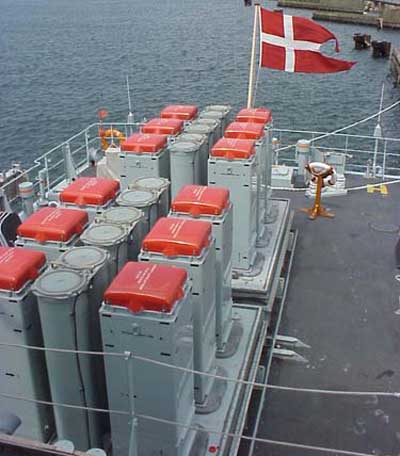

%20Patrol%20Vessel%20Arriving%20in%20Valletta%20GH%20(Malta)%20on%20August%2018,%202007_02.jpg)
The Thai 960 ton Rattanakosin-class corvette is the smallest ship I know with Mk 29 and Sea Sparrow. This uses the Thales WM-25 for missile guidance (as do e.g. ex-Dutch S-frigates of the Kortenaer/Elli class, which additionally have 1 Stir 2.4 and older Tromp class guided missile frigates, which additionally have 2 Stir 2.4)
http://www.thales7seas.com/html5_beta/product397.html


By: fariz - 6th October 2012 at 19:43
Coastlines such as Norway, Malaysia with hundreds of small islands of the coast, can be very protective, for attacks by small boats. Other places such as the coastline similar to the western US coastline and large areas of the eastern Russian/Chinese coastline, will offers little protection.
It will be interesting to see in the coming decades whether traditional FACs operators like Germany, Sweden, Finland, etc, will still have FACs. Malaysia for example, which was the first FAC/Exocet operator in the South East Asia region, has no plans to replace its FACs with newer ones. I like what the Bundesmarine has done with its Gepard class, installing them with RAM but then this is a route many smaller navies can’t afford.
I read somewhere that the performance of sensors of FACs are severely degraded by the heavy vibration that is encountered when FACs or similar sized ships, move at high speeds, anyone know if this is true?
By: Sintra - 17th September 2012 at 17:43
That ESSM didn’t exist in 1991 is besides the point. ESSM can be carried on a small ship like a FAC and WILL outrange Penguin. Clearly, that doesn’t mean defence against AShM, which have varying ranges (but tend to longer ranges). Meanwhile, all but a VERY few select navies will find their ship SAMs being outranged by SSMs. So, how does this disqualify (only) FACs?
ESSM on a FAC? Thats a SARH weapon! It needs quite e “beefy” guidance kit on the ship to actually use it.
Or are we calling ships reaching the 900/1000 tons of displacement a FAC?
By: Adrian_44 - 17th September 2012 at 07:26
Re: Feability of using fast attack craft to replace some of the functions of cruiser
One thing the large ships have are significant assistance from helicopters, large ECM/ECCM suits, the use of SAMs. Or a few dozen Asters, Standard, etc. missiles will devastate a fleet of small boats attacking large a vessels. These weapons they will put a serious dent in attacking small once they get into range of detection.
Coastlines such as Norway, Malaysia with hundreds of small islands of the coast, can be very protective, for attacks by small boats. Other places such as the coastline similar to the western US coastline and large areas of the eastern Russian/Chinese coastline, will offers little protection.
By: leon - 8th September 2012 at 07:49
Ok: other question: which advantage has a FAC compared to a land-based fighter-bomber? The latter is much faster, a smaller target, can have a similar range, needs less crew, the quality of its offensive armament can be similar etc.
Both can be only used in coastal areas, therefore cannot replace blue water warships.
By: matt - 7th September 2012 at 16:58
the debates seem interesting but seem to pre-suppose that the destroyers or frigates are completely replaced in a Navy structure, but maybe read them wrong?
By: leon - 7th September 2012 at 15:46
Torpedo threat was decisive factor at Jellicoe’s planning. He knew that his battleline could take on German battleline – but he had to be wary of torpedo attacks, which enables Germans to escape. He was well aware of torpedo boats success at Russo-Japanese war.
Ok, that means that you think the attacks of the German destroyers (these ships were destroyers not FACs!) were decisive in preventing the battle to be decisive. The reasons for Jellicoe’s decision not turn away from this attack (instead to turn into it) is still debated. Some argue that it was a plotting error…
But neither did anything else, so what exactly that is going to prove? You are going to use D-Day as an examples that everything is useless?
As opposed to German battleships, cruisers and destroyers, which apparently did stop Overlord?
You have stated that FACs can prevent strong navies to enter coastal areas and I had asked you for examples to prove it. Your example was the attack of German S-boats against Overlord – which for sure does not prove that FACs could prevent strong navies from entering and controlling coastal areas! It was your example and not mine!
By: leon - 7th September 2012 at 15:39
Meanwhile, all but a VERY few select navies will find their ship SAMs being outranged by SSMs. So, how does this disqualify (only) FACs?
FACs usually do not have sufficient means to defend themselves against incoming SSMs – and usually also no means to defend themselves against short range helicopter attacks. Frigate-sized warships can have the weapons and sensors to defend themselves.


 Sign In








 July 31, 2012 at 7:40 pm