My wife was reading an article about a pilot who tipped Doodlebugs with the wing of his plane so i was explaining the principle to her. She thought not many could have been destroyed in this way, are there any estimates as to the number brought down like this?………..Martin

By: Bruce McT - 11th May 2011 at 07:20
Flippin Doodlebugs
For mhuxt & Bager1968:
The info re Kate Middleton’s grandfather, Peter Middleton can be found on the Daily Mail website. In search type in ” Kate Middleton’s grandfather, RAF “and the info should come up.
Cheers,Bruce McT
By: |RLWP - 10th May 2011 at 10:47
That makes it even more confusing then. If the low pressure isn’t there, then surely you could ignore pressure effects completely. Unless you get a constriction between the wingtips which would suck the wings together.
I’m not trying to be awkward here, just trying to understand how it worked. I was OK when it was the wingtip of the interceptor raising the wingtip of the bomb, that I could understand…
Richard
By: Moggy C - 10th May 2011 at 09:59
With all due respect to Bernoulli the famed ‘low pressure area’ on the wing’s top surface actually generates very little of the lift required to overcome the force of gravity and create flight.
Moggy
By: lumpy - 10th May 2011 at 09:53
This has got me scratching my head because I must be missing something. If you put your wing tip under the wingtip of the V1, you’re introducing a low pressure area (above your wing) into what was a high pressure area (below the V1 wing). Doesn’t the bomb wingtip drop and veer into your plane?
There’s more to this than meets the eye.
Richard
I believe it may be because there is a high pressure area above the wing too . Its not as high pressure , but is generated just behind the leading edge , before the pressure reduces to form lift ( think of it as the leading edge slamming into the oncomming air , its going to form a little high pressure wave on the top too ) . Ever seem a “cloud “form on top of a wing on a humid day – it doesnt start till about a quarter across the wing , where the lowest pressure is .
I think if you were to approach a V1 from behind , this high pressure might be enough to destabilise it ( but if you were too far forward I would think you would be correct , they would suck together , not the end of the world , just a dented wing as you flip it manually )
By: mhuxt - 10th May 2011 at 09:41
Checking by that name only covers 1 of 2 possibilities… that of her father’s father. What about her mother’s father?
Mail Online has him as Peter Middleton, so…
By: Steve Bond - 10th May 2011 at 09:06
Sid Woodacre, who flew Meteors with 616 Squadron, told me that the only reason the tipping method was devised used was a result of the guns jamming. He said:
“I was among the first to shoot down a V-1. This was on 17 August 1944, when I encountered one south of Canterbury and engaged it at some 400 mph. I saw it explode harmlessly in fields below me, but the blast was enough to throw my Meteor about, even at 1,500 feet.”
“If you were unlucky enough to hit the bomb itself, it would blow up and you could be in considerable danger. One of our pilots (Flg Off Dixie Dean) put his wing tip under the wing tip of a flying bomb, and the airflow disturbed the gyros, toppled it, turned it over, and it went into the ground.”
By: Bager1968 - 10th May 2011 at 08:16
Checking by that name only covers 1 of 2 possibilities… that of her father’s father. What about her mother’s father?
By: mhuxt - 10th May 2011 at 04:53
Can’t find a Combat Report for a Middleton in the National Archives website. Any chance this is a case of “ah, deployed against V-1s, the pilots tipped them over, didn’t they?”
By: Arabella-Cox - 9th May 2011 at 22:37
I knew a Belgian pilot, Paul Leva, who also “tipped” a V1 and must have come into contact (wingtip to wingtip) with the bomb because he had the bent tip of the wing hanging up in his lounge! I wonder where it is now?
My mother, who lived in East Sussex, witnessed several V1s being tipped up by Spits or Tempests and, on one occasion, saw a V1 headed back towards France escorted on each side by a Spitfire! Now there is a story….! I wonder what that story was?
By: Dan Johnson - 9th May 2011 at 21:38
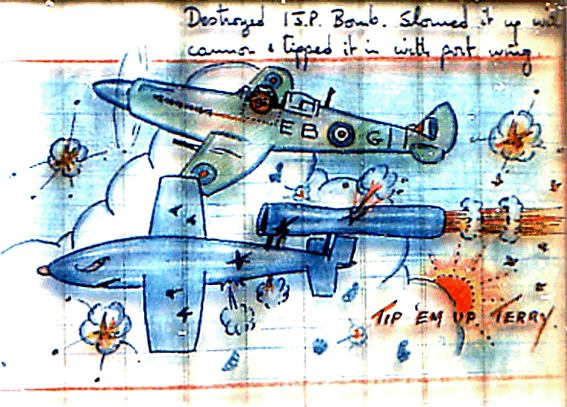
From Terry Spencer’s logbook. Drawn by Tom Slack to commemorate the tipping of the V-1 with the Spit XII.
By: |RLWP - 9th May 2011 at 15:47
If there’s physical contact between the interceptor and the V1, the piloted aircaft is far better placed to recover the situation than the one which is merely gyro-stabilised.
If there’s no contact, then perhaps it’s a matter of the trailing vortex from the interceptor’s wingtip proving a stronger destabilising influence on the V1 rather than the pressure distribution over the two wings.
Well, that’s my two-pennyworth, anyway.
So it could be the upwash from the lower to the upper side of the wingtip that is destabilising the bomb. That would have the advantage of tipping it away from the interceptor.
Richard
By: Scouse - 9th May 2011 at 14:33
If there’s physical contact between the interceptor and the V1, the piloted aircaft is far better placed to recover the situation than the one which is merely gyro-stabilised.
If there’s no contact, then perhaps it’s a matter of the trailing vortex from the interceptor’s wingtip proving a stronger destabilising influence on the V1 rather than the pressure distribution over the two wings.
Well, that’s my two-pennyworth, anyway.
By: |RLWP - 9th May 2011 at 13:54
{snip}
These included using the airflow over an interceptor’s wing to raise one wing of the V-1, by sliding the wingtip to within 6 in (15 cm) of the lower surface of the V-1’s wing. If properly executed, this manoeuvre would tip the V-1’s wing up, overriding the gyros and sending the V-1 into an out-of-control dive.
{snip}
Hope this helps.
This has got me scratching my head because I must be missing something. If you put your wing tip under the wingtip of the V1, you’re introducing a low pressure area (above your wing) into what was a high pressure area (below the V1 wing). Doesn’t the bomb wingtip drop and veer into your plane?
There’s more to this than meets the eye.
Richard
By: AdlerTag - 9th May 2011 at 13:23
The wingtip of Deans’ Meteor is on display in the basement galleries at Imperial War Museum Lambeth, or atleast it was when I was last there a year or so ago…
By: Dan Johnson - 8th May 2011 at 20:17
The first to do it was F/O “Junior” Collier of 91 Squadron in a Spitfire XIV after running out of ammo.
Terry Spencer of 41 Squadron did it in a Spitfire XII which was considered a bit of an accomplishment with a clipped wing Spit.
F/O “Dixie” Deans of 616 did it with a Meteor.
There was a Polish pilot, whose name escapes me who tipped two with his Mustang III. I remember seeing a photo of him holding the dented wingtip of his 51.
Guess we’ve come up with 9 instances in this thread so far 🙂
By: Bruce McT - 8th May 2011 at 19:25
Flippin Doodlebugs
My good friend was a Spitfire pilot who performed this very action. I have had the technique explained to me first-hand. Ben also was one of the two Spitfires that escorted the defecting JU88, with the then secret Lichtenstein radar , into Dyce. This incident is written up in the book “The Great Coup”. Very honoured to know this brave gentleman.
Coincidentally, just read about Kate Middleton’s grandfather doing the same with a Mosquito (on the DM website). He was a pilot instructor in Calgary with the BCATP.
Bruce McTrowe
By: Beermat - 8th May 2011 at 13:47
The latter.
By: piston power! - 8th May 2011 at 12:43
Why did they not just shoot at it? Was this they had no ammo left or the explosion may wipe them out?
By: trumper - 8th May 2011 at 09:57
It must’ve been reasonably successful as i believe they put explosives on the tips of the doodlebug wings to stop that from being done.
http://www.flyingbombsandrockets.com/V1_maintextg.html this guy has a contact number and seems very keen.
http://en.wikipedia.org/wiki/V-1_%28flying_bomb%29 this has a photo of a Spitfire tipping a wing .
“When V-1 attacks began in mid-June 1944, the only aircraft with the low-altitude speed to be effective against it was the Hawker Tempest. Fewer than 30 Tempests were available. They were assigned to No. 150 Wing RAF. Early attempts to intercept and destroy V-1s often failed, but improved techniques soon emerged. These included using the airflow over an interceptor’s wing to raise one wing of the V-1, by sliding the wingtip to within 6 in (15 cm) of the lower surface of the V-1’s wing. If properly executed, this manoeuvre would tip the V-1’s wing up, overriding the gyros and sending the V-1 into an out-of-control dive. At least three V-1s were destroyed this way.[15] That the method was from time to time actually effective could be seen over southern parts of the Netherlands when V-1s headed due eastwards at low altitude, the engine quenched. In early 1945 such a missile soared below clouds over Tilburg to gently alight eastwards of the city in open fields.”
Hope this helps.


 Sign In








 May 8, 2011 at 9:16 am