
By: RMAllnutt - 30th July 2009 at 03:54
I remember a childhood friend of mine finding some small mortar rounds in his garden in Datchet, just across from the Thames… seems an odd place for such things, but I distinctly remember seeing the damaged tail pieces sitting in his garage window back in the mid-seventies.
Cheers,
Richard
By: topgun regect - 30th July 2009 at 00:25
Pete,
Most of the 25-yd range butts on RAF Stations were regularly “de-leaded” – i.e the bullets that had been fired into it were removed. I don’t think this was to recover the scrap value of the metal (the experts will, no doubt, give their thoughts) but was more to do with avoiding ricochets from incoming rounds from those already just below the surface! But as the Cpl i/c the Range at Benson used to explain to me “No problem with your rounds, Sir. They’re probably embedded in the woodwork holding up the corrugated iron roof!”. I presume the same procedure was applied to the longer ranges.
HTH
Resmoroh
I did a range officers course with the air cadets a few years ago and we covered range construction and it is true that barrack ranges are regularly deleaded because of the ricochet risk. Also the other reason ranges are deleaded is the risk of lead poisoning particularly when small arms ammunition (.22 etc.) has been used, as these dont have the ‘full metal jacket’ assault weapon ammunition has.
There was an incident, earlier this year, at Fort Blockhouse (ex HMS Dolphin) in Gosport where some admin bunny was rooting through the records of the place and found that a large Naval mine had been buried in the narrow spit of land between the main camp and the fort area for use if the the Germans ever invaded during WWII. However no records were found of its removal post war. So they went ove the area with a ground mapping radar and found a large anomaly about the size of said mine, so the base was shut down over Easter while the bomb disposal people came in to poke around. thankfully it was just some stray pipingfrom elsewhere in the sites history and nothing else was found in the area.
Martin
By: Maple 01 - 29th July 2009 at 20:03
I was stationed at Gatow. Berlin in the early 1990s. When we handed the place over to the Germans their EOD team did a through sweep of the airfield and recovered over 14 tons of unexploded ordnance that had lain where it had been hasty dumped since 1945. There was a small bunker at the bottom of the lane that ran Parallel to the golf course that contained 90 odd panzerfausts.
Over the weeks of the operation I noticed in the scrap bin an undercarriage leg from a Ju88 and the wing of a FW190 as well as loads of steel helmets and gas mask canisters, some with masks inside
On a similar note there used to be a series of photos of the area of the golf club taken in 1945 which showed it as a dumping ground for Luftwaffe airframes. I don’t know if it was cleared for scrap or if they just bulldozed it all down and landscaped over the top.
By: PeterVerney - 29th July 2009 at 19:46
I guess many airfields which were used during the war will have many small arms rounds lying just below the surface. When aircraft were rearmed in wet weather and odd rounds or short lengths of belted ammo were cleared they dropped in the mud and disappeared. I can remember when the housing was built on Martlesham Heath in the ’70s and ’80s, there were several stoppages of work to clear quite large quantities of just such ammo.
As an aside, when I was a boy during the war the soldiers were happy to give us their blank 303s to save fouling their rifle barrels. We also acquired a considerable amount of live ammo of various calibres both English and German. I well remember disposing of some 300 rounds by lighting a big fire in a slit trench, and pitching the ammo in and diving into another slit trench which the Army had conveniently dug close by. Petrol anyone? We used to collect it by the pint from discarded 4 gallon tins the Army used to refuel their tanks. Second vehicle I ever drove, age about 9, was a Churchill tank.
By: phil103 - 29th July 2009 at 18:36
Funny Falklands should be mentioned a mate of mine is RAF Bomb disposal and he is having a busy six month tour there clearing the left overs from the campaign there
By: Pete Truman - 29th July 2009 at 17:23
But we’ve always been told that it was a civilised war Res, whatever that means, probably like playing a game of snap with the Taliban.
At my last dwelling, I knew of a few local incidents involving aircraft during WW2, I did find a live round in my garden, a 303, I’ve still got it, if I bash it with a hammer, will it make it safe?????????
By: Resmoroh - 29th July 2009 at 16:09
And don’t forget the Forgotten Ordnance in the Falklands.
Our Argentine colleagues scattered anti-personnel mines around like a medieval farmer sowing corn. The problem was that they took the ‘keeper rings’ off them! These ferrous rings enable the mines, subsequently, to be found, retreived, and defused. The AP mines in Falkland (forget who made ’em – I think they were Italian in origin) were almost all of plastic construction. Very difficult to locate – other than by stepping on them!!
Then there’s the other Falklands Forgotten Ordnance. Many of the citizens of Stanley (and its surrounds) cooked, and heated their homes, with self-cut peat blocks in those days. Just prior to the surrender, a number of our Argentine colleagues had pressed 0.45 inch pistol rounds deep into the peat blocks such that they exploded when put on the fire.
Oh, and don’t forget the human faeces liberally smeared over the walls of the ATC “tower” that we took over at Stanley Airport – but whether that can be defined as ‘ordnance’ is a matter of debate.
I consider it despicable, even 30-odd years later!
Resmoroh
By: WG-13 - 29th July 2009 at 15:23
As a curious teenager and ATC cadet I spent more than a little time watching F4s doing dive attacks on the float target off Cowden range. Low tide revealed more than a few cannon shells and rocket projectile heads washed ashore. It was a 14 mile hike home, otherwise some of them would have made the trip in my rucksack.
By: Resmoroh - 29th July 2009 at 15:23
Pete,
Most of the 25-yd range butts on RAF Stations were regularly “de-leaded” – i.e the bullets that had been fired into it were removed. I don’t think this was to recover the scrap value of the metal (the experts will, no doubt, give their thoughts) but was more to do with avoiding ricochets from incoming rounds from those already just below the surface! But as the Cpl i/c the Range at Benson used to explain to me “No problem with your rounds, Sir. They’re probably embedded in the woodwork holding up the corrugated iron roof!”. I presume the same procedure was applied to the longer ranges.
HTH
Resmoroh
By: Pete Truman - 29th July 2009 at 14:48
Nearly 30 years ago we were doing some survey work on the now defunct Isle of Grain oil refinery. We went off to a pub with some of the management at lunchtime and I pointed out the Montgomery to them through the pub window and told them the story. They thought it was a wind up, there were no warnings made to the refinery about the existance of this ship and the possible dangers of it’s cargo, I bet that the directors of BP, safely ensconced in their London headquarters knew all about it.
I recall when I was very young, on my first visit to France in the 50’s walking along the beach and finding this handle thingy sticking out of the sand. I picked it up and showed my old man, whose wartime experience in battles across Europe caused him to recognise it as a German stick grenade. Fortunately, a corner of the head had corroded and the explosives had leached out, or so he reckoned, I wanted to bring it home but I recall him chucking it out to sea as far as he could.
Much closer to home, I recall taking my son and his mates to Legends at DX one year and while examining the Gibraltar Gun Turret, they dissapeared into the sandy shooting butt and came up with all sorts of remnants of bullets and shells, I was astonished that such stuff was still to be found in there, has it ever been cleaned up properly.
By: Arabella-Cox - 29th July 2009 at 13:59
Apparently underwater is the best place for the explosives, the cool water and the fact that it is wet apparently helps keep the bombs ect more stable (think I got this from one of the series of Coast….)
By: Old Fart - 29th July 2009 at 13:13
They have said as long as they do not move the wreck it will not blow up but…
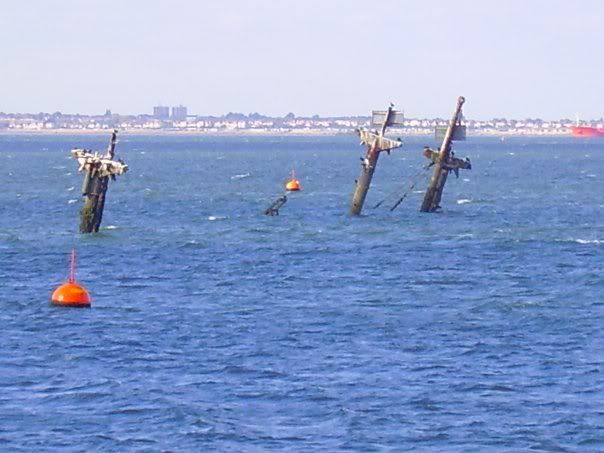
She is beginning to accelerate her break up, apart from the rather large gap where she broke her back a crack is opening up on the hull running top to bottom.
There is a sea scar on one side of the wreck which it might topple into which could reduce the blast but increase the tial wave that the blast would cause.
The Isle of Sheppy would be devistated by the blast, Southend would loose most of its windows and both town would suffer major flouding.
anyone got a rubber ring I could borrow I cant swim…
By: Resmoroh - 29th July 2009 at 13:12
If properly orchestrated it could make the opening of this forthcoming Olympic fest go with a bang! And the EU would have to pay for the reconstruction of the Kent/Essex coastline although I have heard that there are those who say that nothing but good can come from the Richard Montgomery removing large stretches of both coastlines. Indeed, they see it as an improvement!
Resmoroh
By: duxfordhawk - 29th July 2009 at 13:00
SS Richard Montgomery abandoned on 25th September 1944 in the Thames Estuary,
and I live in Southend about 5 miles from it…
286 2000lb bombs
4439 1000lb bombs of various types
1925 500lb bombs
2815 fragmentation bombs and bomb clusters
Smoke bombs including white phosphorus smoke bombs
Signals
Booster charges
The legendary SS Richard Montgomery, It was said should she blow the Maps of South East England would need be redrawn.
There’s lots of stories about the danger of this particular ship and its cargo and it appears government after government choose to ignore it in the hope it won’t go up.
I guess eventually they will need deal with the wreck as surely the cargo can not be stable after all these years.
By: Resmoroh - 29th July 2009 at 12:57
There was – at one stage – the carcase of a dead nuclear submarine moored and floating in Loch Ewe just off Aultbea. Apparently it nearly glowed in the dark, and nobody knew what to do with it as it was not safe to work on. I presume the half-life of dead nuclear submarines is fairly long? Don’t know if it’s still there.
HTH
Resmoroh
By: zoot horn rollo - 29th July 2009 at 12:19
RNAY Donibristle and radioactive particles from cockpit instruments
By: Old Fart - 29th July 2009 at 12:01
SS Richard Montgomery abandoned on 25th September 1944 in the Thames Estuary,
and I live in Southend about 5 miles from it…
286 2000lb bombs
4439 1000lb bombs of various types
1925 500lb bombs
2815 fragmentation bombs and bomb clusters
Smoke bombs including white phosphorus smoke bombs
Signals
Booster charges
By: Alan Clark - 29th July 2009 at 02:11
There will be various nasties lurking around former airfield sites, mainly in and around the former dumps.
Here is a short list of the ones that I can think of right now.
Muntions – from both sides!
Hydrocarbons (fuels etc)
Asbestos
Acids / Alkalis
Glycol
Metal / Metal compounds
Solvents
If you want more take a look at the Department of Environment Industry Profiles on the Environment Agceny web site. There isn’t one for defence sites but you can piece it together from some of the others, mainly aircraft manufacture, airports and explosives manufacture.
By: Arabella-Cox - 29th July 2009 at 01:11
I frequent the old RAF base at Finmere in Bucks and we had a live hand grenade once, luckily we had a RAF guy there who got the bomb squad out to blow it up for us.
We have also seen spent shell casings but not any ordanance as such.
curlyboy


 Sign In








 July 28, 2009 at 7:39 pm