As we’ve gone astray on the 30k tonne CTOL, I’ve put some of the big-gun-boat in here for further suggestions….
To be honest, the best bet would be to simply build a catamaran hull, and park a GMLRS on it, delivering accurate fire, out to a decent distance. If you go with a flat topped Cat, as has been mooted by Austal et al, then you could add in UAVs like the Hermes 900 or even Predator, and have the ability to park a few helos as well, as needed. A 125m Cat, with a flat deck, would be able to carry two dozen light UAVs, a pair of light helos (e.g. Eurocopter Squirrels), and carry a pair of MLRS launchers. Ammunition wise, it should be able to carry, say, 12 ATACMS (12 pods), 288 GMLRS (48 pods), a few hundred Hellfire or Viper Strike, and enough fuel for all of these, for a few days ops. This would be ideally suited to a lot of peace enforcement operations, e.g. British forces in Iraq. You could park a couple of these near wherever you’re operating, and they would be able to keep an eye on things. They would actually be very useful for naval interdiction missions, e.g. the anti-piracy and counter-terror operations in the Horn of Africa.
I agree with the MRLS, but adding in flight ops would push the costs up and away from the cheap. If you’re going to park airframes on it, the pressure to protect that investment will lead to add-on defensive systems.
A single chopper, marine complement and a couple of Ribs might be better. For anti-terror/piracy a good old fashioned gun of some sort (76mm?). An OPV with MRLS?
What I was thinking was a small stealthy platform with two or three 155mm Guns, several MRLS, two 30mm chain guns, and some form of CWIS…..possibly RAM. As for a helocopter why not a small UAV? I believe a STOVL Version would be ideal! (i.e. A160 Hummingbird, EADS Sharc, Sikorsky X-2, etc.) A Stealthy Monitor like that could easily operate within the littorals. Moving in just before or with Amphibious Forces. Which, would be supported with Naval/Marine Air (F-35’s?) and LCS’s.
Does anyone else have a suggestion?

By: sealordlawrence - 20th September 2007 at 12:31
About 13km, IIRC, but that’s not not much difference.
You have to read what I wrote in context. It was a response to the comment about landing craft with 120mm mortars. If you want that sort of close-in fire support (a different beastie from offshore fire support from a long-range naval gun), then a combination of CB90 (or a similar boat, e.g. the Finnish one whose name escapes me for the moment) with a rapid-fire mortar is probably superior to an ad-hoc fitting of mortars onto landing craft. IF.
I wasn’t proposing it as an alternative. It has advantages, but also disadvantages. In some circumstances, it may be a better option, in others inferior. A supplement, not a replacement.
Certainly a combination of CB90 variants would offer a nice initial landing and commando capability able to provide its own short range fire support capability.
By: swerve - 20th September 2007 at 09:56
I was under the impression that the range of that setup is only about 10-12km?:confused: Still useful but not anywhere near the range of a 5inch/155mm/8inch naval gun. Although you could get the CB90 in closer I cant see it fully closing the gap.
About 13km, IIRC, but that’s not not much difference.
You have to read what I wrote in context. It was a response to the comment about landing craft with 120mm mortars. If you want that sort of close-in fire support (a different beastie from offshore fire support from a long-range naval gun), then a combination of CB90 (or a similar boat, e.g. the Finnish one whose name escapes me for the moment) with a rapid-fire mortar is probably superior to an ad-hoc fitting of mortars onto landing craft. IF.
I wasn’t proposing it as an alternative. It has advantages, but also disadvantages. In some circumstances, it may be a better option, in others inferior. A supplement, not a replacement.
By: sealordlawrence - 20th September 2007 at 08:21
CB90 with AMOS . . . .
I was under the impression that the range of that setup is only about 10-12km?:confused: Still useful but not anywhere near the range of a 5inch/155mm/8inch naval gun. Although you could get the CB90 in closer I cant see it fully closing the gap.
By: Bager1968 - 20th September 2007 at 01:59
And just how much per ton does that nano-tech uber-material cost?
Oh, that’s right… they have yet to make any multi-hundred ton lots yet, have they?
By: swerve - 19th September 2007 at 10:45
… The other real candidate for close-in fire support would be 120mm mortars, carried on landing craft, which could fire a few kilometres inland without problems.
CB90 with AMOS . . . .
By: Distiller - 19th September 2007 at 08:48
Distiller: the problem with that is that the armour on the ship puts the cost through the roof. The US hasn’t really built an armoured ship in decades, and it boosts displacement a lot. The aim is not to build a new battleship, but to provide a service, i.e. fire support. The lower the cost, the better.
…
http://nanotechwire.com/news.asp?nid=4912&ntid=116&pg=1
http://www.nanotech-now.com/news.cgi?story_id=11376
http://www.azonano.com/news.asp?newsID=1381
Guess it should have about half the specific gravity of steel.
Displacement of armored ships could be lower today than 60 years ago.
By: EdLaw - 15th September 2007 at 13:57
Distiller: the problem with that is that the armour on the ship puts the cost through the roof. The US hasn’t really built an armoured ship in decades, and it boosts displacement a lot. The aim is not to build a new battleship, but to provide a service, i.e. fire support. The lower the cost, the better.
I would actually argue that the cheapest solution might be to simply put a small rocket launcher on a landing craft. Fundamentally, UAVs are probably going to be the best way to provide cheap fire support, combined with normal howitzers and naval guns. Even the small 76mm Oto Melara gun can provide some fire support, and could be carried on small patrol craft, which can travel around the coastline. The other real candidate for close-in fire support would be 120mm mortars, carried on landing craft, which could fire a few kilometres inland without problems.
By: vajt - 14th September 2007 at 15:22
The US has a tendency to go after the most expensive developments! This 8-inch gun could definitely have been further explored to incorporate a 62-64 cal barrel, lighter weight shield with a more stealthy shape and make it available to many more platforms at a much reduced price. The AGS for the DDX is currently a monster turret and very expensive system. It is so heavy that very few ships can ever carry it. A new development of the 8-inch gun concept could have probably produced 95% of what the AGS will provide but with many more benefits.
—–JT—–
By: Distiller - 13th September 2007 at 09:07
After the Des Moines class (which had those 8″ turrets) all the Navy cruisers were defensive anti-air vessels with secondary anti-ship capability only (that didn’t change till the early 1980’s when TLAM was put on Long Beach and the Virginias).
Anyway, for the fire support mission I wouldn’t use anything less than such a 20.000 tons armored vessel, certainly no thin-skinned oversized destroyer like DDG-1000, or any other such vessel, regardless what kind of gun you mount.
But then again, the real question is, whether or not the combination of navalized ATACMS plus air-dropped PGMs are not more mission [cost] effective than a [new] heavy naval gun (on whatever platform).
By: Arabella-Cox - 13th September 2007 at 04:26
Thanks for posting Jack, the Mark-71 was a real loss for the USN in the long term. Had it have been adopted it could now be upgraded to take a 62 calibre barrel and extended range ammunition.
I have to agree about the 8 inch Mark 71 Gun! Really, I see little advantage in the new 155mm gun for the forthcoming DDG-1000’s. As it will only take extented range ammunition. Which, I believe will not work with any other 155mm gun system!:eek:
By: sealordlawrence - 12th September 2007 at 20:49
I wonder whether a 62-cal version of the 8in gun could be developed for service now, ideally in a twin gun mount. A nice big hull, somewhere around 12,000 tons, with a pair of twin gun mounts could be worthwhile. Add in a nice large VLS installation amidships, and you would have a heck of a cruiser! At a rough guess, the enlarged 8in round could probably get out to 70km unassisted, and perhaps up to 250km with guided, assisted rounds.
I suspect that the best basis for this would be a very large, commercial spec ship, basically an enlarged Absalon class (i.e. cheap and big). If you can have four 8in guns, and perhaps 256 VLS cells, then you’ve got an excellent fire support platform, and hopefully without the massive price tag. Even if you complete the ship with an off-the-shelf SPY-1D radar, and Aegis systems, it should work out a heck of a lot cheaper than a DD(X). I suspect the unit cost would probably be around twice that of the Arleigh Burkes, but for a bigger ship, with more firepower, that’s not unreasonable. I would simply call them cruisers, and have them replace the Ticos.
None of the messing around with armour, its not going to help against modern anti-shipping missiles, and drives costs astronomically high. A better bet might be to simply compartmentalise the ship, and put in kevlar armour, and focus on excellent damage control. If the whole ship is properly divided into sections, it should make damage control relatively easy, and the ship relatively survivable. After all, the best defence is to stop the enemy hitting you in the first place, i.e. have air cover, good air defence missiles, and good close in defences.
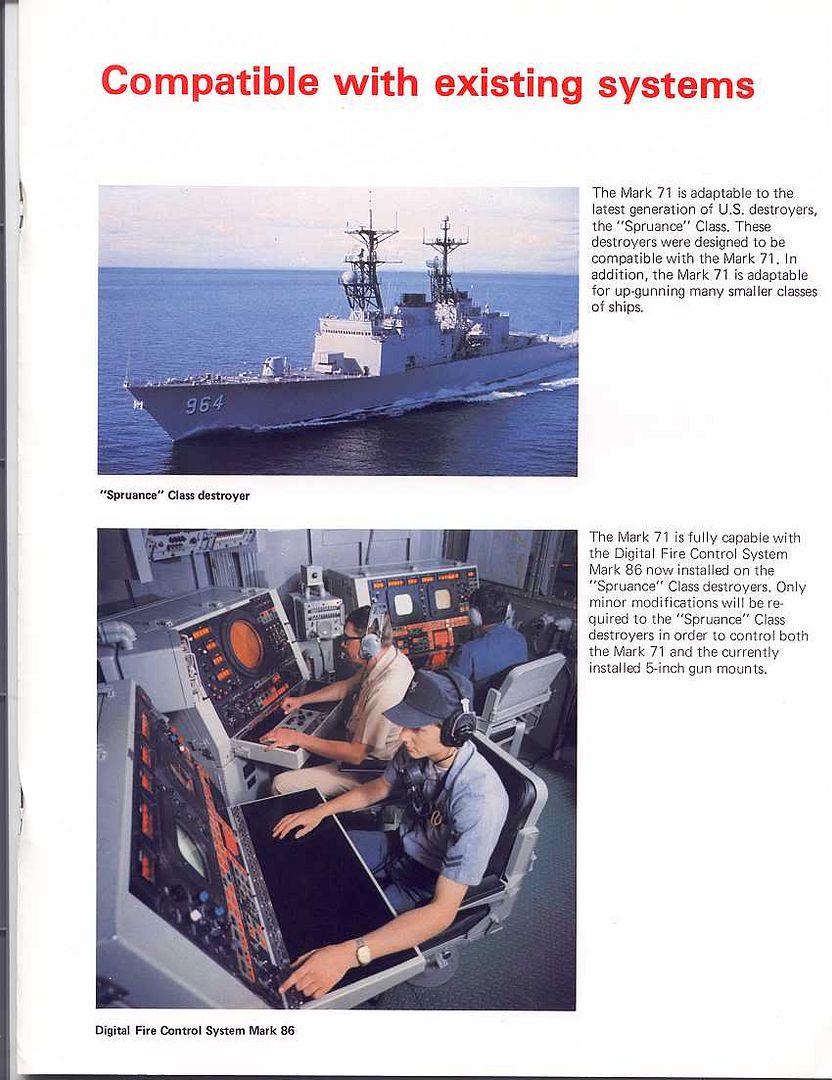
Alternatively you could just follow the original plan and fit them to the DDG’s in place of the 5 inch. A Spruance or the Tico’s could take two (theoretically) and the end result would be very capable. Another idea might be to develop a self contained mission module/container for the weapon for the LCS.
By: Wanshan - 12th September 2007 at 20:14
Absalon cheap?
The Patrol Ship (Frigate) derivative of the Flexible Support Ship (Absalon Class Support Ship) for the Royal Danish Navy (RDN):
Three Danish shipyards (Oerskov Steel Shipyard, Odense Steel Shipyard (Lindoe Yard), and Danyard Aalborg Shipyard) were selected to submit detailed designs and prices by May 2001. Danyard Aalborg Shipyard declined to bid on this program. Tenders were returned in late June 2001, however, both were above the set price ceiling of US$110M (hull, mechanical, and electrical systems only). Of note, the US$110M does not include the weapon and equipment outfit. On 22 June 2006, The Danish Ministry of Defense (MOD) announced the approval of funding for the three-ship class of the Patrol Ship Program (frigate). A total of DKR4.7B (US$800M) was approved for the ship’s construction as well as most of the equipment. The Patrol Ship variant will probably cost an estimated US$267M for each vessel, which includes the entire package.
But that doesn’t include a lot of weapons (much taken from older/other ships)
By: EdLaw - 12th September 2007 at 19:52
I wonder whether a 62-cal version of the 8in gun could be developed for service now, ideally in a twin gun mount. A nice big hull, somewhere around 12,000 tons, with a pair of twin gun mounts could be worthwhile. Add in a nice large VLS installation amidships, and you would have a heck of a cruiser! At a rough guess, the enlarged 8in round could probably get out to 70km unassisted, and perhaps up to 250km with guided, assisted rounds.
I suspect that the best basis for this would be a very large, commercial spec ship, basically an enlarged Absalon class (i.e. cheap and big). If you can have four 8in guns, and perhaps 256 VLS cells, then you’ve got an excellent fire support platform, and hopefully without the massive price tag. Even if you complete the ship with an off-the-shelf SPY-1D radar, and Aegis systems, it should work out a heck of a lot cheaper than a DD(X). I suspect the unit cost would probably be around twice that of the Arleigh Burkes, but for a bigger ship, with more firepower, that’s not unreasonable. I would simply call them cruisers, and have them replace the Ticos.
None of the messing around with armour, its not going to help against modern anti-shipping missiles, and drives costs astronomically high. A better bet might be to simply compartmentalise the ship, and put in kevlar armour, and focus on excellent damage control. If the whole ship is properly divided into sections, it should make damage control relatively easy, and the ship relatively survivable. After all, the best defence is to stop the enemy hitting you in the first place, i.e. have air cover, good air defence missiles, and good close in defences.
By: sealordlawrence - 12th September 2007 at 12:49
Thanks for posting Jack, the Mark-71 was a real loss for the USN in the long term. Had it have been adopted it could now be upgraded to take a 62 calibre barrel and extended range ammunition.
By: jackehammond - 12th September 2007 at 09:56
Folks,
This subject has been debated and discussed in the USA for decades. But a few items on the subject:
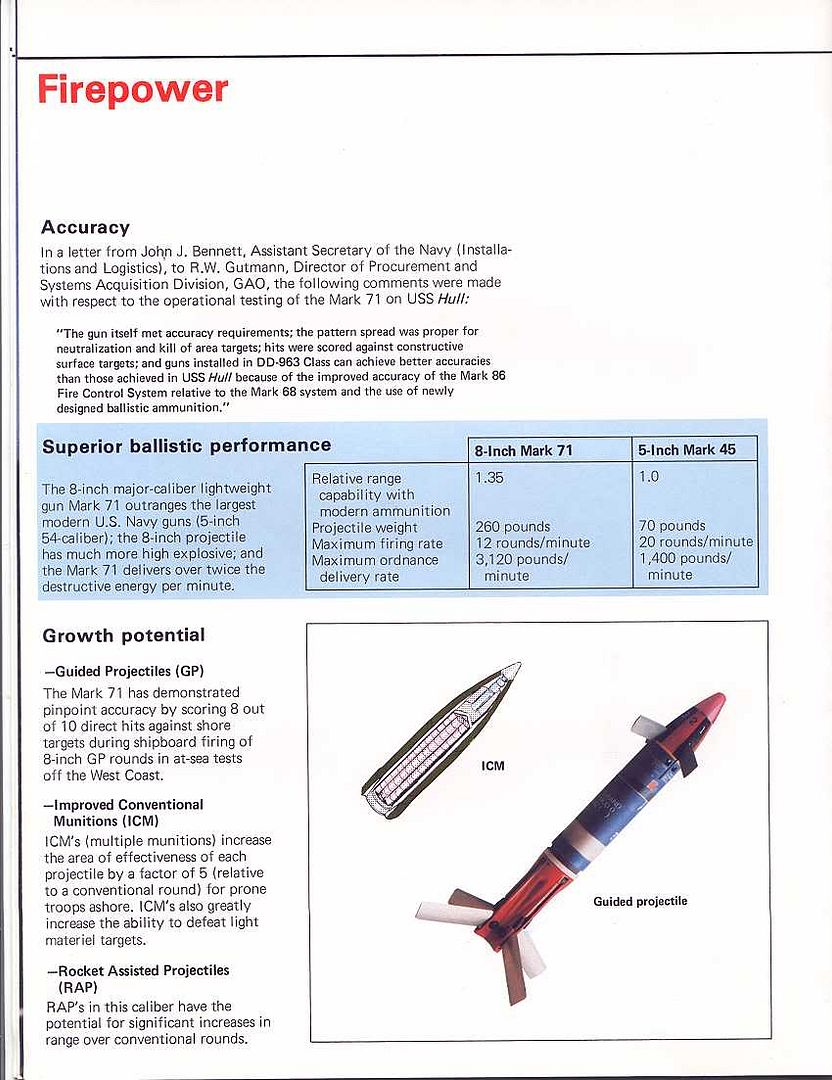
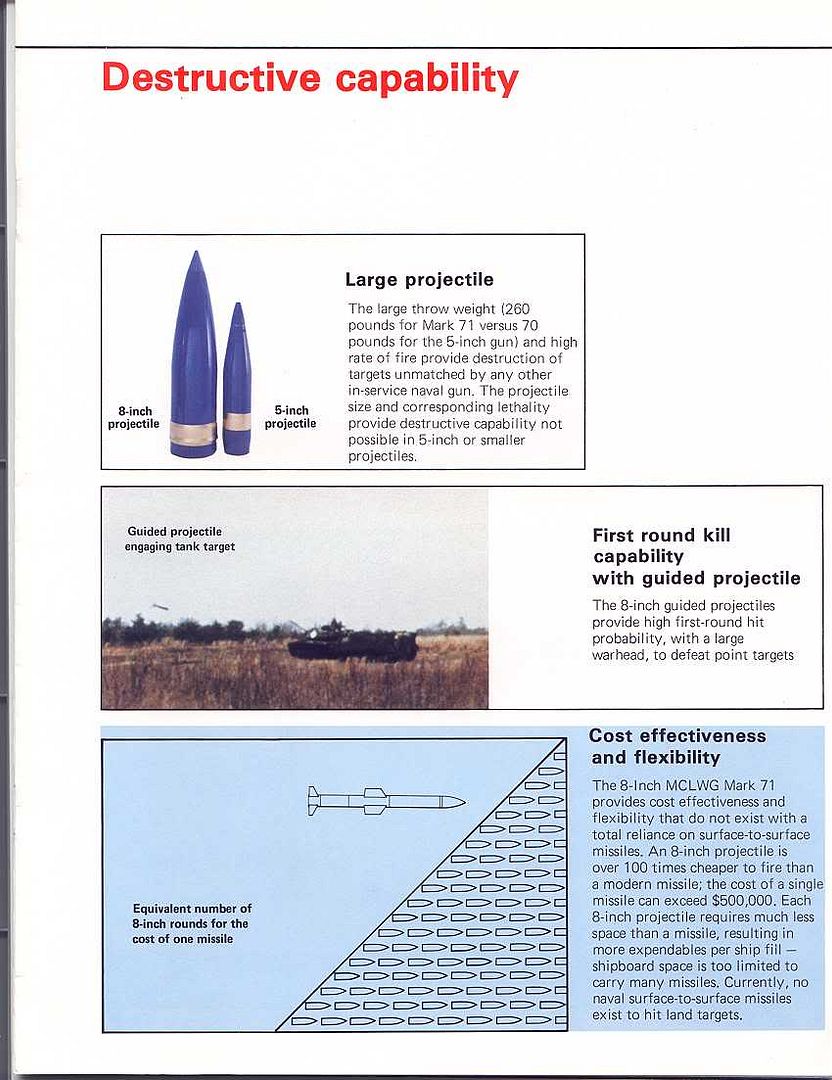
1. Everyone talks about upgrading to the 155mm cannon. Many don’t realize the massive increase in range and shell weight between a 155mm land artillery round and a naval 8 inch round. I don’t have the charts but it is massive for just a two inch increase in diameter.
2. While GPS guided artillery rockets are now as accurate as long range naval cannons of WW2, an artillery rocket can not do what heavy naval cannons did so well in WW2 and the Korean War: destroy deep and heavily re-enforced bunkers and other field fortifications. Israel recently discovered this fact in its short war with Lebanon.
3. One suggestion put forward by US Navy officers after the last US battleship was retired after the Gulf War 1991 was to remove the turrets and cannons from the battleships and replace them with mock turrets and cannons for museum use and fit the turrets and cannon to sea going barges which would be towed to where they are needed in times of conflicts by sea tugs.
4. It is irrelevant today as far as the super large naval cannons. The US Navy to make sure the battleships never came back ordered the destruction of the spare 16 inch barrels and the large metal bars stored to make them.
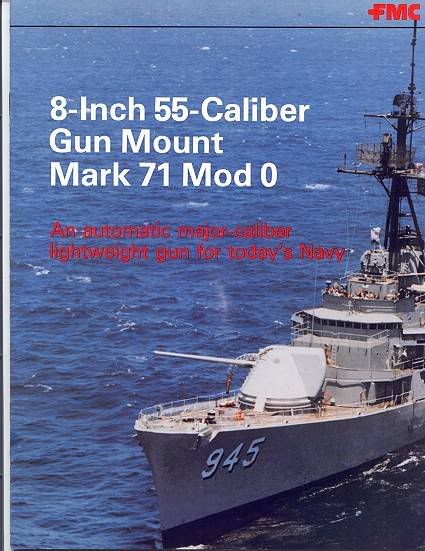
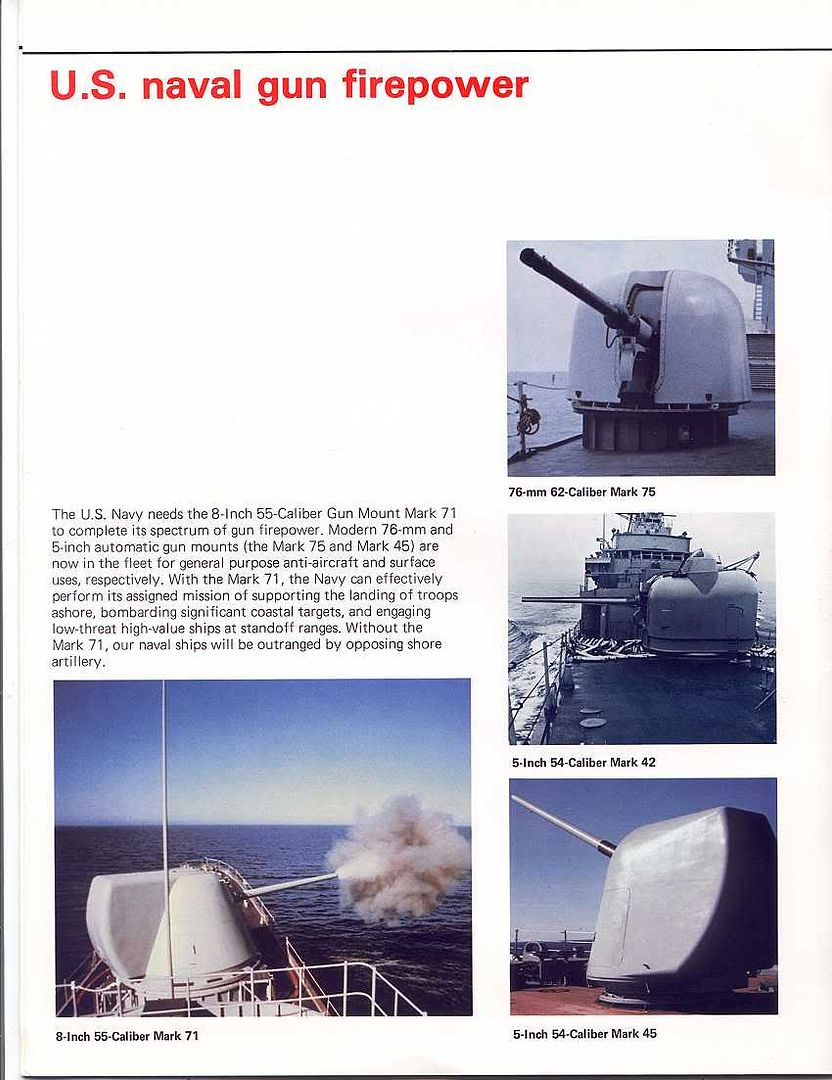
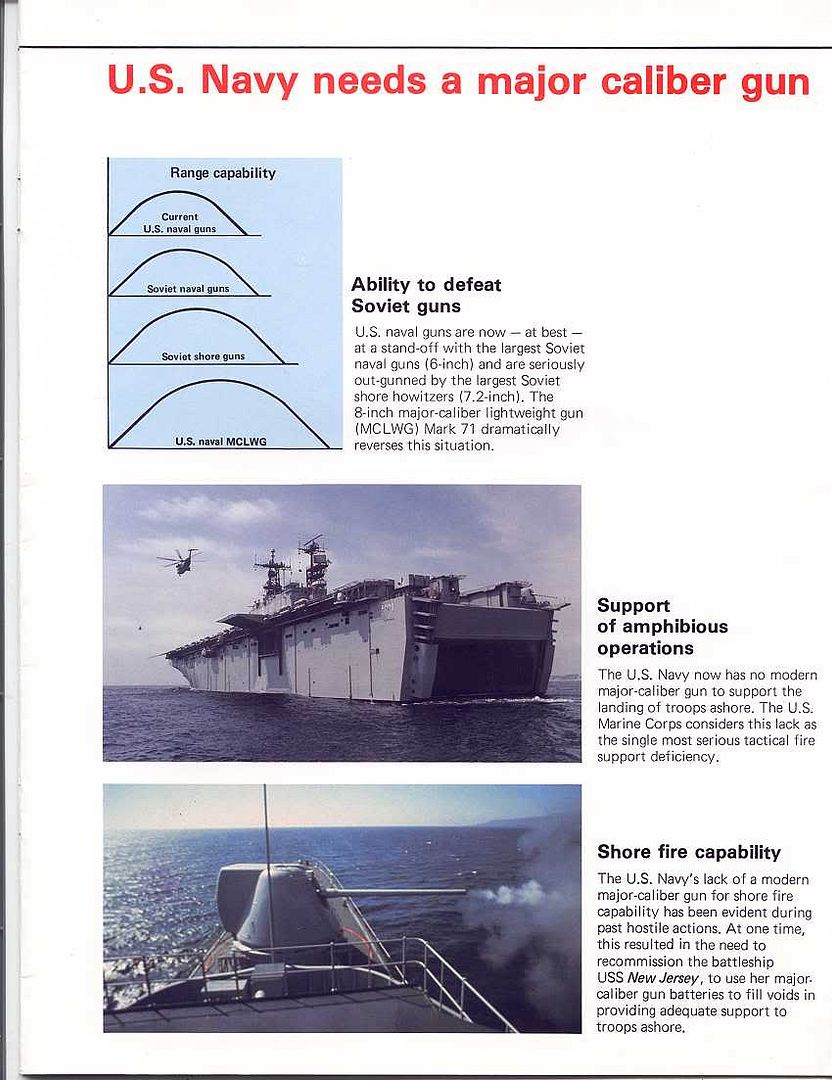
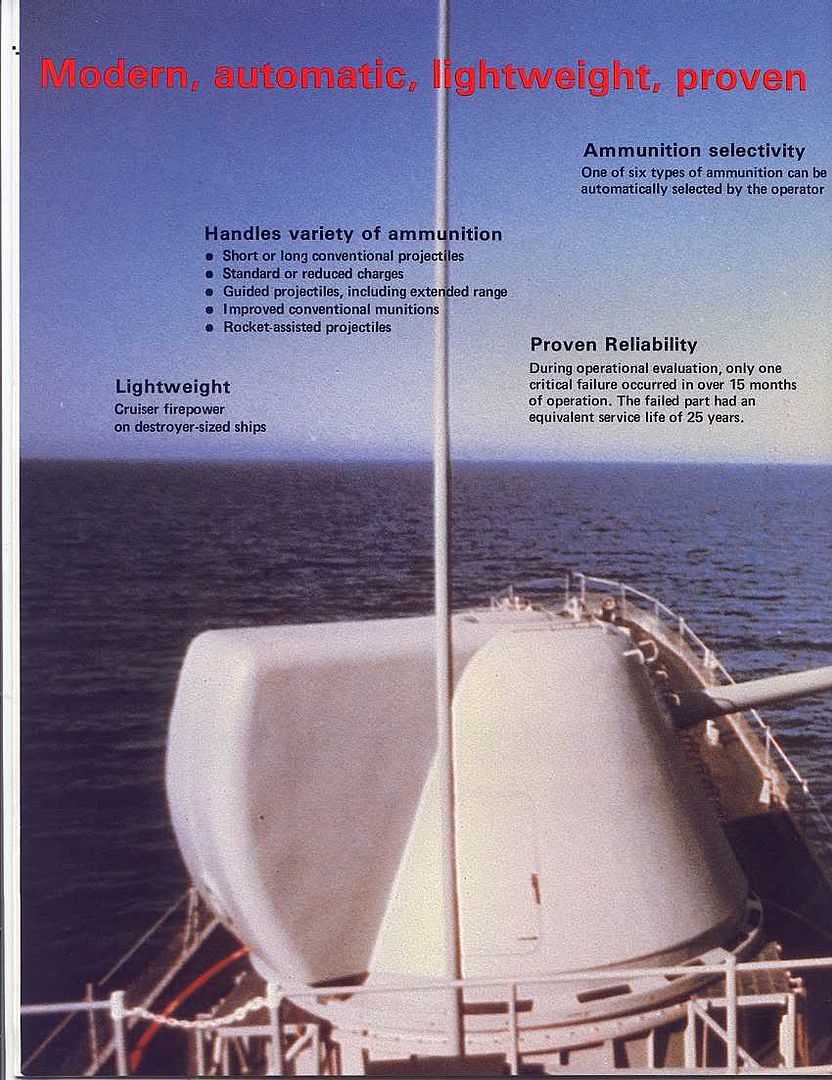
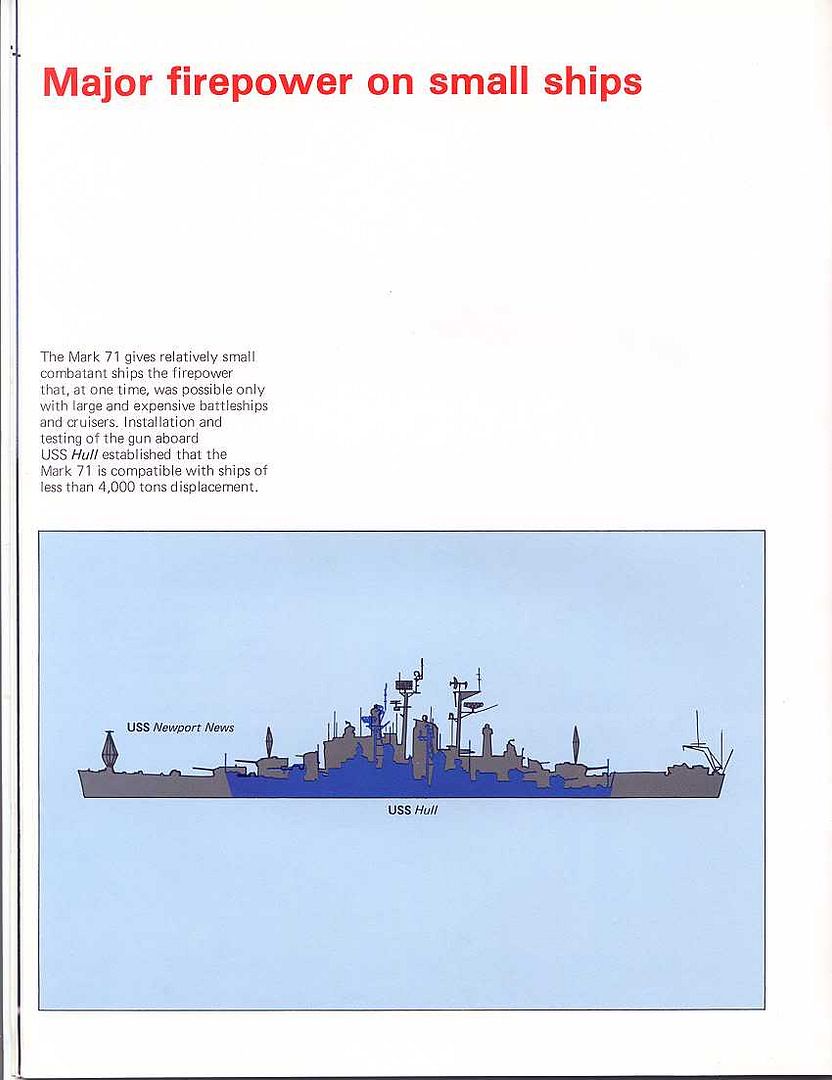
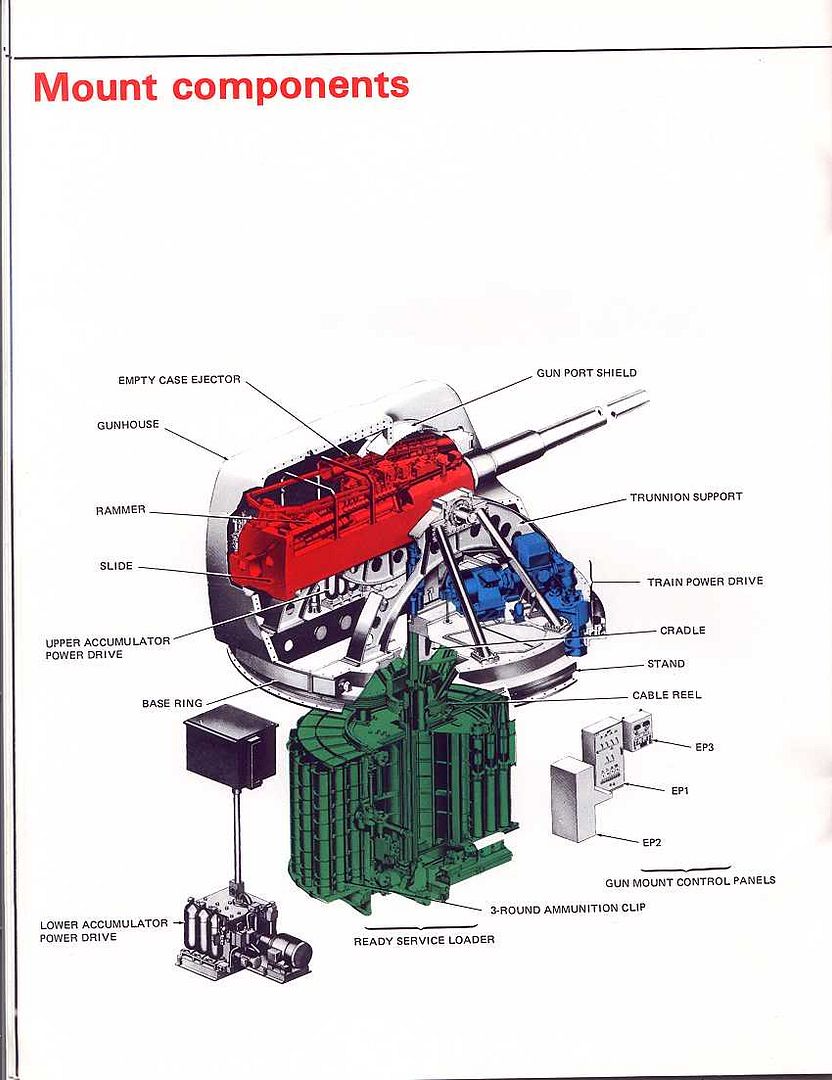
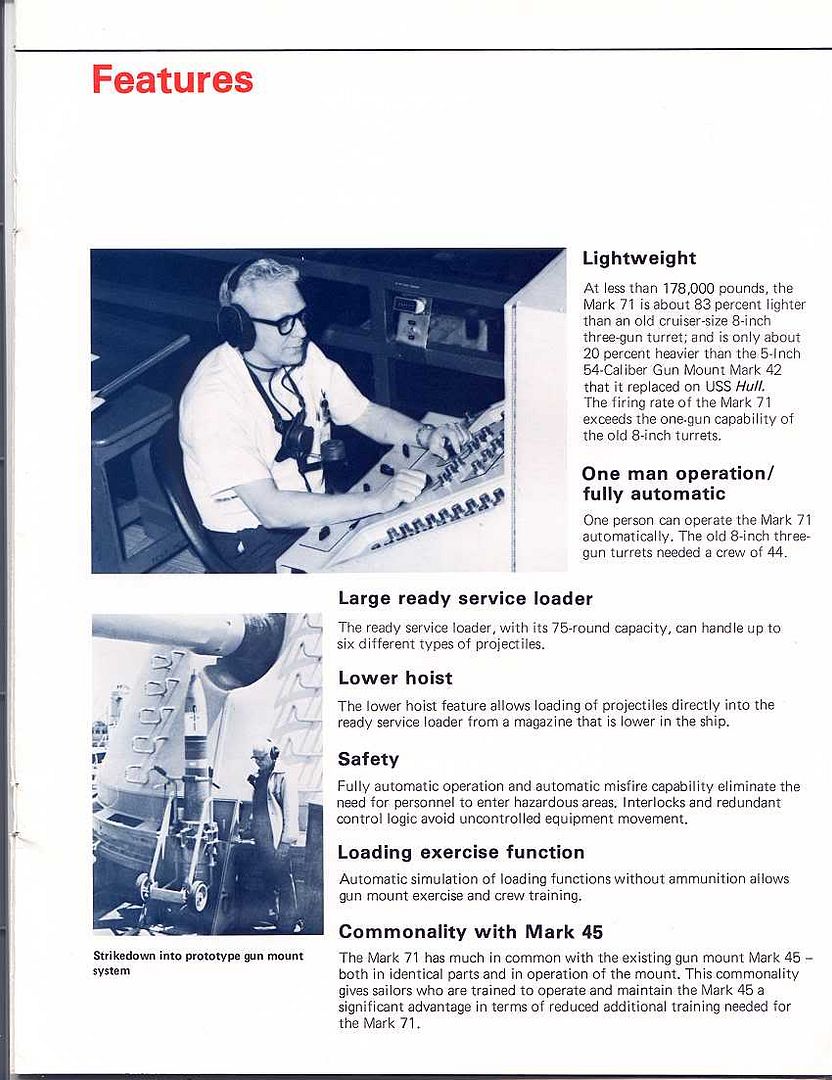
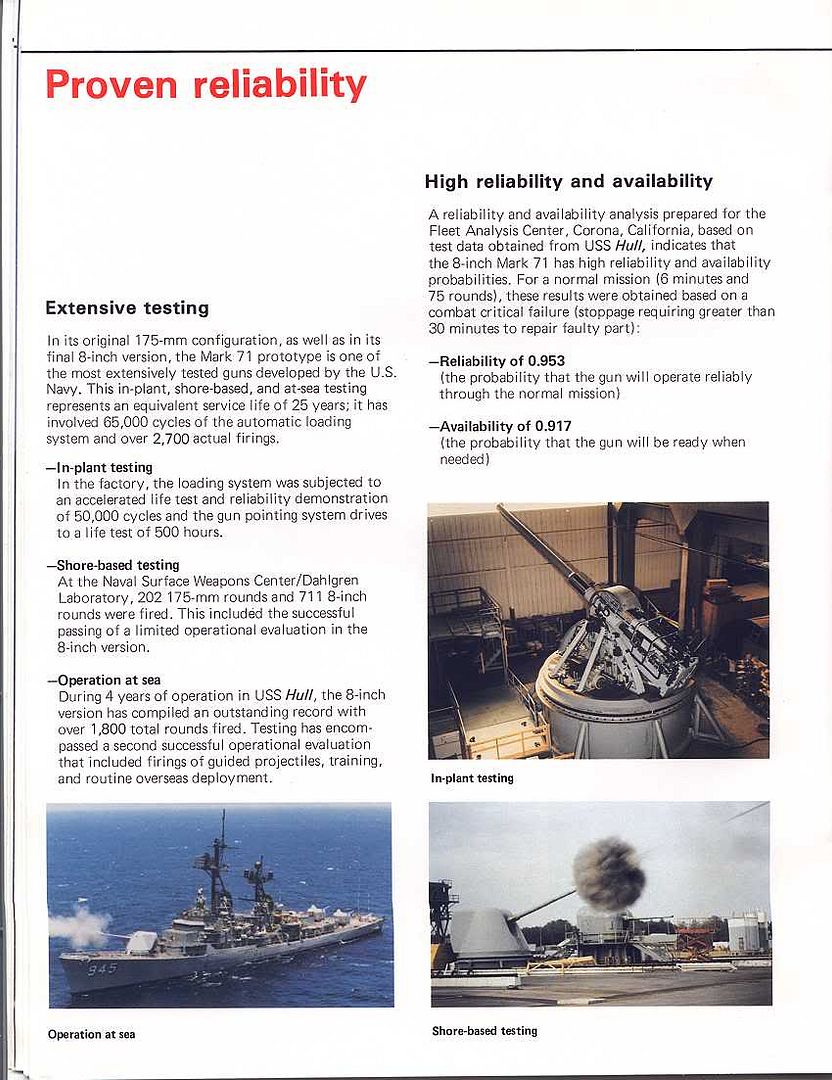
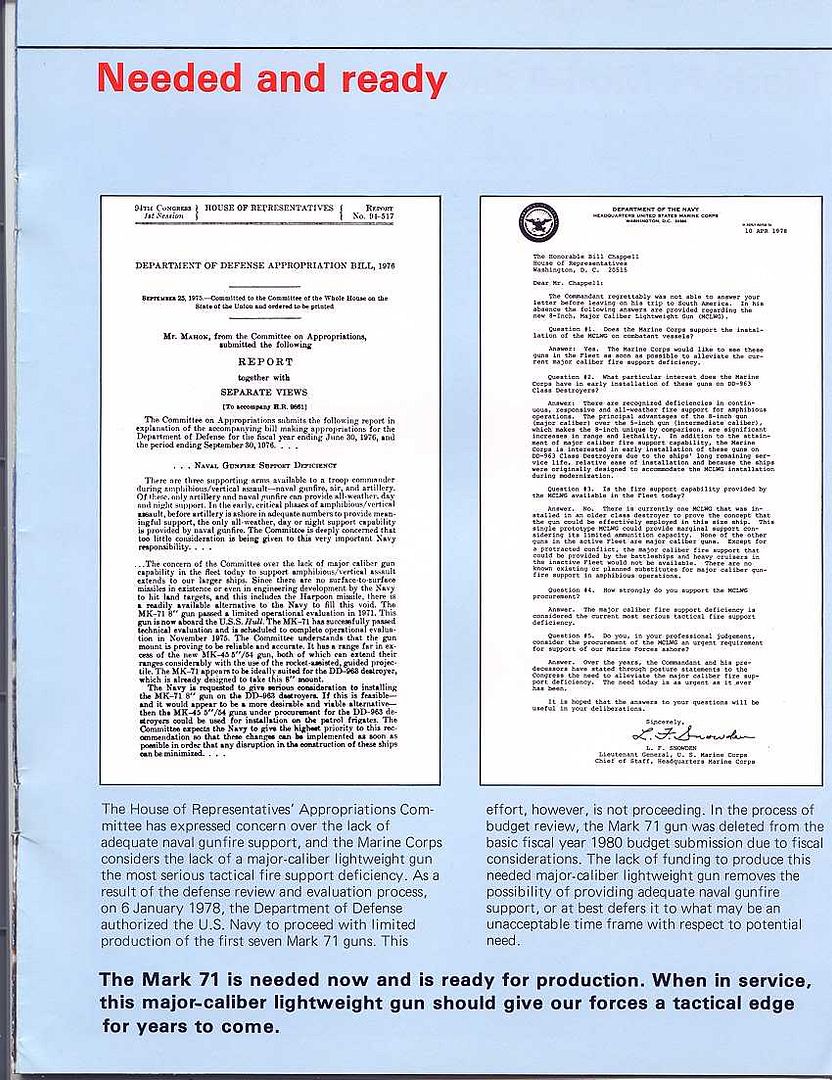
Finally, if anyone is interested, click the thumbnails below for the FMC brochure on the 8 inch cannon/turret that the USN developed after the Vietnam War. This was the best and last great hope for large caliber naval cannons for fire support. The US Navy decided (against strong US Marine objection) to cancel the project just as it was about to be funded. Pages 6 and Pages 7 I think all will find of interest.
Jack E. Hammond

By: sealordlawrence - 10th September 2007 at 12:26
The main point here is that there are alternative ways to provide naval fire support (note I didn’t say naval gunfire support…). A modern ‘monitor’ needn’t be armed with a massive naval gun, instead, it could use much lighter rocket based systems. In addition, you can up-gun the existing surface combattants, i.e. frigates and destroyers, to use either newer 5in guns, or navalised 155mm guns. This offers the ability to improve normal naval gunnery, allowing the ships to maintain their distance from the shore, and provide more hulls with fire support capability.
It may not be simple to add these 155mm guns, but it is doable, and if we want to improve naval fire support, it is a lot cheaper to switch guns on frigates and destroyers, than to build new ships with big guns! I would probably take three or four destroyers, each with one 155mm gun, over a single DD(X) pretty much any day of the week!
What I advocate for the coastal fire support ship would be either the Austal Corvette:
http://www.austal.com/go/product-information/defence-products/multi-role-vessel
or the US Navy’s new Fast Sea Frame:
http://www.globalsecurity.org/military/systems/ship/x-craft-pics.htm
The idea is basically to have a cheap (i.e. $50-100m) ship, capable of carrying a couple of UAVs, and an MLRS launcher with lots of reloads. The ship would be capable of receiving a helicopter, but would not have one permanently assigned (so no spares etc…). The ship would be able to act semi-independently, zooming around the coast, and able to offload naval boarding parties, and provide them with fire support as needed. They would probably have no more than a CIWS, and probably a couple of pintle mounted 30mm cannon for armament.
This kind of ship would be useful for a lot of operations, and even be able to serve as a mother ship for riverine units.
In effect what we are suggesting is a shore bombardment mission module for ships like the LCS.
By: EdLaw - 10th September 2007 at 10:28
The main point here is that there are alternative ways to provide naval fire support (note I didn’t say naval gunfire support…). A modern ‘monitor’ needn’t be armed with a massive naval gun, instead, it could use much lighter rocket based systems. In addition, you can up-gun the existing surface combattants, i.e. frigates and destroyers, to use either newer 5in guns, or navalised 155mm guns. This offers the ability to improve normal naval gunnery, allowing the ships to maintain their distance from the shore, and provide more hulls with fire support capability.
It may not be simple to add these 155mm guns, but it is doable, and if we want to improve naval fire support, it is a lot cheaper to switch guns on frigates and destroyers, than to build new ships with big guns! I would probably take three or four destroyers, each with one 155mm gun, over a single DD(X) pretty much any day of the week!
What I advocate for the coastal fire support ship would be either the Austal Corvette:
http://www.austal.com/go/product-information/defence-products/multi-role-vessel
or the US Navy’s new Fast Sea Frame:
http://www.globalsecurity.org/military/systems/ship/x-craft-pics.htm
The idea is basically to have a cheap (i.e. $50-100m) ship, capable of carrying a couple of UAVs, and an MLRS launcher with lots of reloads. The ship would be capable of receiving a helicopter, but would not have one permanently assigned (so no spares etc…). The ship would be able to act semi-independently, zooming around the coast, and able to offload naval boarding parties, and provide them with fire support as needed. They would probably have no more than a CIWS, and probably a couple of pintle mounted 30mm cannon for armament.
This kind of ship would be useful for a lot of operations, and even be able to serve as a mother ship for riverine units.
By: sealordlawrence - 9th September 2007 at 20:07
The AGS is unspeakably heavy, pehaps the heaviest naval gunmount since the battleship era. This is not a light or cheap system.
So. If you have a sufficiently large fleet that you can afford to have Hulls as dedicated Monitors you could probably afford the AGS. Furthermore the example being used here is world war 2 era Monitors that were fitted with twin 15inch gun turrets, they certainly were not cheap or light.
By: Turbinia - 9th September 2007 at 19:05
If boosting maritime gunnery capability required no more than lifting a modern 155mm SP gun turret onto a ship I suspect we’d see plenty of such systems in service, as there is no shortage of excellent 155mm artillery systems for land use around the world. Unfortunately, it’s not quite as simple.
By: Logan Hartke - 9th September 2007 at 12:06
It’s not a matter of just being self-contained. As weapons and ammunition expert Tony Williams pointed out…
A simpler alternative would appear to be to use existing turrets from army 155mm self-propelled artillery. BAe Systems proposed a weapon based on the British AS90 Braveheart SPG, intended to achieve 18 rpm. France also considered such a solution based on the turret of its GIAT 155mm/52 gun (19 tons unloaded) together with PELICAN guided ammunition, with a range of 85 km, but that now appears unlikely to happen. The Germans have actually mounted an 18 ton turret from their 155m PzH 2000 SPG to the F124 class frigate Hamburg for demonstration purposes (made easier by their MEKO modular armament system for warships). The concept is known as MONARC (which stands for the German for Modular Naval Artillery Concept for Naval Gun Fire), and is claimed to be capable of 10 rpm. Rheinmetall is also developing a new generation of 155mm ammunition which doubles the current maximum range to 80 km.
Army turrets need considerable modification to compare with purpose-designed naval guns. The MONARC installation requires the turret to be installed in a flexible mounting to help absorb the recoil. It is also necessary to fit a gun stabilising system to compensate for ship movement, and the ammunition storage and handling systems need to be modified. Perhaps the most obvious difference is that army guns do not use naval-style fixed ammunition (i.e. the cartridge case and projectile fixed together so they can be mechanically handled as one unit). This implies that either new cartridges (and thereby new guns) need to be developed, or it will still be necessary to have manual handling of modular propellant elements in the turret, something which naval guns moved away from several decades ago. The AS90 at present also has an air-cooled barrel, which means that although it can fire 10 rounds in the first minute, it can manage only 6 rpm for three minutes. BAe were presumably proposing to fit a new water-cooled barrel to achieve 18 rpm, which would account for the quoted weight of 29.5 tons (excluding magazine).
More recently BAE Systems have changed tack and are now offering a new concept, the existing 4.5 inch Mk 8 naval mounting with the gun switched to the 155mm L/39 from the AS90. This is known as the 155 TMF (Third generation Maritime Fire support). The existing mounting is apparently strong enough to stand the additional weight and recoil (and could also accept the 155mm L/52 if required). The weight of the 155 TMF mounting goes up from 22.5 tons (Mk 8 Mod 1) to 24.5 tons. although this is still lighter than the original 4.5 inch Mark 8 Mod 0 at 26.4 tons. Other modifications needed to the mounting include a double-loading cycle to fire the separated ammunition (which would presumably halve the RoF to around 12 rpm) plus some adjustments to accommodate the wider ammunition. It appears that the gun will use a single-module L10 artillery charge. Obvious advantages include commonality of gun and ammunition with the British Army, 80% commonality with the existing Mk 8 Mod 1 mounting, and greater destructive power than the 5 inch gun with a longer range than even the new 4.5 inch Extended Range ammunition (30 v. 27 km)
Logan Hartke


 Sign In








 September 6, 2007 at 12:06 pm