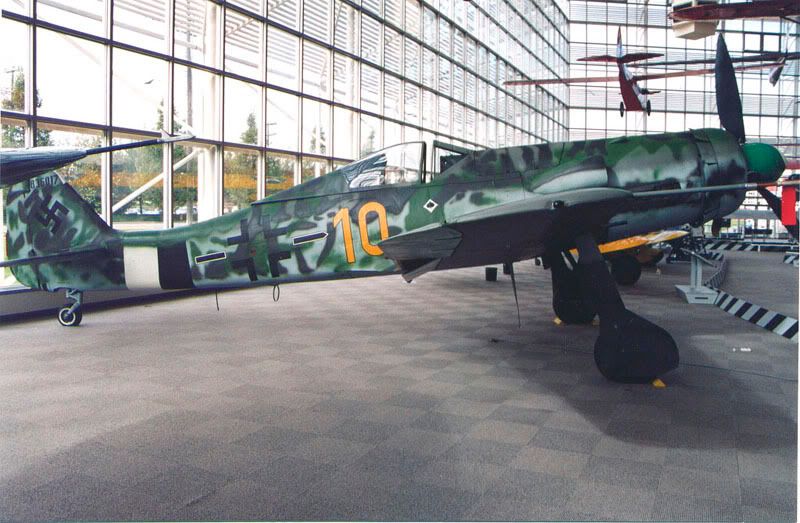
On the US Civil Register as of 11 July, 2007, the new owner of Focke Wulf Fw-190D-13 836017 N190D is listed as Vulcan Warbirds, Seattle…..in other words billionaire Paul Allen and his Flying Heritage Collection! This beautiful and extremely rare warbird has been on display at the Museum of Flight Seattle, on loan from Doug Champlin after a complete restoration by Dave Goss. Since the FHC policy/goal has been to eventually have all of their warbirds flying at least several times a year, I wonder if this applies to the Dora? Wouldn’t that be a VERY cool sight and sound!!
Here’s an average snapshot taken in October 2004 with my first little digital camera.
Dennis

By: Scarebus - 23rd July 2007 at 19:42
Yes, machines do have a soul and sometimes a particularly perverse mind of their own.
Must be why you always call an aeroplane ‘she’ or ‘her’!!!!:diablo:
By: jagdtiger - 23rd July 2007 at 11:24
A replacement kommandogerat (brain box) was located and included in last rebuild. Also, the missing D-13 propeller hub was added–a D-9 hub was substituted in the first restoration.
From what I remember, there wasn’t time to perform any engine runs after new rebuild since the plane was being transported to Seattle. That’s too bad because even a run-up on the ground would have been great to see on video or in person. If anyone has old video of the ground runs from the early 1990’s, please share them.
I hope that Yellow 10 does some grounds runs in the future. I think it is too rare and original to put back into the air and risk losing it. With the D-9 airframes coming from FlugWerk, I think someone with the right resources can get a Jumo-engined D-9 in the air soon, hopefully.
Hopefully not long to wait
JT
By: octane130 - 14th July 2007 at 20:47
While I’m on a roll :), below are some interesting facts about the Smithsonian Institution’s Focke-Wulf FW-190 F-8 aircraft. I read an extensive article in the early ’80s in Smithsonian Magazine about the restoration of this historic aircraft. The Smithsonian back then was probably the most committed organization in the world to restoring aircraft as close as possible to their original condition.
Restoration began in 1980 when specialists began sanding through layers of postwar paint applied in the U. S. to uncover the original German Luftwaffe paint and markings. The sanding process exposed something of the rich history of this artifact. It flew first as a Fw 190A-7 fighter but Focke-Wulf later rebuilt it as a F-8 ground-attack fighter-bomber. The aircraft wore at least three different camouflage schemes and a manufacturer’s data plate found inside the fuselage indicated that its first Werk-Nummer (serial number) was 640 069. Infrared photographs of the aircraft’s vertical stabilizer revealed that after rebuild, Focke-Wulf assigned the airframe a new Werk-Nummer 931 884. Restoration concluded in 1983. The final paint and markings applied were historically accurate for this specific airframe: SG 2 (Schlagtgeschwader or Ground-Attack Squadron 2) during October 1944. Unlike most captured WWII aircraft, this aircraft was never flown following capture.
At the start of the restoration in 1980, it was discovered that the aircraft still had the ORIGINAL, synthetic, coal-derived fuel in the tanks! It was determined that this fuel was not at all deteriorated and could have still been used to run the engine, even after 35 years! Apparently, this fuel also has a very distinctive, permeating, clinging and nauseating odor to it. I have also personally heard this from German WWII pilots. This fact was also noted by Allied pilots flying recently captured German aircraft at the end of WWII, as well as the Smithsonian restorers in the early ’80s.
Also, when replacement bearings for the elevator control surfaces were needed, the original manufacturer FAG in Germany was contacted, just out of curiosity. This exact model of bearing was still being produced in the early 1980s!
Cheers,
– Octane130 –
By: Phantom Phixer - 14th July 2007 at 20:30
My last words Re the Comet (as I hate it when I start threads and they get hijacked) the David Ogilvy book on the Comet describes in detail what was done restoration wise up untill 1984. And a lot of replacing of orginal structure was undertaken. Like David Burke ive seen the pics and its more than a reskin like many would have you believe.
Back on topic, I would just be worried with the FW190D that the POTENTIAL loss of an important airframe is there. I just think with two examples left we need to preserve them for future generations. Even more so now as replicas of this variant are on the horizon.
We moan about how past generations scrapped warbirds enmasse leaving us with so few to enjoy.
Wouldnt it be a shame if future genrations berrated us for having risked and lost rare and historic aircraft which meant they were unable to enjoy even the static view of certain types. Maybe due to loss at airshows etc etc. I know thats really going to an extreme but……….
Saying that though if you told me this FW190D was going to fly at Legends in 2008 would I be making the trip to see it? I would be lying if I said no.
Not quite so black and white is it?
By: octane130 - 14th July 2007 at 19:54
With respect to attendance/viewing figures of static, museum-bound aircraft vs flying examples:
The Collings Foundation of Massachusetts operates two to three aircraft on a nation-wide tour every year (B-24, B-17 and B-25). They have done this for 17 years and estimate that up to 4 million people view these aircraft each year! Thousands also get to actually fly in these aircraft for a substantial, but not really outrageous donation amount ($375.00 to $425.00). Considering that a B-17 costs at least $4,000.00 per hour to operate, this is not unreasonable. Nobody makes a profit and nobody cares. The Collings Foundation is officially designated as a “non-profit organization” by the US government for taxation purposes (i.e. no taxation). This tax exempt status has also allowed a great many other warbirds to be restored, survive and operate in the USA. The Collings Foundation figured that if the aircraft were put on static display in Massachusetts, they might attract 40,000 visitors per year.
To put these attendance/viewing figures in perspective, IWM Duxford only attracts approx. 443,000 visitors per year (yes, INCLUDING the airshows). Once the most visited museum in the world, the Smithsonian’s Air and Space Museum in Washington D.C. attracts 5 million visitors per year. The new museum annex, the Udvar-Hazy Center (where the B-29 Enola Gay is housed) attracts 1 million per year. The British Museum attracts approx. 6.2 million visitors per year. Considering the above figures, 4 million visitors/viewers per year for the tiny little 3-aircraft contingent of the Collings Foundation is pretty impressive, isn’t it? This is literally world class. And that was my original point, active aircraft reach many more people than static displays. Unless the airframe is a one-of-a-kind example, responsibly fly the aircraft as living history and then retire the aircraft to static display when it is no longer feasible to fly them.
It is also the philosophy of Paul Allen (see my previous posting just before this one) to occasionally have his meticulously restored jewels flown for the benefit of the public.
Thanks for the lively discussion,
– octane130 –
By: octane130 - 14th July 2007 at 19:25
I’m sure I read somewhere that of all the many Mustang survivors not one is left in its original “in service” condition. That’s as wrong as saying we should stop flying old aeroplanes.
As far as absolutely original Mustangs that were put in a museum or storage right after shutting down from their last operational mission (1957 in the USA), yes, that is true. Fortunately, several very financially well-heeled enthusiasts have done a lot towards restoring and preserving examples of aircraft to as close to original condition as can possibly be achieved. One major enthusiast, Mr. Paul Allen (co-founder of Microsoft) is on an ALL-OUT MISSION to restore and preserve WWII aircraft in absolutely the most original condition as possible. Mr. Allen is really, really low-key about his warbird activities. Apparently, cost is not at all a limiting factor in these landmark restorations. This is an example of what “unlimited” funding can do. Check out his website at http://www.flyingheritage.com/
I don’t know if Mr. Allen is a pilot, but I do know for a fact that he never pilots any of the aircraft in his warbird collection. He is just dedicated to the heritage of these aircraft, much to the benefit of everybody :).
I have personally been able to observe the restoration of his P-51, P-47, B-25 and Zero. These aircraft (with the exception of the Zero) are usually detailed right down to the original electrical wire type (not really the best for safety, but amazing for originality).
Best,
– Octane130 –
By: McChesney - 14th July 2007 at 18:49
Umm….perhaps you could seek the advice of those who flew them in combat, isn’t that ‘first hand’ and ‘to the limits’ enough for ya? No ‘replication’ needed.
‘Too hard’ you say?…..dig a little, do a little research, make a few inquiries with veterans organisations……Dave
I take Eric Brown’s notes and RAE test data as truth, but there are many less reasonable types who, uh how do I put this politely, claim bias if the data came from Farnborough or even post war USAF. I think also that combat reports tend to be rife with bias and contain far too many variables to be quantitative for most. I still love reading them tho :).
I suppose the skeptical heart attitudes wouldn’t change even if we had new data. If something didn’t fit one’s expectations there would be cries of bias again.
But still, IMHO the best rational for flying these birds is to learn from them. Imagine what we could get from modern test equipment? Probably never happen, we have buckets of Warbirds flying and I see very little info on how they perform…
Kermit if you are out there, I’d love to see new data on the Tempest:diablo:
By: David Burke - 14th July 2007 at 17:30
I think kevlar top decking in front of the pilot would work for starters . Add to that the substancial rebuild of the wing. View FlyPast Aug 1984 page 16 for a view of her in stripped down state – examine the wing and it’s clear that it went beyond just reskinning it.
By: Bruce - 14th July 2007 at 16:13
Many people have stated that G-ACSS has lost a lot of its original structure along the way. Would anyone care to suggest exactly what was lost? As far as I am aware, the basic fuselage is largely original, as are the fin, rudder, tailplane and elevators. The wing was reskinned during the restoration. The entire aircraft was stripped out by de Havilland postwar for the Festival of Britain, and much of its systems were lost forever. The restoration therefore HAD to replace a great number of items that simply were not there!
Bruce
By: Phantom Phixer - 14th July 2007 at 15:42
Interesting that you bring the Shuttleworths DH.88 Comet into the conversation Roger. I was going to mention it much earlier but thought the conversation may wander off topic a little.
But an excellent example of a highly original and historically important airframe that in the process of been made airworthy has lost a lot of its historical integrity.
A large portion of the airframe structure (that would have been suitable for a static aircraft) was replaced so she could fly. To Joe public its still Grosvenor House but for me it’s lost a little something along the way.
Ive seen the pictures of the flying replica in the USA and that looks lovely. Next to each other it would be hard to tell the difference.
Ok when the restoration was started all those years ago it wasnt an option but today would Shuttleworth go down the same route with such a historic machine? I personally hope they wouldn’t.
Ok the FW190D isnt in the same league but its one of only two. Having read all the thoughts and views Im still with the leave it on the ground brigade. Sorry chaps.
By: Pondskater - 14th July 2007 at 15:32
Unless it is a totally one-of-a-kind aircraft (and no other airframes exist), sitting on static display is quite useless and uninteresting to all and to the historical record. You could make a fiberglass replica that would serve the same purpose for static display.
This is very far from reality. Although I lean towards allowing aircraft to fly, museum exhibits have a huge contribution to the historical record – especially those genuinely original airframes which are still in “straight from service” condition with little work done other than draining the fluids.
David said it better above:
It [the FW190D] was built under the Nazi regime – very likely by people conscripted or even forced into making it . It is very much something of it’s time. It’s even likely that people involved in building her died at some time after she flew either in under Allied bombing raids or under the excesses of the Nazi regime.
Certainly with modern spec alloys you could reconstruct her after an accident but she wouldn’t have the same social and military history.
While I want to see rare aircraft flown, I also feel that the most original version should be preserved in a museum.
It is all about compromise. We want to see an original FW190 fly. But future generations, perhaps in 100 years or more, should not be deprived of their right to see an original example – not one that has been flown and rebuilt so often that it becomes a replica.
I’m sure I read somewhere that of all the many Mustang survivors not one is left in its original “in service” condition. That’s as wrong as saying we should stop flying old aeroplanes.
Preserve at least one very original example and fly any others.
By: RPSmith - 14th July 2007 at 14:53
Several posts seem to have strayed from the core of the argument – whether or not to fly UNIQUE aircraft. The list in Pete Truman’s post includes mostly unique types such as the Mew Gull, whereas the Lancaster is not unique.
I remember in the 1960’s filling in an SVAS questionnaire asking which Shuttleworth aircraft should next be restored to fly (and there were a lot unflyable then) and top of my list was the Comet. I still haven’t seen her in the air 😡 so I guess I fall in with the “Fly em” camp – but with reservations.
However, picking up another aspect about the alternative (and sometimes there is little choice) to flying
…. sitting on static display is quite useless and uninteresting to all and to the historical record……
I would take great issue with this statement. An aircraft “sitting” in a museum can be far more accessible to many more people than a flyer.
Let’s take, as an example, Spartan Arrow G-ABWP – a unique (ie sole survivor) of it’s type – a lovely aeroplane kept in flying condition by it’s owner (? Raymond Blain – still?) but it is many, many years since I have seen it and have no idea when I might see it next. I’m not for a moment suggesting the owner should surrender her to live for evermore in a museum but, if she were in a museum, I could travel tomorrow, or next week and go and gaze at her.
I could go on with more arguments against statically displayed aircraft being “useless” but I’ll stop here.
Roger Smith.
By: Nashio966 - 14th July 2007 at 12:10
yep, they need as much love and attention as much as the next person, if not more 😀
By: mike currill - 14th July 2007 at 11:52
I have to surmise that David is not a romantic. When our Skybolt was under its 5 year restoration up to 1997 it was, to all intents and purposes, “dead”. In the 10 years that it has been back in the air it has indeed “come alive”. It seems to appreciate accurate handling and gentle arrivals. This pilot at least feels more “alive” before, during and after each trip.
I do hope David finds similar satisfaction from his new RV-9 when the construction process is complete and in time realises that it also has a soul.
Having said that I recognise that all those who post on this thread hold sincere opinions which I respect. However in the end it is the new owners wishes that will prevail.
Cheers.
Trapper 69
😎
Yes, machines do have a soul and sometimes a particularly perverse mind of their own.
By: Nashio966 - 14th July 2007 at 10:33
That said, I never heard how Black 6 fared against the XI that it was flown with. (?) Allison knows? Perhaps it was never flown close to its limits?
I seem to remember having heard that the higher ups at the MoD used her as a runaround, one time one of them turned up to fly her in a pinstripe suit 😮
By: bexWH773 - 14th July 2007 at 10:26
Ok, im not too hot on whether or not some of these old ladies are unique, but, if as has been noted in this thread before, that they had some rather iffy reputations in flight etc, then why not make them look pretty put em in a museum, then, as some of these warbird owners / groups have the odd penny or two, make a replica so it is less likely to give them a bad day? Lets face it, apart from the experts & rivet counters out there, who’d know? Ok if they stuck a Merlin or Griffon into an FW190 Id know that one, but Id rather a reliable lump like those being used than an unreliable lump likely to bite the pilot on the backside. Just a though. Bex
By: Pete Truman - 14th July 2007 at 10:00
An interesting thread where I can see the pros and cons of both sides, on the other hand, were totally unique a/c to be grounded, last weeks Legends would have been a bit lacking, no Hawk, Moraine, Mew Gull, Active, Hind, Nimrod, etc etc, even Lancaster.
I won’t quote examples here, but I’m sure you know which one’s I mean, have’nt most warbird accidents been down to pilot error and not airframe failure. Over my many years of airshow attendance I’ve seen performances from some of the best pilots that have made me wince. SG’s performance in the Bearcat on Sunday was awsome, he knows what he’s doing, but so did some of our late friends, it only takes a momentary lapse and…
I think that the BBMF have got it right, they seem to be able to put over a nicely choreographed performance without due risk to the airframes and pilots, in 50 years of constant airshow appearances, I think that their only accident was with the Hurricane, and that was down to a mechanical problem, perhaps the way they do things should be a benchmark.
By: David Burke - 14th July 2007 at 09:18
Skybolt – I think maybe these is a romance in terms of the attraction that makes people congregate around aircraft and speak enlessly about them .
I do feel however that some machines capsulate a time or event to the degree that they have achieved their aim. In terms of something like the ‘Dora’ – it was designed purely to shoot down other aircraft. Barrel rolls and loops are great fun – however if she was full armed and shooting down aircraft during the course of Flying Legends people might see another side to her! She is a beautful killer in much the same way as a shark – however in spanking condition at an air display with supporting cast of preened reinactors isn’t an accurate reflection of what she was all about.
As for the ‘Bolt’ – at one stage I had the chance to work on the breed and indeed under the owners supervision have a fly of her . However speaking from an engineer stance – a pilot’s sole purpose in life is to borrow an aircraft from an engineer and hopefully return it in one piece !
Enjoy the romance !
By: Skybolt - 14th July 2007 at 08:51
I am currently building an RV-9 – it isn’t ‘dead’ at present – it’s something being built – when it’s flying it won’t be ‘alive’ – it will be a machine being used what it’s designed for . When it’s finished with it could be grounded or indeed scrapped – it won’t be ‘dead’ however – just finished with.
I have to surmise that David is not a romantic. When our Skybolt was under its 5 year restoration up to 1997 it was, to all intents and purposes, “dead”. In the 10 years that it has been back in the air it has indeed “come alive”. It seems to appreciate accurate handling and gentle arrivals. This pilot at least feels more “alive” before, during and after each trip.
I do hope David finds similar satisfaction from his new RV-9 when the construction process is complete and in time realises that it also has a soul.
Having said that I recognise that all those who post on this thread hold sincere opinions which I respect. However in the end it is the new owners wishes that will prevail.
Cheers.
Trapper 69
😎
By: DaveM2 - 14th July 2007 at 08:49
Umm….perhaps you could seek the advice of those who flew them in combat, isn’t that ‘first hand’ and ‘to the limits’ enough for ya? No ‘replication’ needed.
‘Too hard’ you say?…..dig a little, do a little research, make a few inquiries with veterans organisations……
Dave
I gotta chime in again.
I want Yellow 10 (and a real Bf-109F4 and a few other Axis planes) to fly again because I want the TRUTH.
I want a pilot like Hinton, Walker, Brown or Romain to tell us how it performs. I know that trying to replicate the mech conditions that these planes flew under in the 1940s may be an impossible dream, but we would know much more about the Dora if it was flown by someone who could fly it back to back against Spits and Mustangs.
That said, I never heard how Black 6 fared against the XI that it was flown with. (?) Allison knows? Perhaps it was never flown close to its limits?


 Sign In








 July 13, 2007 at 5:42 am