In contrast to the threads on QEC/CVF there appears to be nothing regarding the Ford Class carriers. Is it really “more of the same, but EMALS and can you move the island aft please”?
I know the island move allows for the “pit stop” shere they hope to improve re-arming/refuelling (with automated ammunition handling as per QEC) and thus SGR.
I have seen mention of better aircraft maintenance computer systems.
Out of this there is a reduction in crew (mostly I assume by the computerised ammunition handling).
But all in all that doesn’t seem a lot of change over Nimitz. I am sure there is more:
Sensors (EO/IR as well as radar)?
C4I?
ATC?
Signature reduction?
Damage Control?
All areas where I would expect them to improving to take into account modern technology, plus many more, but I haven’t seen anything (perhaps because I am looking in the wrong places).
Anyone?

By: i.e. - 14th November 2011 at 23:02
The only consolation is that the navies of the world’s rising powers are by and large aspiring to follow the same path as the US Navy, much as a rising Germany was obsessed with emulating the grandeur of the Royal Navy’s battleships.
Not true in case of Soviet navy.
where tactical and geographical constraints forces it to adopt an (imho execellent) alternative.
By: Rii - 14th November 2011 at 21:53
the USN kinda hit the ball out of the park with the forrestal design. today they are still building carriers based off of that original design that will be serving in front line service roughly 100 years after the forrestal was first launched. that’s kind of amazing when you consider how so much else in our world seems to change at ever increasing paces. granted, the internals of the ford and forrestal will be quite different, but the overall conceptual design remains surprisingly similar.
Not coincidentally, the closest we’ve come to a naval conflict between adversaries living on the same planet since then is the Falklands. It’s no different than the evolution of the battleship pre-WW2. Newton’s First Law applies as much to the military as to physics. The US Navy is the most conservative of the services (and the Army the most adaptive) because it has been the least (most) challenged. Major changes will only occur when events demonstrate that the status quo is no longer tenable.
The only consolation is that the navies of the world’s rising powers are by and large aspiring to follow the same path as the US Navy, much as a rising Germany was obsessed with emulating the grandeur of the Royal Navy’s battleships.
By: steely dan - 14th November 2011 at 16:21
USS Gerald R Ford progress continues:
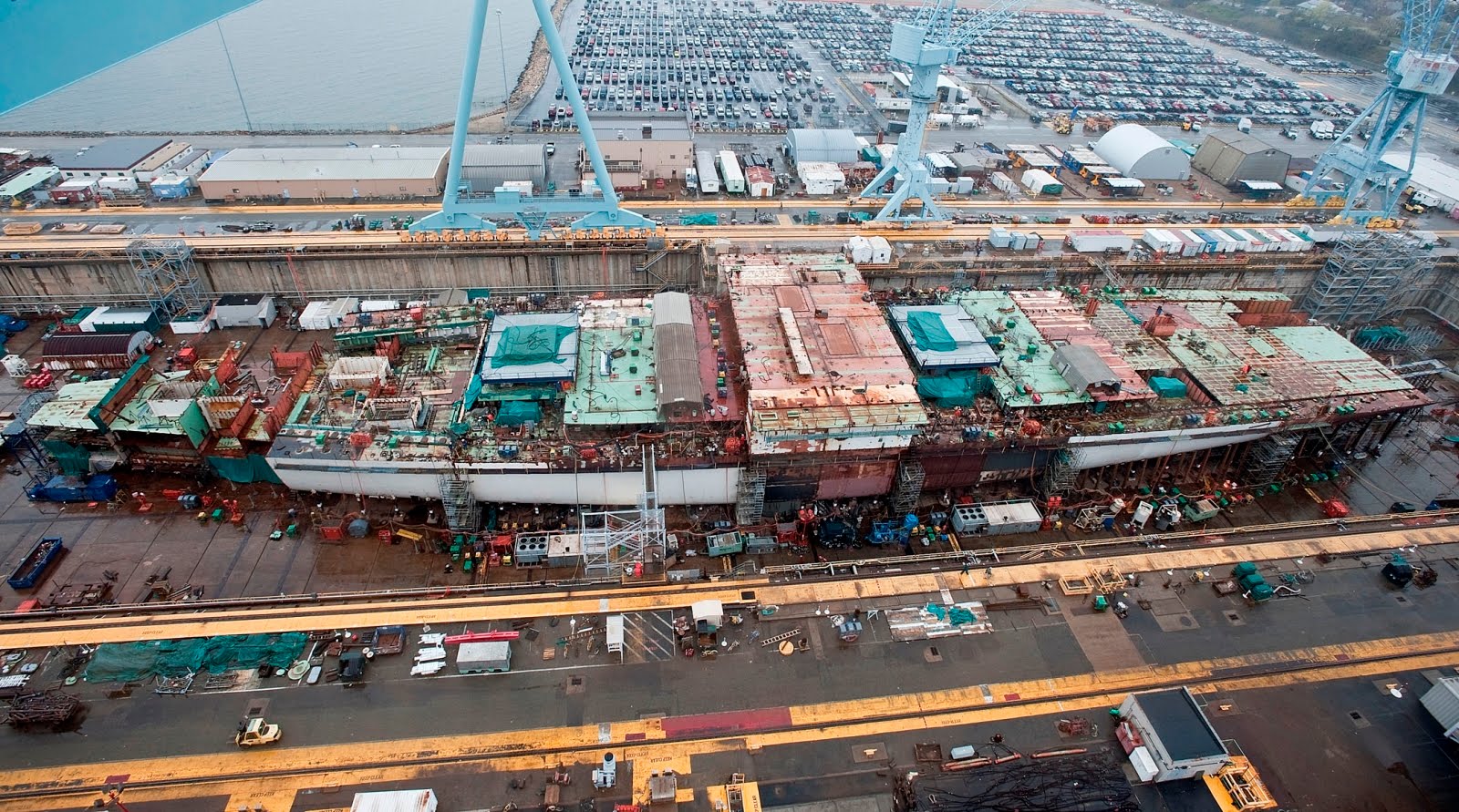
http://nosint.blogspot.com/2011/08/structural-work-on-gerald-r-ford.html
By: Prom - 2nd September 2011 at 22:57
Thanks for that guys. But..
Enhanced self defenc(s)e: The picture just shows ESSM, what about ECM; Phalanx, SC Guns etc? I would hope they aren’t just relying on escorts for defense against asymmetric threats in this day and age
Sensors – which radars have been selected? What about EO/IR sensors?
Any improvement to the command & control/ATC/aircraft direction because they had a pretty ageing architecture
Anything on damage control? IR fire detection; automated fire suppression or the like
What about close range EO/CCTV for covering the area around the ship, improved awareness of deck ops etc?
By: Arabella-Cox - 2nd September 2011 at 17:51
Out of this there is a reduction in crew (mostly I assume by the computerised ammunition handling).
I think manning really is the main area where there might still be some potential for optimisation in the US designs compared to European practise.
But all in all that doesn’t seem a lot of change over Nimitz. I am sure there is more:
Sensors (EO/IR as well as radar)?
C4I?
ATC?
Signature reduction?
Damage Control?
All of those, as well as new reactors and a new architecture for distribution of electrical energy to accommodate the increased load demands of these new systems compared to the previous generation and still offer margin for growth.
This pretty much sums it up:
http://img.blog.yahoo.co.kr/ybi/1/24/56/shinecommerce/folder/14/img_14_4640_1?1152118480.jpg
the USN kinda hit the ball out of the park with the forrestal design.
Agree, this is the main reason why the improvements look so minor compared to the seemingly more unconventional approaches taken by smaller, non-US designs. Simply put, the US super carriers are big enough not to be constrained in any major way by size, so there is at best some fine tuning of the basic design to be done. Ships like the CVF or CdG though must compromise and prioritise and depending on what capabilities the navy in question values most, optimisation for these features can take the configuration in very different directions.
By: steely dan - 2nd September 2011 at 16:50
ever since the commissioning of the USS Forrestal back in 1955, USN fleet carrier design has really been more evolutionary than revolutionary (ok, nuclear propulsion in the enterprise was a BIG step forward, but the overall design of the ship was still pretty much based on what came before it). each successive ship that has been built in that line of 19 super-carriers has worked with the same basic design and made evolutionary improvements upon the ship that preceded. i would say that the ford class is merely following along in that tradition.
the USN kinda hit the ball out of the park with the forrestal design. today they are still building carriers based off of that original design that will be serving in front line service roughly 100 years after the forrestal was first launched. that’s kind of amazing when you consider how so much else in our world seems to change at ever increasing paces. granted, the internals of the ford and forrestal will be quite different, but the overall conceptual design remains surprisingly similar.
but speaking of the Ford, are there any current estimates on when the hull might be launched?


 Sign In








 September 2, 2011 at 11:26 am
