By: bring_it_on - 21st June 2017 at 00:02
Probably that and other Chinese and Russian missiles. The Chaff/Flare carriage requirement for a future insert probably also indicates where they expect the threat to evolve in the near-mid term.
By: Ryan - 20th June 2017 at 17:32
In March 2006 PMA-208 started working in conjunction with Orbital to develop a modification that would enable the GQM-163A to perform a powered dive in order to replicate the high-altitude cruise/near-vertical dive attack profile associated with a specific high-diving missile threat.
Kh-22/32.
By: bring_it_on - 20th June 2017 at 15:02
A brief write up on the new mode courtesy Jane’s (2016)
Wily Coyote: Evolving the US Navy’s supersonic anti-ship missile surrogate – Jane’s IDR November, 2016
High diver
In March 2006 PMA-208 started working in conjunction with Orbital to develop a modification that would enable the GQM-163A to perform a powered dive in order to replicate the high-altitude cruise/near-vertical dive attack profile associated with a specific high-diving missile threat. A single GQM-163A was adapted to support the high-diver modification: this was in large part a software modification, but the extended flight time of the vehicle in high-diver mode also presented a challenge in terms of heat build-up and thermal management, necessitating some minor engineering changes to improve the thermal resistance of the on-board electronics.
A successful operational flight demonstration of the new high-diving mode was completed in July 2010. A number of mission-specific equipment kits were subsequently purchased to support GQM-163A targets configured with the heritage FES; the high-diver capability can be incorporated as a kit in all OFES targets and has been partially integrated into FRP-8 assets and beyond to reduce build time.
“To date, there have been 13 high-diver missions since the demo flight,” said Capt Cecil, adding, “Additional modifications to high-diver capabilities continue to be made to meet test requirements. The GQM-163A recently completed high-diver flights at White Sands Missile Range that flew higher and faster than previous operations [52,000 ft and Mach 4].”
A further effort is the development and embodiment of an improved flight termination system kit. The objective here is to enable the Coyote target to fly a closer approach to manned ships conducting weapons system testing.
“Current range safety operating procedures limit the target to get no closer than 2.5 miles from manned ships,” said Capt Cecil. “Modifications to the flight termination system are being made, which may allow the target to fly closer to a manned ship.”
Work continues on the closer approach effort and associated range-safety approval for the GQM-163A target. In December 2015, NAVAIR notified its intention to award a delivery order to Orbital ATK to procure six OFES closer-approach kits in support of the GQM-163A programme.
Another initiative is the integration of a non-developmental government off-the-shelf Joint Advanced Missile Instrumentation (JAMI) Target Integrated Module (JTIM) into the OFES. NAVAIR in April 2016 notified its intention to contract Orbital ATK for this work, together with the provision of associated launch equipment for use in Quad Launch operations.
“Launch site preparation and required upgrades to the targets [for Quad Launch] are currently in work,” Capt Cecil confirmed to IHS Jane’s . “These are expected to be complete in 2018.”
By: bring_it_on - 20th June 2017 at 12:42
GQM-163A Flight Plan – The High Diver mode that has been in testing for the past few years and has been cut into production. It will IOC this year. They have had 14 developmental and demonstration flights for the high-diver mode with achieved speeds of Mach 4 at 50,000+ ft. having been demonstrated.
Future upgrades planned for the Coyote include increase in performance to 15G, a seeker, Chaff and Flare dispenser, EW upgrades, and the ability to launch at sea.
Additionally, the USN is also going to be soon releasing an RFI for the Jayhawk replacement in the Air launched supersonic target portfolio. Also exploring a hypersonic target program.
By: bring_it_on - 4th September 2004 at 05:58
Orbital’s ‘Coyote’ Supersonic Sea-Skimming Target Missile Successfully Launched for U.S. Navy
August 31, 2004 11:45 AM US Eastern Timezone
Orbital’s ‘Coyote’ Supersonic Sea-Skimming Target Missile Successfully Launched for U.S. Navy
DULLES, Va.–(BUSINESS WIRE)–Aug. 31, 2004–
Company Completes Second Successful Flight of Ramjet-Powered Target Vehicle
Orbital Sciences Corporation (NYSE:ORB) announced today that it carried out another successful flight test of the GQM-163A Supersonic Sea-Skimming Target (SSST) system for the United States Naval Air Systems Command (NAVAIR) on August 27, 2004. The flight test, conducted at the Navy’s missile test range in southern California, is part of a series of flights Orbital will conduct under the company’s SSST Engineering and Manufacturing Development (EMD) contract from NAVAIR. Orbital was awarded the EMD contract in 2000 to meet the Navy’s requirement for an affordable SSST to simulate supersonic anti-ship cruise missiles for fleet training and weapon systems research, development, test and evaluation. Orbital is scheduled to conduct several more flight tests of the Coyote target vehicle through the end of the year.
“We are very pleased with the results of the recent flight test of the Coyote target vehicle,” said Mr. Keven Leith, Vice President of Navy Programs for Orbital’s Launch Systems Group. “By meeting all the objectives for the flight test, we believe we are well down the road toward moving the program from its developmental phase to providing the Navy with a robust operational anti-ship target system.”
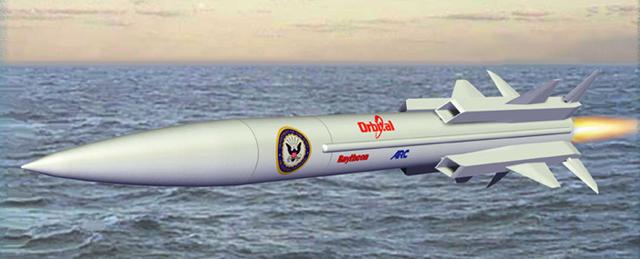
The GQM-163A “Coyote” target missile design integrates a four-inlet, solid-fuel ducted rocket ramjet propulsion system into a compact missile airframe 18 feet long and 14 inches in diameter. Ramjet supersonic takeover speed is achieved using a decommissioned Navy MK 70 solid rocket motor for the first stage. Rail-launched from Navy test and training ranges, the highly maneuverable GQM-163A Coyote achieves cruise speeds of Mach 2.5+ following the separation of the MK 70 first-stage booster. The range of the target vehicle system is approximately 50 nautical miles at altitudes of less than 20 feet above the sea surface.
This most recent flight test of the GQM-163A Coyote vehicle was the second consecutive success for the program, following a successful flight carried out earlier this year in May. The primary objectives for this test, all of which were achieved, included the verification of booster ignition and stable first stage flight, the verification of the transition of the ducted rocket ramjet from booster separation to inlet start, and verification of the ducted rocket ramjet ignition, navigation to waypoint capability, verification of the laser altimeter performance, and initial horizontal weave and vertical maneuver performance verification. In addition, the test target missile was heavily instrumented in order to collect flight environment data to refine aerodynamic and guidance models for future missions.
Orbital is currently the only U.S. Department of Defense prime contractor to be both developing and operating ramjet-powered missile systems. In addition to developing the GQM-163A Coyote, Orbital provides the Navy with launch services for the MQM-8 VANDAL SSST. The MQM-8 VANDAL is based on the liquid-fuel ramjet-powered Talos missile and provides the Navy with a legacy SSST until the more capable GQM-163A Coyote is operational.
Orbital is developing and manufacturing the GQM-163A Coyote at its launch vehicle engineering and production facility in Chandler, Arizona. Orbital’s major subcontractors include Aerojet Corporation in Gainesville, Virginia and Sacramento, California for the solid-fuel ducted rocket motor and CEi in Sacramento, California for the vehicle’s avionics system.
Orbital develops and manufactures small space and rocket systems for commercial, military and civil government customers. The company’s primary products are satellites and launch vehicles, including low-orbit, geosynchronous and planetary spacecraft for communications, remote sensing, scientific and defense missions; ground- and air-launched rockets that deliver satellites into orbit; and missile defense systems that are used as interceptor and target vehicles. Orbital also offers space-related technical services to government agencies and develops and builds satellite-based transportation management systems for public transit agencies and private vehicle fleet operators.
More information about Orbital can be found at http://www.orbital.com
By: bring_it_on - 12th July 2004 at 06:13
in january 2004 a seperate contract was awarded by raytheon to aerojet for the specific purpose of developing a ramjet v ducted propulsion for an air-to-air missile. also the descision to use the technology for a2a missile system was taken in 1996. the USAF/USN allready have the amraam which is being continously bettered with the c7 – and d models which would be ready by 2008 so the basic missile is continuing development therefor once the ramjet technology is ready the missile that uses will allready be there so possibly the time lag b/w propulsion and test flight wont be or shouldnt be that much
By: YellowSun - 11th July 2004 at 23:19
But there’s no flying hardware for that AAM program (and not much budget) – at least none that we know of. So Coyote takes on a whole new importance.
Meteor is progressing well. First launch will be in Sweden next year, around September.
YS
By: bring_it_on - 11th July 2004 at 22:08
the Ramjet contract for the a2a missiles has allready been awarded to aerojet.BTW whats the status on the meteor
By: YellowSun - 11th July 2004 at 22:02
The true importance of the Coyote programme is that it keeps the VFDR engine alive and funded – that ensures that VFDR remains available for future air-to-air ramjet missiles.
The US is waking up to the fact it is going to need some bigger, better AAMs and VFDR is the fastest way to make it happen. The Meteor is not going to have it all its own way any more…
YS
By: gabrujatt - 10th July 2004 at 18:27
what is this missile. and is it ramjet engine technology
By: seb92100 - 10th July 2004 at 18:21
You don’t understand : it is a target not an attack missile !!!
==> it has to be cheap and the developpement cost must be low. It would need a lot of investment to be developped into a supersonic attack missile.
It is not crappy. It was developped according to the navy requirement and budget. Its flight is representative of a supersonic missile.
By: bring_it_on - 10th July 2004 at 12:55
i know it aint air-launched but i didnt know they had released all the performance figures….can u quote the source about flight performance…and if it is so crappy then why has it not been cancelled….
By: seb92100 - 10th July 2004 at 10:18
The coyote is a target, not a missile.
Its performance are really poor when compared to existing supersonic attack missile (ASMP, Kh31, …). Remenber that the coyote do not have a warhead thus avoiding something like 90 kg of unused mass !
It won’t be air-launched. This phase of the flight is difficult because you have to control the missile also at subsonic speed, and moreover under the aerodynamic influence of the launcher airplane … The Coyote will probably be uncontrollable at subsonic speeds, without its booster.
By: bring_it_on - 10th July 2004 at 03:53
that is where i got the info and the pic from…but it doesnt talk much…wrote to the author he was a nice guy but even he didnt know much about the why only 60 will be bought , price etc
By: GDL - 10th July 2004 at 03:38
More on it here: GQM-163


 Sign In








 July 10, 2004 at 3:14 am