
By: sealordlawrence - 1st July 2007 at 09:18
And EF-2000 deal fell due to delivery date and time of payments related problems-PTV (Pakistani govt Controlled TV)
Just a pakistani fantasy, nothing more.
By: jawad - 1st July 2007 at 05:11
Pakistan wanted the F-16s also because it is familiar with the system and has developed an infrastructure that includes trained pilots and maintenance and servicing facilities. i am just saying that J-10 was choosen under a different requirments then that of F-16 😮
As for EF-2000, it’s just a rumour that’s been flying around amongst Pakistani internet warriors for several years.
And EF-2000 deal fell due to delivery date and time of payments related problems-PTV (Pakistani govt Controlled TV)
By: tphuang - 29th June 2007 at 04:29
This is very old article which was published before the JF-17 came in PT-4 version and F-16 deal went through after USA cleared the weapons like the AMRAAM etc and F-16 C/D Block 52+
It was in fact Fc-20 (J-10) which was used to put pressure on the USA.
PAF’s new air chief said after the deal of F-16 went through that PAF will buy a new 4th Generation jetfighter from west other then the F-16 being bought from the USA
At the same time PTV in its news showed how EF-2000 is better then F-16 and will be suited for the PAF’s future requirements. And said that PAF is in negotiations with the EU for its sale to it
And F-16 number was reduced due to the tragic earthquake in Northern areas and AJK not due to J-10
so how does coming before PT-4 make it an old article? It was already decided by that time that Pakistan was getting AMRAAM and F-16s. And then J-10 came in after this new broke out and it’s number of orders exactly matched the number of orders that got reduced on F-16s.
As for EF-2000, it’s just a rumour that’s been flying around amongst Pakistani internet warriors for several years. There has been no basis for it. Since J-10 delivery to Pakistan will probably not occur until after 2010. And then, you are inducting a lot of JF-17s. By that time, I don’t consider EF-2000 to be that advanced anymore.
Seriously, stop dreaming. I’m honestly tired of Pakistanis dissing Chinese military hardware.
By: jawad - 26th June 2007 at 17:51
This is very old article which was published before the JF-17 came in PT-4 version and F-16 deal went through after USA cleared the weapons like the AMRAAM etc and F-16 C/D Block 52+
It was in fact Fc-20 (J-10) which was used to put pressure on the USA.
PAF’s new air chief said after the deal of F-16 went through that PAF will buy a new 4th Generation jetfighter from west other then the F-16 being bought from the USA
At the same time PTV in its news showed how EF-2000 is better then F-16 and will be suited for the PAF’s future requirements. And said that PAF is in negotiations with the EU for its sale to it
And F-16 number was reduced due to the tragic earthquake in Northern areas and AJK not due to J-10
By: tphuang - 25th June 2007 at 02:23
That would be helpfull:rolleyes:
here it is, note the 3 way competition he was mentioning in there.
By: jawad - 24th June 2007 at 08:10
that’s because they just started negotiating on buying the plane. But the stuff with plus one requirement and J-10 winning is well known, I have the JDW article where PAF ACM admitted this. Do you want me to post it?
That would be helpfull:rolleyes:
By: tphuang - 23rd June 2007 at 17:54
NO J-10 Always was there for a Fighter contract to which PAF always refered as High Tech fighter other then F-16
that’s because they just started negotiating on buying the plane. But the stuff with plus one requirement and J-10 winning is well known, I have the JDW article where PAF ACM admitted this. Do you want me to post it?
By: jawad - 23rd June 2007 at 14:53
no idea where your sources are, but it seemed to me that the plus-one fighter project was down to J-10, JAS-39 and F-16. In which J-10 won out, F-16 order was cut down. As for your link, don’t think that conclusively proves anything.
NO J-10 Always was there for a Fighter contract to which PAF always refered as High Tech fighter other then F-16
By: Unicorn - 23rd June 2007 at 04:09
I don’t object to the discussion, only the location.
Unicorn
By: Kaduna2003 - 22nd June 2007 at 19:24
Gents, would it be too much to ask to take this **** to the PLAN thread, and return this thread to its orginal topic?
Unicorn
I think this is a great discussion and i for one am learning a lot about both the 054 and the OHP. Very relevant to PN’s acquisition plans.
By: YourFather - 22nd June 2007 at 18:34
To satisfy the wishes of Unicorn and Wanshan, I shall continue this discussion in a new thread.
By: Pinko - 22nd June 2007 at 18:22
Does the Sea Eagle do surface tracking and horizon search? The Sampson doesn’t need to do terminal guidance since the system it is part of uses Aster missiles. The OHP gets elevation information through its CAS.
But the data refresh rate is lower than that of the CAS from which the IADT can derive altitude information. IADT may add another layer, but the number of layers is not relevant. It is the time saved from faster target detection and transition to track that matters, and here is where IADT gives an advantage. SYS-2 even has a special quick reaction mode where track data is passed directly to the WDS for immediate target prosecution, bypassing the CDS.
You mean a big horse like FFG-7 makes the 3D data available only when the CAS comes into range?! That’s a far cry compared to Sea eagle’s radar which will have the target’s elevation info far more away then FFG-7. what a better detection stands for of course not only inclusive of a better scanning rate right, obviously the better detection also speaks for better situation awareness. Your enemy will exactly capitalize such an incompetence of your 2D radar by flying the strikers low or you won’t be able to tell the incoming missile whether is an AshM in descending stage or a “zenith” approach of an ARM early enough.
Of course sea eagle is supposed to do horizon search but not necessary it will be the only platform to do so, after I reviewed the 054A’s photos, I indeed found that the SR-64 radar with 1rpm/s rotating rate for low flying target tracking is still there. Judged from the fact that one of the sea eagle’s 2 face antenna is in C-band, sea eagle will be the main horse to tract the surface targets and provide midcourse guidance for HQ-16 to incept them. HQ-16 is SARH missile that requires terminal guidance that’s why there’re separate FCR on board 054A. The presenting of FCR got nothing to do with Sea eagle is multirole or not as you previously claimed.
What does that have to do with what I said – the SPS-49 and the SPQ-9B is (in some cases, will be) an integral part of the AEGIS. Which throughly debunks your assertion that “Aegis never relies so many individual systems to accomplish the same role”. The SPQ-9B is to be part of the system dedicated to horizon search in the ASCM defense role.
You still seem do not understand, the SPY-1 is capable to do the horizon search itself, the SPS-49’s role is just a backup of that of SPY-1. nobody wants turn on an expensive SPY-1( 4 faces in total) in order just to do horizon search?
There is no problem with synchronisation. The IADT is able to handle up to 1500 track updates per sec. Look at the number of radars in the IADT capable of horizon search. The SPS-49, the STIR and the CAS. With RAIDS, even the Phalanx radars and the SLQ-32 will be integrated to formulation of the ship’s response to an ASCM threat.
Certainly IADT has its limit as it’s designed to be a legacy equipment booster:
“ When radars are employed with different scan rates, a separate external timing reference must be employed, which becomes the scan rate for the IADT and the synthetic video display. Track updating and smoothing occur as previously described, except updates are considered relative to narrow sectors of the search volume — typically a few degrees in width. System software updates tracks a few sectors behind the azimuth position of the synthetic scan.”
OHP cannot compete with the 054A in terms of number of channels, but it may (and is likely to) be more capable in terms of detection and tracking of low altitude, heavily maneuvering targets in clutter. And in those cases, ability to detect early and maintain track matters just as much as number of FC channels.
So something like the ability to detect and maintain track is now lame to someone who cannot quite substantiate their claim that the 054A is definitely better at detection and engagement of low altitude targets.
Well, the 054A also has other means for low altitude targets. 1st, the SR64 will boost much fast update rate for sea skimming target and cure type 730 CIWS to intercept it, also, there’s IR surveillance device in supplement of radar system in case the latter is in clutter & heavy ECM environment. The IR-17 system has a reaction time of 3s and tracking of sea skimming AshM up to 8kms. see the below specifications:

All the sensors no matter it’s 3D radar or IR tracking system are integrated by a combat command system similar to JRSCCS, the JRSCCS is an export version which features a double redundant 100M databus and FDDI high speed LAN in an fully open structure.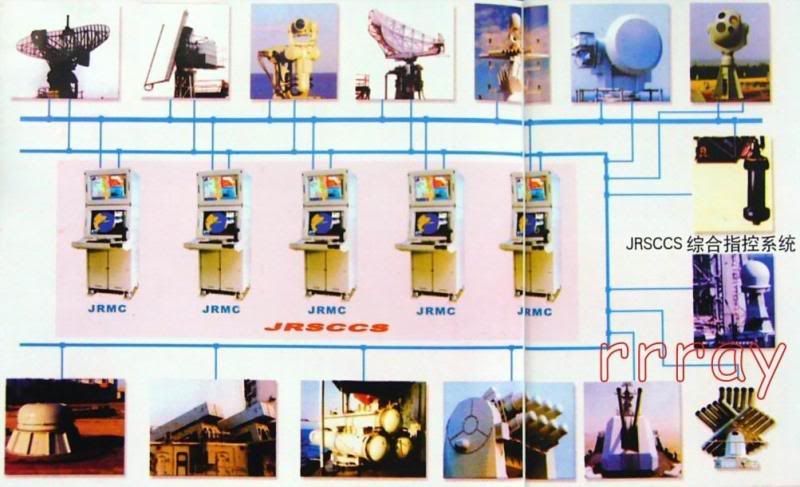
By: Wanshan - 22nd June 2007 at 17:38
Gents, would it be too much to ask to take this **** to the PLAN thread, and return this thread to its orginal topic?
That was Greek frigates being sold to Pakistan, not you two having a technical knowledge pissing contest!
Thank you.
Unicorn
This motion seconded.
By: Unicorn - 22nd June 2007 at 10:11
Gents, would it be too much to ask to take this **** to the PLAN thread, and return this thread to its orginal topic?
That was Greek frigates being sold to Pakistan, not you two having a technical knowledge pissing contest!
Thank you.
Unicorn
By: YourFather - 22nd June 2007 at 04:29
1st, I need to check whether there’s any Type 364 Seagull C ( SP64) onboard 054A in the 1st place or not, yes, older 054 FFG does have this radar but older generation 054 doesn’t have Sea Eagle.
If you can accept Sampson as a MFR, you will notice Sampson also can’t guide a semi-active radar homing missile like SM-2, it still needs another dedicate fire control radar to do the terminal guidance. HQ-16 is semi-active guided. The benefits of Sea eagle is it features 2 antenna in S & C band respectively, although the sea eagle features 2 phased array antennas working in different bandwidth, its single signal processing is still able to integrate different & massive volume of signals from both phase arrayed panel by rotating simultaneously, the Sea eagle can detect and track multiple targets simultaneously, thanks to its phase array antenna which is multiple beam forming capable, and it’s nature a phased array radar can engage more targets than your mechanically scanned SPS-49, SPS-55 by its power output and design is still not a capable volume search option. the Sea eagle’s capability to find a target farther with better situational awareness by knowing the targets’ not only bearing and range but also altitude. Being a phase arrayed, it can engage more targets simultaneously and the dedicate fire control radar only need guide the SARH HQ-16 in the final kill thus greatly enhance the latter’s capability to switch to new target for next illumination fast enough. Do you mean the saying of Sampson a MFR a joke as well? This time is not me, but Britons.
Does the Sea Eagle do surface tracking and horizon search? The Sampson doesn’t need to do terminal guidance since the system it is part of uses Aster missiles. The OHP gets elevation information through its CAS.
Can you deny IADT is still an additional layer? Do the SPS-55 & SPS-49 combine their individual signal processing units into one or still separately? Do mind, the sea eagle does combine the different signal from different antenna panel by processing them in one unit. Do those individual signal processing work synchronized or still in different pace, think about, their rotating rate are still different. Yet you still don’t understand 2D & 3D, when you have no good enough altitude data via SPS-49, your IADT has to wait such feed from another capable SPS-55 while Sea eagle can have altitude and other 2D information at the same time. No time lagging,
But the data refresh rate is lower than that of the CAS from which the IADT can derive altitude information. IADT may add another layer, but the number of layers is not relevant. It is the time saved from faster target detection and transition to track that matters, and here is where IADT gives an advantage. SYS-2 even has a special quick reaction mode where track data is passed directly to the WDS for immediate target prosecution, bypassing the CDS.
The point is when no phased arrayed radar like SPY-1 available, the SPS-49 plays main role in volume search, but since, there’s SPY-1, the SPS-49 has to be in the back seat. SPY-1 is high cost in operation, so does the phased array radar on PLAN 052C, nobody will turn on such high power, expensive radar in normal surveillance
What does that have to do with what I said – the SPS-49 and the SPQ-9B is (in some cases, will be) an integral part of the AEGIS. Which throughly debunks your assertion that “Aegis never relies so many individual systems to accomplish the same role”. The SPQ-9B is to be part of the system dedicated to horizon search in the ASCM defense role.
As I said, phase arrayed Sea eagle can provide one more dimension of data simultaneously, it need no time lagging IADT process. All in one radar eliminates synchronization issue of your different radars. Phased array radar provide true multi target capability over your aged SPS-49, it can do from detection to tracking simultaneously, greatly enhanced radar’s efficiency and your FCRs therefore spend shorter time to engage targets.
There is no problem with synchronisation. The IADT is able to handle up to 1500 track updates per sec. Look at the number of radars in the IADT capable of horizon search. The SPS-49, the STIR and the CAS. With RAIDS, even the Phalanx radars and the SLQ-32 will be integrated to formulation of the ship’s response to an ASCM threat.
comparing the tracking radar + number of FCRs, OHP cannot possibly compete with 054A.
OHP cannot compete with the 054A in terms of number of channels, but it may (and is likely to) be more capable in terms of detection and tracking of low altitude, heavily maneuvering targets in clutter. And in those cases, ability to detect early and maintain track matters just as much as number of FC channels.
So, you are down to this lame argument of China can’t combine it’s radar data.
So something like the ability to detect and maintain track is now lame to someone who cannot quite substantiate their claim that the 054A is definitely better at detection and engagement of low altitude targets.
If you ever checked their surveillance radar export brochures, you would see that they have developed a land based system that integrates everything together. It’s not that hard to assume they put it on naval AAW platforms.
And what sort of integration does it carry out? There are different ways of integration, just as there are IADT integrates radar information differently from other radar integrators out there. There is also nothing to say that just because some land based system in China does radar integration, that means the 054A also has a similar system.
As for what evidence I see of such a system on 054A. Most of this is seen on 891, you can see clearly where the test ship is testing out the combined effort of HH-16 + FCRs + the new Sampson like MFR + new variant of Sea Eagle LRR. To me, that’s clearly a naval AD system at work. Even before being deployed on any ship, they are bringing this set of sensors together to work with HH-16. If they are not also testing out the hardware+software that integrates the data from all the sensors, why would they do this?
Probably to see that they simply work under the CDS.
If they are not also testing out the hardware+software that integrates the data from all the sensors, why would they do this?
Integrating the disparate systems under a CDS is quite different from integrating radar outputs.
Now, what you can argue is whether 054A’s radar integrator is as advanced as OHP or not, but without data of each, nobody can answer that for you.
Exactly. So you cannot make the claim you initially did that the 054A is better than the OHP in tracking and engaging low altitude targets, because you don’t know.
Now, what you can argue is whether 054A’s radar integrator is as advanced as OHP or not, but without data of each, nobody can answer that for you. As for this OHP being able to handle 2 air targets, I read at least the SM-1 can only handle 1 due to the limited nature of MK-92. Unless you have some other sources that show it can handle 2 air targets, which I can’t seem to find online.
Each SM-1 can of course handle only one target. But the Mk 92 system can handle 2 air targets, CAS provides one, STIR provides another.
still doesn’t address the real problem that SM-1 is just not that capable of intercepting sea-skimming missiles.
Based on? :rolleyes: Somehow the HH-16 of which little is known just is better. You don’t know how it is better, but it is better, because you want it so.
Going back to the topic, it is by no means certain that the 054A is necessarily better than the OHP or the Type 23 as the platform of choice for Pakistan. OHP and T23 will be transferred at very low cost compared to the 054A, and they even provide better capabilities in some important areas like ASW and littoral ASuW. Even in AAW, while it looks from the number of FCRs that the 054A is a more capable platfrom, it is not really clear that it is indeed that much more capable than the OHP when it comes to stressing low altitude targets, where time to detect and track are factors just as critical as fire channels.
By: tphuang - 22nd June 2007 at 02:43
i agree with first part and here is a answer to the question of this thread
Perhapes Confusing Sweden with Switzerland:D
but what i said about European solution was a thing that happened before President Pervez Musharraf intervened and decided to go for Fc-20(PAF’s J-10)
PAF high officals because of thir tranning and close relationship etc wanted to go for EF-2000 (which was available before and after the F-16 deal )or JAS-39 (which is thought to became available after the F-16 deal)
But that is thing of past and i think this is not a right place to discuss it
no idea where your sources are, but it seemed to me that the plus-one fighter project was down to J-10, JAS-39 and F-16. In which J-10 won out, F-16 order was cut down. As for your link, don’t think that conclusively proves anything.
By: tphuang - 22nd June 2007 at 02:39
What makes you assume that the 054A has a radar integrator? just because it is newer? Or because you wish it to have one? Show us proof. And the OHP is able to handle 2 air targets simultaneously, not one.
You might want to find out what a radar integrator like IADT actually does, and what bearing that has on ship-self defense capability. The constant comparisons of radar vs radar shows a lack of understanding of the contributions of a radar integrator to ship self defense. And Pinko does not seem to understand how RPM affects data-update rate, as well as how IADT dramatically increases update rate as a result of integrating plots from almost every onboard radar.
so clearly, you can see that individually comparing the volume search radar, comparing the tracking radar + number of FCRs, OHP cannot possibly compete with 054A. So, you are down to this lame argument of China can’t combine it’s radar data. As I mentioned before, they already have something like that in their national AD network. If you ever checked their surveillance radar export brochures, you would see that they have developed a land based system that integrates everything together. It’s not that hard to assume they put it on naval AAW platforms. That’s in fact one of the biggest difference in quality between something like 051C and 052C.
As for what evidence I see of such a system on 054A. Most of this is seen on 891, you can see clearly where the test ship is testing out the combined effort of HH-16 + FCRs + the new Sampson like MFR + new variant of Sea Eagle LRR. To me, that’s clearly a naval AD system at work. Even before being deployed on any ship, they are bringing this set of sensors together to work with HH-16. If they are not also testing out the hardware+software that integrates the data from all the sensors, why would they do this? To make sure that the radar frequencies don’t cause problems? I don’t think they need to put them all on 891 just for this. Now, what you can argue is whether 054A’s radar integrator is as advanced as OHP or not, but without data of each, nobody can answer that for you. As for this OHP being able to handle 2 air targets, I read at least the SM-1 can only handle 1 due to the limited nature of MK-92. Unless you have some other sources that show it can handle 2 air targets, which I can’t seem to find online.
Prior to IADT installation and the MPU upgrade to the SPS-49, the FFGs required the SPS-55 and CAS. With both IADT and MPU, the ability to detect, form and maintain track of low flying, violently maneuvering targets in clutter has been dramatically increased.
still doesn’t address the real problem that SM-1 is just not that capable of intercepting sea-skimming missiles.
look, this is getting weak, clearly the only argument you can make right now is that you assumed that China can’t integrate it’s radars as well as on IADT OHPs. First, you jumped guns on my arguments before reading them and now the only argument you can use is this “well, since you can’t show me how well China can combine the radar info, that must mean it doesn’t work that here”.
Pinko, there is not a chance Sea Eagle can be a MFR.
By: Pinko - 22nd June 2007 at 02:16
If the Sea Eagle was a MFR, why the need for the SR-64 and Orekh radars? The Sea Eagle simply doesn’t provide the required refresh rate to provide low level tracking. MFRs like APAR and SPY-3 are indeed the future, but sorry, Sea Eagle isn’t a MFR. Calling it a MFR is a joke on yourself. .
1st, I need to check whether there’s any Type 364 Seagull C ( SP64) onboard 054A in the 1st place or not, yes, older 054 FFG does have this radar but older generation 054 doesn’t have Sea Eagle.
If you can accept Sampson as a MFR, you will notice Sampson also can’t guide a semi-active radar homing missile like SM-2, it still needs another dedicate fire control radar to do the terminal guidance. HQ-16 is semi-active guided. The benefits of Sea eagle is it features 2 antenna in S & C band respectively, although the sea eagle features 2 phased array antennas working in different bandwidth, its single signal processing is still able to integrate different & massive volume of signals from both phase arrayed panel by rotating simultaneously, the Sea eagle can detect and track multiple targets simultaneously, thanks to its phase array antenna which is multiple beam forming capable, and it’s nature a phased array radar can engage more targets than your mechanically scanned SPS-49, SPS-55 by its power output and design is still not a capable volume search option. the Sea eagle’s capability to find a target farther with better situational awareness by knowing the targets’ not only bearing and range but also altitude. Being a phase arrayed, it can engage more targets simultaneously and the dedicate fire control radar only need guide the SARH HQ-16 in the final kill thus greatly enhance the latter’s capability to switch to new target for next illumination fast enough. Do you mean the saying of Sampson a MFR a joke as well? This time is not me, but Britons.
SPS-55, like the other radars, feeds its plots to the IADT, resulting in a much higher data rate than relying on any single radar. This ensures far less false alarms, high probability of detection, and much more robust holding of track against a violently maneuvering low altitude target in clutter, especially compared to a combat system relying on independant radars (with a comparatively lower update rate like the Sea Eagle, or even the SR-64) to hold a track.
Can you deny IADT is still an additional layer? Do the SPS-55 & SPS-49 combine their individual signal processing units into one or still separately? Do mind, the sea eagle does combine the different signal from different antenna panel by processing them in one unit. Do those individual signal processing work synchronized or still in different pace, think about, their rotating rate are still different. Yet you still don’t understand 2D & 3D, when you have no good enough altitude data via SPS-49, your IADT has to wait such feed from another capable SPS-55 while Sea eagle can have altitude and other 2D information at the same time. No time lagging,
What’s your point?
The point is when no phased arrayed radar like SPY-1 available, the SPS-49 plays main role in volume search, but since, there’s SPY-1, the SPS-49 has to be in the back seat. SPY-1 is high cost in operation, so does the phased array radar on PLAN 052C, nobody will turn on such high power, expensive radar in normal surveillance
That still doesn’t provide a comparable data-rate to the SPS-49, SPS-55 and CAS fed IADT
As I said, phase arrayed Sea eagle can provide one more dimension of data simultaneously, it need no time lagging IADT process. All in one radar eliminates synchronization issue of your different radars. Phased array radar provide true multi target capability over your aged SPS-49, it can do from detection to tracking simultaneously, greatly enhanced radar’s efficiency and your FCRs therefore spend shorter time to engage targets.
By: Wanshan - 21st June 2007 at 23:46
Gents: Greece to Pakistan frigates!
By: YourFather - 21st June 2007 at 14:09
IADT in FFG-7 case is just a compromise when you don’t have a multi-role radar. Already shown here is that the Sea Eagle Double band, double antenna 3D radar can do your SPS49/55 jobs all in one, what you showed to us is the speed upgrade on the SYS 2 Integrated Action Data System which 054A FFG doesn’t need , instead 054A FFG benefits zero time lagging on such a system by using all-in-one detecting & tracking 3D radar. IADT in FFG7 is just a layer of processing you need when you bring multiple radars into a more competence system. No matter how fast the IADT system can be, it still consumes time to go through this layer when the single multi-functional radar can accomplish and skip this layer and directly cue Fire control radar for missile’s terminal interception. Such a SYS 2 Integrated Action Data System only needed when you want to combine data from different radar platforms for the same function, either SPS55 or SPS49 or any other. Sea eagle radar is just a all in one, what you get is what you want, you no need Sys2 to integrate anymore. The multiple function Radar represents the trend in the new age ship airdefense, which is centered on Phased array radar, rotated type like Sampson or non rotated type like SPY-1.
If the Sea Eagle was a MFR, why the need for the SR-64 and Orekh radars? The Sea Eagle simply doesn’t provide the required refresh rate to provide low level tracking. MFRs like APAR and SPY-3 are indeed the future, but sorry, Sea Eagle isn’t a MFR. Calling it a MFR is a joke on yourself.
But you mean after IADT/MPU, the FFG no longer needs SPS-55?
SPS-55, like the other radars, feeds its plots to the IADT, resulting in a much higher data rate than relying on any single radar. This ensures far less false alarms, high probability of detection, and much more robust holding of track against a violently maneuvering low altitude target in clutter, especially compared to a combat system relying on independant radars (with a comparatively lower update rate like the Sea Eagle, or even the SR-64) to hold a track.
SPS49 is just a cheap and reliable backup of SPY-1, to use SPY-1 doing daily surveillance is totally overkill, when you can find a low cost, cheap but reliable search radar, SPS49 comes into play, PLAN 052C has similar arrangement where you can find round dome alike search radar on top of the mast. BTW, how slow do you think the solid state phase shifter of Sea eagle will be if compared to really faster SPY-1?
What’s your point?
Sea eagle has 2 antennas in a back to back arrangement which means every half round there will be an antenna facing the target instead of SPS49’s per round.
That still doesn’t provide a comparable data-rate to the SPS-49, SPS-55 and CAS fed IADT.


 Sign In








 June 7, 2007 at 12:36 pm