
By: mark_pilkington - 5th August 2008 at 07:17
im not to sure on how valuble/ invaluble it is
Given its an original 1909 aircraft engine, (despite its lack of successful flight) it would seem to be very important and of great significance, perhaps not equal to AV Roes original triplane, but certainly one of the few original survivors from those early pioneers?
I am becoming convinced the engine is a normal combustion engine, given its original intended use in a car, and no apparant details of a steam boiler in the drawings or design discussion in the research material sent to me.
regards
Mark Pilkington
By: Scott Marlee - 4th August 2008 at 23:18
indeed CD, thats why i havnt took anything apart as yet, im not to sure on how valuble/ invaluble it is and dont wanna break anything, however i shall speak to the powers that be and see what they will allow
By: Creaking Door - 4th August 2008 at 17:53
Do you still have access to the engine?
While the archives are out of bounds you could at least post some more photos as requested by some on this thread. At the very least you should sort out, or re-post the original photos. Somebody out there may be able to help with your request but with only a single re-posted photo you may not get much more interest.
And what about removing one of the ‘sparkplugs’? 🙂
That would a least add some progress to your request…..but be careful this engine is probably unique!
By: Scott Marlee - 4th August 2008 at 16:52
still no luck from NEAM, the archives are still under construction so i cant really access anything yet
Scott
By: low'n'slow - 4th August 2008 at 13:44
A quick scan of the excellent Flight International archive site at www.flightglobal.com came up with the following gems from May 1909 publications:
Donovan Aeroplane Co., Ltd., 11, Church Street, West
Hartlepool.—Capital £2,000, in £1 shares. Formed to acquire
and construct flying machines and similar apparatus, and particularly
to acquire absolutely the Patent No. 21,618 for improvements in the
mode of and apparatus for flying machines, which is the invention
and sole property of Capt. Joseph Donovan, of West Hartlepool.
First directors, Richard James Blacklin, Thomas McCleod, and
Joseph Donovan.
An Aeroplane Company.
WHAT was probably the first of its kind appeared in
the public Press in the early part of this week in the
shape of a prospectus inviting public subscriptions to a
limited liability company formed to construct and develop
an aeroplane. The machine in question is the invention
of Capt. Joseph Donovan, of West Hartlepool, who has
met with a good deal of success in his experiments with
models.
http://www.flightglobal.com/pdfarchive/search.aspx?search=Joseph%20Donovan%20&page=1
According to an April 1909 copy of Flight, Donovan had displayed at Olympia a model which was “a helicopter aeroplane fitted with twin
lifting screws and a circular aeroplane surface”.
http://www.flightglobal.com/pdfarchive/view/1909/1909%20-%200221.html
By: mark_pilkington - 4th August 2008 at 12:51
Scott,
any updae from NEAM on the engine?
I have recieved info from the UK that advises the following:
The engine was designed and built by Harry Fothergill, an Engineer from Teeside in 1907/1908 as a 30hp 6 cylinder engine for a car, however that did not proceed and the engine was ony partially completed as a two cylinder and never fitted to a car.
It was acquired by Captain Joseph Donovan for his aircraft and given to Thomas Macleod another local engineer who took it to Gale’s Garage in West Hartlepool where it was completed to its original 6 cylinder specification during 1909.
Captain Donovan had designed what might be best described as a helicopter with two driven short contra-rotating rotors above a circular canvas wing, and two contra-rotating pusher propellors at the rear in front of a single vertical rudder.
The circular wing was to act as a parachute during landing, and the undercarriage was jettisonable wheels and two skids, , the machine was intended to be able to be fitted with floats for operation as a flying boat or seaplane.
The design was patented as #21618 and a company formed – the Donovan Aeroplane Company in May 1909
Construction of the machine was undertaken at the Howcraft Carriage Company in Oxford Road West Hartlepool at a cost of 200 pounds, and it was then taken to a field at Johnson’s Rift House Farm.
It was placed in a specially built shed to await its testing.
It was tested by Captain Donovan on 25 October 1909, and proved to be a dismal failure, the engine had insufficient power to do anything more than turning the propellors and could not cause any “tractive effect”?, the completed airframe was excessively heavy and “unwiedly”, “the plane would not have flown even if driven by a 300hp engine” was the comment of eye witness Harry Fothergill (the original designer and constructor of the engine) in 1965.
Flight on the 29th of October 1909 reported the construction and failure , and the subsequent sale of machine and fittings by auction for 35 pounds.
Captain Donovan died at the age of 84 at Grove Hill Middlesbrough in 1928, suggesting he was 65? at the time of the attempt to fly in 1909?
regards
Mark Pilkington
By: mark_pilkington - 27th June 2008 at 16:26
Quote:
Originally Posted by stuart gowans
Hallard Howcroft, was a wheelright, and carriage builder, at that time, (1908) their premises were at Oxford road and Stockton road (west Hartlepool?) the business was known as Howcroft carriage & engineering co; they were noted as supplying small steam engine boilers to the trade, is it possible that the engine is of their own manufacture?Don’t suppose this was the source of your research, Mark?
No Stuart it is’nt the source, it was however a starting or reference point along with the original post/photo with the engine plaque inscription.
I have been corresponding with a number of newspaper archives and library archives in the UK on this since the photos were posted as artifacts from such early aviation interests me, and the info above is from those sources seperately confirming Howcraft Carriage Company (and their address) as the builders, but also providing the additional details of the date, designer and pilot’s name, cost of the aircraft etc, I am currently awaiting the full research material of newpaper clippings of the time via mail to turn up, the info above is a summary of what has been found so far, but still no allusive aircraft photo etc.
regards
Mark Pilkington
By: Creaking Door - 27th June 2008 at 15:57
Have you pulled a ‘plug out yet? 😉
By: Scott Marlee - 27th June 2008 at 15:50
at the moment, the archives are being sorted out so ill see if any information is lurking up there, none of the current members know of any so ill have to have a dig and see 🙂
By: stuart gowans - 27th June 2008 at 15:38
Hallard Howcroft, was a wheelright, and carriage builder, at that time, (1908) their premises were at Oxford road and Stockton road (west Hartlepool?) the business was known as Howcroft carriage & engineering co; they were noted as supplying small steam engine boilers to the trade, is it possible that the engine is of their own manufacture?
Don’t suppose this was the source of your research, Mark?
By: mark_pilkington - 27th June 2008 at 15:14
Scott?
Any more information available at the museum on the engine or aircraft it was fitted to?
My research has identified the aircraft was built by Howcraft Carriage Company of Oxford Road West Hartlepool at a cost of £200.00.
The aircraft was designed by a Captain Joseph Donovan and on the day of the scheduled flight it was he who attempted to fly the aircraft.
The attempted flight occured in late October 1909, thereby an important attempt at rivalling S F Cody for first to fly in the UK?
regards
Mark Pilkington
By: Scott Marlee - 15th June 2008 at 22:22
yeah image shack went U/S on me…ill see if i can upload as attachments ?
By: BlueRobin - 15th June 2008 at 10:11
I think Imageshack may be currently experiencing “issues” 🙂
By: Creaking Door - 15th June 2008 at 10:05
Where did the photographs go Scott?
By: Scott Marlee - 10th June 2008 at 12:26
ill try and get more photos tomorrow when i go up to NEAM, busy job hunting today 😀 ohh the funn
ill see what information i can dig out too
Regards
By: mark_pilkington - 10th June 2008 at 00:58
.
Scott,
Can you take some pictures from the water manifold side of the engine?
Can you also elaborate on any information the museum has on Mr Howcraft and his aircraft, and flight in 1908?
Has the museum explored the local newspaper at Hartlepool?
I understood SF Cody was the first to fly in the UK in October 1908, so I would have thought Howcraft’s flight in the same year would be well documented?
It would be interesting to know what links existed between Cody and Howcraft as both appear to be “showmen” at the time?
regards
Mark Pilkington
By: Scott Marlee - 9th June 2008 at 19:26
That thought had occured to me too.
The only thing that really confuses me is that the brass access ‘plugs’ for the inlet valves all seem to have a hole in them. I suppose it is possible that these were where the spark plugs were actually located as the ‘spark plugs’ on the top of the cylinders seem too close to the ‘coolant outlet’. Possibly twin ignition systems? I didn’t realise that twin ignition systems were used so early until I read the quotes above.
I don’t suppose you could whip a ‘plug’ out could you Scott? It would certainly solve the steam / petrol argument.
ill see what i can do mate…not sure how easy the thing comes apart
By: Pim Pouw - 9th June 2008 at 18:57
To me it looks like an “compression ignition engine”. Most people would call this a diesel. This early type of diesel would have run on a more eplosive mixture like petrol mixed with ether.
Why ?
-The valves setup makes it a combustion engine
– Lack of source of ignition
– the screws on the top of the domes are probably connected to a moving top cilinder which were used to regulate the compression ratio of the engine ( very important on a “diesel” ), this setup is still used on modelplane diesel engines
– early “diesels” had the nasty habit of exploding sometimes , so I think the studs together with the opening above the inlet valves were used for a safety valve sytem
Pim Pouw
Early Birds Foundation
the Netherlands
By: Creaking Door - 8th June 2008 at 22:34
The remaining two large gears/cogs are identical, and appear to be for chain drives to propellors, suggesting a Wright Flyer type twin pusher prop configuration?
That thought had occured to me too.
The only thing that really confuses me is that the brass access ‘plugs’ for the inlet valves all seem to have a hole in them. I suppose it is possible that these were where the spark plugs were actually located as the ‘spark plugs’ on the top of the cylinders seem too close to the ‘coolant outlet’. Possibly twin ignition systems? I didn’t realise that twin ignition systems were used so early until I read the quotes above.
I don’t suppose you could whip a ‘plug’ out could you Scott? It would certainly solve the steam / petrol argument.
By: mark_pilkington - 8th June 2008 at 15:20
.
I have’nt been able to find any google reference to Mr Howcraft and his aircraft at Hartlepool, although it is confirmed his coach building company made fairground rides.
Novelty is always important in attracting customers; if a trip through the Channel Tunnel, complete with smoke and steam did not appeal, then a ride on Razzle Dazzle might. Sitting on seats on a circular platform, it dipped from side to side as it rotated. As early as 1893 Savages held a patent for the machine, but later examples built in Hartlepool by the Howcroft Carriage and Waggon Works proved superior.
I personally agree with Creaking Door and think it could be an upright, inline 6 cylinder water cooled internal combustion aero engine.
The copper and brass is consistant with the water jackets etc applied to the cast iron cylinders of other water cooled aero engines of the period such as the V8 E.N.V. (as seen under restoration in the De Cater’s Voisin in Belgium below), and therefore not neccessarily indicative this engine is associated with either marine applications or steam locomotion.
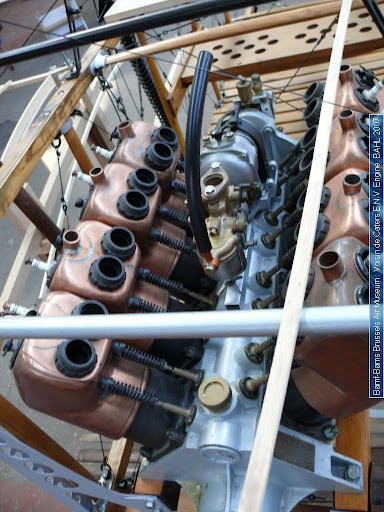
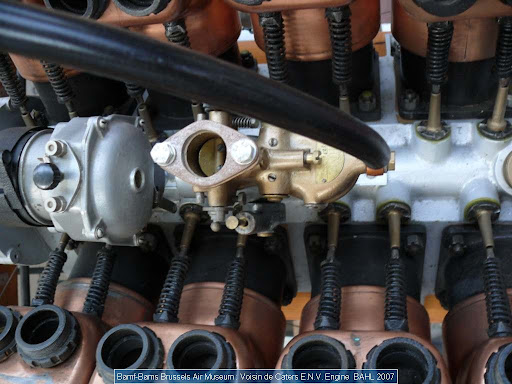
Links to the above pics as they do not seem to be visible?
http://picasaweb.google.com/bamf.bamrs/VoisinDeCaters/photo#5188458859203623650
http://picasaweb.google.com/bamf.bamrs/VoisinDeCaters/photo#5188458683109964434
I have a 1972 reprint of “The Aero Manual – 1910”, it describes the water cooled V8 E.N.V. ,the water cooled upright 4 cylinder Bayard-Clement and the water cooled upwright 6 cylinder Buchet motors.
I suspect the Howcraft engine is a self created engine on the same principles?
It seems from the photo below that:
1: It is possible spark plugs exist top dead centre of the cylinders
2. It seems the fuel inlet manifold is missing from the LHS of engine (can we have a better side on pic from that side?
3. It seems the water inlet manifold was located on the top of the engine adjacent to the sparkplugs?
4. It is assumed the carburettor is missing with the inlet manifold?
5. There is an exhaust gas manifold on the RHS of the engine, venting to the rear?
6. It seems there is a water jacket outlet manifold on the LHS of the engine
7. It is assumed there is some inlet and outlet to the manifold to allow connection to an external radiator and header tank that was a feature of water cooled aircraft of the period?
8. the “front” of the engine has a single gear/cog fitted to the crankshaft, possibly a drive shaft for the magneto?
9. The “rear” of the engine has three gears/cogs fitted to the main crankshaft, the closest to the engine drives the two camshafts, (one of the camshaft gear/cogs is missing).
10. The remaining two large gears/cogs are identical, and appear to be for chain drives to propellors, suggesting a Wright Flyer type twin pusher prop configuration?
The 1907 and 1909 Wright Flyers used a 4 cylinder upright inline water cooled engine, I wonder if this engine by Howcraft was used to power a Wright Flyer or derivitive? in the UK.
Short Brothers built 6 Wright Flyers at Leysdown UK during 1909-1910, but “apparantly” used French built engines?
Flugmaschine Wright GmbH in Germany constructed 22 Wright Flyers during 1909-1910, details of engines used is unknown?
Elsewhere the Green Engine Company of the UK is listed as supplying the upright water cooled 4 cylinder inline in November 1909 for the Short brother’s Wright Flyers?
Is it possible Howcraft was competing with Green’s for Short’s business?

The following webpage extract suggests there were many other inline 6 cylinder engines in development over the same period?
It would be interesting to unearth the 1910 Critchley and 1912 Clark engine lists referred to in it?
A later development of the Green engine was a six-cylindered vertical, cylinder dimensions being 5.5 inch diameter by 6 inch stroke, developing 120 brake horsepower when running at 1,250 revolutions per minute. The total weight of the engine with ignition system 398 was 440 lbs., or 3.66 lbs. per horse-power. One of these engines was used on the machine which, in 1909, won the prize of L1,000 for the first circular mile flight, and it may be noted, too, that S. F. Cody, making the circuit of England in 1911, used a four-cylinder Green engine. Again, it was a Green engine that in 1914 won the L5,000 prize offered for the best aero engine in the Naval and Military aeroplane engine competition.
Manufacture of the Green engines, in the period of the War, had standardised to the production of three types. Two of these were six-cylinder models, giving respectively 100 and 150 brake horse-power, and the third was a twelve-cylindered model rated at 275 brake horse-power.
In 1910 J. S. Critchley compiled a list showing the types of engine then being manufactured; twenty-two out of a total of seventy-six were of the four-cylindered vertical type, and in addition to these there were two six-cylindered verticals. The sizes of the four-cylinder types ranged from 26 up to 118 brake horse-power; fourteen of them developed less than 50 horse-power, and only two developed over 100 horse-power.
It became apparent, even in the early stages of heavier-than-air flying, that four-cylinder engines did not produce the even torque that was required for the rotation of the power shaft, even though a flywheel was fitted to the engine. With this type of engine the breakage of air-screws was of frequent occurrence, and an engine having a more regular rotation was sought, both for this and to avoid the excessive vibration often experienced with the four-cylinder type. Another, point that forced itself on engine builders was that the increased power which was becoming necessary for the propulsion of aircraft made an increase in the number of cylinders essential, in order to obtain a light engine. An instance of the weight reduction obtainable in using six cylinders instead of four is shown in Critchley’s list, for one of the four-cylinder engines developed 118.5 brake horse-power and weighed 1,100 lbs., whereas a six-cylinder engine by the same manufacturer developed 117.5 brake horse-power with a weight of 880 lbs., the respective cylinder dimensions being 7.48 diameter by 9.06 stroke for the four-cylinder engine, and 6.1 diameter by 7.28 stroke for the six-cylinder type.
A list of aeroplane engines, prepared in 1912 by Graham Clark, showed that, out of the total number of 112 engines then being manufactured, forty-two were of the vertical type, and of this number twenty-four had four-cylinders while sixteen were six-cylindered. The German aeroplane engine trials were held a year later, and sixty-six engines entered the competition, fourteen of these being made with air-cooled cylinders. All of the ten engines that were chosen for the final trials were of the water-cooled type, and the first place was won by a Benz four-cylinder vertical engine which developed 102 brake horse-power at 1,288 revolutions per minute. The cylinder dimensions of this engine were 5.1 inch diameter by 7.1 inch stroke, and the weight of the engine worked out at 3.4 lbs. per brake horse-power. During the trials the full-load petrol consumption was 0.53 pint per horse-power per hour, and the amount of lubricating oil used was 0.0385 pint per brake horse-power per hour. In general construction this Benz engine was somewhat similar to the Green engine already described; the overhead valves, fitted in the tops of the cylinders, were similarly arranged, as was the cam-shaft; two springs were fitted to each of the valves to guard against the possibility of the engine being put out of action by breakage of one of the springs, and ignition was obtained by two high-tension magnetos giving simultaneous sparks in each cylinder by means of two sparking plugs–this dual ignition reduced the possibility of ignition troubles. The cylinder jackets were made of welded sheet steel so fitted around the cylinder that the head was also water-cooled, and the jackets were corrugated in the middle to admit of independent expansion. Even the lubrication system was duplicated, two sets of pumps being used, one to circulate the main supply of lubricating oil, and the other to give a continuous supply of fresh oil to the bearings, so that if the supply from one pump failed the other could still maintain effective lubrication.
It would be interesting to know what archival information/ photos exists about Howcraft’s aircraft? in 1908?, as to if it was his own design, and what its configuration was? (twin pusher etc?)
regards
Mark Pilkington


 Sign In








 June 6, 2008 at 11:15 am


