Just picked up the Flypast Hurricane Special today (finally!) and, whilst flicking through it, came across the article regarding the FH.40 Hurricane (the famous “slip-wing” biplane mod).
There’s a couple of photos of an aircraft that was used as a flying test-bed prior to the modification being tried out for real, and I have to say it’s rather bloody cute! It is the Hillson Bi-Mono:
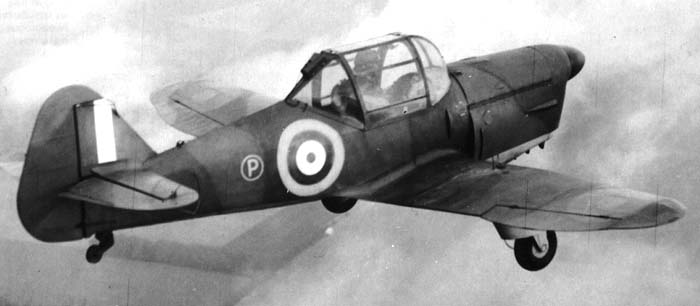

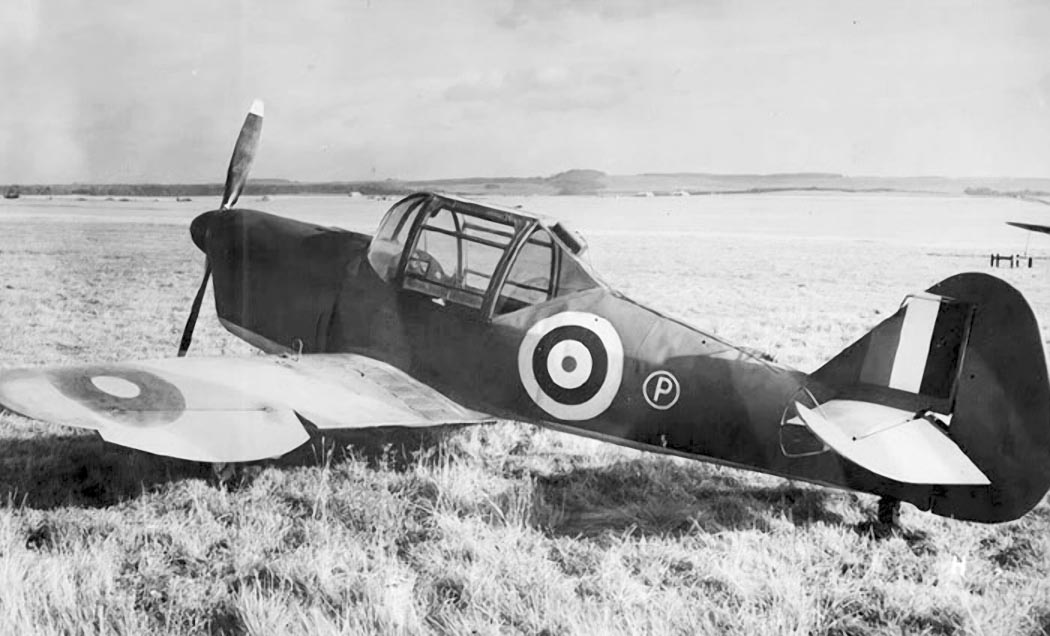
(photos via http://www.airwar.ru)
The blurb (from http://www.jaapteeuwen.com) says:
Small single-seat cabin aircraft, intended as scale model for a light/cheap fighter, built in 1940 by F Hills and Sons Ltd as a PV and powered by 205 hp DH Gipsy Six. Extra area of upper wing was to allow take-offs from grass fields or roads at ‘overload’ weights, wing then to be ‘slipped’ (jettisoned) to allow good fighting performance and maneouvrability. Single Bi-Mono prototype (with no serial number but in military prototype finish) flown extensively in both monoplane and biplane configuration at Squires Gate – upper wing initially with greater span, later reduced to same span as lower wing. Single, successful, ‘slip’ made on July 16, 1941, at height of 4,500 ft (1,372 m) over sea off Blackpool.
Span, 20 ft (6.1 m). Length, 14 ft 6 in (4.4 m). Wing area (each wing), 66 sq ft (6.13 mi).
Wonder what the performance was for such a high-powered, small-scale aircraft, and what happened to it? The article doesn’t state either.

By: pogno - 24th December 2008 at 16:03
I think it is unique in another area – that of markings. It would be the only British biplane (albeit a temporary one) that has the blue/red roundel on the upper surface of both upper and lower wings.
Pretty aircraft.
I think the DH6 might have qualified for this also as the wings were interchangeable top and bottom, certainly had roundels on the bottom of both.
Richard
By: DazDaMan - 24th December 2008 at 14:42
It would make a nice homebuilt today & a nice change to all the plastic ones.
I’m not the only one who thought that then! 😀
By: Malcolm McKay - 24th December 2008 at 10:15
I think it is unique in another area – that of markings. It would be the only British biplane (albeit a temporary one) that has the blue/red roundel on the upper surface of both upper and lower wings.
Pretty aircraft.
By: Arm Waver - 24th December 2008 at 09:06
I wonder if any structural/cutaways exist?
It would make a nice homebuilt today & a nice change to all the plastic ones.
It appears never to have had any serial or registration, so ultimate fate would, I imagine, be difficult to trace through official sources.
By: DazDaMan - 23rd December 2008 at 23:25
The article states that it was built with that sole function – as a scaled-down test-bed, since official backing for a full-scale prototype wasn’t forthcoming.
By: StevSmar - 23rd December 2008 at 23:20
It certainly is a rather interesting looking aeroplane. The pilot looks huge in relation to the cockpit.
Wonder if it was intended to perform some other role other than testing the slip-wing function?


 Sign In








 December 23, 2008 at 5:25 pm