Hi,
last night I caught some of a Bridge Too Far on Channel 5. Apart from numerous Dakotas rather a lot of Horsa gliders were also shown. Which set me wondering; assuming they built full size Horsas for the film, how accurate were they? and what happened to them afterwards? does anyone know.
Many thanks in anticipation Steve.

By: Arabella-Cox - 29th December 2007 at 18:26
Worth noting that even in the film, XXX Corps doesn’t say ‘right, we’re over the bridge and now we’re going to stop and have tea’ – it’s the US Airborne who accuse them of doing that. The reason the tanks stopped there was because they were waiting for infantry to come up the road to support their advance
The film is not a documentary and not correct. The few tanks that crossed stopped near Lent just north of the bridge. Here they met a platoon of Americans when it was dark. The crossing of the bridge happend late in the afternoon. (No American were at the bridge) The Americans (about platoon size) although very happy to see the tanks, they even kissed them, did not wished to guard the tanks at night and withdrew to other positions.
The tank crews had to guard the tanks without any support that night. If the German had counter attacked that night they could have got the bridge back.
The next day with the infantry support and other tank units they went on to Elst.
By: Junk Collector - 29th December 2007 at 18:10
There are quite a few sections of fuselage about in the UK they were used extensively post war, I have moved a few about including one to France, they surprisingly still turn up and I know of a large floor section in Kent although the worms are taking their toll of them over the years !!
By: XN923 - 29th December 2007 at 16:21
He crossed the bridge in a Bren carrier with bullets pinging off the side, and swears that the conversation with the US Airborne over carrying on where the British were stopping for tea actually took place as he was part of it.
Worth noting that even in the film, XXX Corps doesn’t say ‘right, we’re over the bridge and now we’re going to stop and have tea’ – it’s the US Airborne who accuse them of doing that. The reason the tanks stopped there was because they were waiting for infantry to come up the road to support their advance – it was a raised, single road which was too vulnerable to tanks to progress along in single file without infantry support. The whole Market Garden operation was compromised by their being only one road to move everything along in both directions. It was indeed a bridge too far in too many respects.
I read somewhere that there was a plan to build an airworthy Horsa replica for ‘The Longest Day’, that fell though due to the aviation authorities saying no to it being allowed to fly.
I read this in Steven Ambrose’s ‘Pegasus Bridge’ – he says the glider was built and the director wanted to fly it over (towed behind a Dak presumably) but the aviation authority said no, so it was dismantled and shipped over. Anyone know what became of it? According to Ambrose it was a complete replica rather than a film set.
By: G-ORDY - 29th December 2007 at 16:06
Horsa at Stapleford Tawney
There were several fuselage sections (including a cockpit) in open store at Stapleford Tawney aerodrome, Essex, on 22 February 1967, according to my spotting logbook of the time.
I can well remember them but as it was nearly dark by late afternoon and my Brownie 127 only had 8 shots per film I didn’t photograph them.
Anyone else remember them or know where they ended up (hopefully not burnt in situ like the Miles Aerovan which I noted in one of the hangars!)
By: BIGVERN1966 - 29th December 2007 at 15:52
Found this site that lists a number of the gliders that took part in Op Tonga, including the 6 in the Coup de main assult on the bridges.
By: Ross_McNeill - 27th December 2007 at 22:48
AP 3231 Airborne Forces only contains the following description:
This system used a pair of 14 foot parachutes which were released from a stowage under the tail just before touchdown. A fully laden Horsa could be stopped in less than 100 yards with this device.
Regards
Ross
By: BIGVERN1966 - 27th December 2007 at 22:41
Hi,
Of the Halifax/Horsa combinations 3 were from No.644 Sqn and 3 from No.298 Sqn.
The Horsa were specially equipped with arrester parachute systems as were the Merville battery gliders used on the same night.
Regards
Ross
Cheers Ross, I knew the Horsa’s used by Howard’s force were fitted with a parachute system, is there any details of how it was fitted kicking about on the net or in a publication? One other request, does anybody have large-scale plans of a Hamilcar, I know Airfix magazine did one years ago. I need a port side view for a little project I’m putting together.
By: Ross_McNeill - 27th December 2007 at 22:30
Hi,
Of the Halifax/Horsa combinations 3 were from No.644 Sqn and 3 from No.298 Sqn.
The Horsa were specially equipped with arrester parachute systems as were the Merville battery gliders used on the same night.
Regards
Ross
By: BIGVERN1966 - 27th December 2007 at 22:15
I read somewhere that there was a plan to build an airworthy Horsa replica for ‘The Longest Day’, that fell though due to the aviation authorities saying no to it being allowed to fly. On another (bit off topic) note, does anybody happen to know what mark of Horsa was used on the Peagus bridge op on D-day and the serials of the aircraft (any details about the Halifax tugs would be helpful as well).
By: David Burke - 27th December 2007 at 18:42
There is the cockpit of a former ‘Saving Private Ryan’ Waco at Doncaster too with Aeroventure.
By: Arabella-Cox - 27th December 2007 at 16:58
For this film 6 full size Horsa gliders were made and 2 so called “flats” these were used on the landingzones scenes together with the full size models.
They were build in an abandoned Dutch factory were als props, uniforms, film equipment were stored. It als contained several workhops.
No American type Waco CG-4a / Hadrian gliders were build. This is a pity as the Americans did not used Horsa’s during operation Market.
1 glider was wrecked for the filming. Remember the scene were the German soldier enters a crashlanded Horsa en finds the mapcase with the Market-Garden plans?
1)One of the glider being constructed in the factory.2) Gliders being constructed picture taken from tv. 3) Horsa at Deelen being towed in position.


The Gliders were first filmed for the landingzones scenes and afterwards for the take-off scenes at Deelen airfield.
For the gliders they found a few drawings on microfilm. This was not enough and most of the drawings had to be remade. Full sets of the horsa MK1 and mk2 still exist on microfilm. These are in 2 different archives but the firm who owns them will not copy them / show / sell them as this big firm is afraid that these drawings might be used for building a flyable glider and they wish not to be held acountable for accidents. It was said at the time that Attenborough, the director, would like to have a real flyable glider!
During the take-off scenes one of the gliders hopped into the air. Imagine the extra’s behind the controls!
The wings of the gliders were not as though as the originals. Using less wood the wings of the gliders drooped down expecially in damp mornings!
After the filming all the equipment was auctioned. Uniforms, equipment, dakota’s (some were bought) and the Horsa’s.
4)A page from the auction catalogue. One of the Horsa’s pictured at Deelen. 5 available for sale. Look at the wings in the front vieuw! The tail needs support if not moving. Can also been seen in the film
Most if not all of the Horsa’s went to Britain. The airborne museum now located in Hartenstein Oosterbeek wanted one for their collection. Probably they could not afford one or lacked the space. Not even a replica Horsa cockpit ended up at this museum. A seperate cockpit with a piece of forward fuselage was built and used for closeups.
It is not strange that not one single glider stayed in one piece. They are simply too large to house. The flimsy wings would not survive Fall and Winter.
5)Horsa after being ready for filming.
After Arnhem the gliderpilot regiment was so decimated that they were forced to use RAF pilots as replacements and train them as soldiers.
Eleven dakota’s were used for the filming, they actually wanted 12. Seven were actual military used C-47 with crews trained in paratroop dropping. Three from the Royal Danish air Force and 4 from the Finnish Air Force. The other aircrtaft were from civilian sources 2 (described as near wrecks) from Air Djibouti and 2 from ex- Portugese African colonies.
Being former military aircraft these were restored to military guise. The aircraft were flown by John Hawke and it is said (Dutch) airline pilots who took days of at work to fly these historic aircraft.
The RAF were responsable for converting the aircraft so they would be able to drop British paratroopers with their PX-type pararchute and equipment safely.
Although they had 11 dakota’s at times only 9 were available. These aircraft were painted in the wrong colour scheme.
Desert Yellow instead of Olive Drab. It is said that this was done to make them more visible against the dark background of the heath
There is a museum near Deelen airfield AVOG crash museum. It has a few pictures taken of the film Horsa’s on display. Also a small piece (relic) of Horsa MK2 fuselage and other Horsa and CG-4/Hadrian parts.
Also an interesting picture and story. The owner of these Horsa parts owns a near complete forward fuselage of a Horsa mk1 found in Britain with a house build around it. It is at of this moment somewhere in The Netherlands not yet on display. The Deelen museum is going to move house to a location with much more space.
My info came from a special edition of After the battle magazine there is an article about The making of A bridge too far.
Also in the special DVD version there is a bit about the making of. There was a film made during the filming called The Arnhem report and an intervieuwer Iain Johnstone and a camera man intervieuw several of the stars and it contains a lot of behind the scenes filming.
I also had brief contact with a Dutchman who worked for the movie in the props department. The mailed me some nice info and a few scan of pictures he took1,4,5. I could by his pictures and other stuff he had in his archive. He even had 8mm colour footage made behind the scenes. But I could not afford it! 😮
picture 2 Taken from tv Abridge too far special edition
picture 3 Taken from a photo AVOG Crash museum Deelen.
There was 1 replica Horsa build for the film The Longest Day. But this glider looks as if it is in size a bit smaller. The detail wrong roundels incorrect, cockpit incorrect. I am not sure if this glider was also used as a backdrop of a scene with John Wayne in a hangar. No CG-4 gliders were built or at least used for the American airborne landings. At this moment I only can find a photo of the tail. So it will have to do. :rolleyes:
In Saving Private Ryan a few replica CG-4 gliders were built with co-operation of The Army Air Corps museum Middle Wallop. But they used probably for the ease of construction square tubing not round as the original. They were “wrecked” for the scene. One of these survived restored in The Netherlands in the Wings of Liberation museum.
Waco replica from Saving private Ryan.
By: Paul F - 4th September 2007 at 09:23
There was certainly a yard adjacent to (but not part of) the Muckleburgh site that many years ago had some genuine Horsa fuselage sections stored. I have colour slides of those substantial remains including shots of the serials stencilled on the bulkheads. Those examples were definitely original and I’ve no idea what happened to them. Can’t access the pics as they’re stored but when I do find them next I’ll post.
Hi Consul,
I too have a few 35mm slides of those parts, probably taken one summer between between 1998 and 2000 (IIRC?) on one of our summer hols to Norfolk. At the time I assumed the fuselages were replicas/repros used in “Private Ryan” or even dating back to “A bridge too far”? Ddin’t realise they were the real thing 😮 . I’ll try and dig them out and scan them for posting.
Paul F
By: Resmoroh - 3rd September 2007 at 16:53
[QUOTE=JDK;1044519]Some of the LZ Horsas were actually scenic ‘flats’ and not three dimensional at all.
The parachuting scenes in “A Bridge Too Far” were filmed between 31 Aug – 17 Sep 76 based at RNAF Deelen, and using the Spuelde DZ.
Prior to that the film company had experimented with dropping Belgian (I think?) paratroopers from C-130 Hercules (out of shot) and were, by camera ‘trickery’, made to appear as if they were exiting from Dakotas. This was a total failure.
The film company then, effectively, “hired” a Company of the then 16 Para Bde. I was involved (RAF Mobile Met Unit) in both the preceeding trials of dropping real paratroopers out of Dakotas (which no-one had done since WW2), and in the actual filming sequences.
The technical trials were conducted at Hankley Common DZ using (I presume?) the Farnborough/Boscombe Dakota on 24 and 25 Aug 76. These involved the correct setting of the famous “6 Bolt Stop”, and jumps by the Instructors from 1 PTS. On 25-27 Aug 76 real ‘Grunts’ were chucked out of this a/c onto the Everleigh DZ on Salisbury Plain. Nobody died so we went to Deelen.
I can confirm that most of the gliders seen in the film were 2-D ‘flats’. Those from which action was required were probably done in very partial reconstructions in the studio.
The “numerous” Dakotas were not so. If my memory serves me right there were 3 from the Royal Danish Air Force mainly (if not exclusively) used in the Supply Dropping sequences. There were 6(?) from the Finnish Air Force. Both these guys were highly professional and ‘bl**dy good’ at the job. There were (I think) about 6 assorted ‘civilian’ Dakotas which had been assembled from all over the place – known to the RAF/Paras as “Jam Butty Airlines”. Very dodgy! Almost all a/c were painted/re-painted in various guises (RAF/USAAF) several times. If you watch the drop sequences very carefully you can see a ‘vic’ of 3 Daks in one part of the screen moving in synchronisation with another ‘vic’ in another part of the screen. Camera trickery – or ‘matting’ as I understand it’s called in the trade.
Taking real, modern, young, Grunts to the Oosterbeek Cemetery was a very special event. And this was, remember, pre-Falklands. Been an honour to have served with them.
On the return from Deelen Mod had hired the cheapest flights from KLM they could arrange. Once airborne the Captain apologised that MoD had only budgeted for Coffee & Biscuits as the refreshments. “However” he said “in view of the debt of honour that the Dutch people owe to the Parachute Regiment, KLM Royal Dutch Airlines invite you all to partake of complimentary champagne.”. Don’t come much better than that!!!!!!
Rgds
Resmoroh
By: Eye on the Sky - 3rd September 2007 at 14:23
I believe that this is an original section of a Horsa, certainly appears to be, pictured at Pegasus Bridge a few years back…
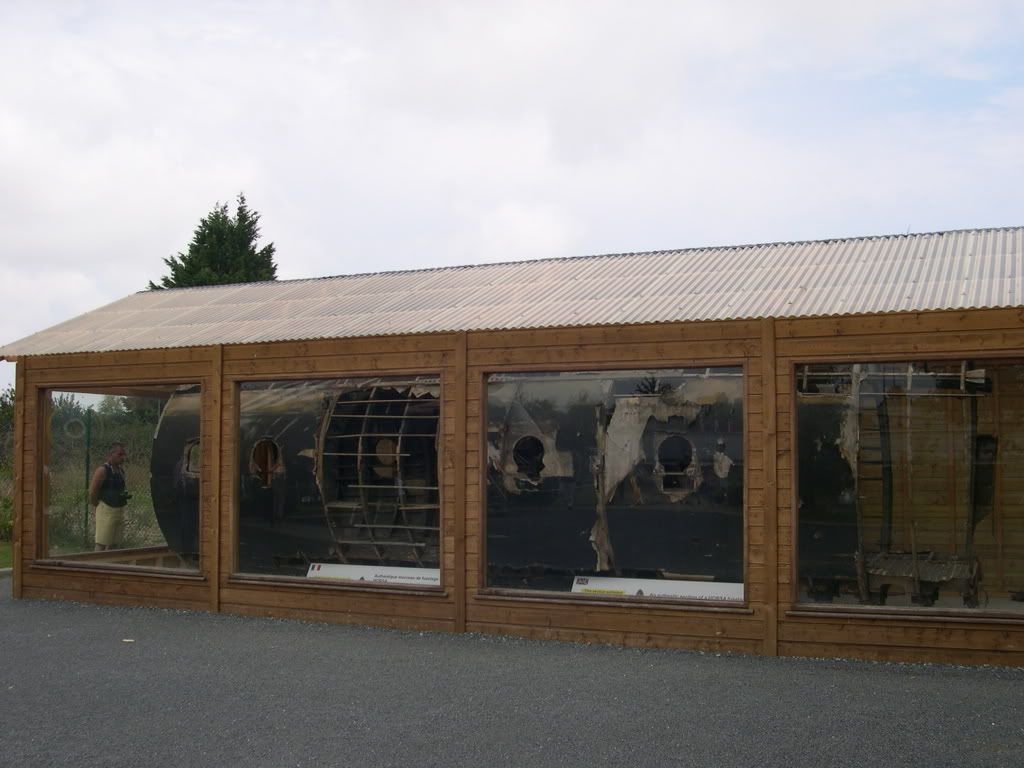
Dean
By: TEXANTOMCAT - 3rd September 2007 at 13:41
Theres also an ex- Bridge too Far Horsa Fuz (though with ‘new’ nose) at the Ridgeway/RAF Welford Museum – see my article in Flypast last year –
http://home.freeuk.net/rmarg/index.htm
ATB
TT
By: Consul - 1st September 2007 at 15:32
If i remember rightly there was some bits of gliders made for a film at the muckleburgh collection.
http://www.aeroflight.co.uk/mus/uk/l-m/muckleburgh.htm
There was certainly a yard adjacent to (but not part of) the Muckleburgh site that many years ago had some genuine Horsa fuselage sections stored. I have colour slides of those substantial remains including shots of the serials stencilled on the bulkheads. Those examples were definitely original and I’ve no idea what happened to them. Can’t access the pics as they’re stored but when I do find them next I’ll post.
It is possible the collection itself separately / later obtained some parts off film replicas I wouldn’t know.
By: Livewirex - 1st September 2007 at 12:29
If i remember rightly there was some bits of gliders made for a film at the muckleburgh collection.
http://www.aeroflight.co.uk/mus/uk/l-m/muckleburgh.htm
By: flyernzl - 1st September 2007 at 11:47
Attached are a couple of shots of the Waco and Horsa replicas built for the Omaka (New Zealand) air show last Easter. They were used for a replay of an airborne landing. I have never seen real ones, but I presume that these replicas are a fairly loose interpretation.
By: Baldeagle - 22nd November 2006 at 15:53
Melvyn,
You’re thinking of the Yankee Air Museum in Willow Run, Michigan, http://yankeeairmuseum.org/index.php
The above is the Yanks Air Museum at Chino, California: http://www.yanksair.com/ , although they have the CG-4 listed as awaiting restoration, so maybe it’s now on the back burner.
By: Melvyn Hiscock - 22nd November 2006 at 10:17
From the April 2004 “Air Classics” magazine:
Waco CG-4A underway at Yanks
One of the most unusual projects at Yanks Air Museum is the restoration of a Waco CG-4A combat glider back to flying condition. Over the years, Yanks has managed to find the hulks of several Wacos as well as gathering a significant collection of “new old stock” parts including wings, struts, and even a complete set of troop seats (built out of wood). “We have some great volunteers working on this project,” states Yanks’ Ron Blondell, “including a war-time CG-4A pilot and the son of a Waco pilot. The project is now really starting to come together and we intend to fly this aircraft towed behind our C-47 which is also a very stock military example.” However, one item which Ron has yet to find is the glider tug kit that was attached to the C-47 and enabled the transport to fly with the Waco. Anyone with information on the kit should contact Ron at 909-597-1734.
Wasn’t that lost in the fire?


 Sign In








 November 20, 2006 at 8:45 am