Ive been reading with interest the Stirling recreation thread and also the numerous Whirlwind threads that have been doing the rounds over the last few months and I have a question.
If so little date exists in the form of original drawings how are model manufacturers able to say with any certainty that they have produced an accurate replica of the above aircraft types? Are the outlines taken purely from photographs or………?

By: HughT - 31st March 2025 at 15:30
John raises an interesting point regards drawings, written dimensions and actual measurements not matching. Having worked for many years in the building design industry I gave up trying to explain why it was important that things are drawn, written and measured correctly and to scale, thankfully CAD has removed many of the drawn (not to scale) errors.
.
Creating drawings that are both accurate and correctly dimensioned has always been integral to draughtsmanship – whether manual or cad. The biggest difference is that it is easy to change something in CAD whereas with manual drawing it can be a very time intensive task to change drawn details and occasionally it was just the dimension that changed and should be noted NTS.
However it should also be noted that more predesign work was carried out prior to committing the information to a manual drawing because change was not a practical option, whereas today with Cad the design tends to evolve and drawings are changing all the time.
Anyway you should never actually scale from a paper copy of a drawing – either manual or cad.
By: AVI - 31st March 2025 at 15:30
Manual Drafting vs CAD
Creating drawings that are both accurate and correctly dimensioned has always been integral to draughtsmanship – whether manual or cad. The biggest difference is that it is easy to change something in CAD whereas with manual drawing it can be a very time intensive task to change drawn details and occasionally it was just the dimension that changed and should be noted NTS.
However it should also be noted that more predesign work was carried out prior to committing the information to a manual drawing because change was not a practical option, whereas today with Cad the design tends to evolve and drawings are changing all the time.
Anyway you should never actually scale from a paper copy of a drawing – either manual or cad.
It occasionally seems to be much easier for me to sketch initially in manual drafting before inputting the measurements in CAD. AutoCAD is excellent (MHO as a novice) in reproducing known elements/dimensions with infinite accuracy, but it’s not user friendly for doodling or sketching.
It’s also very interesting to discover how manual drafting was done in the “good ol’ days’, and thank God CAD has taken much of the work out of drafting! I’d highly recommend the following two 1940s books:
A Manual of Aircraft Drafting
Carl Lars Svensen
D Van Nostrand 1941 and
Airplane Lofting
William Nelson
McGraw-Hill 1941
Alex
By: CeBro - 2nd January 2010 at 14:26
no i understand completely, i guess i just dont like being told what cant be done :diablo:
Here’s what im working on at the moment 🙂 ive not cut any wood yet, as most of the design is still in the prelim stages, and of course before i do cut any wood im going to join the LMA and do it properly. the thing is for me, once said model is finished and ready to fly, the interest for me ends lol, ill just want to build another!
It’ll be 1/10th scale and im going to build it as the prototype Victor 🙂 in the proper scheme too 🙂
Excellent choice!
Cees
By: AVI - 1st January 2010 at 15:05
Scale Effect
One other thing to bear in mind – and I am sorry if I am teaching anyone here to suck eggs – is that scale flying models do not generally use exact scale copies of the original aerofoil sections simply because the characteristics of a 1/5 scale aerofoil in 1/1 scale air are not usually the same as a 1/1 scale aerofoil in 1/1 scale air.
Often the aerofoil needs altering to obtain acceptable take off and landing speeds and to avoid undesirable handling characteristics in a model as well.
I think this all a bit of a black art but those who are heavily involved in scale flying seem to manage to sort it out pretty well.
This holds true for most 75%, 80% flying replicas as well. Subtle changes often have to be made not only to the airfoil section but to the wing planform and tail surface volume. It’s also difficult to fit a 100% modern-day, 250 lb McAviator into a 75% cockpit, or as the gals call it today, a “boxoffice”, so the fuselage also has to be tweaked. Building replicas to 100% scale makes more sense but then a suitable powerplant has to be sourced. Then it usually becomes a hi-dollar project …
By: Arabella-Cox - 1st January 2010 at 14:54
My B-17 uses scale aerofoils. Everything I’ve done in 1/6 scale and larger has had scale sections.
By: WJ244 - 1st January 2010 at 14:25
One other thing to bear in mind – and I am sorry if I am teaching anyone here to suck eggs – is that scale flying models do not generally use exact scale copies of the original aerofoil sections simply because the characteristics of a 1/5 scale aerofoil in 1/1 scale air are not usually the same as a 1/1 scale aerofoil in 1/1 scale air.
Often the aerofoil needs altering to obtain acceptable take off and landing speeds and to avoid undesirable handling characteristics in a model as well.
I think this all a bit of a black art but those who are heavily involved in scale flying seem to manage to sort it out pretty well.
By: Nashio966 - 1st January 2010 at 03:11
they are indeed, he’s a super chap, one of the four sheets for the victor gives all the datum points for the whole airframe, giving all incidences, and angles of every control surface too 😉
By: AVI - 31st December 2009 at 22:51
Drawings
no i understand completely, i guess i just dont like being told what cant be done :diablo:
Here’s what im working on at the moment 🙂 ive not cut any wood yet, as most of the design is still in the prelim stages, and of course before i do cut any wood im going to join the LMA and do it properly. the thing is for me, once said model is finished and ready to fly, the interest for me ends lol, ill just want to build another!
It’ll be 1/10th scale and im going to build it as the prototype Victor 🙂 in the proper scheme too 🙂
Are those Arthur Bentley drawings? They sure look good!
By: Nashio966 - 31st December 2009 at 17:50
no i understand completely, i guess i just dont like being told what cant be done :diablo:
Here’s what im working on at the moment 🙂 ive not cut any wood yet, as most of the design is still in the prelim stages, and of course before i do cut any wood im going to join the LMA and do it properly. the thing is for me, once said model is finished and ready to fly, the interest for me ends lol, ill just want to build another!
It’ll be 1/10th scale and im going to build it as the prototype Victor 🙂 in the proper scheme too 🙂
By: WJ244 - 31st December 2009 at 17:46
As I said in a previous post absolute exact scale doesn’t always look right to the human eye and I suspect the smaller you go the more this holds true.
To me what matters is that the model looks right and I don’t have a problem with semi scale models like the Vulcan shown in the photos.
As far as I am concerned if that is what makes the builder happy then good luck to him – after all collecting diecasts, building plastic kits and building / flying radio control is all meant to be about enjoyment rather than about losing sleep because your model could be just a tiny bit out of scale.
If on the other hand you prefer to count every rivet then fair enough but you should accept that others are a little more easy going but still derive great pleasure from their chosen hobby.
By: Arabella-Cox - 31st December 2009 at 17:43
To be fair, the committee got a little cautious after a certain modellers B-52 was I believe, test flown without inspectors and paperwork in place. It broke up in mid-air. Models this size are potentially very dangerous in the hands of an in-experienced pilot/builder ( and even those with vast experience ). Another case of everyone covering their own backs, just in case.
The first B-52 was lost partly due to the fact that it was so scale, and had the same slow rolling characteristics as the full size.
By: Nashio966 - 31st December 2009 at 17:36
well it was rather entertaining.
Just rather stunned at the negativity of some people to be honest, I havent been back to the forum since I was banned :diablo: but i guess if i want to build any large model, ill have to get them involved to some degree?
By: Arabella-Cox - 31st December 2009 at 17:34
Oh yes, I remember that! 😀
By: Nashio966 - 31st December 2009 at 17:32
Gorgeous model! 🙂 ive got some photos somewhere of what i intend to build 😀
i dont know if you frequent the LMA forum but i have the feeling that they didnt take kindly to me.
I proposed a 1/4 scale vulcan model about 10 months ago :diablo:
By: Arabella-Cox - 31st December 2009 at 17:30
…….are you a member of the LMA?
Yes, for a long long long time!
…….I wasnt in any way putting down his model making skills, merely using it as an example 🙂
I know, perhaps my reply came across a bit strong? Dave I think is like many modellers who build large ‘scale’ in that as long as it looks ok in the air and flies well, that’s ok. That’s fine if that’s what you want from the hobby, but for me, scale means scale. That also goes for the way may people fly scale models. Why do rolling circuits with a B-17 model when the real one wouldn’t. Get an aerobatic aircraft if that’s what you want to do.
As for plastic kits, some compromises at smaller scale are understandable, such as previously mentioned regarding landing gear sizes, but if original examples survive to take measurements from, there’s little excuse for having basic outlines and shapes correct, especially in todays 3D scanning era.
Models of extinct aircraft should perhaps have a disclaimer on the box to say they are as accurate as available information allows?
This is my offering for a scale model. There are bound to be errors. You can’t make everything 100% scale, but I think it’s a fair representation of the type.
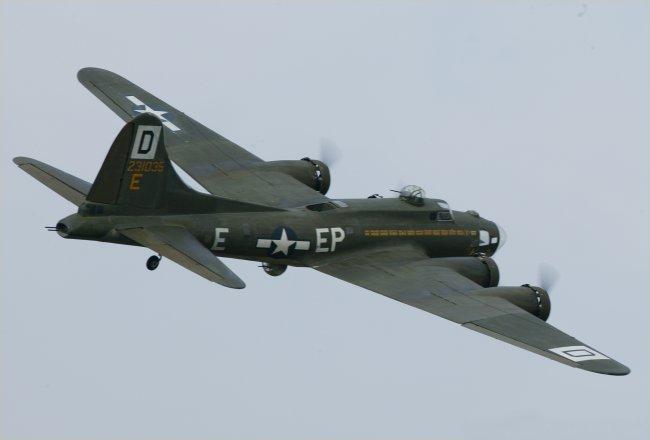
By: Nashio966 - 31st December 2009 at 15:59
ive never personally met dave, but have exchanged a couple of emails with him, and found him to be an agreeable chap. are you a member of the LMA? I wasnt in any way putting down his model making skills, merely using it as an example 🙂
i wholeheartedly agree on the scale models not to scale part. if you’re going to spend all that time and money, then you might as well make it as accurate as possible, as to minimise any clever jibes that are likely to come your way 😉
By: Arabella-Cox - 31st December 2009 at 15:51
classic example of a strangely measured vulcan…
If you knew Dave, you’d know that none of his models are 100% scale, more cartoon scale, looking like the fullsize without being accurate. They are built as model airshow display aircraft rather than competion scale models.
Personally I’ve never seen the point of making a scale model, not scale. I’m guessing many such ‘cartoon scale’ models are caused by laziness on the part of the builder rather than lack of documentation.
By: AVI - 31st December 2009 at 15:37
Scale Drawings
I personally wouldn’t scale anythin up from a model. It is also bad practice to scale up from small scale drawings too in a drawing office. Just the thickness of a 1mm pencil line at 1/24, becomes 24mm thick full size. So even if at 1/24 scale drawing was 100% accurate, you will still get an approximation at full size.
The only true way to do these things are to get the original co-ordinate plots (lofting lines) for an aircraft from the original manufacturer. John “Aeroclub” is spot-on here: The Hornet for example has had its length incorrectly stated in the 1946 and re-produced as fact ever since! This was not helped by the fact that AP’s gave packaging dimensions for major sub-assembly parts of the Hornet with an allowance for clearance too!
Even when you have some original drawings and some small pieces of distorted wreckage, creating full size drawings of something the size of a Stirling can mean errors of several inches could appear just by drawing a line to the information you have, which may or may not be ok?
As Dave mentioned above. A simple error of 1mm can be greatly compounded. So far, the discussion has revolved around plastic scale models but what about the larger 1/5 or 1/4 RC models or even a 75% or 100% scale replica?
Let me back up a bit …. for a number of years now, I’ve been developing my own 100% scale drawings of a well-known military trainer, trying to get the drawings accurate down to the last millimeter.
My initial research began with photocopies of a couple of pages out of an old issue of Janes which included a tiny 3-view drawing of the aircraft. Well, as naive as I was back then, I actually believed that I could blow the 3-view up and create working drawings with the help of photographs and the published specifications. Right! :)-
Next was a serious attempt to obtain accurate scale drawings. The manufacturer was of no help, declining to provide material by claiming a proprietary interest, but over the course of a couple of years, several scale 3-view sets of drawings that had been published in various model magazines were obtained. However, not one single set of drawings was accurate in outline. They varied from pretty good to downright lousy! So … back to the drawing board ..
A major break came at a military airshow when the owner of an example of the aircraft was kind enough to grant permission for me to crawl all over the airplane, taking measurements, photographs, and making sketches. (This was the first occasion of seeing the aircraft in the flesh, and my initial impression was how tiny it actually was.) Since then, I’ve taken measurements off various examples of this aircraft.
Over the past few years I’ve managed to examine a half dozen of the aircraft, taking more measurements, making more sketches, and taking many more photographs. The problems involved with accurately measuring a full-size airplane are immense and deserve a tread of it’s own on this forum. Those who have actually attempted to do this, I’ve discovered, usually have access to the aircraft while it is sitting propped up and level, and from what I understand, plumb lines are dropped and measured on the tarmac. Then there’s got to be a way to take measurements of the fuselage bulkheads and airfoil shapes. Yeah, a lot of work, and unfortunately it’s usually impossible to find an example propped up under ideal conditions for taking measurements. And don’t forget the helpers. It’s not easy measuring an aircraft on your own.
Next we come to research. We’re really talking about detective work here. The amount of research required to develop accurate scale 3-view drawings is absolutely staggering! Especially when the drawings are to full 100% scale and must be accurate down to the last silly millimeter. (How guys like Arthur Bentley did it before CAD is beyond me!) Factory manuals are a great help here, but much factory information is incredibly misleading and may have been intentionally misstated by the manufacturer, perhaps in order to protect proprietary information. Whatever the reason, there are many critical errors. An example for this particular aircraft was the root chord. We normally measure the wing root chord at the aircraft centerline. Not these guys!! And the tip chord wasn’t at the tip either! Go figure!
But if factory drawings showing the fuselage and wing stations can be obtained, they are invaluable. A set of factory maintenance manuals is priceless. It would be difficult to complete the drawings without them.
The unsuspecting can easily be thrown off track … such things as a spinner modification, either a longer or shorter spinner can throw the overall length off quite a few millimeters or inches. The list goes on.
Bottom line, unless you’ve got a draftsman who’s cross-referenced factory drawings with actual measurements taken off aircraft such as the Spitfire drawings offered by Monforton Press http://www.monfortonpress.com/ and drawings by professionals like Arthur Bentley http://www.albentley-drawings.com/ scale 3-view drawings may vary from pretty accurate to being absolutely lousy. It would be foolish to presume that drawings for a 1/48 plastic kit were 100% accurate.
By: Nashio966 - 31st December 2009 at 10:15
classic example of a strangely measured vulcan…

By: TempestV - 31st December 2009 at 09:22
David,
How was the error in the Hornets published dimensions determined?
regards
Mark Pilkington
Hi Mark,
I have the component drawings for the Hornet. It was just a matter of adding all of the lengths together:
Spinner + Engine cowling to main spar + fuselage from main spar + short tail cone = correct length for non-NF.21 versions.
Radar + fuselage + long tail cone = correct length for NF.21 version.
We did the same with the 3 different tail plane widths too (prototype, early production, late production)


 Sign In








 December 28, 2009 at 4:14 pm