
By: Wanshan - 18th September 2012 at 00:06
Basically, the later versions with smaller radome and antenna were able to have the same or better resolution by advances in antenna design & construction and improvements in signal-processing circuits (as well as in the components of those circuits).
They just didn’t need that large set-up to do what they needed to.
I expect that the fabric of the inflatable cover was also not as durable as required, the antenna folding mechanism was a problem (jamming in place, etc), and the added weight/volume of the inflating equipment, etc was detrimental to payload/range performance.
HOw ’bout we tried this cover today, with modern fabrics. We still need something to put on the V22, EH01 and old S2 Trackers….
By: Bager1968 - 17th September 2012 at 13:06
Basically, the later versions with smaller radome and antenna were able to have the same or better resolution by advances in antenna design & construction and improvements in signal-processing circuits (as well as in the components of those circuits).
They just didn’t need that large set-up to do what they needed to.
I expect that the fabric of the inflatable cover was also not as durable as required, the antenna folding mechanism was a problem (jamming in place, etc), and the added weight/volume of the inflating equipment, etc was detrimental to payload/range performance.
By: Wanshan - 16th September 2012 at 11:56
HH-2D Cubic Corps radar deflated (the antenna folds flat inside):
Mmm, not bad. Wonder why this method was not adopted: any insight into findings from testing this rig? And whether it was ever (again) considered for another air/rotorcraft?
By: Distiller - 15th September 2012 at 10:11
Who has its landing photo?
….
That was the prototype for hot refuel-in-a-hover HIFR idea. Once it’s airborne you can’t get it down. But since they had a problem putting a whole family up there in the helicopter to, you know, make sure that there are always pilots available, they decided it’s more practical to make it ship-board only, and you land by always keeping the nose over the edge of the flight deck. Or maybe it’s an airbag anyway 😀
By: Bager1968 - 14th September 2012 at 15:02
I have found that the inflatable radar trialed on the HH-2D that started this thread was named “Cubic Corps”.
AND HERE IS YOUR LANDING PHOTO!
HH-2D Cubic Corps radar deflated (the antenna folds flat inside):
And more experimental Kaman H-2 versions:
HH-2C CSAR Seasprite with YSH-2E experimental radar installation in front of “turret” for M134 7.62 mm six-barreled “minigun” (similar to M61 Vulcan cannon).

HH-2C (6 built):
larger version here: http://www.flickr.com/photos/sdasmarchives/6313190976/sizes/o/in/set-72157627928485093/
By: Bager1968 - 14th September 2012 at 13:37
Here is the Sea King AEW in RN service:


By: Bager1968 - 14th September 2012 at 13:26
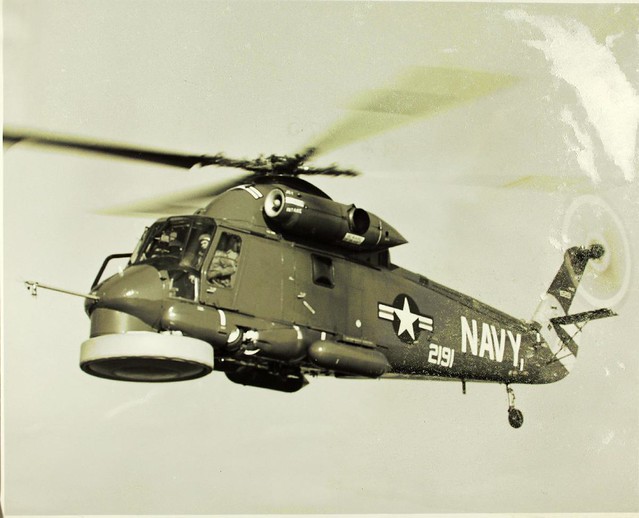
A U.S. Navy Kaman YSH-2E ”Seasprite” anti-submarine helicopter was tested with an inflateable radome in the early 1970s. |Source=U.S. Navy Naval Aviation News July 1973 page 23]
It was actually a modified HH-2D (BuNo 152191), and the radome was inflatable… it had a diameter of 80″ (6′ 8″) and an inflated height of 52″ (4′ 4″). When deflated it had a height of 12″ (1′).
There were also two YSH-2Es purpose-built, 149033 & 150169, with a smaller radome (but still larger than the radome of the production SH-2F).
This was a surface-search radar only, for ASW/SAR use!
http://www.history.navy.mil/nan/backissues/1970s/1973/jul73.pdf

Kaman YSH-2E Seasprite LAMPS II-prototype (BuNo 150169) landing on the guided missile cruiser USS Fox (DLG-33) at San Diego, California (USA), in 1971.

The production SH-2F had a fixed low-profile radome.

By: Fedaykin - 14th September 2012 at 12:57
The plan was when the Gannet AEW.3 retired the RAF would eventually take over the GIUK gap AEW mission with the in development Nimrod AEW.3. In theory as the Royal navy was reducing in size and focusing on a North Atlantic cold war ASW mission where land based Nimrod AEW.3 and USN E2C Hawkeye would provide the cover.
Gannet AEW.3 had no way to operate off Invincible and the equipment to operate off Hermes was long removed, finally the Gannets had been gutted of their AN/APS-20 radar to be installed in the Shackleton AEW.2 that were acting as an interim solution until Nimrod AEW.3 entered service.
The Falklands scenario of long range expeditionary warfare where the carriers would have to protect an amphibious assault group was an utter surprise! There was no way the Shackleton AEW.2 could of provided cover to the task force so a crash program instigated on getting Searchwater installed on the Sea King. Luckily design work had already happened as the conversion was proposed but rejected when the RN went to Through Deck cruisers and Sea Harrier. Also a number of ex Gannet AEW.3 personnel were able to assist in the development work.
Unfortunately for the taskforce the converted Sea King became available after the war finished.
By: springers - 14th September 2012 at 10:07
Who has its landing photo?
It looks like there is a small horizontal davit protruding from the nose and I’m guessing it would be possible to winch the Radome? to a horizontal position to enable landing.I seem to recollect that the FAA had some Sea Kings? that had a side mounted radome which had to be swivelled horizontal for landing.
Colin.
Did the first FAA Sea King with a radome come about as an emergency measure to provide AEW cover for the Falklands conflict because there were no Gannets remaining servicable ??


 Sign In








 September 14, 2012 at 5:32 am
