I was just reading that one of the designers of the Patriot missile, Zdzislaw Starostecki has died.
http://www.washingtonpost.com/wp-dyn/content/article/2011/01/04/AR2011010406311.html
With all these potential threats comming from the PAK-FA and JXX in the pipeline, how long before companies like Raytheon develope a new generation of anti-stealth aircraft missiles? How soon before it proliferates?

By: Erkokite - 3rd February 2011 at 22:07
The fact is that shaping affects RCS returns. Radio waves reflect off objects when they strike them. If they did not you would not get any radar return. VLO shaping is all about controlling how the waves are reflected.
Granted, different frequencies are not affected by the same shape in the same manner, but the fact remains that a properly shaped VLO aircraft will have a greatly reduced RCS no matter what the radar frequency. This is not to say that the RCS will be the same, just not as bad as the “340km vs a F-117” suggests.
To support this assertion, I have a pic from a 2002 Cal-Poly VLO Bomber design study.
Things to notice:
1. They have no agenda to falsify data and they will fail the class if their data is not accurate.
2. All RCS measurements were done assuming bare metal.
3. RCS, across all bands, is affected by shaping. This affect is roughly the same (within an average of about 10db).
I should point out that the RCS software they used was based on the Physical Optics method, and therefore neglects edge diffraction, thus likely making their RCS analysis quite inaccurate- wildly inaccurate in fact for relatively electrically large objects (for example anything smaller than an aircraft carrier in the VHF). It seems to be otherwise a very interesting paper on combat aircraft design that I will read through though.
As for “failing their class if their data is inaccurate,” I think you vastly overestimate the stringency of undergraduate level AE design courses (coming from somebody who has been there). 😀 They are primarily intended as learning experiences and much less so actual design/research programs, and the students are undergraduates meaning they have little to no experience or higher education in some of the intricacies of aircraft design (such as nonlinear control theory or RCS shaping, which are graduate level). There is nothing wrong with this- it tests the students’ abilities to work in teams in a multidisciplinary project designing a comprehensive system.
You probably don’t want to use it as actual research source though- especially when talking about VHF band RCS (especially since they only tested down to 1 GHz, which is not VHF, and neglected edge diffraction, which is the dominant return source in the VHF for an aircraft sized target).
PS. Thanks for the link.
By: PeeD - 3rd February 2011 at 12:56
@SpudmanWP
Interesting paper. The design is for a very large fighter-bomber and the lowest band tested in the simulation was one GHz, with 0.3m wavelength.
Modern VHF band radars however work at down to 100-150mhz, which is 2-3m, a difference in wavelength of the factor 10.
There will be a disproportional increase in detection range against a similar aircraft.
By: Rodolfo - 31st January 2011 at 19:54
I’m aware that RCS can vary with different bands, however we don’t know what sort of reductions that may have been made in metric etc… An F-22 is still not going to be as reflective as a conventional design though.
Yes; but the VHF wave is too large to be reduced by RAM and so on. The problem here is that the characteristic lengths of the figther size F-22 are quite similar to the wave size. So, scattering can not be avoided. The B-2 is much more stealth efficient on these frequencies.
By: SpudmanWP - 31st January 2011 at 18:07
The fact is that shaping affects RCS returns. Radio waves reflect off objects when they strike them. If they did not you would not get any radar return. VLO shaping is all about controlling how the waves are reflected.
Granted, different frequencies are not affected by the same shape in the same manner, but the fact remains that a properly shaped VLO aircraft will have a greatly reduced RCS no matter what the radar frequency. This is not to say that the RCS will be the same, just not as bad as the “340km vs a F-117” suggests.
To support this assertion, I have a pic from a 2002 Cal-Poly VLO Bomber design study.
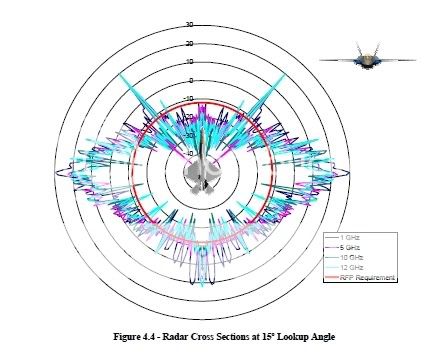
Things to notice:
1. They have no agenda to falsify data and they will fail the class if their data is not accurate.
2. All RCS measurements were done assuming bare metal.
It is important to note that the addition of radar absorbing material (RAM) would further reduce some of the returns on the aircraft. Also, currently the RCS software is treating the entire aircraft and all of its parts as purely reflective metal surfaces.
3. RCS, across all bands, is affected by shaping. This affect is roughly the same (within an average of about 10db).
By: wrightwing - 31st January 2011 at 15:08
I’m aware that RCS can vary with different bands, however we don’t know what sort of reductions that may have been made in metric etc… An F-22 is still not going to be as reflective as a conventional design though.
By: Rodolfo - 31st January 2011 at 13:41
Objects have different RCSs on different bands. I.e. a F-22 has an extremely low RCS in the X-band but is not very different from a F-15 in the metric-band.
By: wrightwing - 31st January 2011 at 08:52
RCS is what an object looks like to a radar, based upon the amount of RF energy that is returned. A missile can have a much higher RCS, than an aircraft that is shaped properly, and coated in radar absorbant material. There’s no apparent reduction about it. It’s not the size, as a properly shaped object the size of an aircraft carrier, could still have very low returns.
By: pm3 - 31st January 2011 at 07:54
No. The RCS of stealth aircraft appears different under metric bands and centimetric bands. And there’s a difference between a “reduced” RCS and a “real” RCS. A stealth aircraft with a reduced RCS to 0.1m is not the same as a missile with 0.1m, mainly because under metric waves, the shaping intended to re directionate waves does not make any effect, due to phisical limitations, and to these waves the smallest detail makes a return. It’s impossible to the size of the aircraft. The missile, with it’s “real” RCS will appear always the same on all radars. The F-35, F-22 or the F-117, whatever the figures of 0.01 or 0.0001 they have, appear with their real RCS on L-band radars, wich is Many times bigger. Stealth can and it is a game changer, but modern aircraft combine it with sensors, speed and altitude. F-35 is effective, F-22 is, T-50 is and the chinese one is. You cannot rely on stealth cause you get killed. That’s why nobody builds horrors like the F-117 or the B-2.
By: wrightwing - 31st January 2011 at 01:32
Those graphics show the range in proportion of the real target size, not the apparent reduction, as I explained earlier. Those graphics have also in account an ECM enviornment, hence the 50kms range, exactly as my link says. Not a fan of Kopp´s works, but he knows about radars, perhaps you should see this?
http://www.ausairpower.net/DT-Rus-VHF-Radar-2008.pdf
The RCS of the B-2, F-22, and F-35, are not apparent. That’s their actual size, when viewed by radar. You’re confusing actual size, with RCS, and they are completely separate things. When ECM is added, thise ranges will go down even more, and that’s why passive stealth is considered such a game changer(and why the Russians/Chinese are working on their own aircraft).
By: wrightwing - 31st January 2011 at 01:23
I cited their max detection range, not engagement range of fighters. Yes, the Barrier is a radar system and not a radar itself, I got confused (It happens to the best of us!)
But you seem to ignore the function of these L-bands. Different aircraft give different radar cross sections on radars, and it is proportionate to their size. What “stealth” aircraft do is achieve an “apparent” reduction in RCS through shaping and RAM covers, that is, under normal radars they appear much smaller and it reduces the detection range, hence you need either to get closer or to use more power. But the RCS of stealth aircraft is only apparent. Against metric wavebands the situation is different. These metric waves overhelm the fighter´s shaping and it provides return practically the same as a normal fighter does, so if the stealth fighter has an “apparent” RCS of 0.1 or 0.001, under an L-band it will appear with it´s “true” RCS, 1, 1.5 or 2m. My earlier post proves this point, the Vostok 2D VHF has a max range of 360km, and detects stealth the same as normal targets, from 350kms. Whatever the stealth the aircraft has, it does not produce a significant advantage against these systems. Aircraft can´t breake phisic rules.
There’s nothing apparent about RCS reduction. There’s no breaking the laws of physics going on. In fact it’s physics, that’s responsible for the RCS reduction. The shaping is responsible for minimizing the amount of RF energy that returns to its source, and the RAM assists the shaping, by absorbing RF energy, further reducing the amount that is returned to to source. The shaping/RAM on the B-2, F-22, and F-35 isn’t only effective against one radar band, but is particularly effective vs the centimetric bands(the B-2 especially). Once ECM/EA is added to the equation, and the noise floor is raised, then this provides a synergistic effect to the already low RCS.
By: pm3 - 30th January 2011 at 22:39
[QUOTE=SpudmanWP;1697737]
That logic about RCS and frequency does not jive. For instance your link (2d VHF) on the detectability of a F-117 is nearly identical to that of a B-52, yet is only 1/5 the range of a B-52 when in the presence of jamming. How does that work?
The 350km vs a F-117 is obviously a mistake (and the whole link is not official anyways).
Not a radar expert, but conditions and range change in an ECM enviornment, the B-52 is also way bigger than the F-117. That link is from Kbradars.by, the company wich designed the radar, pretty official to me.
Even Kopp (who hates all things F-35) admits that range scales with RCS.
Here is VHF:
And UHF & L-Band:
Those graphics show the range in proportion of the real target size, not the apparent reduction, as I explained earlier. Those graphics have also in account an ECM enviornment, hence the 50kms range, exactly as my link says. Not a fan of Kopp´s works, but he knows about radars, perhaps you should see this?
http://www.ausairpower.net/DT-Rus-VHF-Radar-2008.pdf
By: SpudmanWP - 30th January 2011 at 22:09
That logic about RCS and frequency does not jive. For instance your link (2d VHF) on the detectability of a F-117 is nearly identical to that of a B-52, yet is only 1/5 the range of a B-52 when in the presence of jamming. How does that work?
The 350km vs a F-117 is obviously a mistake (and the whole link is not official anyways).
Even Kopp (who hates all things F-35) admits that range scales with RCS.
Here is VHF:

And UHF & L-Band:

By: pm3 - 30th January 2011 at 21:50
I cited their max detection range, not engagement range of fighters. Yes, the Barrier is a radar system and not a radar itself, I got confused (It happens to the best of us!)
But you seem to ignore the function of these L-bands. Different aircraft give different radar cross sections on radars, and it is proportionate to their size. What “stealth” aircraft do is achieve an “apparent” reduction in RCS through shaping and RAM covers, that is, under normal radars they appear much smaller and it reduces the detection range, hence you need either to get closer or to use more power. But the RCS of stealth aircraft is only apparent. Against metric wavebands the situation is different. These metric waves overhelm the fighter´s shaping and it provides return practically the same as a normal fighter does, so if the stealth fighter has an “apparent” RCS of 0.1 or 0.001, under an L-band it will appear with it´s “true” RCS, 1, 1.5 or 2m. My earlier post proves this point, the Vostok 2D VHF has a max range of 360km, and detects stealth the same as normal targets, from 350kms. Whatever the stealth the aircraft has, it does not produce a significant advantage against these systems. Aircraft can´t breake phisic rules.
By: SpudmanWP - 30th January 2011 at 21:12
Corrected:
“Protivnik GE 3D L-band: Range:400km”
That is 340km vs a 1.5m² target. The B-2, F-22, and F-35 are several orders of magnitude smaller than that.
“Barrier E L-band:Range: Range:500km”
You need to read deeper. It’s meant to be part of a 500km package (10 units connected by a 50km link). It’s antenna is only 2.5m*5m (12.5m²) in size and uses 1-10 watts. By comparison, the Nebo set uses 100kWs of power (that’s 10000 times more power) and has a much larger antenna. Did you notice where it says “fill gaps (40-80km) in the radar field”? It is meant as a short range tripwire type of radar.
“Nebo UE 3D AESA VHF: Range:400km”
Again read deeper. It says that it’s detection range for a fighter type (that’s 3-5m²) is only 310km. The B-2, F-22, and F-35 are several orders of magnitude smaller than that.
By: pm3 - 30th January 2011 at 20:40
And yes, modern L-bands give enough resolution to track targets, and guide missiles.
http://www.nniirt.ru/
Protivnik GE 3D L-band: Range:400km
Barrier E L-band:Range: Range:500km
Nebo UE 3D AESA VHF: Range:400km
By: pm3 - 30th January 2011 at 20:12
Here is it, from 350kms, thought this is a specific system with that range, 2d VHF:
http://webcache.googleusercontent.com/search?hl=en&q=cache:gDvMcslpGREJ:www.kbradar.by/text/pages-view-37.html
By: wrightwing - 30th January 2011 at 18:21
I’d love to see the source for VHF/L band radars detecting B-2s, F-22s, and F-35s, at anything approaching 400-500km. The only radars that could accomplish that feat, would be OTH systems, and those most certainly can’t put a SAM in its engagement basket.
By: pm3 - 30th January 2011 at 13:30
You’re doing precisely what I’d mentioned earlier- using the word stealth in a monolithic manner, without context(it makes a big difference on what order of magnitude one’s RCS has been reduced, and even VHF/L band don’t render VLO planes visible at conventional ranges). Without knowing the detection/tracking ranges, resolution/accuracy, etc…vs. targets like the B-2, F-22, and F-35, it’s a bit specious to make assertions about effectiveness. You’re also getting off the topic, of my original response to Plawolf. As for the sensor capabilities, ECCM, missile Pk’s, etc…, I think you’re awfully optimistic about how effective they will be. The fact that the Russians and Chinese are building their own stealthy aircraft should be a clue as to just how obsolete the notion of passive stealth is.
You also have to factor in that any air campaign will be synergistic, in it’s target list(I.e. all aspects of an air defense/C2 network will be targeted in parallel, not serially. This means you can expect attacks on the sensors, weapons, communications network, airbases, command posts, etc…. to be hit in one seamless operation, creating mass confusion.)
It does not matter how was the RCS reduced, coating and shaping has phisical limitations, the stealth of the F-22 does not give any significant advantage over the F-35 under those radars. And we are talking about speciffically “anti-stealth” radars, high power VHF and L-bands wich are used as surveillance systems. These radars see any F-117 or F-22 as clear as any others, and they have ranges of 400 and 500kms, regardless of the shaping of the targets, wich is phisically limited against metric bands, and regardless of any supossed range reduction, they detect them at hundreds of miles away, quite conventional ranges. They do not need to be accurate, they give the position to the engagement radars, wich direct a high powerfull beam against them. In case they need to engage the aircraft, they have enough resolution to guide missiles against them. Missiles are not blind, and have their own radars, so the radar needs just to guide them against close ranges, and there are multiple missiles and they interactuate.
PK is particulary high, B-2, subsonic, difficult to handle, easy prey for missiles, especially if detected hundreds of miles away, F-117 same, F-35, subsonic, nothing challenging in maneouvers, hence vulnerable. If goes supersonic it´s enormous afterburning engine is a joke for IR seekers. F-22, supersonic, high altitude, agile. A challenge but not in the massive SAM enviornment it will operate. Can survive, but not destroy SAMs without looses.
I never said stealth is obsolete, but RCS reduction is only a part of the equation, along with speed, altitude and agility. Aircraft wich relied on being invisible are obsolete, the F-117 and the B-2. Modern stealth aircraft are not intended to be invisible, but to operate in reduced ranges in conjuction with all their capabilities, agility, sensors, weapons and supercruise.
You also heve to know that these SAM´s are mobile, operate in LPI and passive mode and hide, along with False targets wich I talked about. They are also all networked, and are protected by point defense systems, Tor and Pantsir, whose function is to shut down cruise missiles and other munitions. Air defense is no longer a batch of static systems easily detected and eliminated by point weapons. Modern systems make the life impossible for conventional tactics.
By: plawolf - 30th January 2011 at 06:59
Just a few issues here:
-you’re giving far too much credit to the accuracy of long wave radar
Long wave radar might not be accurate enough to guide a radar homing missile, but with and IR missile, all you need to do is get it into the ‘ball park’ and its own onboard sensor should be able to do the rest.
and the range that an IR seeker in an AAM can detect a fighter.
-you’re ignoring IR reduction on the stealthy target
-you’re ignoring defensive aids(I.e. DIRCM)
And you are ignoring current developments in IR technology and treating a massive long range SAM as having the same limitations as a tiny WVR AAM.
Currently available IRSTs such as those fitted to the Typhoon and Rafale are claimed to be able to detect the F22 at something like 20, 30km(miles? I forget which unit but that is not important here, 20, 30km/miles is well within the accuracy of ground based long wave radar). A big long range SAM like the S300 could easily fit a IR seeker larger than the IRST fitted to the Eurocanards.
-you’re ignoring the fact that at long range, the SAM can be defeated by change of direction/altitude
What makes you think you would have any idea that a missile is on its way until maybe your MAWS picks it up? With a passive missile, you are not going to get the benefit of a radar lock to warn you someone is taking a shot at you.
By: obligatory - 30th January 2011 at 03:43
I think it will have no effect in VHF whatsoever


 Sign In








 January 9, 2011 at 9:46 am