Idly googling “halifax bomber” images I came across this picture on the MOD UK website. It’s stated to be a photo of a Halifax during a bomb run on Brest at the time of the attacks on the Gneisenau and Scharnhorst in 1942.
I’m intrigued by what appear to be hardpoints under the wings (between fuselage and inner engine nacelles) and although the bomb-bay is open, bombs falling from somewhere wider than (outside of) the fuselage.
Of course this could all be optical illusion. What are we seeing?

By: Vicbitter - 8th December 2008 at 21:17
Well whoever would have thought, you learn something new every day 😮
By: Deryck - 8th December 2008 at 14:08
The Halifax Mk VII, NA 337, had only 4 wing bomb bays, the two remianing ones were permanently used to house additional fuel tanks.
By: neil996 - 8th December 2008 at 10:03
I just found out about the bomb bays in the wings this week to from “Truculent AME”
Truc sent me these pictures.
[ATTACH]167570[/ATTACH]
[ATTACH]167571[/ATTACH]
I didnt know about this!
😮
By: Smith - 8th December 2008 at 01:47
Fascinating … thanks guys. D
By: turretboy - 8th December 2008 at 00:31
Here is a closer view of the wing bomb bays on the NA337 project.
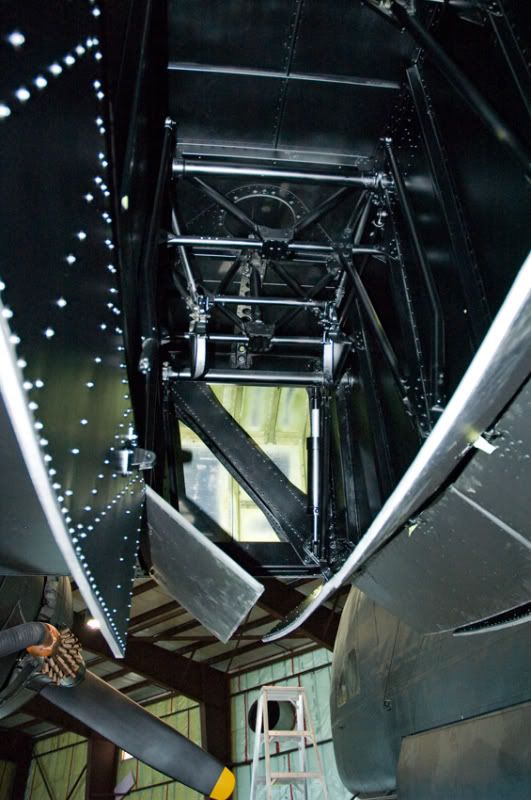

By: Eddie - 8th December 2008 at 00:02
I think the Halifax had bomb bays in the wing area.
Exactly – they aren’t hardpoints that are visible, they are miniature bomb bay doors.
EDIT – beat me to it, Ant!
By: Ant.H - 8th December 2008 at 00:01
What look like ‘hardpoints’ are actually the doors of the underwing bomb bays in the open position. There were three bays in each wing, but IIRC they were more usually occupied by cylindrical fuel tanks.
Edited to add that the wing bomb bays are visible on NA337, although she appears to only have four. Found the following shot on Flickr, not my photo!
By: Bruggen 130 - 7th December 2008 at 23:47
I think the Halifax had bomb bays in the wing area.
By: old shape - 7th December 2008 at 22:57
The bombs are being flung out of the bomb-bay by a dropping device…possibly rotating?
They look like hard points don’t they? A bit thin though. Edit, found this by Gogling
http://www.jaapteeuwen.com/ww2aircraft/html%20pages/handley%20page%20hp57%20halifax.htm
Mk Ills (HP.61) had retractable tailwheel, D-type enlarged fins, Hercules VI or XVI engines, Srs 1A type nose with single gun plus four-gun dorsal and tail turrets and in some cases ventral fairing containing an 0.50 in (12.7 mm) gun in Preston-Green mount. Fuel capacity increased to 1,986 Imp gal (9,028 1) and all but first few had longer wing with span increased to 104 ft 2 in (31.75 m). Max bomb load, 10,000 Ib'(4,540 kg) in fuselage and 3,000 Ib (1,362 kg) in wings. Production totalled 326 by HP at Radlett, 900 by English Electric at Samlesbury, 260 by LAPG at Leavesden, 280 by Rootes Securities at Speke and 326 by Fairey Aviation at Stockport; first deliveries November 1943 to No 433 Sqn, RCAF and No 466 Sqn, RAAF, and used by 41 operational squadrons in 1944/45, principally in 4 and 6 Groups.


 Sign In








 December 7, 2008 at 10:52 pm