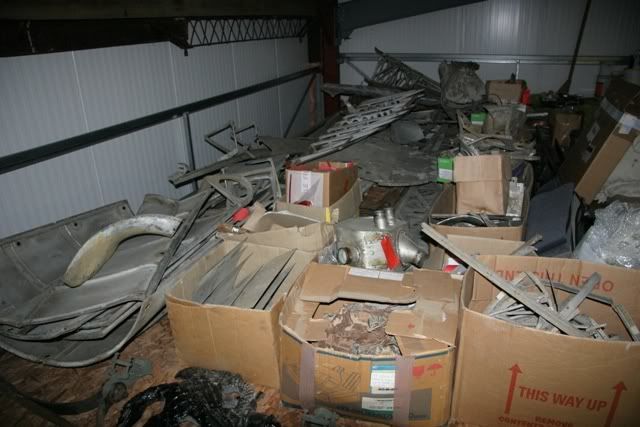
Does anyone know how much of Hurricane P2902 has been usable in it’s restoration?
Given that P2902 crash landed on the beaches of Dunkirk and lay surbmirged in the sand until excavated it seems unlikely that much of the aircraft will be able to be used in this airworthy restoration. Maybe a few stainless steel bits?
(Fingers crossed this thread doesn’t get sidetracked with the arguments of restoration/replication and providance…)
Regards,

By: SMS88 - 25th January 2009 at 23:28
There lies a potential minefield, I imagine.
If one were to dispose of these substantial relics as a job lot, then there is a strong possiblility that eventually somebody will put them all together into a very Hurricane-looking shape, covered with the disgarded and worn-out skin, and announce ” Here is AA123 ” , which it pretty much would be.
This would be awkward for the owners of the recently-flown Hurricane AA123.
Perhaps then it would be a wonderful idea for the owner of the flyer and these discarded parts to assemble a static himself,then it would be a treasure to complement the flyer
By: Nostalgair - 25th January 2009 at 20:31
Hi again,
Here are some photos of P2902 taken prior to its move to the current restoration facility. Kenneth would have loved to have lived to have seen the Hurricane take to the skies again.
[ATTACH]168874[/ATTACH]
[ATTACH]168875[/ATTACH]
[ATTACH]168876[/ATTACH]
Cheers
Owen
By: StevSmar - 18th January 2009 at 01:59
So is it the presence of the sand which prevented oxygen getting to the airframe and therefore it’s relatively good condition?
I would have thought that there would be no difference in corrosion rate of a metal item which is:
1) Buried in sand which is submerged in salty water.
2) Submerged in salty water to the same depth.
I have read of wooden piles for piers lasting hundreds of years when the pile is driven into clay, but it just seems that sand would allow fresh supplies of oxygenated salty water to percolate through it?
The proof is in the condition of the airframe though, obviously the sand makes a huge difference even if it doesn’t make sense to me.
(Rocketeer, if you are able to obtain the dimensions we had corresponded about that would be great, no hurry as I have my hands well and truly full with other tasks)
By: Rocketeer - 17th January 2009 at 18:31
down to amount of air old chap…..corrosion requires water, oxygen and the metal to corrode….heat helps corrosion too…..I have many fishplates and other stainless items from a saline environment, some do get a form of worm like corrosion (impurities in the stainless)….if I get a chance I will post a pic if anyone cares…..dont worry about yourdimensions I will sort them
Tony
By: Rocketeer - 17th January 2009 at 18:27
cheers Tangers old chap
By: StevSmar - 16th January 2009 at 23:55
Nostalgair thanks for the photo. I am finding it very surprising at how good a quality the components were after the Hurricane was buried all that time in the sand.
Regards,
By: Nostalgair - 16th January 2009 at 23:43
Andy
do any pix of the cockpit/control column grip area exist Andy?
Hi again,
I have this image of the turn indicator.
[ATTACH]168574[/ATTACH]
Cheers
Owen
By: Arabella-Cox - 16th January 2009 at 23:35
Nope. Sorry. It was pretty empty with just the seat, heel boards, rudder bar and pedals. The bottom joint for the column and the big control cable drum. That was it as I recall.
By: Rocketeer - 16th January 2009 at 23:31
And this is how it looked when I first saw the aircraft post-recovery. Sorry about image quality.
Andy
do any pix of the cockpit/control column grip area exist Andy?
By: Nostalgair - 16th January 2009 at 19:35
Hi Nostalgair, I have enjoyed reading your book, picked it up as a present for myself on a trip to Australia to see the family Christmas a year ago. Your biography gives me the impression that Kenneth McGlashan was a real gentleman.
I would certainly be interested in seeing the additional images you have.
[ATTACH]168569[/ATTACH]
Hi Steven,
Kenneth was most definitely a “real gentleman”. He also possessed the enduring modesty that I have found with so many veterans from these times.
One of my favourite pieces regarding Kenneth puts it in perspective,
“In spite of the many dangers he faced and despite evidence to the contrary, McGlashan regarded himself as nothing more than just another pilot; an ordinary man in extraordinary times. Of the 3,000 allied airmen who flew in the Battle of Britain, only three percent could lay claim to the title of ‘ace’, Kenneth McGlashan always felt great honour in being counted amongst the 97 percent.”
Cheers
Owen
By: StevSmar - 14th January 2009 at 19:01
And this is how it looked when I first saw the aircraft post-recovery. Sorry about image quality.
Tangmere140, Thanks for posting the images. Very surprising to see how good a quality the parts appear to be. My bet would have been that any aluminum would have fallen apart.
Hi Nostalgair, I have enjoyed reading your book, picked it up as a present for myself on a trip to Australia to see the family Christmas a year ago. Your biography gives me the impression that Kenneth McGlashan was a real gentleman.
I would certainly be interested in seeing the additional images you have.
By: Mark V - 14th January 2009 at 12:45
With the Hangar 11 example at North Weald, will this allow work to commence on the two seater?
G-HHII is still at Moat Farm (well it is today anyway). I am not aware of any solid plans to commence a 2-seat Hurricane at HRL although the concept has been talked about.
By: Cees Broere - 14th January 2009 at 11:39
Wonder if the wings would turn up at one point.
Cheers
Cees
By: Propstrike - 14th January 2009 at 10:52
There lies a potential minefield, I imagine.
If one were to dispose of these substantial relics as a job lot, then there is a strong possiblility that eventually somebody will put them all together into a very Hurricane-looking shape, covered with the disgarded and worn-out skin, and announce ” Here is AA123 ” , which it pretty much would be.
This would be awkward for the owners of the recently-flown Hurricane AA123.
By: Fouga23 - 14th January 2009 at 09:52
A previous UK Hurricane restoration yielded a superb airworthy restoration, but also created a large stockpile of original metal that could not be incorporated.
What will happen to those parts? Seems they can be of mighty use for a static restoration!
By: Nostalgair - 14th January 2009 at 02:49
Hi All,
Good to touch base Andy. I am also under the impression that the armoured windscreen is still in circulation, but I am unsure of its location.
Thanks for the photos Merlin. I also saw some up-to-date images in ‘FlyPast’ a while back. Here’s hoping that she’ll take to the skies in the not too distant future. (I’ll be flying to the UK for that one!:)) I have some other images I can post if there is any interest.
As for the wings of P2902, Kenneth recounted that they had been stolen the very day the Hurricane had been raised from its sandy resting place. A member of the recovery team had told him that they had decided to temporarily store the aircraft overnight before moving it to its new residence the next day. The place chosen for this storage was the yard of the local police station. The next day, the wings were gone.
Their ultimate fate is unknown, but photos of the recovery show that they were substantially intact. It is a real shame that they were taken after surviving so many years.
All the best,
Owen
By: Arabella-Cox - 13th January 2009 at 15:44
I never did know what happened to them. They were certainly recovered.
I have only recently heard that they were later “stolen” and possibly scrapped, but Owen Zupp (Nostalgair) might be able to add more detail for us.
By: Cees Broere - 13th January 2009 at 13:50
What’s the story about the dissapearing wings? Don’t have the book (yet).
Cheers
Cees
By: merlin70 - 13th January 2009 at 13:21
Complex construction
Another view of G-ROBT taken in June 07.
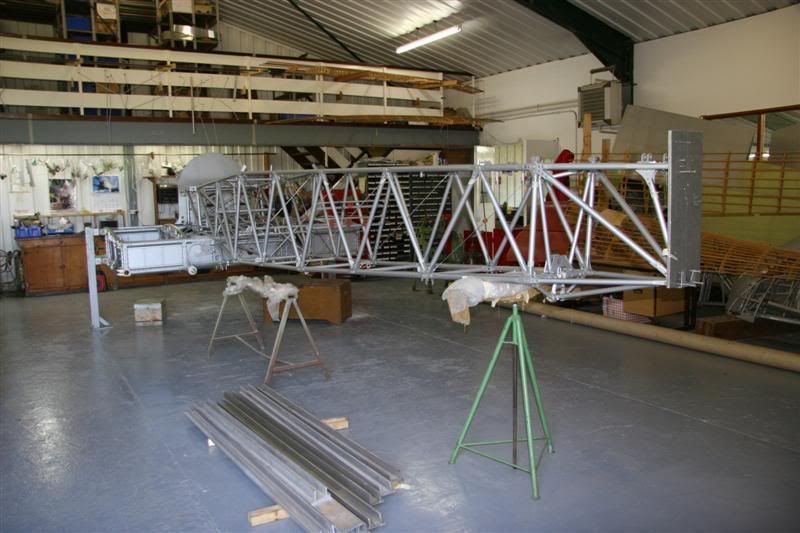
The shot below of G-HRLI shows the square ended round hollow section tubes which are swaged in order to connect them together.
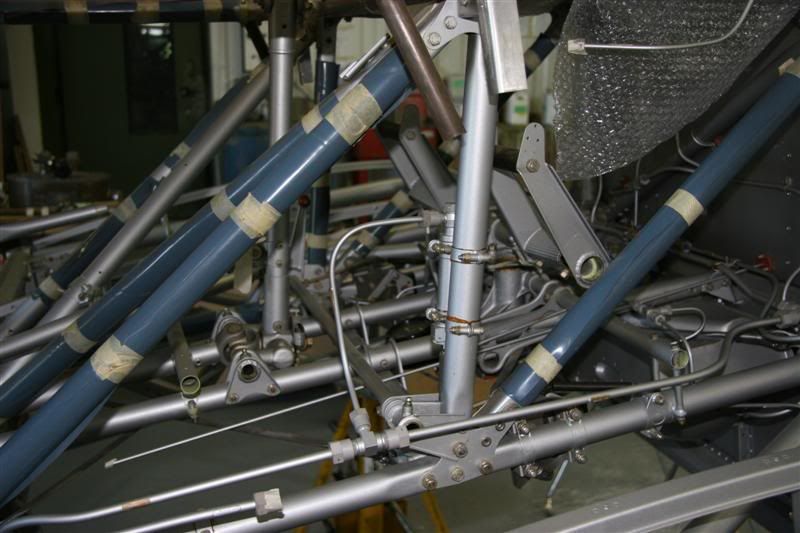
The squaring of the circular sections is done using this press.
With the Hangar 11 example at North Weald, will this allow work to commence on the two seater?

By: Arabella-Cox - 13th January 2009 at 13:05
And this is how it looked when I first saw the aircraft post-recovery. Sorry about image quality.


 Sign In








 December 22, 2008 at 6:24 pm